



Tanium vs Automox vs Action1 vs Ivanti Neurons: Patch and Endpoint Management Compared
Technical comparison of Tanium, Automox, Action1 and Ivanti Neurons for patch and endpoint management: architecture, catalogue depth, rings, risk scoring, scale.
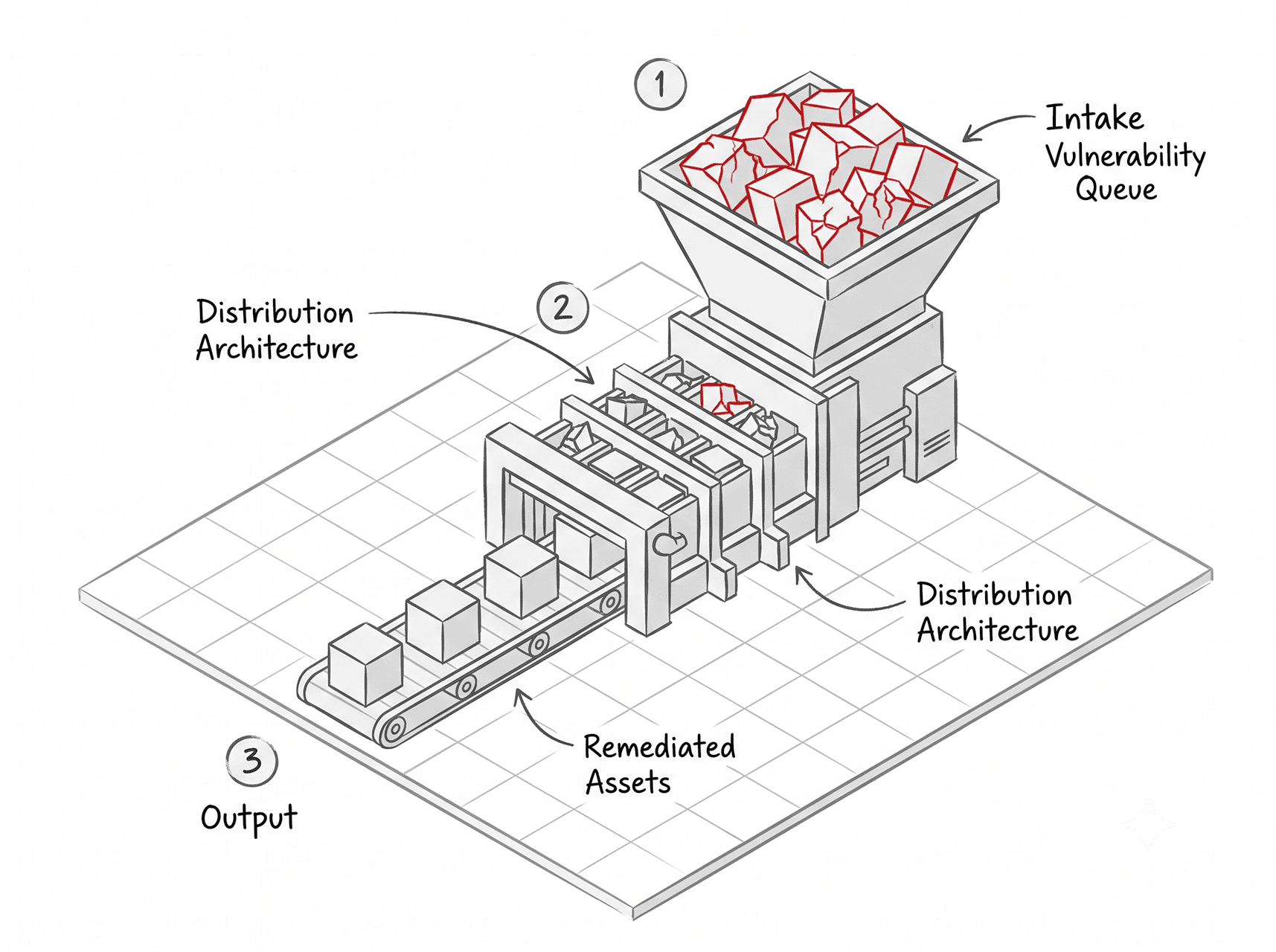
Patching roughly once a month with no reliable hardware and software inventory is the most common operational pattern I see in mid-market IT, and it is the one auditors and cyber-insurers press hardest after multi-factor authentication. The data now backs that pressure.
Verizon's 2026 Data Breach Investigations Report, covering incidents from November 2024 to October 2025, found vulnerability exploitation became the leading initial access vector at 31% of breaches, up from 20% and ahead of credential abuse at 13%.
Median time to full remediation rose from 32 days to 43. Only 26% of CISA Known Exploited Vulnerabilities were fully remediated in 2025, down from 38%.
The volume feeding that queue keeps climbing. 48,185 CVEs were published in 2025, a 20.6% rise on the 40,009 recorded in 2024, with the Linux kernel and Windows 10 the two most-cited products.
These four platforms all close that gap. They do it with different architectures, different catalogue depths and very different operational overheads. I have laid out what separates them technically, and where each one stops being the right answer.
IT Leaders Report 2026
What are your IT peers investing in 2026?
We spoke to about 1,300 IT leaders from various organisations to understand what they're evaluating. Most of it is the kind of thing you'd only hear from a peer you know well enough to ask, so we've put it in one place.
Read the report
Architecture and communication model: peer-to-peer, cloud-only, or hybrid
Architecture determines your scale ceiling, your branch-office bandwidth profile, and how much infrastructure you inherit. It is the first thing to settle.
Tanium's linear chain architecture and the TCP 17472 requirement
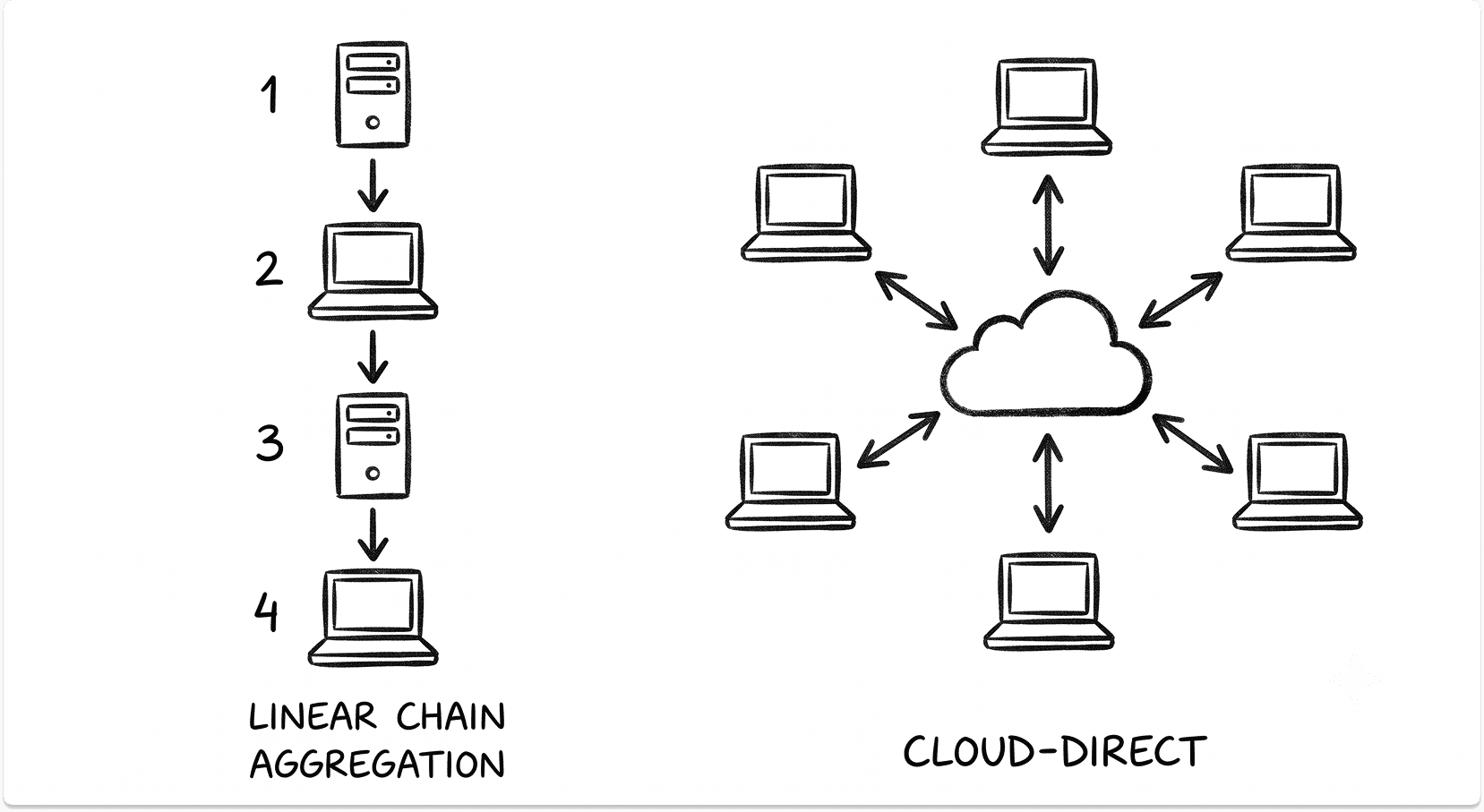
Tanium clients do not each report to a central server. They register, receive a list of nearby peers, and form long-lived unidirectional connections into a chain. A query passes along that chain, each client folds its own answer into the aggregate, and the endpoint at the end returns one consolidated response.
The academic description of this is precise: an endpoint with no upstream peers acts as the backward leader receiving messages directly from the Tanium Server, and the endpoint with no downstream peers acts as the forward leader returning the aggregated data. Chains form to match your topology, so endpoints in one region group separately from another.
All of this runs over TCP 17472, bi-directionally, both client-to-server and client-to-client. DISA's STIG for Tanium requires a host-based firewall rule permitting 17472 bi-directionally on every managed endpoint, and a network rule allowing it between managed computers on the same LAN. In DMZ or less-trusted segments, a Zone Server and Zone Server Hub proxy that traffic on the same port.
You can run this on-premises with a Tanium Server, Module Server and Zone Server, or consume it as Tanium Cloud. Tanium states the architecture scales to millions of endpoints without additional infrastructure. Treat that as a vendor claim; I found no independent benchmark.
Automox and Action1 as cloud-only platforms
Both run a single lightweight agent that reaches out to a cloud console. No on-premises servers, no VPN dependency, and roaming endpoints work the same as office endpoints.
Automox separates two operations: a check-in that maintains connectivity, and a device scan that evaluates policy. Automox documentation sets the scan interval as configurable between 6 and 24 hours, defaulting to 24, with failed check-ins retried on exponential backoff from one minute up to a 30-minute ceiling. The Windows agent executes in SYSTEM context.
Action1 deploys via a Windows-based deployer with Active Directory and group policy integration, and uses peer-to-peer distribution between endpoints to reduce repeated downloads at a site.
Ivanti Neurons versus the on-premises Endpoint Manager estate
This distinction matters more than the marketing suggests. Ivanti Neurons for Patch Management is a cloud-native SaaS product on the Neurons agent. Ivanti Endpoint Manager is the separate on-premises platform, previously LANDesk Management Suite. They are different products with different risk profiles.
A third option, Neurons Patch for Intune, publishes Ivanti's pre-tested third-party updates into Microsoft Intune so you deploy them alongside Microsoft's own content. If you are mid-way through an SCCM to Intune migration, that is the integration point worth evaluating first.
Third-party application catalogue depth and operating system coverage
Operating system patching is largely a solved problem across all four. Third-party application coverage is where the gaps live, and where vendor numbers need reading carefully.
Automox addresses the counting problem directly in its own material, stating it uses one entry per software title per platform rather than counting every version or architecture separately, and that its titles represent unique applications.
Its patching feature page carries live counters currently showing 580 in the software catalogue and 368 Worklets. Automox does not cache packages for Linux; third-party patching there runs through the device's own package manager or repository.
Action1 states a catalogue of 630+ titles, built and maintained in-house rather than pulled from Winget or Chocolatey. The gap to watch is platform asymmetry.
A 12-month independent field review across environments of 15 to 180 endpoints estimated the macOS catalogue at roughly 30 applications, far narrower than the Windows equivalent. If you run a meaningful Mac fleet you will likely still need dedicated Apple device management alongside it.
Ivanti curates its Supported Products Catalog with pre-testing and publishes it into Intune, ConfigMgr or Neurons, but does not state a single title count. Tanium handles third-party applications through Deploy rather than Patch, using a managed applications data file distributed down the chain, and likewise publishes no catalogue figure.
On operating systems, Action1 publishes the most granular current matrix, having introduced a native Linux agent in December 2025 covering both DEB and RPM distributions. Tanium carries the broadest range including legacy Solaris and AIX, which matters if you still run Windows Server 2012 R2 or 2016 alongside older Unix in the same estate.
Deployment rings, maintenance windows and patch rollback
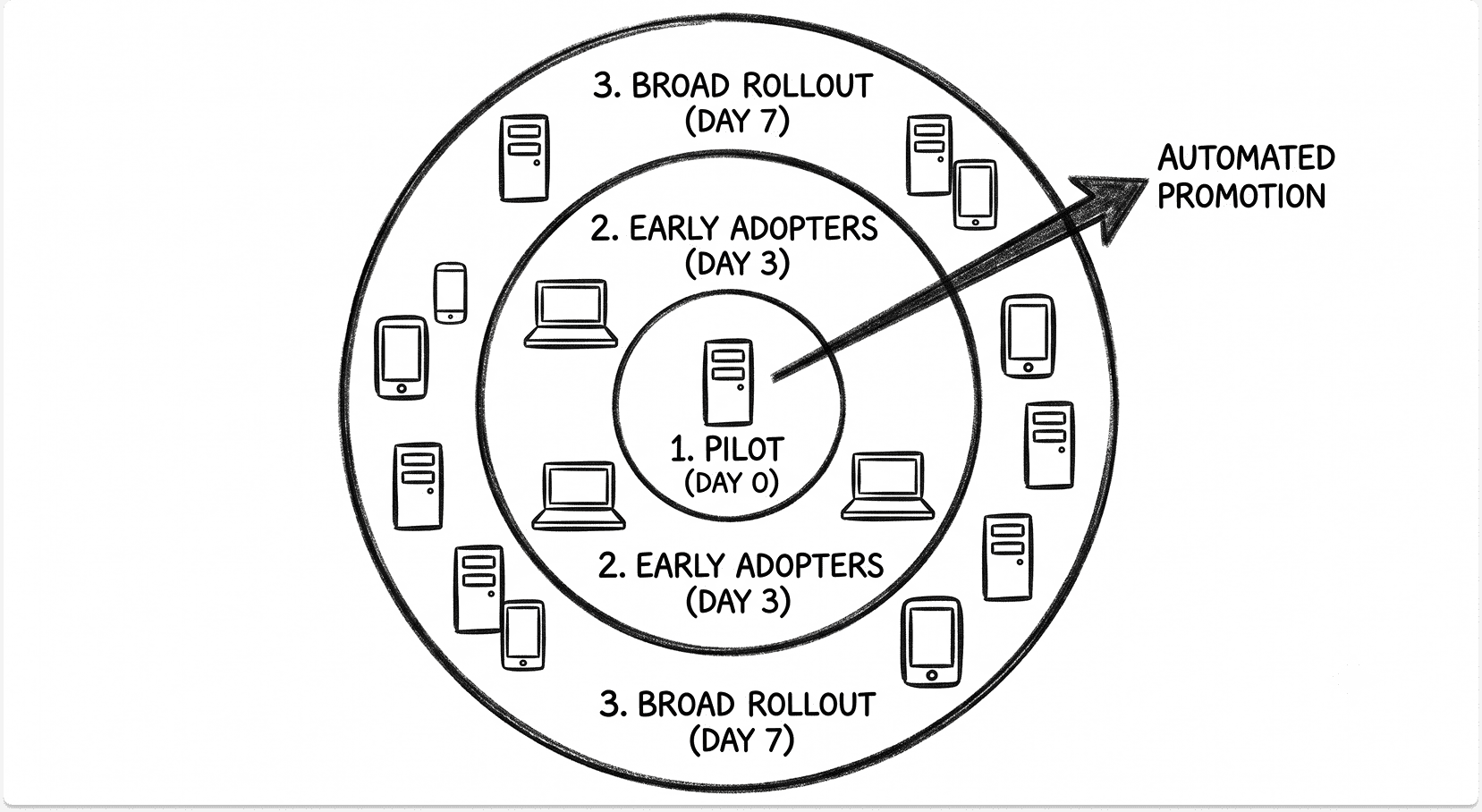
Ivanti holds a patent on its Ring Deployment capability, launched into Neurons for Patch Management in April 2025. It groups devices into rings by risk tolerance and phases rollouts by risk tier and SLA priority, running alongside a Deploy by Risk function that supports parallel tracks: monthly maintenance, weekly priority updates, and immediate zero-day deployment.
Ivanti also states it derives patch reliability insights from anonymised deployment data across its customer base plus crowdsourced sentiment, used to flag patches likely to cause problems before you deploy them. I could not independently verify the accuracy of that signal, and you should treat it as a vendor claim until you have tested it against your own failure data.
Tanium supports progressive ring deployment with validation on small groups before broad rollout. Action1 offers staged deployment through update rings. Automox's documented practice is to assign a policy to a test group first, then promote.
The distinction worth probing in a demo is automatic promotion. Ask each vendor whether the platform advances a ring on its own once success criteria are met, or whether an administrator has to push it forward manually. The answer changes your operational headcount.
On rollback, be realistic. Uninstall and revert for third-party applications works across all four. Genuine rollback of operating system updates is constrained everywhere, because the underlying OS servicing stack sets the limits rather than the management tool. Validate it against your own image in a pilot rather than accepting a feature-matrix tick.
Vulnerability correlation: CVE, CVSS, KEV and EPSS handling
A patch tool that cannot tell you which patch matters first is an execution engine rather than a remediation programme. The four differ sharply here.
Ivanti's Vulnerability Risk Rating is the most developed layer. It combines exploit activity, CISA KEV data, asset criticality and threat intelligence into a dynamic score, with human validation from penetration testing teams.
Ivanti states the rating operates independently of the NIST National Vulnerability Database, which became a live concern when NIST moved NVD to a triage enrichment model on 15 April 2026 and stopped enriching most non-critical, non-KEV records. If your prioritisation depends on NVD-sourced CVSS vectors, that change affects you directly.
Tanium provides endpoint and organisation-level risk scoring and integrates with external scanners, which suits teams who have already standardised on a dedicated vulnerability management platform and want patching to consume its findings.
Automox takes the same route through Vulnerability Sync, ingesting findings from Rapid7, CrowdStrike, Tenable and Qualys and converting them into remediation tasks. That works well if you already run one of those, and less well if you do not.
Action1 is the only one of the four that surfaces CVE data natively in the patch console without a separate scanner, correlating missing patches to CVEs with CVSS scores and flagging KEV membership and ransomware association.
If you already run an EDR or managed detection service, check which of these consumes its telemetry before adding another data source.
Scale, query speed and where the published figures stop
Tanium's performance case rests on chain aggregation. Because the query result is assembled as it travels rather than collected centrally, response time stays roughly flat as endpoint count grows, and every endpoint is touched rather than a sample extrapolated. Tanium states this scales to millions of endpoints without additional infrastructure.
I want to be precise about the evidence here. Those figures come from Tanium and from Tanium customer references. I found a peer-reviewed description of the linear chain mechanism in database literature, which corroborates how it works. I found no independent benchmark corroborating the throughput numbers.
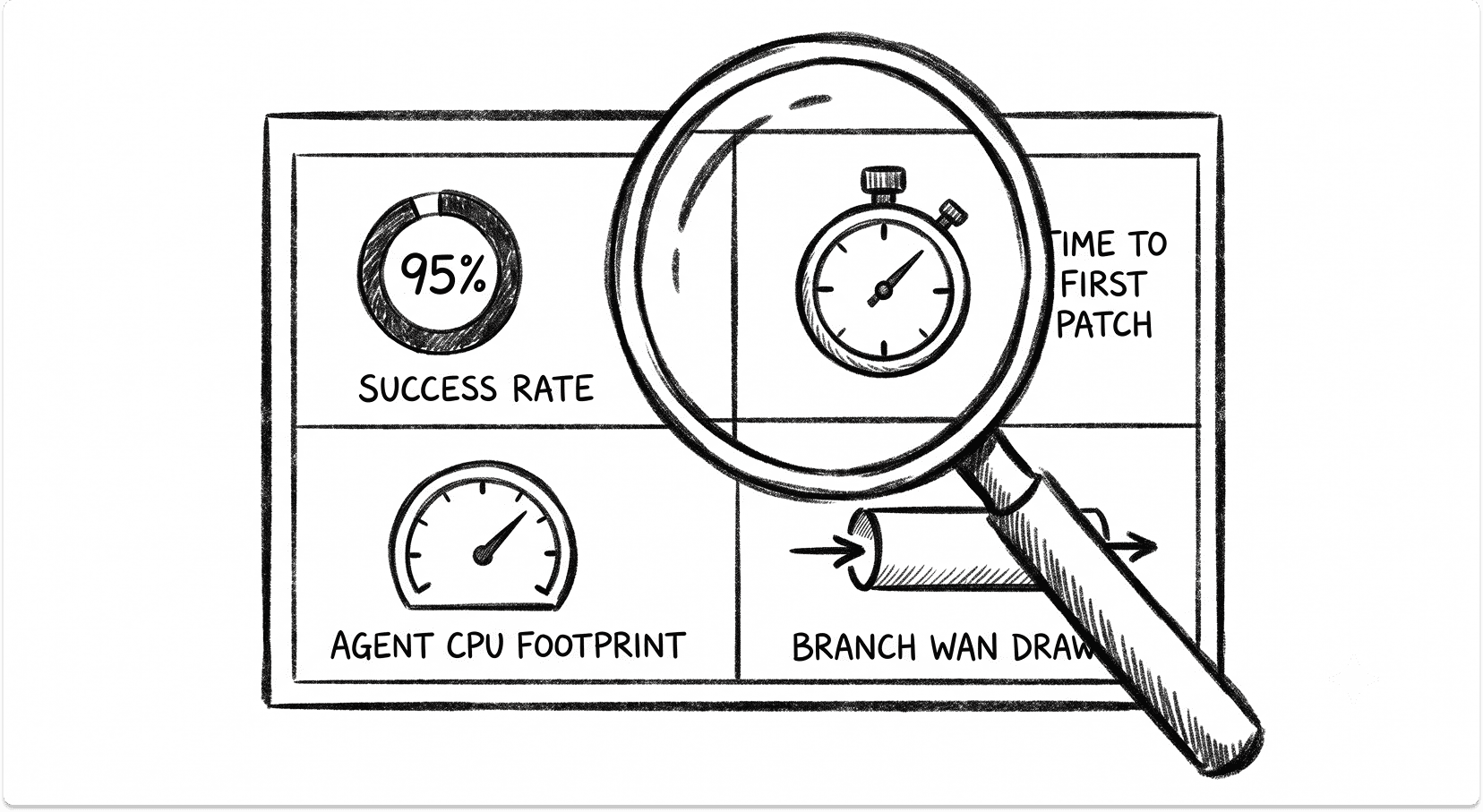
For Action1, the most useful evidence is the same 12-month field review, which recorded a 97% success rate on Windows security updates and roughly 12 minutes to first patch across 15 to 180 endpoints. That is a small-fleet result and should not be extrapolated upward.
For Automox and Action1 above a few thousand endpoints, and for Ivanti Neurons at any scale, no independent published ceiling exists. This is a genuine gap in the available evidence rather than an omission, and it is why the pilot section below matters more than any vendor datasheet.
Management plane security and published vulnerability history
Every agent discussed here runs as SYSTEM or root. That is inherent to patching, and it means the management console is one of the highest-value targets in your estate. A compromised patch platform can push code to everything it manages.
The reference case remains the July 2021 Kaseya VSA compromise, where attackers pushed a malicious update through legitimate remote monitoring tooling to an estimated 800 to 1,500 downstream organisations. The same structural exposure applies to any RMM or endpoint management platform you deploy.
Against that backdrop, published exploitation history is a legitimate evaluation input. Here is what the record shows, restricted to the endpoint management products in scope.
Ivanti Endpoint Manager, the on-premises platform, has appeared on the CISA Known Exploited Vulnerabilities catalogue multiple times. An SQL injection flaw, was added in October 2024.
Three absolute path traversal flaws were added in early 2025 following public proof-of-concept release. Most recently, an authentication bypass rated CVSS 8.6 affecting versions before 2024 SU5, was added to the catalogue on 9 March 2026 with a shortened two-week federal remediation deadline.
Two qualifications belong with that list. First, these entries concern Ivanti's on-premises Endpoint Manager. I did not find Neurons for Patch Management, the cloud service, on the catalogue.
If you are evaluating the cloud product alone, the exposure profile differs from the on-premises estate. Second, Ivanti publicly committed in April 2024 to a secure-by-design programme including stack modernisation, expanded threat modelling and a broader bug bounty, and stated that disclosure volume might rise as a result.
For Tanium, Automox and Action1, I found no actively exploited, catalogue-listed vulnerabilities in the sources reviewed. I am stating that as what the search found rather than as proof none exist.
The practical takeaway is the same for all four. Segment the management plane, restrict console access, apply least privilege to administrative accounts, and ask every vendor for their agent and console hardening guidance in writing.
Licensing models and operational overhead
Action1 publishes the clearest commercial position: free permanently for the first 200 endpoints with no functionality limits, plus a free one-time vulnerability assessment across an unlimited endpoint count, confirmed in Action1's licensing documentation.
Above 200 endpoints, pricing is quote-only. Secondary sources publish per-endpoint figures that contradict each other by an order of magnitude, so I am not reproducing any of them.
Automox licenses per endpoint, with Worklets availability tied to plan tier. Tanium licenses by module, so Patch, Deploy, Asset, Discover and Comply are separately costed and list pricing is not published.
Ivanti licenses Neurons capabilities as separate SKUs, which means Patch Management, ITAM and risk-based vulnerability management each carry their own line item.
Operational overhead tracks architecture almost exactly. Action1 and Automox stand up in hours with no infrastructure. Tanium carries the heaviest planning and professional services requirement, particularly on-premises, and expects dedicated platform ownership. Ivanti sits between the two, scaling with how much legacy Endpoint Manager remains in play.
Producing the evidence auditors and insurers actually ask for
The compliance framing changed materially this year. On 10 June 2026, CISA issued Binding Operational Directive 26-04, which supersedes and revokes both BOD 22-01 and BOD 19-02. The flat KEV remediation window is gone.
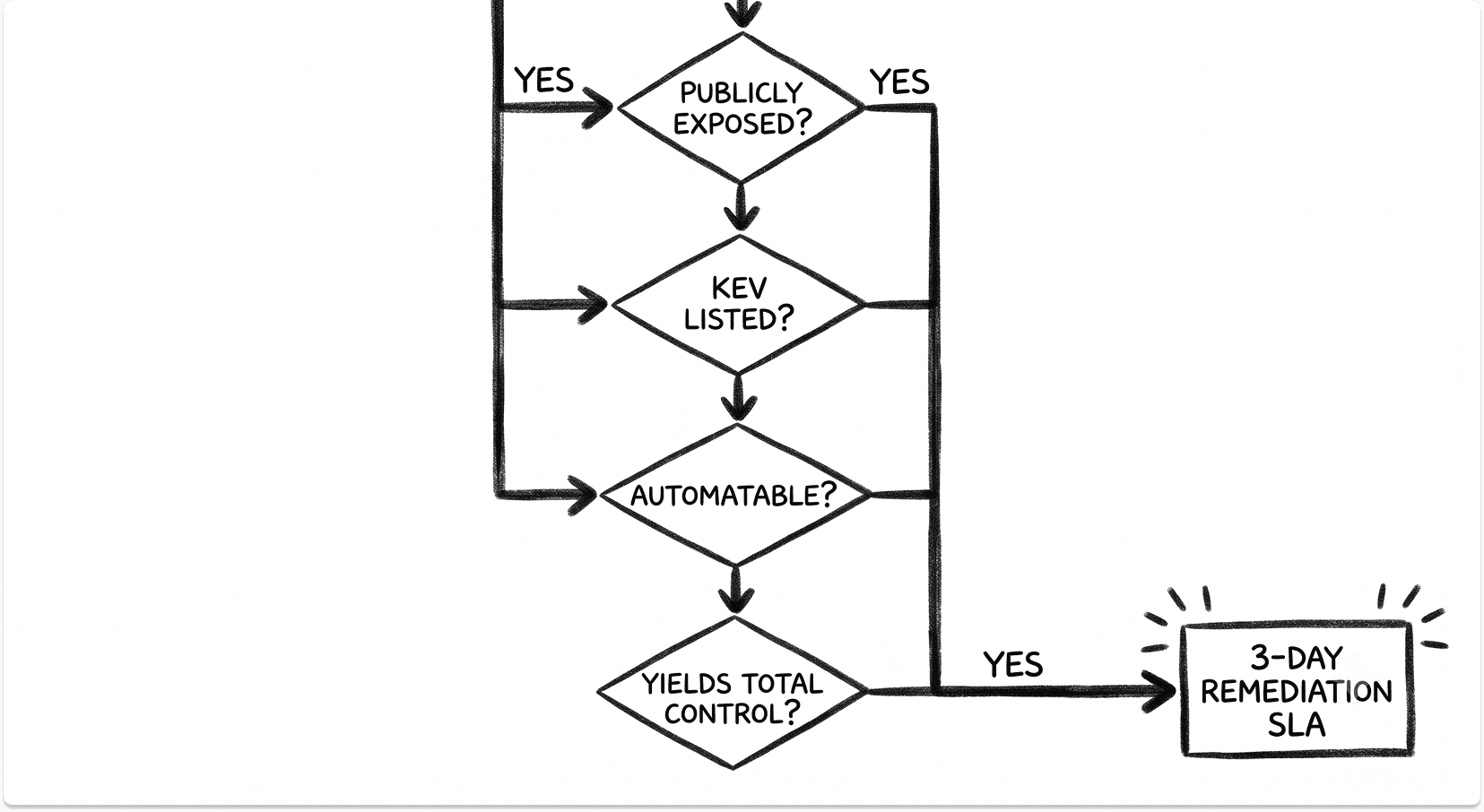
In its place sit four binary risk variables assessed per vulnerability per asset: is the asset publicly exposed, is the vulnerability in the KEV catalogue, is exploitation automatable, and does exploitation yield total or partial control.
A vulnerability meeting all four must be remediated within three days. Federal agencies must be operating against the new timelines by 7 December 2026.
The directive binds federal civilian agencies only. It matters to everyone else because BOD 22-01 is precisely how the KEV catalogue entered private-sector and insurance vocabulary, and the same migration is already underway. If your cyber-insurance renewal questionnaire currently asks about patch cadence, expect exposure and automatability questions next.
NIST SP 800-40 Revision 4 and CIS Controls v8 Control 7 remain the frameworks auditors map against, and both demand three artefacts your tool must produce: documented patch cadence against an SLA, a complete asset inventory including devices the tool does not manage, and a tracked exception register for anything deliberately deferred.
That second artefact is where Automox has a structural limitation worth naming. It patches devices running its agent and has no native agentless discovery of unmanaged endpoints.
Tanium Discover and Ivanti Neurons for Discovery both address that directly. If unmanaged devices are already an audit finding for you, pair whichever platform you choose with a dedicated IT asset management tool, or with a compliance automation platform that collects the evidence continuously.
Which platform fits which environment
How to run a 30 to 60 day pilot that actually decides the question
Vendor catalogue counts describe the vendor's catalogue. They do not describe your software estate. The only number that matters is what percentage of your installed applications the platform can patch without custom packaging, and you can only get that by exporting your own inventory and checking it against each catalogue.
Run every shortlisted platform against the same endpoint group, through at least one real Patch Tuesday and one out-of-band KEV entry. Record these seven measurements. Anything a platform cannot produce is itself a finding.
Put four questions to every vendor in writing before you sign: current certification status for the exact SKUs you are buying, agent and console hardening guidance, network segmentation recommendations for the management plane, and the escalation path when a deployed patch breaks production.
Running this alongside a broader endpoint security stack audit will surface overlaps you are already paying for.
One closing rule. Under the risk-based model CISA has now adopted, a platform that cannot demonstrate which vulnerabilities it remediated, on which exposed assets, within which window, has failed the evaluation regardless of how well it deploys patches.
Shortlisting across these four?
We connect you to with pre-vetted vendors who fit your environment. Speak to someone from out team and we'll get back to you with a shortlist. If you want to move forward, we'll put you on calls with vendors and prep them so your conversation starts with context.
FAQ
Is Action1 really free for 200 endpoints?
Yes. Action1's own licensing documentation confirms the first 200 endpoints are free permanently with no functionality limits, alongside a free one-time vulnerability assessment across an unlimited endpoint count. Beyond 200 endpoints, pricing is quote-based rather than published.
What is the difference between Ivanti Neurons for Patch Management and Ivanti Endpoint Manager?
Neurons for Patch Management is a cloud-native SaaS product using the Neurons agent. Ivanti Endpoint Manager is a separate on-premises platform with a longer history, previously branded LANDesk Management Suite. They have different architectures, different licensing and different published vulnerability records.
Does Tanium require on-premises servers?
Not necessarily. Tanium can run on-premises with a Tanium Server, Module Server and Zone Server, or be consumed as Tanium Cloud. Either way, client endpoints require TCP port 17472 open bi-directionally for peer communication.
Which patch management tool has the largest third-party application catalogue?
Action1 states 630+ titles and Automox publishes a live counter currently showing 580. Tanium and Ivanti do not publish a single figure. All counts are vendor-stated and counting methods vary, so compare each catalogue against your own software inventory rather than against each other.
Can these tools patch Linux servers as well as Windows?
All four patch Linux, but the mechanisms differ. Automox uses the device's native package manager and does not cache Linux packages. Action1 introduced a native Linux agent in December 2025 covering DEB and RPM distributions. Tanium is the only one of the four that also covers legacy Unix including Solaris and AIX.


.png)