CrowdStrike vs SentinelOne vs Arctic Wolf: Choosing an MDR Solution in 2026
Looking to outsource cybersecurity to an MDR solution provider? Compare Crowdstrike vs. SenticelOne vs. Arctic Wolf to see which solution to decide if you need a premium tool or a security partner.
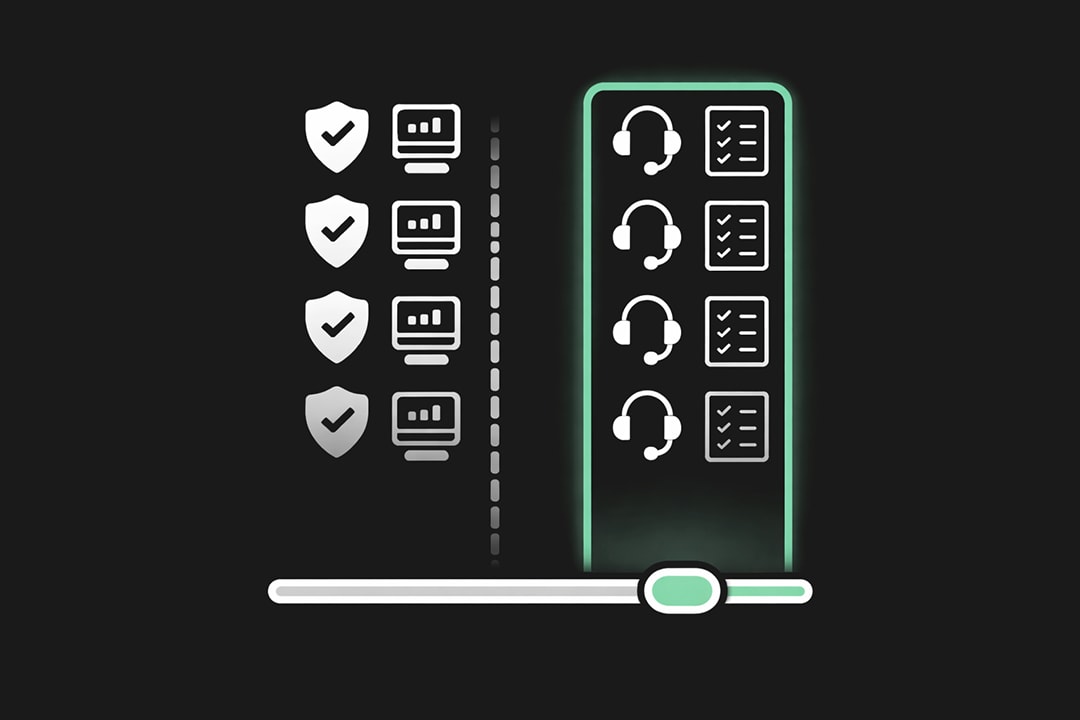
The Managed Detection and Response (MDR) market is crowded with vendors promising complete visibility and instant remediation. IT leaders face a difficult challenge when evaluating these tools because the marketing claims often sound identical. You are not buying a simple software license. You are hiring a partner to protect your infrastructure when your team is offline.
The difference between CrowdStrike, SentinelOne, and Arctic Wolf lies in their operational philosophy rather than their brochures. CrowdStrike sells a breach warranty backed by a widely deployed sensor. SentinelOne sells automation that reverses damage without human intervention. Arctic Wolf sells a service layer that acts as an external security department.
This guide analyzes the operational realities, technical architectures, and trade-offs of these three major players.
Product-First vs Service-First MDR
IT leaders must understand the fundamental architectural differences before evaluating features. These three vendors solve security problems in distinct ways.
CrowdStrike and SentinelOne are product-first companies. They built proprietary endpoint agents and added a service layer to manage them. Their primary value proposition is the technology itself.
Arctic Wolf is a service-first company. They built a Security Operations Center (SOC) and a log ingestion platform. They act as a wrapper around your existing technology stack while providing their own sensor. Their primary value proposition is the human element.
Your choice depends on whether you want better technology that you might have to manage yourself or a service team that manages everything using technology you might not control.
CrowdStrike Falcon Complete
CrowdStrike is the default choice for the Fortune 500. When you choose Falcon Complete you outsource your security operations entirely to their team.
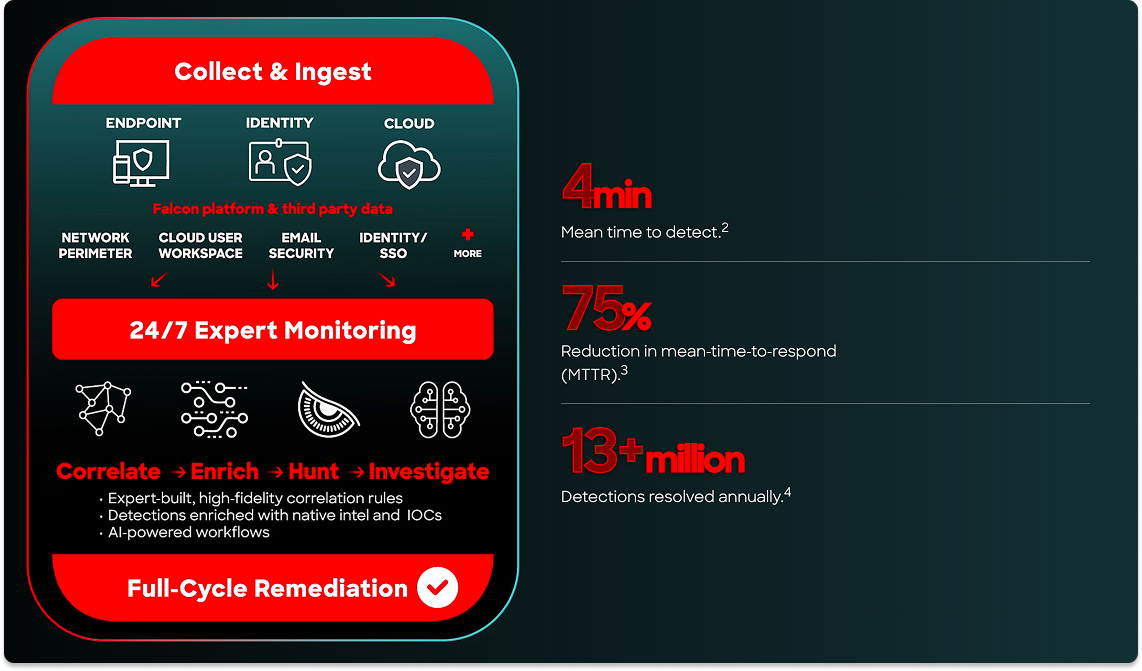
Kernel-Level Remediation Capabilities
Falcon Complete offers a hands-off experience. Many MDR providers act as sophisticated alarm systems that detect threats and email you to re-image a machine. CrowdStrike operates differently.
Their analysts have surgical access to the endpoint. If they detect a malicious process they remote into the kernel to kill the process and delete the registry keys. They remove persistence mechanisms without requiring you to lift a finger. You receive a notification stating the threat is neutralized rather than a request to perform work. This is a critical differentiator for lean IT teams that cannot handle 3 AM remediation.
OverWatch Threat Hunting for Living off the Land Attacks
CrowdStrike relies on their OverWatch threat hunting team. Automated tools excel at catching known malware signatures but often struggle with living off the land attacks. These attacks occur when hackers use legitimate administrative tools like PowerShell to move through a network.
CrowdStrike consistently outperforms competitors in detecting these subtle intrusions. Their threat intelligence feeds on millions of sensors globally. If a new attack vector appears in a bank in Singapore your sensors in Chicago update to detect it within minutes.
CrowdStrike Pricing and Operational Risks
The primary downside to CrowdStrike is the cost structure. The base price is high and increases when you add features. USB device control and firewall management are extra costs. Long-term log retention requires an additional subscription.
IT leaders must also consider operational risk. The global outage in July 2024 demonstrated the danger of relying on a single vendor. CrowdStrike kernel-level access provides deep visibility but a bad update can impact your entire fleet. You must weigh the security benefits of this deep access against the stability risks of having a single vendor with that much power over the operating system.
Best For:
- Large enterprises with high compliance requirements.
- Teams that need complete outsourcing of remediation.
- Organizations willing to pay a premium for established market leadership.
SentinelOne Vigilance
SentinelOne positions itself as the alternative for the modern enterprise. Their philosophy prioritizes on-device automation over cloud-based analytics.
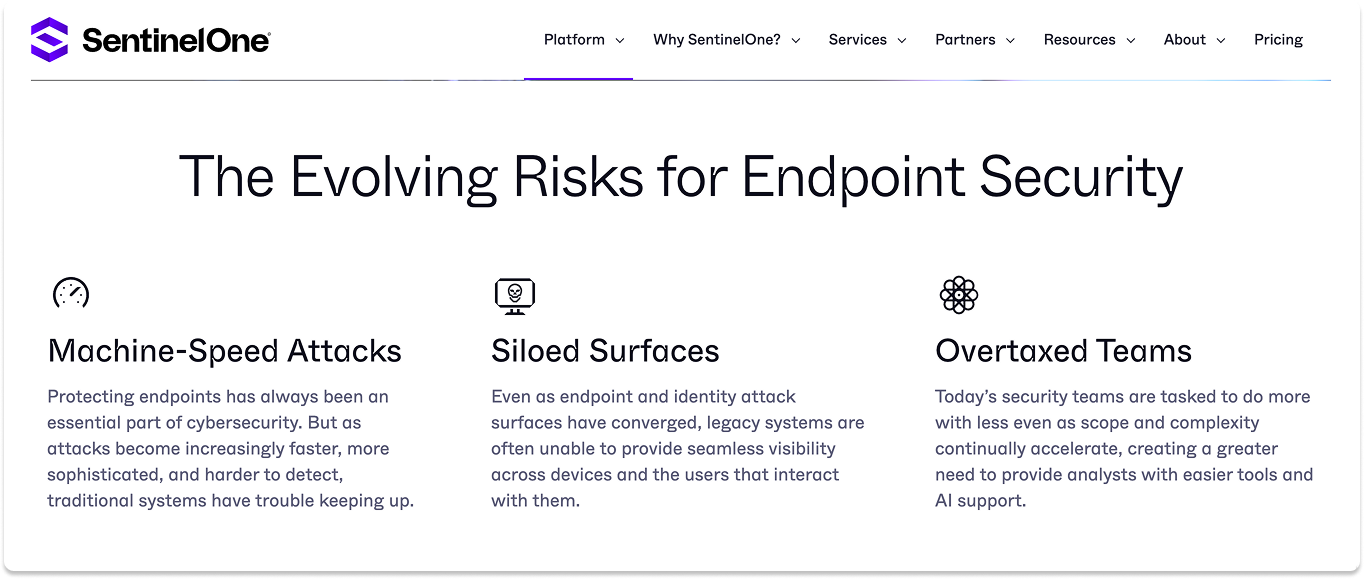
Ransomware Rollback with VSS Snapshots
The rollback feature is the primary selling point for SentinelOne. The agent utilizes Microsoft Volume Shadow Copy Service to take constant lightweight snapshots of the operating system.
If a ransomware attack encrypts files you do not need to restore from a backup server. You issue a rollback command and the agent reverses the changes made by the malicious process. It restores the files to their pre-infection state in minutes. This capability is significant for organizations that cannot afford the downtime of a full server restore.
Storyline Visualization for Incident Response
Technical teams prefer the SentinelOne console because of the Storyline feature. The tool visualizes the entire attack chain during an investigation. It assigns a unique ID to the process tree. You see exactly which command spawned a PowerShell script and which IP address it connected to.
This reduces the time required to investigate an incident. A Tier 1 analyst can look at a Storyline and understand the root cause without needing deep forensic expertise.
SentinelOne Support and Service Challenges
The technology is impressive but the service often falls short. SentinelOne Vigilance is their MDR service tier. Feedback from the IT community indicates that support can be difficult to navigate.
Tickets often sit in queues for days and communication is frequently transactional rather than consultative. Unlike CrowdStrike where you feel like you have hired a partner, SentinelOne often feels like you have bought a software tool with a help desk attached. This is a critical distinction for teams that lack internal expertise.
Best For:
- Technical teams who want to maintain control and visibility.
- Organizations prioritizing ransomware resilience and fast recovery.
- Budget-conscious buyers who want enterprise-grade tech without the CrowdStrike price tag.
Arctic Wolf MDR
Arctic Wolf takes a different approach. They do not manufacture their own antivirus engine in the same way competitors do. They position themselves as a Security Operations Center as a Service.
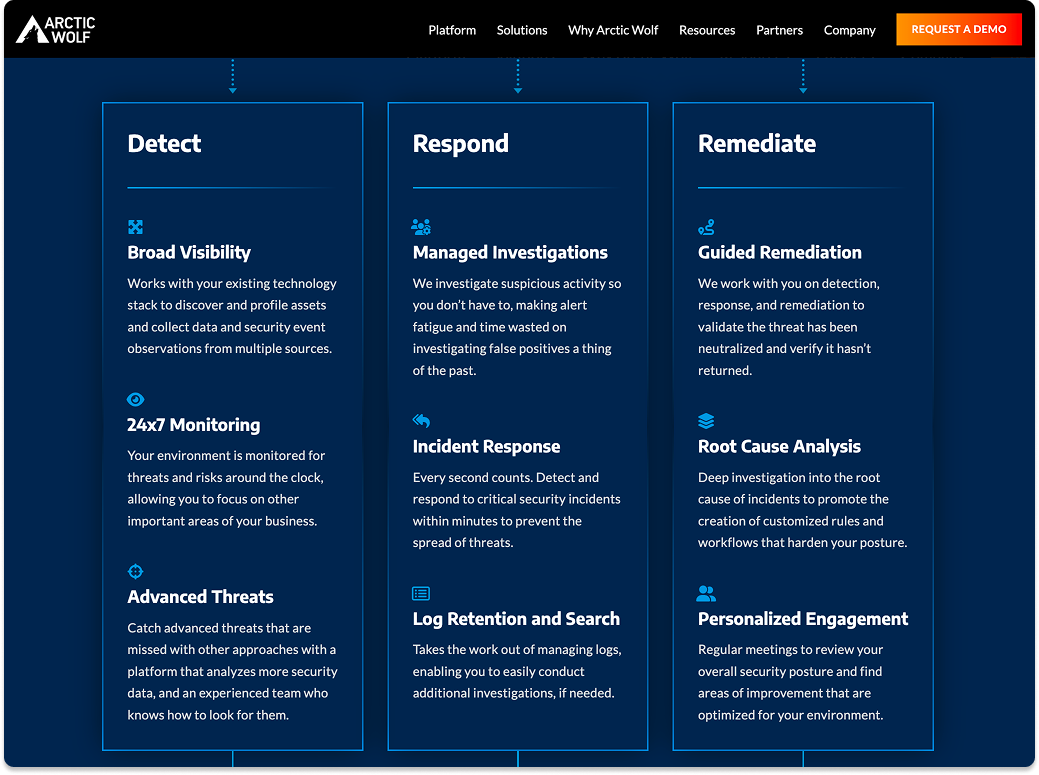
The Concierge Security Team Model
The Concierge Security Team is Arctic Wolf primary selling point. You are assigned named individuals you speak with on a regular basis.
They hold monthly or quarterly reviews to discuss your overall security posture. They might notice that your firewall firmware is consistently out of date or that a specific user has dangerous browsing habits. This ongoing consultation is valuable for small to mid-sized organizations that cannot afford a dedicated CISO.
Cloud and Network Log Ingestion Capabilities
CrowdStrike and SentinelOne are endpoint-focused. They see what happens on laptops and servers. Arctic Wolf aims for broader ingestion. They install a sensor on your network to watch traffic. They hook into your cloud APIs to monitor Office 365 and Okta.
This allows them to catch threats that bypass the endpoint entirely. If a hacker compromises a CEO email account and sets up a forwarding rule an endpoint tool will miss it. Arctic Wolf will catch it. This holistic view is a major advantage for organizations with heavy cloud reliance.
Limitations of the Alert-Centric Approach
Arctic Wolf can become an expensive notification service. They sit on top of your stack rather than being the stack itself which limits their ability to instantly kill a process or isolate a host as surgically as CrowdStrike.
They will detect a threat and call you at 2 AM to tell you to fix it. If your team is small and exhausted this is not helpful. You are paying for detection rather than the hands-on remediation that Falcon Complete offers.
Best For:
- SMBs and mid-market companies with no internal security staff.
- Organizations that need to check compliance boxes for insurance.
- Environments with heavy cloud usage that need monitoring beyond the laptop.
How to Decide an MDR Solution?
Making this decision requires an honest assessment of your internal capabilities. You should buy the tool that fits the team you actually have.
Evaluating Internal Team Bandwidth and Expertise
If you have a team of one or two generalist sysadmins you need a service that does the work for you. CrowdStrike Falcon Complete is the safest bet because they handle the remediation. Arctic Wolf is a strong second choice if you need strategic guidance but be prepared to do some of the legwork yourself.
Managing Legacy Systems and Technical Debt
If you run legacy Windows servers that cannot be patched you need virtual patching and strict control. SentinelOne legacy support is robust and their rollback feature provides a safety net for fragile systems.
Cloud vs On-Premise Infrastructure Visibility
If your organization is 100% in the cloud an endpoint-only tool might leave gaps. Arctic Wolf ability to ingest cloud logs gives you better visibility into identity-based attacks. CrowdStrike and SentinelOne are catching up with cloud modules but they are often expensive add-ons.
Budgeting for MDR: Hidden Costs and Value
CrowdStrike is the most expensive option. SentinelOne is generally the most aggressive on price especially if purchased through a channel partner. Arctic Wolf sits in the middle but often provides better value for money if you factor in the consulting hours you get from their team.
If you want to look further into vulnerability management platforms, you can read this guide comparing Tenable, Qualys, and Rapid7.
Hidden Risks and Vendor Limitations
We believe in transparency. Here are the uncomfortable truths about each vendor.
CrowdStrike: They are becoming the Oracle of security. Their dominance has led to rigid contract negotiations. You must also consider the risk of platform concentration. If CrowdStrike has a bad day the whole world has a bad day.
SentinelOne: Their false positive rate is higher than they admit. The engine is aggressive. You will likely spend the first three months tuning it to stop killing your developer compilers or your custom business applications.
Arctic Wolf: Their underlying technology stack relies heavily on open-source tools like OSSEC and Zeek. You should know that a significant portion of what you are paying for is available for free. You are paying for the management of those tools not proprietary magic.
Closing Thoughts
The best tool depends entirely on what you are trying to solve.
CrowdStrike Falcon Complete is the answer if your Board of Directors asks if you are safe and money is no object. It provides the highest level of assurance and transfers the liability of remediation to a third party.
SentinelOne Vigilance is the answer if your Engineering Lead asks how to recover faster and you have a competent technical team. The rollback capabilities and forensic visibility are unmatched for the price.
Arctic Wolf is the answer if your Auditor asks if you have 24/7 monitoring and you have no security staff. They check the boxes and provide a human face to your security program while helping you mature your organization.
Do not let a sales rep pressure you into a decision. Ask for a Proof of Concept. Run the agents in your environment to see which one breaks your legacy app. Call the support line to see who answers. The only truth is how the tool performs on your network.
Also read: What are the Best MDR and XDR Providers for Security Teams in 2026, What is Red Canary, How it Works, and What it Offers IT Leaders
Looking for MDR solutions?
Before you commit to a solution, it's worth seeing your options and exploring if there are vendors who might be a better fit. Tell us what you're working with. We'll match you with the the ones worth your time.
FAQ
Is CrowdStrike Falcon Complete worth the high price compared to SentinelOne?
CrowdStrike Falcon Complete commands a premium because it includes full remediation. You pay for a human analyst to remotely access your endpoints and surgically remove threats without re-imaging the machine. SentinelOne is generally 30-40% less expensive but places the responsibility of remediation on your internal team using their automated rollback tools. If your team lacks the time or skill to fix a breach at 3 AM, CrowdStrike provides better ROI despite the higher upfront cost.
Can Arctic Wolf replace my internal Security Operations Center (SOC)?
Yes. Arctic Wolf is designed specifically to replace or augment a SOC for mid-sized organizations. Unlike CrowdStrike or SentinelOne which are primarily technology platforms, Arctic Wolf is a service engagement. They provide a Concierge Security Team (CST) that handles log monitoring, compliance reporting, and incident escalation. This makes them the ideal choice for companies that cannot afford to hire 24/7 internal security analysts.
Which MDR solution is best for protecting against ransomware?
SentinelOne Vigilance is often the superior choice for ransomware resilience due to its unique "Rollback" feature. If a device is encrypted, the SentinelOne agent uses local shadow copies to revert the operating system to its pre-infection state in minutes. CrowdStrike relies on preventing the encryption from happening in the first place through behavioral blocking. While both are effective, SentinelOne provides a faster mechanical recovery path if prevention fails.
Does Arctic Wolf use its own antivirus agent?
Arctic Wolf does not manufacture its own proprietary antivirus engine in the same way CrowdStrike or SentinelOne does. Instead, they use a managed agent based on open-source technologies (like OSSEC) combined with their own sensor. They often overlay this on top of your existing antivirus (like Microsoft Defender) to ingest logs and correlate data. This allows them to monitor your environment without forcing you to rip-and-replace your current endpoint protection.
How do CrowdStrike and SentinelOne differ in legacy Windows support?
SentinelOne is generally preferred for environments running legacy infrastructure like Windows Server 2008 or 2012. Their agent is less resource-intensive on older hardware and their rollback capabilities provide a safety net for systems that cannot be easily patched. CrowdStrike supports legacy systems but their sensor often requires more specific kernel versions and updates which can be risky on fragile, out-of-support servers.