What is Red Canary, How it Works, and What it Offers IT Leaders
Red Canary: 24/7 MDR with expert analysts filtering alerts, integrating 200+ tools across endpoints/cloud/identity. Forrester Leader; Zscaler acquiring 2025.

If you're evaluating managed detection and response providers, Red Canary has likely come up in your research. The company monitors security for over 1,000 organizations and processes billions of security events daily. That's a significant operational scale.
Red Canary is a managed detection and response provider that delivers security operations as a service. Founded in 2013 and headquartered in Denver, Colorado, they've been recognized as a Leader in the Forrester Wave for Managed Detection and Response in Q1 2025.
The company operates a 24/7/365 security operations center with expert analysts. They maintain a 99% customer satisfaction score and claim to detect 4x more threats than traditional approaches. Their platform integrates with over 200 security tools, including CrowdStrike, Microsoft Defender, SentinelOne, and Carbon Black.
It could be of note to know that Red Canary was recently acquired by Zscaler - a Zero Trust and Cybersecurity company.
The Security Operations as a Service Model
Red Canary's approach differs from traditional security tools. They deliver complete security operations capability without requiring organizations to build internal SOC teams. This addresses the persistent cybersecurity skills gap and staffing challenges.
Their model combines technology, threat intelligence, and human expertise. The platform ingests telemetry from customer security tools, applies detection logic, and routes findings to security analysts. These analysts investigate every alert before it reaches the customer. You receive confirmed threats with context and remediation guidance, not thousands of raw alerts requiring triage.
Core Platform Components
The proprietary platform normalizes data from multiple security tools and presents findings through a unified interface. Integration spans endpoint detection and response tools, cloud security platforms for AWS, Azure, and Google Cloud, identity providers including Active Directory and Azure AD, plus SIEM and ticketing systems.
Red Canary uses "detection-as-code" methodology allowing rapid updates to detection logic as new threats emerge. Their approach layers behavioral analytics, threat intelligence from their in-house research team, machine learning for anomaly detection, and continuous tuning. Every detection maps to the MITRE ATT&CK framework.
Managed Detection and Response (MDR)
Red Canary's MDR service is their foundational offering—complete security operations delivered as a managed service, monitoring customer environments around the clock for threats across endpoints, networks, cloud environments, and identities.

How MDR Works
24/7/365 Security Operations Center:
The security operations center runs continuously with expert analysts monitoring customer environments. There are no gaps in coverage regardless of holidays, weekends, or time zones. When threats emerge, analysts investigate immediately.
Detection Engineering:
Red Canary's detection engineering team continuously develops and refines detection logic. They analyze emerging threats, adversary techniques, and attack patterns. Behavioral analytics identify suspicious activity patterns that signature-based tools miss. Machine learning models detect anomalies. Custom detection logic gets tailored to specific customer environments.
Human-Led Investigation:
Every alert gets investigated by a trained security analyst before reaching the customer. Analysts filter false positives, enrich alerts with context, and provide actionable intelligence. The investigation includes reviewing related telemetry, identifying affected systems, assessing scope, determining root cause, and mapping to MITRE ATT&CK techniques.
Threat Intelligence:
Red Canary maintains an in-house threat intelligence team that researches emerging threats and adversary techniques. They publish an annual Threat Detection Report sharing industry insights. This intelligence directly informs detection logic and customer guidance.
Platform Integration:
Red Canary integrates with existing security tools rather than requiring replacement. This includes EDR platforms from CrowdStrike, Microsoft, SentinelOne, and Carbon Black. Cloud security integrations cover AWS, Azure, and Google Cloud. Identity integrations include Active Directory, Azure AD, and Okta.
What MDR Solves
The SOC staffing challenge tops the list. Building and maintaining a 24/7 security operations center requires significant investment. Red Canary provides enterprise-grade security operations without the staffing burden.
Alert fatigue is another major problem MDR addresses. Security tools generate thousands of alerts daily. Most are false positives. Red Canary's human-led investigation filters this noise, delivering only confirmed threats with context.
Coverage gaps disappear with 24/7/365 operations. Threats don't wait for business hours. Red Canary ensures threats get detected and investigated immediately. Response delays shrink dramatically with median detection time measured in minutes.
Best Suited For
- Mid-market to enterprise organizations lacking internal SOC capabilities
- Companies with limited security staffing for 24/7 coverage
- Organizations experiencing alert fatigue from existing security tools
- Businesses using supported security tools (CrowdStrike, Microsoft Defender, SentinelOne)
- Companies with compliance requirements needing documented security operations
- Organizations seeking predictable security costs vs. building internal SOC
Endpoint and Network Threat Detection
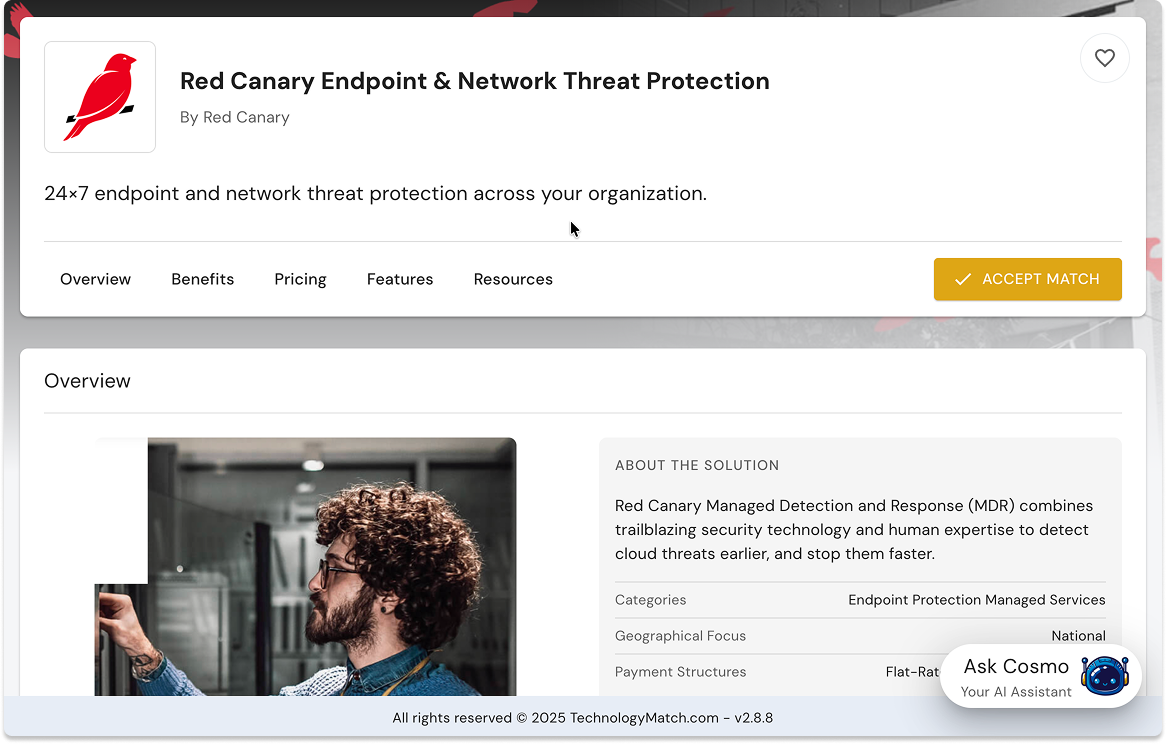
Red Canary provides comprehensive threat detection across endpoints and networks by integrating with existing EDR platforms and network security tools.
Endpoint Detection Capabilities
EDR Platform Integration:
Red Canary integrates with CrowdStrike Falcon, Microsoft Defender for Endpoint, SentinelOne, VMware Carbon Black, and Cisco AMP. They ingest telemetry from these tools and apply their own detection logic. Organizations leverage existing EDR investments while gaining Red Canary's detection expertise.
Monitored Activity:
- Process execution and command-line activity
- File system changes and registry modifications
- Network connections from endpoints
- PowerShell and script execution
- User authentication and privilege escalation
- Lateral movement attempts
Detection Methods:
Behavioral analysis looks for suspicious patterns rather than just known malware signatures. This catches living-off-the-land techniques where attackers use legitimate tools maliciously. Examples include credential dumping, persistence mechanisms, defense evasion techniques, and command and control communication.
Threat hunting involves analysts proactively searching for threats that automated detection might miss. They look for unusual process relationships, anomalous network connections, suspicious scripting activity, and signs of reconnaissance.
All detections map to the MITRE ATT&CK framework, providing standardized context on adversary behavior.
Network Detection Capabilities
Red Canary monitors network traffic for indicators of compromise:
- DNS queries and responses
- Network flow data
- Proxy and firewall logs
- VPN access logs
Network threats detected include command and control communication, data exfiltration attempts, lateral movement across network segments, unusual external connections, DNS tunneling, and port scanning.
Investigation Process
When a detection occurs, automated triage performs initial filtering. A security analyst then reviews the detection, gathering context from related telemetry. The analyst enriches the finding with information about the threat, affected systems, and potential impact. Only confirmed threats get escalated with clear, actionable remediation steps.
What It Solves
Comprehensive coverage across endpoints and network eliminates blind spots. Reduced false positives mean security teams receive confirmed threats instead of thousands of raw alerts. Faster detection with 24/7 monitoring reduces dwell time and limits damage. The tool-agnostic approach works with multiple EDR and network security tools.
Best Suited For
- Organizations with existing EDR deployments needing better detection
- Companies lacking 24/7 SOC capabilities
- Businesses experiencing advanced persistent threats
- Organizations with compliance requirements for endpoint monitoring
- Companies wanting to maximize existing EDR investments
Cloud Detection and Response
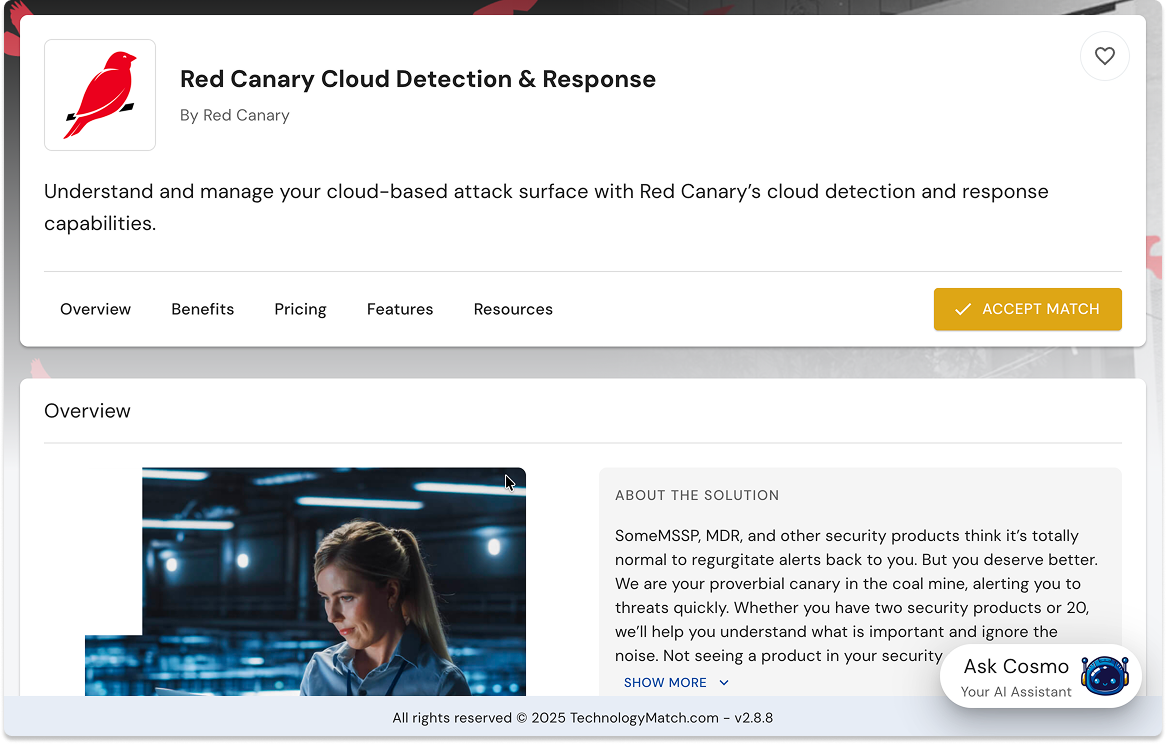
Red Canary extends managed detection and response into cloud environments, providing visibility and threat detection for AWS, Azure, and Google Cloud Platform.
Multi-Cloud Coverage
Red Canary monitors all three major cloud platforms with telemetry from CloudTrail logs, VPC Flow Logs, GuardDuty findings, Security Hub findings, activity logs, sign-in logs, audit logs, and Security Command Center findings.
Cloud Threat Detection
Identity and Access Threats:
Compromised cloud credentials, privilege escalation attempts, unusual API calls, creation of backdoor access, and cross-account access abuse.
Resource Abuse:
Unauthorized resource provisioning for cryptomining, unusual compute instance creation, data exfiltration from storage buckets, and snapshot abuse.
Configuration Threats:
Publicly exposed storage buckets, overly permissive security groups, disabled logging, encryption disabled on sensitive resources, and compliance violations.
Lateral Movement:
Movement between cloud accounts, privilege escalation within cloud environments, abuse of service roles, and cross-service attacks.
Detection Methodology
Red Canary establishes baselines of normal cloud activity. Deviations trigger investigation: unusual API call patterns, access from new locations, resource creation outside normal patterns, and privilege escalation attempts. Cloud-specific threat intelligence includes known malicious IP addresses, compromised credential indicators, and cloud-focused adversary techniques.
Investigation and Response
Analysts review API calls and activity logs, identify affected resources and accounts, determine scope and potential impact, and assess lateral movement risk. Remediation guidance includes revoking compromised credentials, isolating affected resources, reviewing misconfigurations, implementing additional controls, and restoring from known-good states.
Red Canary enhances rather than replaces tools like AWS GuardDuty or Azure Security Center by investigating findings, correlating cloud alerts with endpoint and network activity, and filtering false positives.
What It Solves
Cloud visibility gaps get addressed through comprehensive monitoring. The cloud expertise shortage is mitigated by providing access to specialists. Rapid cloud threat detection is critical given how fast threats can scale. Configuration drift detection identifies misconfigurations before exploitation. Compromised credential identification stops attackers using stolen cloud credentials.
Best Suited For
- Organizations with significant cloud infrastructure
- Companies lacking cloud security expertise
- Businesses with multi-cloud environments
- Organizations facing compliance requirements in cloud
- Companies experiencing rapid cloud adoption
- Businesses concerned about misconfigurations and credential compromise
Identity Threat Detection and Response
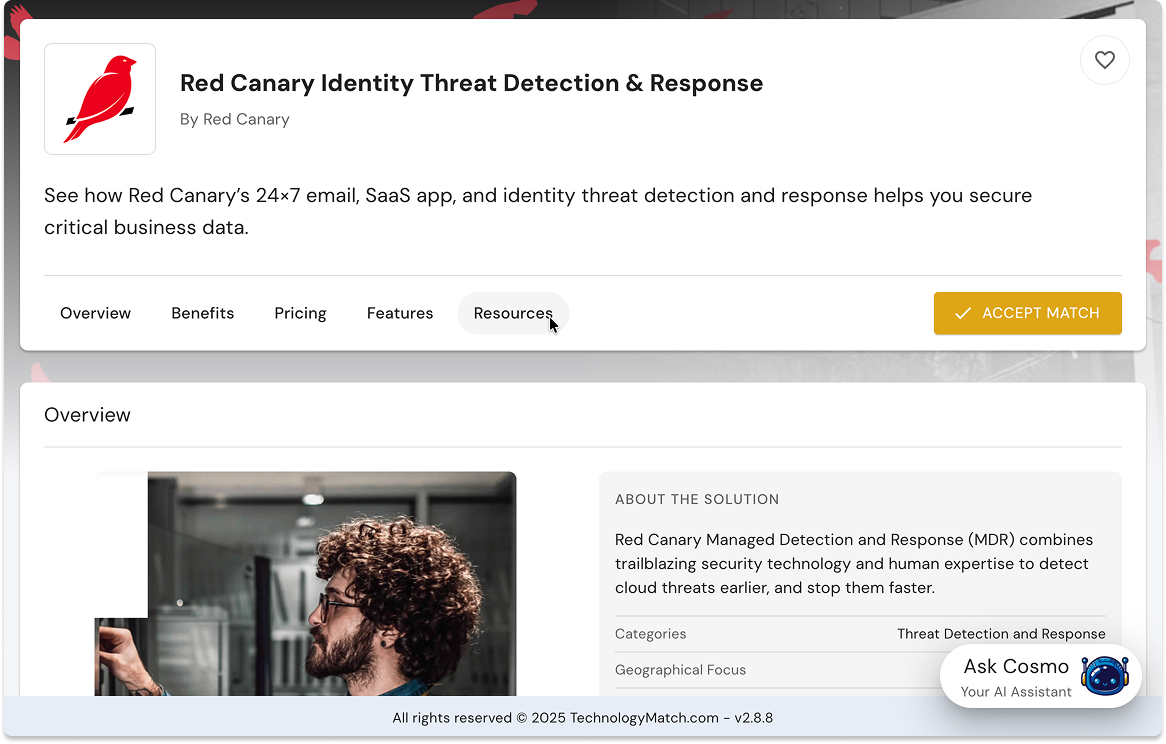
Red Canary's Identity Threat Detection and Response focuses on protecting identity systems and detecting identity-based attacks across Active Directory, Azure AD/Entra ID, and other identity providers.
Identity System Monitoring
Active Directory:
Authentication events and patterns, account creation/modification/deletion, group membership changes, privilege escalation attempts, Kerberos ticket activity, NTLM authentication patterns, domain controller activity, and GPO modifications.
Azure AD / Entra ID:
Sign-in attempts and patterns, conditional access policy changes, application permissions, service principal activity, privileged role assignments, MFA configuration changes, and unusual sign-in locations.
Identity Threat Detection
Credential Compromise:
Impossible travel (logins from distant locations in impossibly short timeframes), login attempts from unusual locations, multiple failed authentication attempts, successful login after failures, and login from known malicious IP addresses.
Privilege Escalation:
Addition to privileged groups like Domain Admins, service account privilege changes, role assignments in cloud identity systems, delegation of permissions, and modification of security policies.
Persistence Mechanisms:
Creation of new accounts with admin privileges, modification of account properties, golden ticket indicators, service principal credential creation, and scheduled tasks for credential theft.
Lateral Movement:
Authentication patterns indicating movement between systems, use of stolen credentials across multiple systems, pass-the-hash or pass-the-ticket activity, and remote access tool usage with compromised accounts.
Identity System Attacks:
DCSync attacks, Kerberoasting, AS-REP roasting, LDAP reconnaissance, and directory service manipulation.
Detection Methodology
Red Canary establishes baselines of normal authentication and identity activity: typical login times and locations, normal privilege usage patterns, standard administrative activity, and expected service account behavior. Deviations trigger investigation. Threat intelligence includes known credential stuffing campaigns, phishing campaigns, and adversary techniques for identity attacks.
Investigation and Response
Analysts review authentication logs, identify compromised accounts, assess scope, determine lateral movement, and evaluate privilege escalation risk. Remediation guidance includes resetting compromised passwords, revoking active sessions and tokens, reviewing unauthorized access, implementing additional MFA, auditing privileged accounts, and reviewing group memberships.
Red Canary's integration with Microsoft Entra ID facilitates rapid automated response to identity threats with expert AI agents.
What It Solves
Early detection of credential compromise reduces dwell time. Identification of unauthorized privilege increases prevents attackers from gaining administrative control. Detection of lateral movement stops attackers from spreading. Visibility into authentication eliminates blind spots. Detection of compromised insider accounts addresses insider threats.
Best Suited For
- Organizations with Active Directory or Azure AD/Entra ID
- Companies experiencing credential-based attacks
- Businesses with significant privileged account usage
- Organizations with compliance requirements for identity monitoring
- Companies lacking identity security expertise
- Businesses with remote workforces using cloud identity
Active Threat Remediation
Red Canary's Active Threat Remediation goes beyond detection to provide hands-on threat containment and removal.

Remediation Approaches
Guided Remediation:
For most threats, Red Canary provides detailed, step-by-step remediation guidance with clear instructions, context on why each step is necessary, warnings about potential business impact, validation steps, and follow-up actions to prevent recurrence.
Active Remediation:
For organizations needing hands-on support, Red Canary analysts directly execute remediation actions. With customer permission, analysts remotely access affected systems to terminate malicious processes, remove malware and persistence mechanisms, quarantine affected systems, collect forensic evidence, and validate complete threat removal.
Automated Response:
For specific threat types, automated actions include process termination, network isolation, file quarantine, account disablement, and session termination based on predefined playbooks.
Remediation Capabilities
Endpoint: Malware removal, persistence elimination, registry cleanup, scheduled task removal, service disablement, file system cleanup
Network: Firewall rule implementation, DNS blocking, network segmentation, VPN access revocation
Identity: Password resets, session termination, token revocation, MFA enforcement, privilege removal, account disablement
Cloud: Resource isolation, IAM credential revocation, security group modification, snapshot and backup, resource termination
Remediation Process
Threat confirmation assesses scope before recommending remediation. Remediation planning considers threat type, affected systems, business impact, customer preferences, and forensic needs. Customer approval is required before executing active remediation. Execution happens systematically with documentation, validation, and monitoring. Post-remediation monitoring ensures the threat doesn't return.
What It Solves
Access to skilled incident responders addresses the remediation expertise gap. Immediate 24/7 remediation capability eliminates response delays. Validated, complete threat removal prevents reinfection. The surgical approach minimizes business disruption. Clear guidance and validation reduce response uncertainty.
Best Suited For
- Organizations lacking incident response capabilities
- Companies with limited security staffing for remediation
- Businesses requiring 24/7 response capability
- Organizations that have struggled with incomplete threat removal
- Companies wanting to minimize business disruption
- Businesses needing validated threat elimination
Cybersecurity Incident Response Training
Red Canary's Cybersecurity Incident Response Training, branded as "Readiness Exercises," provides continuous training, tabletop exercises, and atomic tests in one integrated experience.

Training Approach
Red Canary Readiness unifies continuous training on emerging threats, tabletop exercises for scenario practice, and atomic tests validating detection capabilities. Training emphasizes practical skills with real-world attack scenarios, hands-on exercises using actual tools, simulated incident response activities, decision-making under pressure, and cross-team coordination practice.
Training gets tailored to each organization's industry, technology stack, existing processes, team skill levels, and specific concerns. Red Canary's security analysts and incident responders deliver training, providing current, practical knowledge from practitioners handling real threats daily.
Training Components
Incident Response Fundamentals:
The incident response lifecycle, roles and responsibilities, communication and escalation procedures, evidence collection and preservation, documentation and reporting.
Threat Detection and Analysis:
Log analysis and threat hunting techniques, understanding indicators of compromise, behavioral analysis and anomaly detection, MITRE ATT&CK framework application, threat intelligence utilization.
Containment and Remediation:
Containment strategies for different threat types, surgical remediation techniques, minimizing business disruption, validation of successful remediation, preventing reinfection.
Tool-Specific Training:
EDR platforms (CrowdStrike, Microsoft Defender, SentinelOne), SIEM and log analysis tools, forensic tools, response automation platforms.
Training Formats
Tabletop Exercises: Realistic incident scenarios drive team discussion and decision-making, identifying process gaps without technical execution.
Simulated Incident Exercises: Teams respond to realistic attack scenarios using actual tools and processes. Red Canary observes and provides feedback.
Atomic Tests: Based on Atomic Red Team, these tests validate detection capabilities against specific MITRE ATT&CK techniques, identifying detection gaps.
Purple Team Exercises: Red Canary simulates attacker behavior while the customer security team defends, enabling collaborative learning.
What It Solves
Building practical incident response capabilities addresses the skills gap. Maximizing security tool investments addresses underutilization. Identifying procedure weaknesses fills process gaps. Improving cross-team collaboration addresses coordination challenges. Meeting training requirements helps with compliance. Reducing panic when real incidents occur improves outcomes.
Best Suited For
- Organizations building or enhancing incident response capabilities
- Companies with security teams lacking incident response experience
- Businesses preparing for compliance audits requiring IR training
- Organizations that have experienced incidents and want to improve
- Companies underutilizing security tools due to lack of expertise
- Businesses wanting to validate incident response procedures
Understanding Fit: Is Red Canary Right for You?
When Red Canary Makes Sense
Red Canary works best for mid-market to enterprise organizations lacking internal SOC capabilities. Companies with limited security staffing unable to provide 24/7 coverage benefit from continuous monitoring. Organizations experiencing alert fatigue see immediate value through filtered, confirmed threats.
Businesses using supported EDR platforms (CrowdStrike, Microsoft Defender, SentinelOne, Carbon Black) integrate quickly. Companies requiring rapid threat detection appreciate median detection time measured in minutes. Organizations with compliance requirements find MDR helps meet obligations. Businesses seeking predictable security costs appreciate the subscription model.
When to Consider Alternatives
Red Canary may not fit organizations wanting fully automated response without human involvement. Companies with unsupported or legacy security tools that don't integrate face challenges. Small businesses with very limited budgets may need lighter solutions. Organizations requiring hands-on forensics as part of base service should clarify what's included. Companies with highly customized security requirements may find the standardized service model limiting.
Important Consideration: Zscaler Acquisition
Zscaler's acquisition of Red Canary (expected to close August 2025) will integrate MDR capabilities with Zscaler's Zero Trust platform. Organizations should inquire about the post-acquisition roadmap, how existing contracts will be honored, what product changes are planned, how pricing may change, and the timeline for integration.
Making Your Decision
Red Canary offers six distinct solutions that can be implemented independently or comprehensively. The platform's strength lies in human-led investigation backed by technology. If your organization struggles with alert fatigue, lacks 24/7 coverage, or needs expert security operations without building internal teams, Red Canary addresses these challenges.
Their 99% customer satisfaction score and recognition as a Forrester Wave Leader suggest strong execution. The pending Zscaler acquisition adds a variable to consider in long-term planning.
Looking for IT partners?
Find your next IT partner on a curated marketplace of vetted vendors and save weeks of research. Your info stays anonymous until you choose to talk to them so you can avoid cold outreach. Always free to you.
FAQ
1. What is Red Canary and what does it do for cybersecurity?
Red Canary is a managed detection and response (MDR) provider delivering 24/7/365 security operations as a service. The platform monitors endpoints, networks, cloud environments, and identities for threats, with expert analysts investigating every alert to filter false positives and deliver only confirmed threats with remediation guidance. Integrates with 200+ tools including CrowdStrike, Microsoft Defender, SentinelOne, AWS, Azure, and Google Cloud.
2. How does Red Canary's managed detection and response (MDR) work?
Red Canary's MDR combines detection-as-code methodology, behavioral analytics, threat intelligence, and machine learning with human-led investigation by expert analysts who investigate every alert before customer escalation. The platform ingests telemetry from existing security tools, applies custom detection logic mapping to MITRE ATT&CK framework, and delivers confirmed threats with clear remediation steps, eliminating alert fatigue and providing 24/7 coverage without staffing burden.
3. What is the difference between Red Canary and traditional security tools?
Red Canary delivers security operations as a service rather than just technology, providing 24/7/365 expert analysts who investigate every alert and filter false positives before escalation. Unlike traditional tools generating thousands of raw alerts, Red Canary delivers only confirmed threats with context and remediation guidance, integrating with existing EDR, cloud, and identity tools rather than replacing them, addressing SOC staffing challenges and alert fatigue.
4. How does Red Canary detect threats across endpoints, cloud, and identity systems?
Red Canary monitors endpoints through EDR integration (CrowdStrike, Microsoft Defender, SentinelOne), cloud environments via AWS CloudTrail, Azure Activity Logs, and GCP Audit Logs, and identity systems through Active Directory and Azure AD monitoring. Detection combines behavioral analysis for living-off-the-land techniques, threat hunting by expert analysts, anomaly detection via machine learning, and threat intelligence, all mapped to MITRE ATT&CK framework with sub-minute detection times.
5. What should organizations know about the Zscaler acquisition of Red Canary?
Zscaler announced intent to acquire Red Canary in 2025 with deal expected to close August 2025, integrating Red Canary's MDR capabilities with Zscaler's Zero Trust platform. Organizations evaluating Red Canary should inquire about post-acquisition roadmap, how existing contracts will be honored, planned product changes, pricing impacts, and integration timeline. The acquisition may enhance capabilities through combined technologies but will likely result in service evolution.