
What are your IT peers investing in?

We spoke to about 1,300 IT leaders from various organizations to understand what they're evaluating.

The data presented is consensual and comes directly from our conversations.

Most of it is the kind of thing you'd only hear from a peer you know well enough to ask, so we've put it in one place.
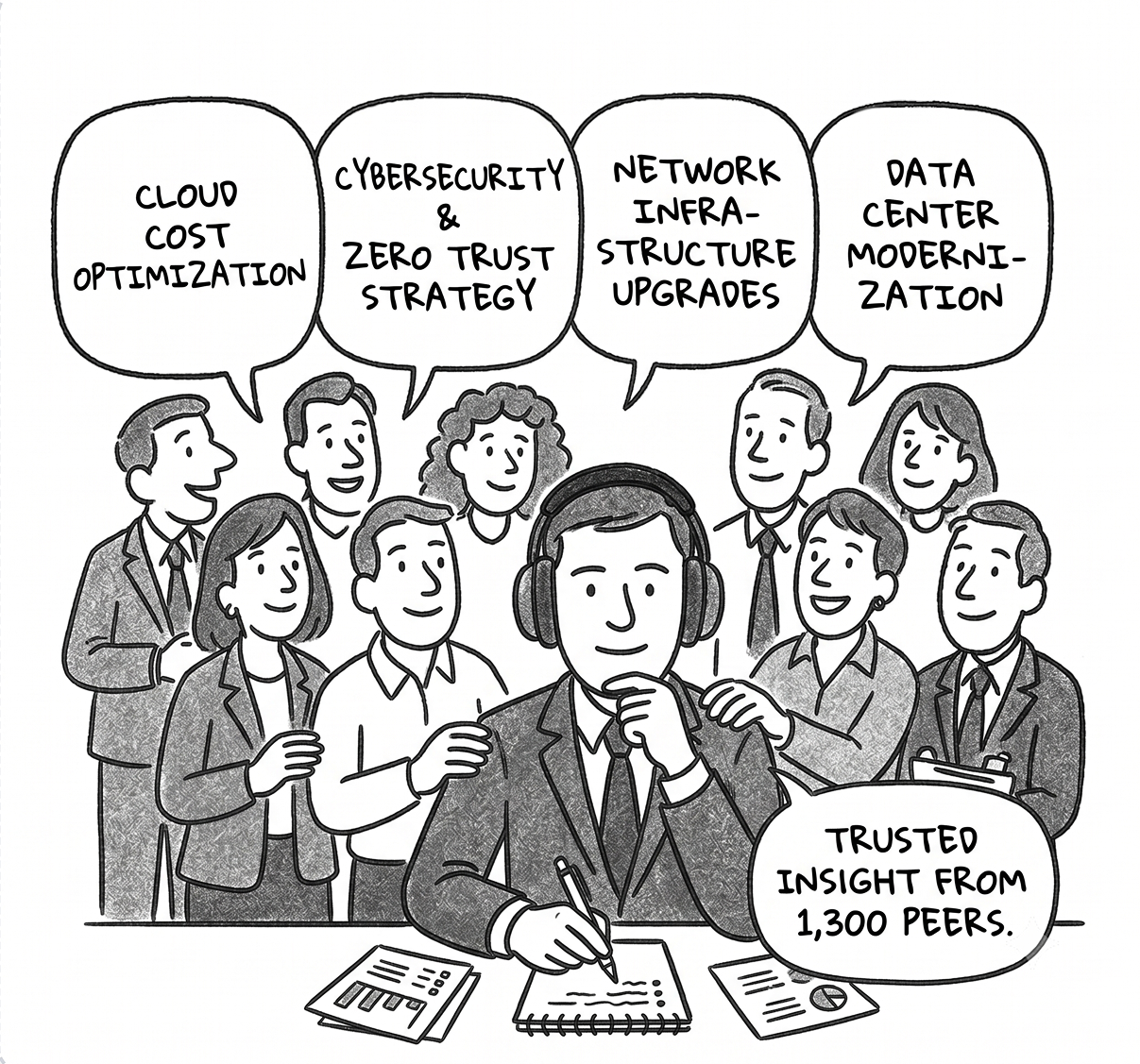
IT leaders talking about what they're evaluating
4,388
vendor evaluations
1,296
organizations covered
422
IT buyer conversations
The numbers

What your peers are prioritizing

Top ten categories, by number of organizations evaluating each one:

AI / machine learning
265
Zero Trust security
214
AI-enabled automation
168
Storage
148
Network security
136
Backup and recovery
124
Cloud security
114
Laptop and endpoint refresh
110
Networking
103
AI infrastructure
82
AI and security Infrastructure and refresh

A couple of things worth pulling out:

  • AI and security categories together make up a little over half of all the evaluations in the data.
  • Storage, backup, endpoints and networking add up to around 485 evaluations between them, which is a fair chunk of the list.
  • That's the quiet half of the list that a lot of IT leaders haven't been able to pay much attention to, and going by these numbers, a good number of their peers have been getting on with it anyway.
Continue the benchmark

Unlock the rest of the peer benchmark.

You’ve seen what IT leaders are prioritizing. Continue to see where buying patterns are shifting, what is creating urgency, how quickly peers are moving, what they’re budgeting, and the gaps showing up most often.

WHAT’S SHIFTING
Where AI and security evaluations are moving
BUYING TRIGGERS
What is actually creating urgency
PACE & SPEND
How quickly peers are moving and what they’re budgeting
GAP CHECKLIST
7 situations already showing up across peer environments

Continue the benchmark

Enter your details below and the rest of the report will open immediately.

We use your details to open the report and to follow up about your requirements. Nothing else.

The shifts

What your peers are moving towards

We compared the first half of the period with the second, and two shifts came through fairly clearly.

AI evaluations got more specific

Number of evaluations, first half of the period against the second.

First half
Second half
General AI/ML 215
AI agents for procurement 10
AI agents for IT help desk 9
Conversational and agentic AI 7
AI agents for HR self-service 5
AI security 1
69 AI agents for IT help desk
49 Conversational and agentic AI
30 AI agents for HR self-service
22 AI agents for procurement
19 AI security
0 General AI/ML
  • General AI/ML: 215 evaluations in the first half, and none in the second. Those evaluations went into named use cases instead, which is why the general category empties out.
  • AI agents for IT help desk: 9 to 69. The biggest of the named use cases.
  • Conversational and agentic AI: 7 to 49.
  • AI agents for HR self-service: 5 to 30.
  • AI agents for procurement: 10 to 22.
  • AI security as its own line: 1 to 19.

What we'd take from that:

  • Peers who are buying tend to have a specific job in mind rather than a general AI plan.
  • Help desk is the most common place people start, and it's also the one where the saving is easiest to put a number against.
  • AI infrastructure carries a median budget of $200K against $100K for most other categories, so a fair few organizations are spending on the compute side as well as the software.

Security evaluations moved down a layer

Change in evaluations between the two windows. Grew to the right, shrank to the left.

Zero Trust
145 → 44
Network security
93 → 32
Cloud security
73 → 29
Data protection
51 → 11
Identity and access management
19 → 50
SIEM
10 → 20
Managed detection and response
1 → 21
Shrank
Grew

What we'd take from that:

  • The categories that grew are all things that run day to day, and the ones that shrank are mostly things you set up once, so it looks like a lot of organizations have moved from choosing an architecture to operating it.
  • Identity is the fastest-growing security category in the data by some distance.
  • Detection and response is showing up mostly as a managed service, so it's being bought rather than staffed in a lot of cases.
  • Compliance comes up as the reason behind security spend in more than 100 of these conversations.

One caveat on the comparison: the second window covers nine months and the first covers six, so the direction of each move is more reliable than the size of it.

Buying triggers

What's creating urgency

Purchases start with a deadline or a gap for the most part.

What IT leaders brought up, across 422 recorded conversations:

Compliance requirement
Mostly HIPAA, NIST, PCI and NERC
52
Contract or subscription renewal
38
AI interest with no approved budget
35
No visibility into the environment
30
Manual processes
30
End-of-life technology
14
Merger or acquisition
In most of those the decisions were on hold rather than moving
12
Budget freeze
12
Cyber insurance requirements
7

Worth saying about these numbers: each one only got counted when somebody raised it themselves, usually in a call that was mostly about something else, so the real figures are probably higher.

485
peer evaluations in storage, backup, endpoints and networking
$200K
median budget for AI infrastructure, against $100K for most other categories
100+
conversations where compliance was the reason behind security spend

How quickly peers are moving

Share of evaluations by purchase window.

15%
0–3 mo
19%
0–6 mo
27%
3–6 months
40%
6–12 months
  • 15% are working to a 0–3 month window.
  • 19% are inside six months.
  • 27% are in a 3–6 month window.
  • 40% are looking at 6–12 months, which tends to line up with planning for the next fiscal year.
  • Detection and response, identity, and help desk agents all sit towards the faster end, and all three are fairly operational, so that fits.

What peers are spending

Share of evaluations by budget band.

7%
7%
27%
34%
11%
14%
Under $25K
$25–50K
$50–100K
$100–250K
$250–500K
$500K+
  • The most common band is $100K–$250K, which covers just over a third of all evaluations.
  • About a quarter are budgeting above $250K.
  • 14% are above $500K.
  • It's a reasonable sanity check on scope. Integration and implementation work tend to move the number around more than the category does.
The gap checklist

What this means for you

Have a read down this list. If one of them sounds like your situation, it's something a fair number of your peers have already started on.

01

Zero Trust on the roadmap and nothing lined up on identity.

Identity is the fastest-growing security category in this data.

02

Prevention tools in place with no round-the-clock detection.

MDR went from one evaluation to 21 over the period, and most of it is managed.

03

Logs being collected without much correlating them.

SIEM evaluations doubled, and compliance is the most common reason given.

04

AI on the roadmap without a specific job attached.

35 organizations had the interest and no budget, and the ones that got funded generally had a defined task.

05

AI workloads planned on the compute you already have.

Peers running these workloads are budgeting around $200K for infrastructure.

06

Refresh work sitting still while AI took up the attention.

Around 485 peer evaluations in storage, backup, endpoints and networking suggest it doesn't have to be one or the other.

07

Visibility gaps you know about and haven't funded.

30 IT leaders raised this, which makes it one of the more common things in the data.

In most of these, the thing that's missing is the next layer down from something that's already been bought, so it's usually less about rethinking the strategy and more about finishing it.

If one of them landed, you've probably got a rough idea of the category already. The harder part tends to be working out who's actually in it, and most IT leaders we speak to are at exactly that stage when they call us.

We connect you to vendors that fit your requirements and your budget

We've worked with thousands of IT leaders, and a fair few of them have ended up talking to companies they'd never have come across on their own.

If you're just looking to explore options, book a call with our team and we'll come back with a shortlist. And if you decide to take one of them forward, we'll brief the vendor on your requirements beforehand, so the first conversation picks up where you left off with us.

Based on 4,388 technology evaluations across 1,296 organizations and 422 recorded conversations with IT leaders, Q1 2025 – Q1 2026. Published September 2026.

TechnologyMatch