Vanta vs Drata vs Secureframe vs Sprinto: The Technical Comparison for IT Leaders
What each platform connects to, how it collects evidence, where the automation quietly stops, and how to pick the one that fits your stack. A vendor-neutral, engineering-first breakdown for 2026.

Summary:
Vanta, Drata, Secureframe, and Sprinto are compliance automation platforms that connect to cloud, identity, HR, and code systems over read-only APIs, run scheduled tests mapping system state to framework controls, and flag drift with timestamped evidence.
All four are roughly 80% identical; the decision lives in integration depth, endpoint-agent visibility, control mapping across overlapping frameworks, and data residency.
Each one of these platforms connect to your cloud, identity, HR, and code systems over read-only APIs, runs scheduled tests that map system state to a framework's controls, timestamps the result as evidence, and raises a flag when something drifts.
That loop is the product. The differences that decide your year-two experience sit at the edges: how deep the integrations reach into your specific stack, what the endpoint agent can actually see, how control mapping handles overlapping frameworks, and where your evidence physically lives.
The platform that demos best and the platform that runs best in production are rarely the same one, and the gap almost always traces to a technical detail no one raised during procurement. Here are those details, so you can run the evaluation yourself.
What these platforms are under the hood
All four are agentless for infrastructure and read-only by default. They authenticate through OAuth apps, dedicated service accounts, or cross-account IAM roles, then pull configuration metadata on a schedule.
Secureframe assumes a cross-account AWS role gated by an external ID instead of asking for static keys. Vanta recommends connecting at the AWS Organization, Azure Tenant, or GCP Organization level so new accounts get discovered automatically rather than wired in one at a time.
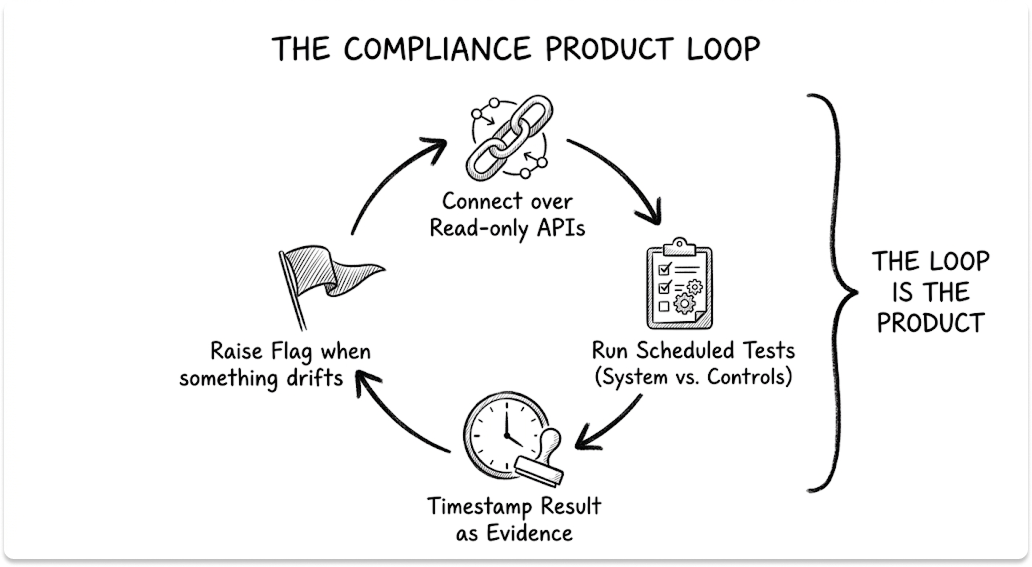
Once connected, the engine is identical in shape. A library of automated tests checks each system against a control requirement, returns pass or fail, and stores the result with a timestamp. For a clean cloud stack, vendor and auditor figures put 70 to 80 percent of the evidence collected and packaged before the auditor arrives.
Here is the part every vendor soft-pedals and every IT leader needs to internalize. These tools detect, they do not remediate. A public S3 bucket, a production host without encryption at rest, a user without MFA, a repository with no branch protection: each one gets caught and mapped to a control, and then a human on your team fixes it. The platform is an evidence and monitoring engine. The remediation work, and the headcount for it, stays with you.
How each one connects to your stack
Integration breadth is where the headline numbers fly, so anchor on what each vendor publishes about itself as of mid-2026:
- Vanta states 400 or more prebuilt integrations across its developer docs and product surfaces. It carries the deepest catalog of the four. Older 300+ figures are superseded.
- Secureframe states 300 or more integrations on its own integrations page.
- Drata does not publish a specific count on its integrations page. Its own AWS Marketplace listing cites over 200 applications and 45+ AWS services. Third-party numbers of 150 to 300 are not corroborated by Drata directly.
- Sprinto states over 200 native integrations (including 45+ AWS services) on its homepage and AWS listing, though one Sprinto blog inconsistently claims 300+.
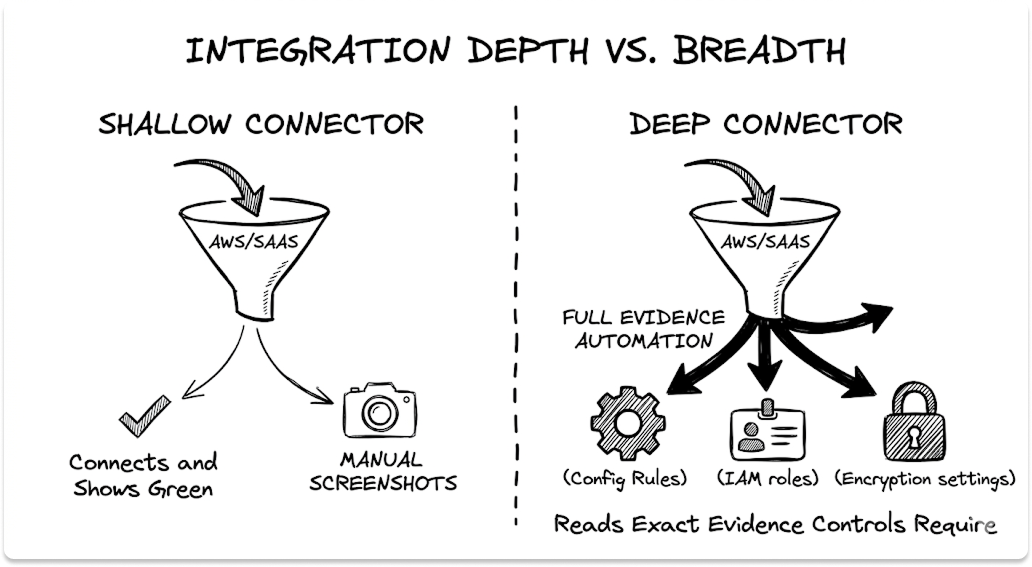
Treat these counts as marketing artifacts. The number that matters is integration depth, meaning whether a connector pulls the exact evidence your controls require.
A deep AWS connector reads Config rules, IAM role bindings, and encryption settings. A shallow one connects, shows green, and quietly leaves you collecting screenshots by hand. During a trial, verify the specific connectors for your in-scope systems, then check that the evidence they return actually satisfies the control. The headline number tells you nothing about either.
Every platform also supports custom tests and an API for systems no native connector covers. Drata ships Custom Connections and Tests with a JSON editor. Vanta exposes Custom Tests and Private Integrations through its API.
Secureframe lets you author automated tests against your own query logic, including on-prem targets. Sprinto offers GraphQL and REST APIs to push evidence from homegrown systems. If a meaningful slice of your estate is proprietary, that extensibility matters more than any connector library.
The endpoint agent question
Infrastructure is agentless, but device compliance needs eyes on the laptop. This is where the four diverge in ways that catch teams off guard.
Vanta's Device Monitor runs a hardened build of osquery with the risky tables stripped out, so it can read a disk-encryption flag but not browser history or SSH keys. It checks full-disk encryption, screen lock, password manager, antivirus, and OS version on macOS and Windows. The catch worth flagging in any Linux-heavy shop: on Linux the agent checks disk encryption only, and screen lock, antivirus, and password-manager detection are unsupported. Vanta scopes the agent for fleets under roughly 75 devices and points larger fleets at MDM.
Sprinto's Dr. Sprinto agent checks encryption, antivirus, firewall, and OS, and is marketed to replace a separate MDM for basic endpoint checks. Drata ships a device agent covering disk encryption, firewall, screen lock, password length, and antivirus.
Secureframe leans on read-only cloud scanning and device or MDM integrations rather than pushing its own agent.
For any fleet of size, the cleaner pattern is to feed device posture from Intune, Jamf, Kandji, or JumpCloud and treat the vendor agent as a fallback for unmanaged machines. Decide this before you sign, because retrofitting agents onto every laptop is consistently cited as the slowest part of onboarding.
Framework coverage and control mapping
Framework breadth is the second number vendors inflate, so again, start from what each publishes:
Two technical points decide real value here. First, cross-framework control mapping, the map-once-comply-many model, is what stops you collecting the same encryption evidence five times across SOC 2, ISO 27001, HIPAA, PCI, and NIST.
Drata's Control Framework is the most frequently praised implementation for de-duplicating overlapping requirements, and it is the reason engineering-heavy teams running three or more frameworks tend to land there.
Second, government work changes the shortlist immediately. If CMMC Level 2 or FedRAMP is in scope, Secureframe and Vanta carry the depth, and the platform's own authorization status becomes relevant.
Vanta is itself FedRAMP 20x Low and Moderate authorized, which matters if your own authorization boundary has to account for the tools inside it.
Risk management depth
Risk is the module where a genuine technical gap separates the four, and it favors Drata. Its risk engine ships a library of 200-plus prebuilt scenarios drawn from NIST 800-30, ISO 27005 and 31000, and the HIPAA SRA tool.

It scores on a quantitative 5×5 impact-by-likelihood matrix, supports the four standard treatment paths, calculates residual risk after controls, pre-maps risks to controls, and opens remediation tasks or Jira tickets directly. Custom scoring thresholds and vendor risk sit in the Pro tier.
Vanta's answer is its newer Risk Graph and Agent for Risk, built on the same integration graph that drives its tests, with an AI risk library and factor-based scoring. It is capable but recent, shipped in early 2026.
Secureframe generates inherent score, treatment plan, and residual score from a written risk description through Comply AI for Risk. Sprinto covers quantitative and qualitative assessment, though reviewers note that bespoke programs with multiple registers need extra configuration. If a mature, owner-driven risk register is central to your program rather than a checkbox, this is a real reason to weight toward Drata.
What continuous monitoring actually does
The phrase covers a wider range of behavior than the demos suggest. The questions that matter are cadence, drift detection, and how a failure reaches the right person.
On cadence, Vanta runs 1,400-plus automated tests on an hourly check (an older 1,200+ figure still circulates). Drata runs continuously with configurable thresholds, and its read-only cloud checks land roughly on a daily cycle; it centralized 1,000-plus infrastructure tests into a single Test Library in early 2026.
Secureframe continuously monitors 150-plus cloud services with real-time alerts. Sprinto evaluates each monitor on a periodic basis and shows live pass, fail, or evidence-required status.
Alerting is broadly equivalent: Slack, Teams, email, and Jira ticket creation on failure are standard everywhere, with webhooks firing on failed tests. The one true differentiator is Sprinto's tiered, SLA-based alerting, which escalates by severity and is designed to surface a control sliding toward failure before it fully breaks, routed to an owner with remediation steps. The other three alert mainly at the moment of failure or evidence expiry.
Auditor access is also universal now. All four expose a dedicated auditor portal so your CPA firm works inside the platform instead of in a shared drive.
Drata's Audit Hub, Vanta's auditor portal and Auditor API, Sprinto's auditor console, and Secureframe's evidence data room (with raw JSON export) all do the same job. Any AICPA-licensed auditor works with all four, so your platform choice never locks your auditor.
The AI reality, separated from the pitch
AI is the loudest part of every 2026 roadmap, so it is worth drawing a clean line between what is shipping and what is theater.
- Vanta AI Agent 2.0 (January 2026) is the broadest suite: a context-aware agent that surfaces program gaps, drafts policies, takes a first pass at questionnaires, and validates evidence, plus agents for third-party risk and customer trust.
- Secureframe Comply AI is the most concrete on the engineering side. Comply AI for Remediation generates infrastructure-as-code fixes in Terraform, AWS CLI, and CloudFormation for failing cloud tests, and its AI Evidence Validation flags missing or stale evidence before the audit. It also offers a read-only MCP server in beta.
- Drata leans AI-native with agentic vendor risk and AI-assisted control mapping. Sprinto answers questionnaires and RFPs, maps controls, and runs shadow-AI detection against ISO 42001 and the EU AI Act.
The honest boundary applies to all four. AI reliably drafts policies, answers questionnaires from a knowledge base, summarizes vendor documents, suggests control mappings, and generates candidate IaC fixes.
It does not reliably judge whether a live configuration truly satisfies a control's intent, and every vendor keeps a human in the loop for final sign-off. Secureframe's own MCP guidance says it plainly: verify AI output before acting, because the data is live but the model can misread it. Treat AI as a force multiplier on the drafting and triage work, and keep your engineers on the judgment calls.
Also read: AWS Bedrock vs Azure OpenAI vs Google Vertex AI: Enterprise AI Platform Comparison
Data residency and the CLOUD Act
This is the diligence item most teams skip and EU teams cannot afford to. All four run on AWS, and residency is not the same as sovereignty.
- Vanta offers US, EU (Frankfurt), and Australian regions, with Frankfurt as an opt-in chosen at onboarding rather than a default.
- Drata offers a US or EMEA cell, though it does not document the exact EMEA region on its own pages. Its trust center runs on SafeBase, which Drata acquired in early 2025.
- Secureframe lets you pick a US or EU data center, but the EU backend is AWS in London. Post-Brexit, that is UK rather than EU mainland, currently covered by the UK's adequacy decision.
- Sprinto runs primary regions in California and Frankfurt with US disaster recovery, so it offers a true EU endpoint despite being headquartered in India.
The trap is jurisdiction. Any US-parent vendor can host your data in Frankfurt and still be reachable under the US CLOUD Act, and an India-headquartered vendor handling EU personal data brings its own transfer obligations.
If your contracts carry NIS2, DORA, or GDPR localization clauses, read the DPA and the subprocessor list, confirm the exact region in writing, and decide whether residency alone satisfies your legal team or whether sovereignty does. None of these four is EU-native.
Operational realities: setup, switching, and where it breaks
Time to a SOC 2 Type 1 clusters around 8 to 12 weeks for all four on a standard cloud stack. Sprinto and Drata market engineering-led, self-serve setup. Secureframe leans on expert-guided onboarding.
Vanta runs a checklist model where most standard integrations connect in under an hour. What slows teams down is consistent across platforms: getting the device agent onto every laptop, HRIS sync lag that throws false access flags, false positives on infrastructure tests that need scoping, and the manual residual for on-prem and process controls.
Switching between platforms is feasible and runs roughly 2 to 4 weeks of re-integrating, rebuilding policy libraries, and re-mapping controls. The real friction is evidence history, which does not port cleanly between vendors because there is no shared export format for controls and evidence.
Plan any migration for the gap between audit cycles so you never break an in-progress Type 2 observation window. That portability gap, rather than the contract, is the genuine lock-in.
The failure mode to budget for is the silent automation gap. Vendor automation covers 70 to 80 percent of evidence for a clean cloud and off-the-shelf identity and HR stack. Push in heavy on-prem or proprietary systems and coverage can fall to 50 to 60 percent, with the rest reverting to manual collection. This rarely shows up in a demo and almost always shows up in month two.

Use the Questionnaire Below to See Which Compliance and Audit Tool Suits You
How to choose
Start with your stack, then match the tool to your dominant constraint.
- Scope before you shortlist. Inventory every in-scope system and sort each into natively and deeply integrated, integrated but shallow, or on-prem and custom. If the third bucket exceeds about 20 percent of your evidence, weight toward strong custom-test and API extensibility and budget for the manual residual. If a trial shows automated coverage under 60 percent, the return narrows fast.
- Match the platform to the need:
- Government or defense (CMMC, FedRAMP): Secureframe for CMMC Level 2 and FedRAMP depth, or Vanta, which is FedRAMP 20x authorized itself.
- Multi-framework GRC with serious risk management: Drata, for the deepest control mapping and the strongest native risk register.
- First SOC 2 or ISO 27001, broad SaaS stack, most mature AI: Vanta.
- Engineering-led team wanting fast audit prep, a bundled endpoint agent, and pre-failure alerting: Sprinto.
- EU residency as a hard requirement: verify Vanta (Frankfurt opt-in) or Sprinto (Frankfurt primary) explicitly, and treat Secureframe's London region as UK rather than EU.
- Run a parallel trial on your real environment. Connect your actual stack to your top two, measure true automated coverage and false-positive rate, and inspect evidence quality. Confirm the exact region, the DPA and subprocessor list, which frameworks and modules are add-ons, and the multi-entity tier.
- Plan for the limits. Staff for remediation, assign an owner for manual evidence, and schedule any future move between audit cycles.
The bottom line
These four are roughly 80 percent the same platform, and the demos are designed to hide that. The decision lives in the remaining 20 percent: integration depth into your real systems, what the endpoint agent sees, how control mapping handles your framework overlap, where your evidence is hosted, and how much of your estate the automation actually reaches.
Vanta leads on integration breadth and AI maturity, Drata on control mapping and risk depth, Secureframe on framework coverage and IaC remediation, Sprinto on engineering-led speed and tiered alerting. Map your stack, trial your top two against it, and the choice resolves itself.
If you would rather compare vetted compliance and security vendors side by side without sitting through four sales pitches, TechnologyMatch lets you shortlist pre-vetted providers, stay anonymous until you reach out, and start the conversation on your terms. It is always free to buyers.
Looking for Compliance Vendors?
A failed audit has your name on it. The right platform shouldn't take four sales calls to find. Shortlist pre-vetted compliance vendors on TechnologyMatch, matched to the frameworks you answer to. You stay anonymous, you pick who to talk to, and it's free.
FAQ
Do these platforms remediate failing controls?
No. All four detect a failing control, map it to the framework, and surface remediation guidance, but a human on your team makes the fix. Secureframe and the others can now draft infrastructure-as-code fixes with AI, and an engineer still reviews and deploys them.
Are they agent-based or agentless?
Infrastructure monitoring is agentless and read-only through APIs, OAuth, or cross-account IAM roles. Endpoint and device checks use a lightweight agent or an MDM integration. For fleets of any size, feeding device posture from Intune, Jamf, or Kandji is cleaner than the vendor agent.
Which one handles the most frameworks at once?
Drata's control framework is the most cited for cross-framework mapping, so one piece of evidence satisfies many requirements. Secureframe carries the widest raw framework count including government standards, and Vanta covers 35-plus with strong AI-governance support.
Does platform choice lock me into one auditor?
No. Any AICPA-licensed firm works with all four through the auditor portal. The real lock-in is evidence history, which does not export cleanly between vendors, so plan migrations between audit cycles.
Can I keep my data in the EU?
Vanta (Frankfurt) and Sprinto (Frankfurt) offer EU regions, Drata offers an EMEA cell, and Secureframe's EU option is hosted in London, which is UK rather than EU mainland. Residency is not sovereignty: any US-parent or AWS-hosted vendor can still fall under the CLOUD Act, so confirm the region and the DPA before signing.