Cyera vs Varonis vs BigID: A DSPM Comparison for Microsoft 365 Copilot Readiness (2026)
Cyera vs Varonis vs BigID compared for Microsoft 365 Copilot readiness: scanning, classification, permissions, remediation, and self-hosting in 2026.
.png)
Summary:
Cyera, Varonis, and BigID are the three data security posture management (DSPM) platforms most shortlisted for Microsoft 365 Copilot readiness. Copilot honors existing permissions but removes the obscurity that hid over-shared files, making DSPM a gating step before rollout.
Their origins differ: Cyera optimizes classification accuracy and runtime activity, Varonis the access-permissions graph, and BigID classification breadth across the widest data surface.
Turning on Microsoft 365 Copilot does not hand anyone new access. It honors the permissions each user already holds, then makes a decade of SharePoint memberships, sharing links, inherited folder rights, and unlabeled files reachable through a plain-language prompt.
As one Microsoft MVP put it after watching it happen in the field, Copilot does not bypass security, it reflects it.
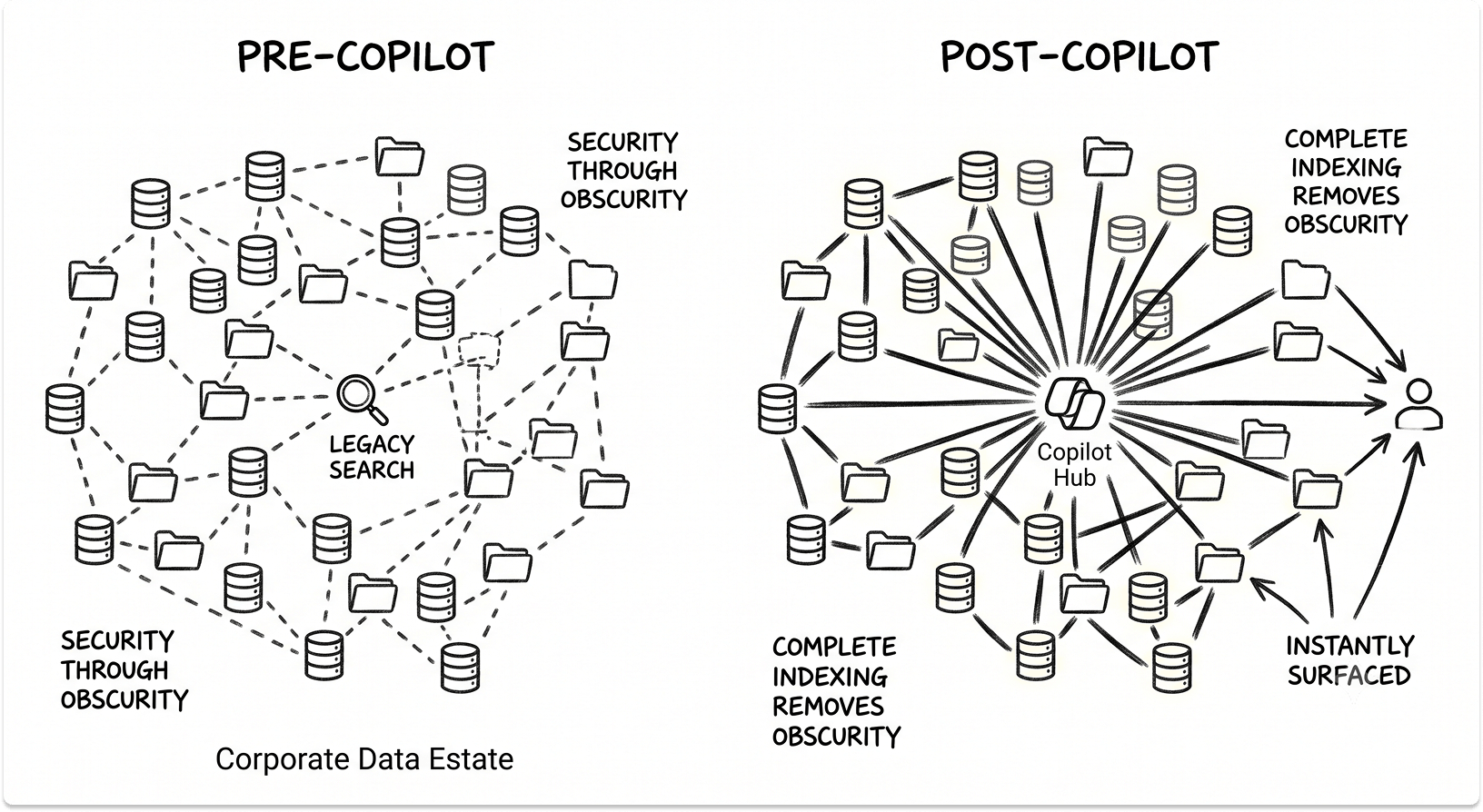
The thing most permission models have quietly leaned on for years is obscurity. A file was technically reachable, but nobody knew it existed or where to look. Copilot removes that safety net the moment it indexes the tenant.
A compensation spreadsheet a finance analyst could always open, but never found, now surfaces the instant she asks Copilot to summarize pay trends.
That single change is why data security posture management (DSPM) has become a gating step before a Copilot rollout rather than a background project. The related risk of sensitive data leaking into generative AI tools sits right next to it.
Cyera, Varonis, and BigID all land on this shortlist. Each one discovers sensitive data, maps who can reach it, and helps shrink that exposure. They arrived at the problem from different starting points, and those origins explain almost every strength and limit that follows.
The core architectural difference between Cyera, Varonis, and BigID
The three platforms were built to solve three different original problems. Read the table below top to bottom and the personalities come through. Cyera optimizes for classification accuracy and current activity.
Varonis optimizes for who can reach what and what they did with it. BigID optimizes for understanding every kind of data across the widest possible surface.
How Cyera works: AI-native classification and runtime activity
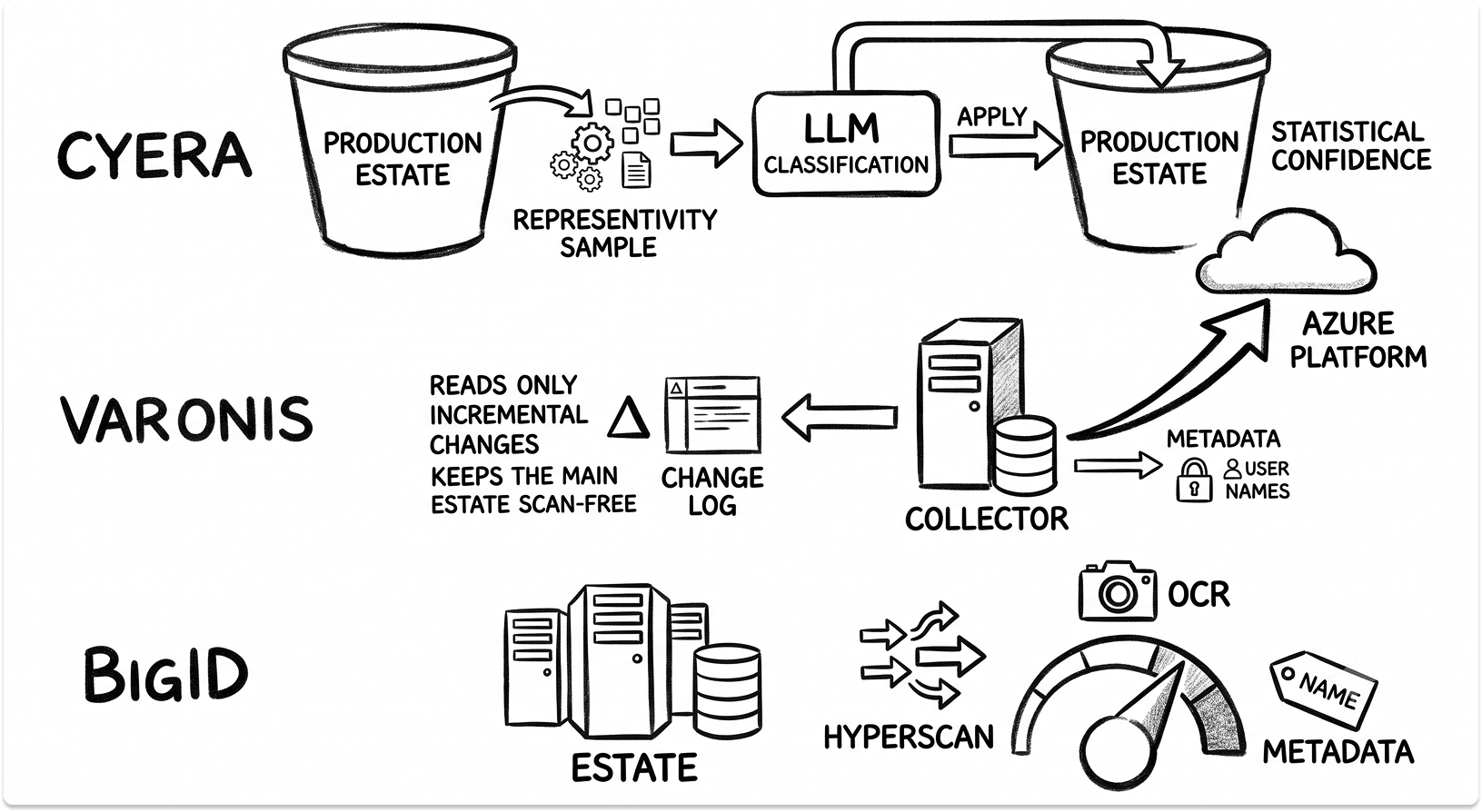
Cyera connects agentlessly over APIs and can run as SaaS or entirely inside your own cloud or on-prem boundary. Its most consequential design decision is a rejection of scanning every byte.
Cyera argues in its own research that reading everything at multi-petabyte scale produces stale results, because the sweep takes weeks while schemas shift underneath it.
Instead it uses an approach it calls smart representation: group similar data into families, fully inspect a small representative sample, generalize the finding to the family or column, and re-verify on a schedule or when data drifts, with targeted deep reads held as a governed exception.
That method pays off on repetitive machine-generated data such as data lakes, object stores, and structured columns. It gives you the same risk signal in weeks rather than months.
Cyera is upfront that human-generated files like documents, slides, mail, and chat carry too much per-file variability for sampling, so it reads those in full. For the messy unstructured content Copilot actually surfaces, Cyera is doing full-file inspection like the others.
For classification, Cyera layers regular expressions, machine learning, and fine-tuned language models per data type, and states 95%+ precision with no manual rule-writing. Treat that figure as a vendor claim rather than an independently validated benchmark.
Cyera's clearest angle on Copilot is treating readiness as an ongoing discipline rather than a one-time launch check. Before go-live, it offers a free, agentless Copilot risk report that returns scored results in days.
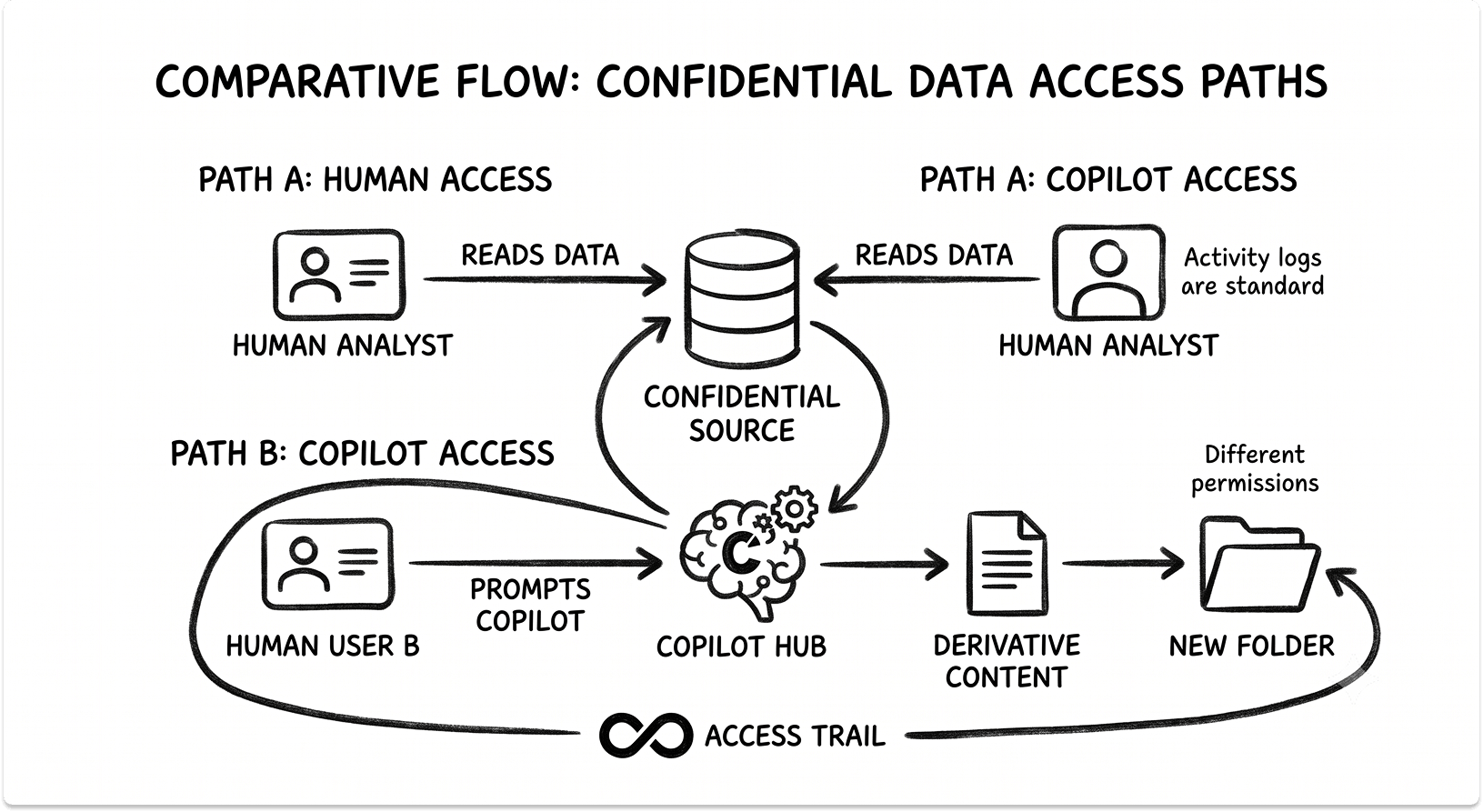
After go-live, its Access Trail feature builds a continuous record correlating sensitivity, identity, and activity, and separates Copilot-driven access from human access. Its Data Lineage view follows one confidential source through the summaries, drafts, and slide outlines Copilot generates from it, as each derivative lands in a workspace with different membership.
On remediation, Cyera states it ships more than 30 out-of-the-box actions such as revoking access, masking, and killing public or org-wide sharing, plus workflow triggers into Slack, Jira, and ServiceNow, prioritized by AI severity scoring.
The honest limit: Cyera has the youngest access model of the three. Its entitlement resolution across gnarly legacy NTFS and Windows file-share sprawl is less battle-tested than Varonis. If most of your Copilot risk lives in fifteen years of on-prem file permissions, prove that out on your own data.
How Varonis works: the permissions graph and data detection and response
Varonis runs local collectors inside your boundary. They scan volumes, classify file contents locally so raw sensitive data never leaves the tenant, and extract permissions and access events. Only metadata gets shipped over Kafka to the Azure-hosted platform.
Varonis also markets itself as the only vendor doing true incremental scanning, where it re-reads only new or changed objects from a known change list rather than crawling the whole file system. That is what makes continuous petabyte-scale monitoring practical instead of a quarterly batch job.
One procurement fact matters here more than any feature. On its Q3 2025 earnings call, CEO Yaki Faitelson announced the end of life of the self-hosted platform as of December 31, 2026, pushing customers to the SaaS architecture.
Varonis has since described the SaaS transition as complete. File contents still classify locally under the SaaS model, but if you have a hard regulatory or architectural reason to stay fully self-hosted past 2026, validate the SaaS model against that constraint before you sign.
For classification, Varonis uses a hybrid of mature rule-based classifiers and AI, states 99% accuracy at scale, and includes OCR for image-borne data. Again, read that as a vendor figure. It also applies and corrects Microsoft sensitivity labels through MPIP rather than only reading them, which matters because Copilot's own security model leans on those labels being correct.
Varonis differentiates on depth of access truth. Its access graph resolves entitlements, nested group memberships, sharing links, and inheritance into an accurate effective-permission view, and it drives automated least-privilege remediation that strips excess access without manual tickets.

For Copilot specifically, Varonis offers a dedicated module with a dashboard of sensitive data exposed to Copilot users, real-time prompt and response monitoring, detection of sensitive-data spikes pulled through prompts, detection of Copilot reaching stale or idle data, and auto-labeling of Copilot-generated output.
Its Data Detection and Response layer adds a searchable forensic audit trail and per-user behavioral baselines, with an optional 24x7 managed service. In one customer example Varonis cites, a company reduced its Copilot exposure by 99.8% in ten days, which is a single case rather than a general result.
The honest limit: that depth is operationally heavy. Varonis is the most involved of the three to deploy, tune, and staff, and its automated remediation, while genuinely powerful, needs careful guardrails and change control before you let it enforce broadly. It is the most capable and the least set-and-forget.
How BigID works: classification breadth and scan-mode flexibility
BigID is agentless and connector-based, and it exposes the most tunable scanning of the three. You pick the mode per objective:
On top of those sits HyperScan, a patented method that predicts where sensitive data is likely to live and surveys huge unstructured estates. BigID states HyperScan can save up to 95% of scan time on historically problematic unstructured files. BigID also offers cluster analysis to group duplicate and related data and cut review noise.
The practical edge is control. On a sprawling, heterogeneous estate you can dial the depth, cost, and coverage trade-off per repository rather than accepting one fixed method everywhere.
Classification is where BigID has always concentrated. It reports more than 1,500 classifiers across structured, semi-structured, and unstructured data, and it added no-code classifier tuning with human-in-the-loop adjustment so teams can raise accuracy without writing rules.

On Copilot readiness, BigID does identity-aware discovery, tying data risk to identities, ownership, and usage to surface over-permissioned users, stale accounts, and shadow access.
It leans into AI security posture, governing training data and model pipelines and detecting shadow AI and toxic inputs. Its remediation is native and increasingly agentic, covering revoke access, delete toxic data, redact secrets, and enforce retention, with the option to delegate fixes to data owners.
The honest limit: BigID tells you what is exposed and to whom very well, but its runtime, per-prompt Copilot telemetry and behavioral detection are lighter than Varonis or Cyera.
It is oriented to posture and governance workflow more than to catching what Copilot did in the last five minutes. If continuous prompt-level monitoring is your priority, test that directly.
Cyera vs Varonis vs BigID feature comparison
How each tool sits next to Microsoft Purview
If you have standardized on Microsoft Purview, none of these three is a clean replacement. Varonis applies and corrects MPIP labels and enforces policy on top of Purview. BigID extends Purview's DSPM with its own discovery and classification. Cyera targets the file types Purview cannot label at all; it states that sensitivity labels cannot cover roughly 40% of files in a typical M365 estate, such as CSVs, ZIPs, images, and code.
Treat all three as complements to Purview and probe the overlap directly in a trial. How Purview's own labeling and DLP mechanics work is a separate topic I have covered in the Purview DLP comparison, so I will not repeat it here.
Matching the DSPM tool to your environment
What each DSPM tool costs
None of these three publishes list pricing, so any figure floating around online is a third-party estimate you should treat as directional. What you can rely on are the pricing models.
The practical takeaway is that a headline number tells you very little until the tool is scoped against your actual tenant. Get each vendor to quote against the same defined slice of your environment, and compare the total, including the deployment and tuning effort, rather than a per-user sticker.
Questions to ask each DSPM vendor before you sign
Slideware will not answer these. A scoped trial on your own tenant will.
Which DSPM tool should you choose?
There is no universally correct answer, because the three are tuned for different failure modes of a Copilot rollout.
The decision is easier to make on your own data than on a datasheet. Enable Copilot on a pilot group, point each tool at the same slice of your real tenant, and judge them on one thing: how quickly and accurately each shows you what Copilot can reach, who acted on it, and what it costs in effort and change risk to shrink that exposure. A structured proof of concept keeps that comparison honest.
The pressure to move here is real, and you probably already feel it. Copilot licenses are paid for whether or not the rollout is live, and a rollout parked on hold is money sitting idle. The harder moment tends to come in a meeting, when someone asks exactly which files, chats, and sites Copilot can read, and the room goes quiet.
The right tool turns that question into a dashboard you can answer from. When you are ready to line up the vendors that fit your environment, TechnologyMatch can help you build that shortlist and get in front of the right teams without sitting through a month of demos first.
Get the rollout off hold
TechnologyMatch helps you build a shortlist and get in front of the right teams, without sitting through a month of demos first. Your details stay private until you choose to engage. It's also free for you.
FAQ
Is DSPM alone enough to make Copilot safe?
No. DSPM makes Copilot governable by exposing what it can reach and tying that to identity and activity. Safety comes from acting on the findings, right-sizing access and correcting labels, and from pairing posture with runtime monitoring. The access and activity layer, rather than raw discovery, is where the real difference between these tools shows up.
Do any of these replace Microsoft Purview?
Not cleanly. BigID extends Purview's DSPM, Varonis applies and corrects MPIP labels and enforces policy on top of it, and Cyera targets the file types Purview cannot label. Treat all three as complements to Purview and probe the overlap in a trial.
How much does the scanning method actually matter?
A lot, for time to value and cost. Cyera's sampling and BigID's HyperScan and metadata modes reach useful results in weeks on large repetitive stores, while Varonis's incremental full-content scanning is heavier but yields the deepest access and activity picture. Match the method to whether your bottleneck is speed to insight or depth of access analysis.
What does the Varonis self-hosted end of life mean for me?
Varonis is retiring self-managed on-prem support on December 31, 2026, in favor of its SaaS model, where collectors run in your boundary and the platform is Azure-hosted. File contents still classify locally under SaaS, but if you have a regulatory or architectural reason to stay fully self-hosted, validate the SaaS model against that constraint before committing.
Can I trust the accuracy percentages these vendors publish?
Treat them as marketing claims until you validate them on your own data. Every headline figure in this space, Cyera's 95%+ precision, Varonis's 99% at scale, and BigID's up-to-95%-faster scans, is self-reported. A short proof of concept on a real slice of your tenant tells you far more than any number on a datasheet.