



What is ServiceNow, How it Works, and What it Does for IT Leaders
Learn what ServiceNow is, how the Now Platform, CMDB, MID Server, and Discovery work, and what ITSM, ITOM, and AI agents do for IT leaders.
What Is ServiceNow?
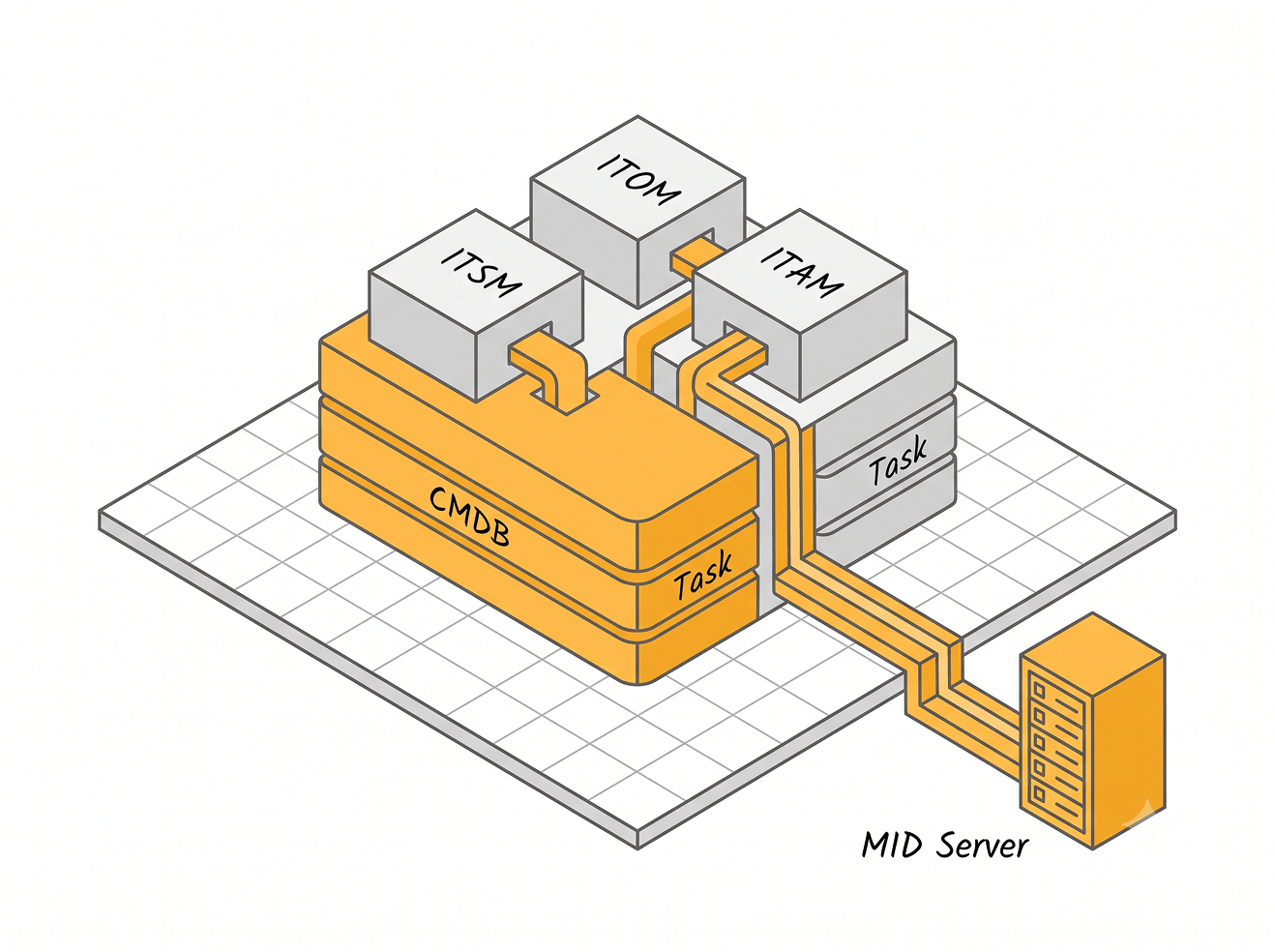
ServiceNow is a single cloud platform that stores enterprise work as records in a shared relational database and moves that work through configurable workflows.
It started as IT help-desk ticketing and now runs IT service management (ITSM), IT operations (ITOM), asset management (ITAM), security response, HR, and custom applications on the same data model, the same automation engine, and the same permission system.
For a CIO or infrastructure head, the technical proposition is precise. You get one system of record for the assets, services, and tasks your organization runs, and one system of action that changes them. What matters is what sits underneath the UI, and where it breaks if you build it wrong.
In practice, ServiceNow:
It is deployed most heavily by organizations with genuine process complexity: multiple support tiers, a change advisory board, regulated audit requirements, and an infrastructure estate no spreadsheet can track.
How Does ServiceNow Work?
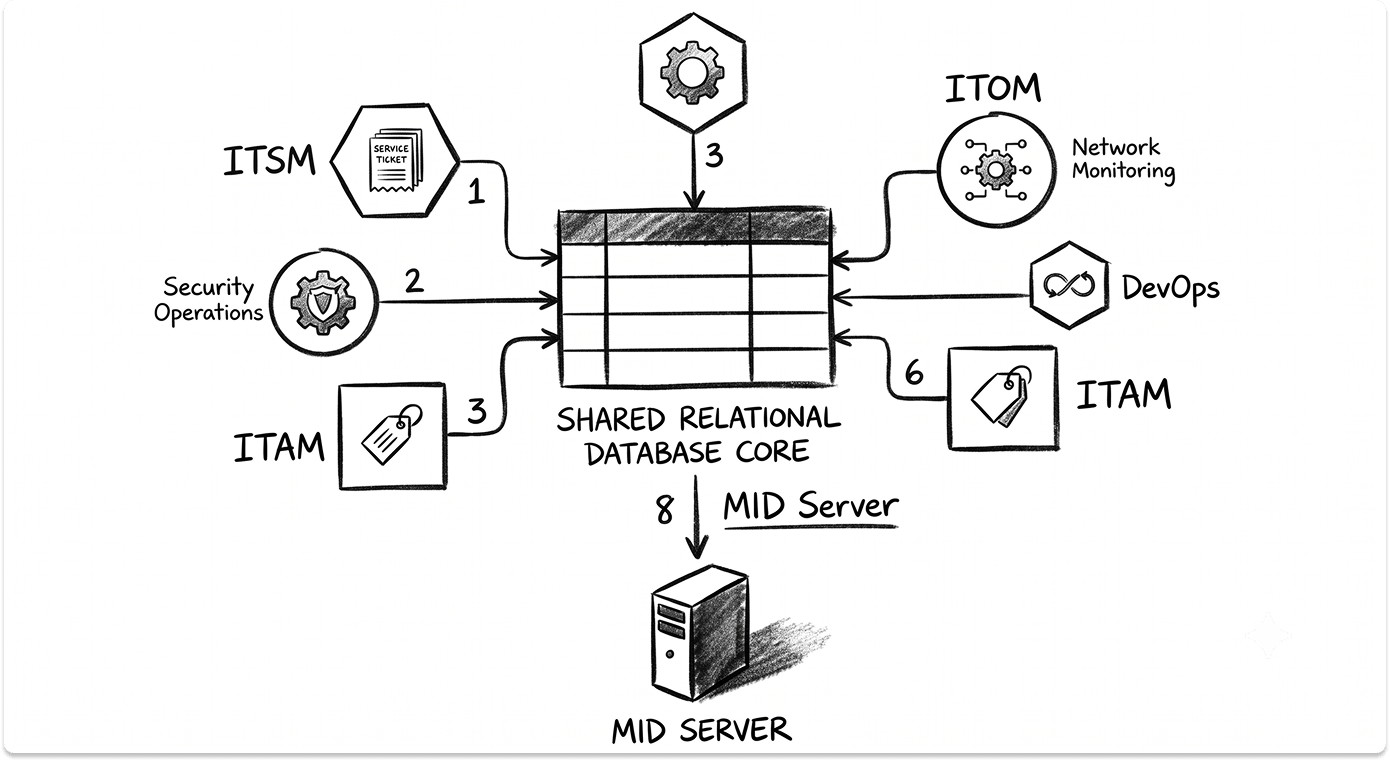
ServiceNow gives each customer a dedicated logical instance of the platform. The instance is the unit of deployment, configuration, and upgrade. It contains one database, one set of tables, one permission model, and every application you license.
There is no separate asset product bolted onto a separate ticketing product. They are views over the same tables. That single design decision drives everything below it.
1. Everything Is a Table, and Tables Inherit
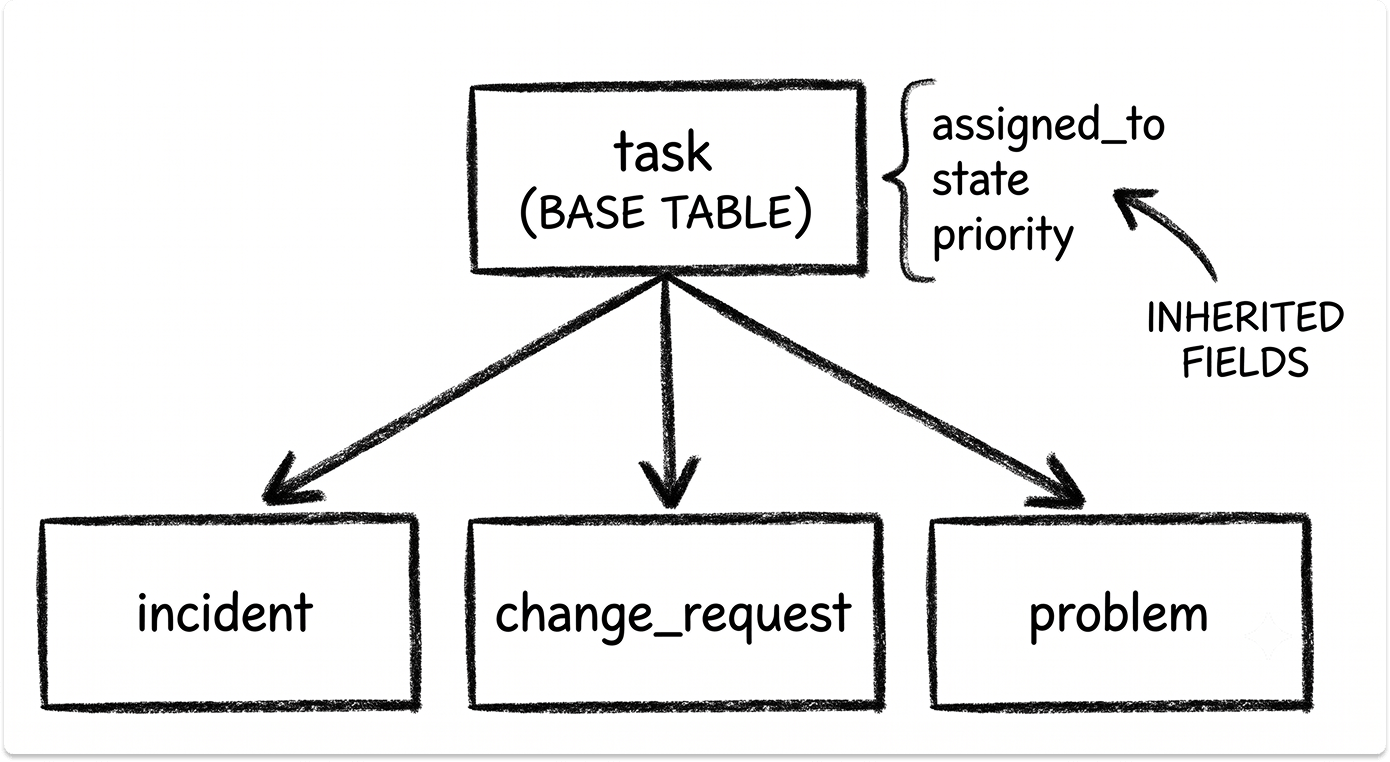
In ServiceNow, every object is a table row. An incident, a user, a server, a change request, a custom record all live in tables. The platform then adds one idea most databases do not expose directly: table inheritance.
Nearly every record that represents work extends a base table called task. Incident, problem, change_request, and the service catalog request item (sc_req_item) all extend task and inherit its core fields: assigned_to, state, priority, short_description, and the SLA and approval plumbing wired to them.
A child table adds only the fields unique to it. Because of this, roughly 95% of database operations on a typical instance touch the task table, which is why its performance sets the ceiling for the whole platform.
The practical consequence: a single query against task returns every incident, change, problem, and request at once. Cross-process reporting, universal SLAs, and shared automation all fall out of the inheritance model for free.
When your team designs a custom application, the rule is simple. If the thing gets assigned, tracked, and moved through states, extend task and inherit that machinery. Do not rebuild fields that already exist and are already wired into reporting.
2. The CMDB Is the System of Record
The Configuration Management Database (CMDB) is the second pillar. It holds a record, called a Configuration Item (CI), for every server, application, database, network device, and business service you run.
The base table is cmdb_ci, and it extends the same way task does: cmdb_ci_server, cmdb_ci_linux_server, cmdb_ci_win_server, cmdb_ci_appl, cmdb_ci_database, and so on.
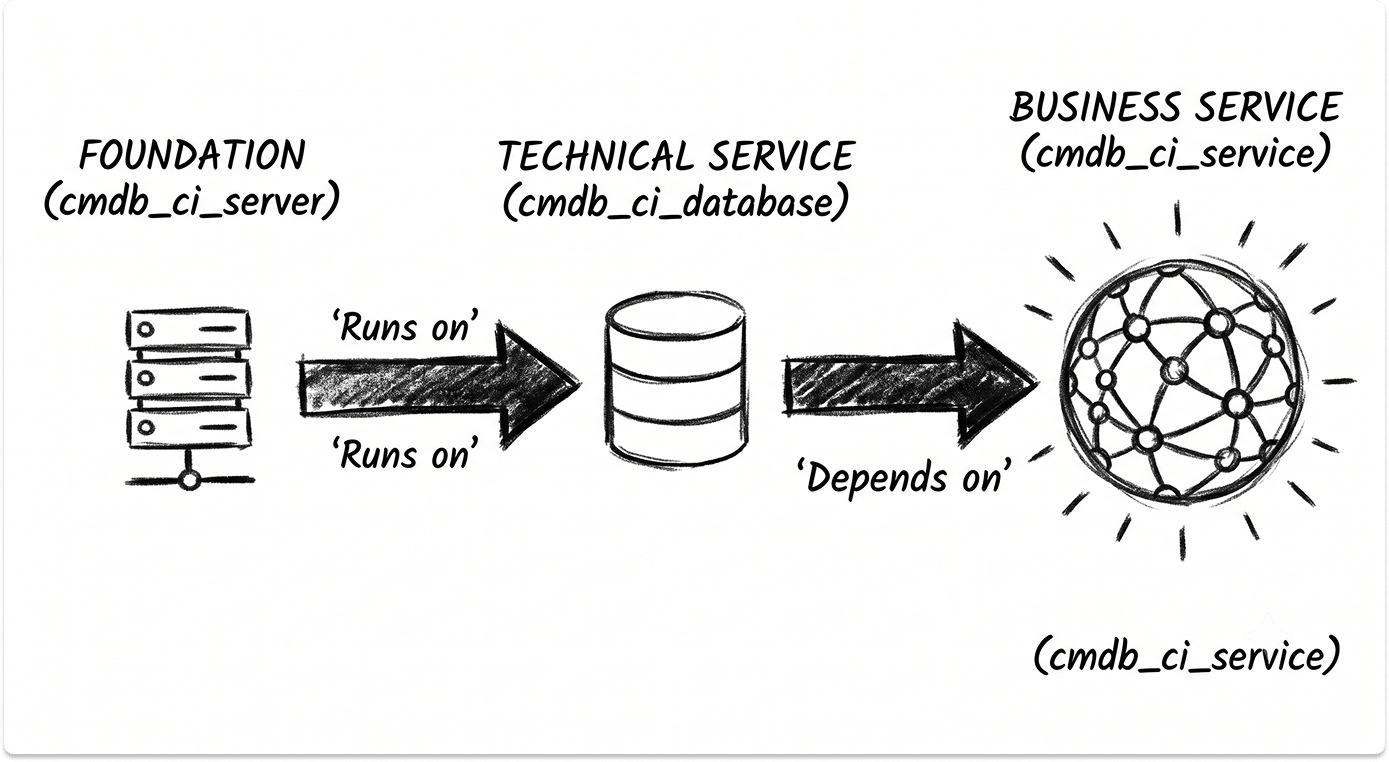
Relationships between CIs live in a dedicated table, cmdb_rel_ci, using directional types such as Runs on, Hosted on, and Depends on. This is what turns a flat inventory into a dependency graph.
When an incident points at a CI, and that CI has a Depends on relationship to a database, ServiceNow can tell you the incident's blast radius before you touch it.
ServiceNow publishes the Common Service Data Model (CSDM) as the prescriptive way to structure service and application data so it stays consistent across teams.
Follow it and every downstream module (change, security, asset, event correlation) reads the same authoritative service context. Ignore it and you get the single most common failure mode I see: a CMDB nobody trusts, which quietly poisons every workflow built on top of it.
3. The Automation Layer Runs Server-Side
Business logic in ServiceNow is configured, not hard-coded into an application binary. The layers that matter to an architect:
Two governance objects decide whether your instance stays upgradeable. Scoped applications isolate custom tables, scripts, and ACLs behind a namespace prefix (for example x_acme_sap_integration) and travel cleanly between instances.
Work done in the default Global scope is harder to isolate and more likely to break on a platform upgrade. Changes move between instances through Update Sets.
If you are building anything beyond trivial configuration, build it in a scoped app. This is the difference between a platform you can upgrade twice a year and one you dread touching. For the broader pattern here, see our guide on measuring and paying down technical debt, because over-customization in ServiceNow is technical debt with a subscription attached.
4. How It Reaches Your Environment: The MID Server
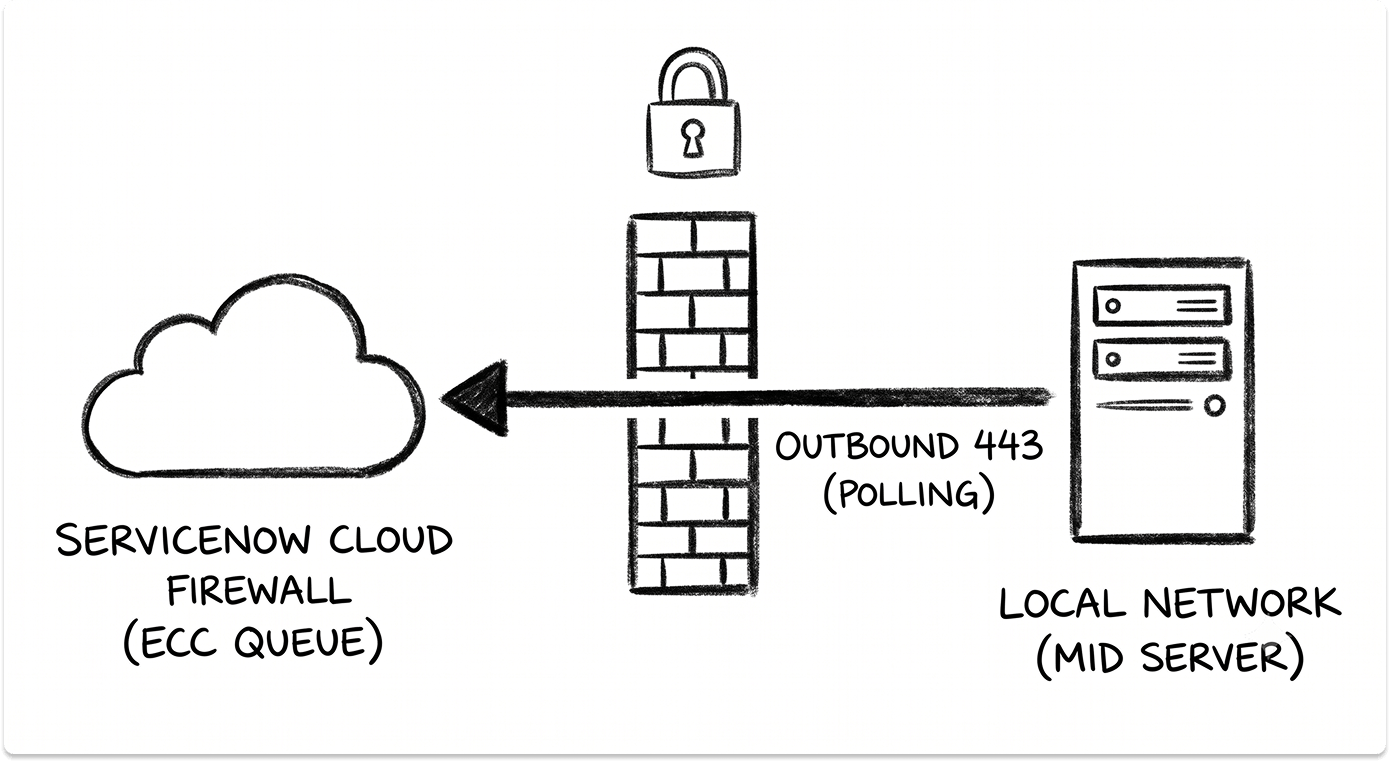
ServiceNow runs in ServiceNow's cloud, so it cannot talk to a server behind your firewall on its own. The bridge is the MID Server (Management, Instrumentation, and Discovery), a Java application you install on a host inside your network.
The security model is the part IT leaders should understand before their network team asks. The MID Server opens only outbound HTTPS on port 443 and continuously polls a queue called the ECC Queue (External Communication Channel).
No inbound ports are opened on your network. When the instance has work, it writes an output record to the ECC Queue, the MID Server picks it up, runs the job locally, and writes the result back as an input record.
Because it lives inside your network, the MID Server can speak protocols the cloud cannot: SSH, WMI, WinRM, SNMP, PowerShell, and JDBC. That is how ServiceNow queries a Windows box, an internal Oracle database, or a network switch.
You can also route an outbound REST call through the MID Server by setting its ECC target, which is the correct pattern for calling an internal API that is not exposed to the internet.
Discovery uses this pipeline to populate the CMDB automatically. A probe called Shazzam scans a subnet for open ports. Classification then reads the results: port 135 open indicates a Windows host, port 22 indicates Linux, and the matching classifier runs deeper probes.
Sensors parse the returned payloads and write CIs into the CMDB. Horizontal Discovery finds devices and their direct relationships; top-down Service Mapping traces a business service across its supporting CIs.
Capacity planning is concrete. A single MID Server typically probes 500 to 2,000 devices per hour depending on protocol and latency, and you deploy at least two in a cluster for redundancy so one failing does not stop Discovery. Place MID Servers close to the targets they scan, and never share one across DEV, TEST, and PROD.
5. The AI Layer: Now Assist and AI Agents
The current generation of the platform layers generative and agentic AI on top of the same data model. It comes in three tiers of capability:
Two supporting pieces matter for governance. The AI Control Tower monitors and secures every agent, including third-party ones, from one dashboard.
The AI Agent Fabric acts as the communication backbone and supports open protocols including Model Context Protocol (MCP) and Agent2Agent (A2A) for integrating agents from other vendors.
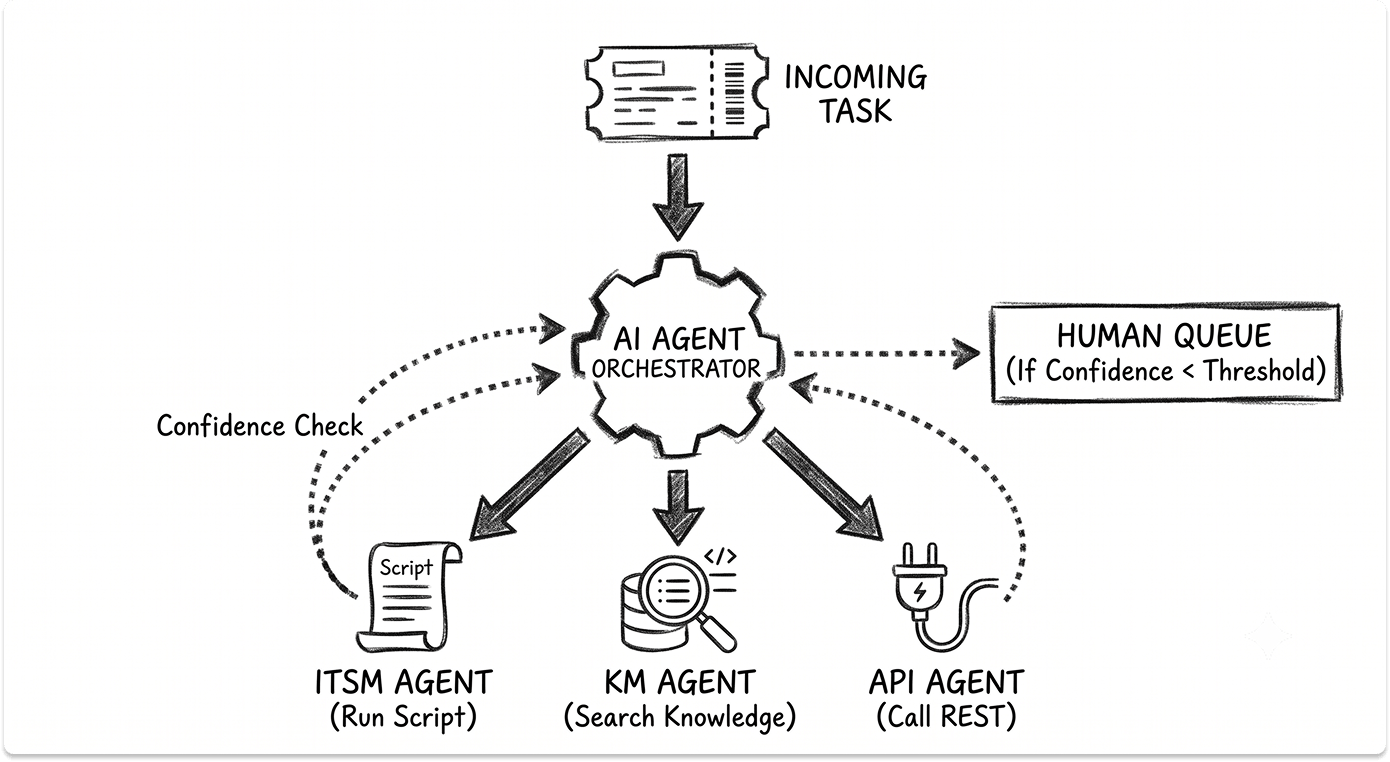
The technical caveat is real. An AI agent acts on your data, and your data lives in the CMDB and the task tables. An agent reading stale or wrong CMDB records repeats a wrong decision at machine speed.
Clean data governance is now a prerequisite for safe AI, not a nice-to-have. Building and operating agents also requires specialized ServiceNow developer skills and a setup process that can run for weeks, so treat agentic AI as an engineering project, not a switch.
ServiceNow Product Architecture: ITSM, ITOM, ITAM, and Beyond
ServiceNow is not a single product. It is a set of licensed product families that share the platform. Each solves a different problem and is priced separately, and most evaluation conversations collapse all of them into "ServiceNow" without saying which family is actually in scope. Getting specific about the module is the first step to a clean deployment.
IT Service Management (ITSM)
What it does: Runs the IT service desk on the task table hierarchy. This is where most organizations start.
Problems it replaces: Legacy ticketing tools, email-driven request handling, and spreadsheet change logs.
Key capabilities: Incident, problem, change, and request management; the service catalog and self-service portal; knowledge base; and SLA definitions and escalations inherited from the task table. For how ITSM incident routing compares to dedicated alerting tools, see our incident management platform comparison.
IT Operations Management (ITOM)
What it does: Discovers and monitors infrastructure, and keeps the CMDB accurate. ITOM is the reason the CMDB is trustworthy instead of aspirational.
Problems it replaces: Manual inventories, disconnected monitoring silos, and alert floods with no correlation.
Key capabilities: Discovery and Service Mapping; Event Management, which correlates and deduplicates alerts from monitoring tools into actionable incidents; and AIOps for anomaly detection and predictive alerting. It ingests signals from observability tools rather than replacing them, so it sits alongside platforms covered in our AIOps platform comparison and monitoring tools like Datadog.
IT Asset Management (ITAM)
What it does: Tracks the full lifecycle and cost of hardware, software, and cloud assets against CIs in the CMDB.
Problems it replaces: Standalone asset databases, license true-up scrambles before an audit, and untracked SaaS spend.
Key capabilities: Hardware Asset Management (HAM), Software Asset Management (SAM), and SaaS license management. Because assets are CIs, an asset record and the incident affecting it reference the same object. Compare the category in our ITAM solutions guide and, for SaaS specifically, our SaaS management platform roundup.
Security Operations (SecOps) and GRC
What it does: Brings security response and risk onto the same platform as IT, mapping threats and vulnerabilities to CIs so priority follows business impact.
Problems it replaces: Security work tracked in tickets disconnected from IT change, and vulnerability lists with no remediation workflow.
Key capabilities: Security Incident Response, Vulnerability Response (ingesting data from scanners in our vulnerability management comparison), Threat Intelligence, and integrated risk and compliance. SecOps orchestrates on top of your SIEM; it does not replace it. For the risk and compliance side, see our overview of GRC software.
Platform, HRSD, CSM, and Custom Apps
What it does: Extends the same task-and-workflow model beyond IT. HR Service Delivery gives employees a case portal; Customer Service Management applies the model to external customers; the App Engine lets you build custom workflow apps as scoped applications.
Why it matters technically: Because HRSD (sn_hr_core) is a scoped app with its own isolated tables and ACLs, HR data stays separate from ITSM while sharing the platform, the identity model, and the automation engine.
What ServiceNow Offers to IT Leaders
Strip away the module names and the value shows up in four technical properties.
1. One System of Record and Action
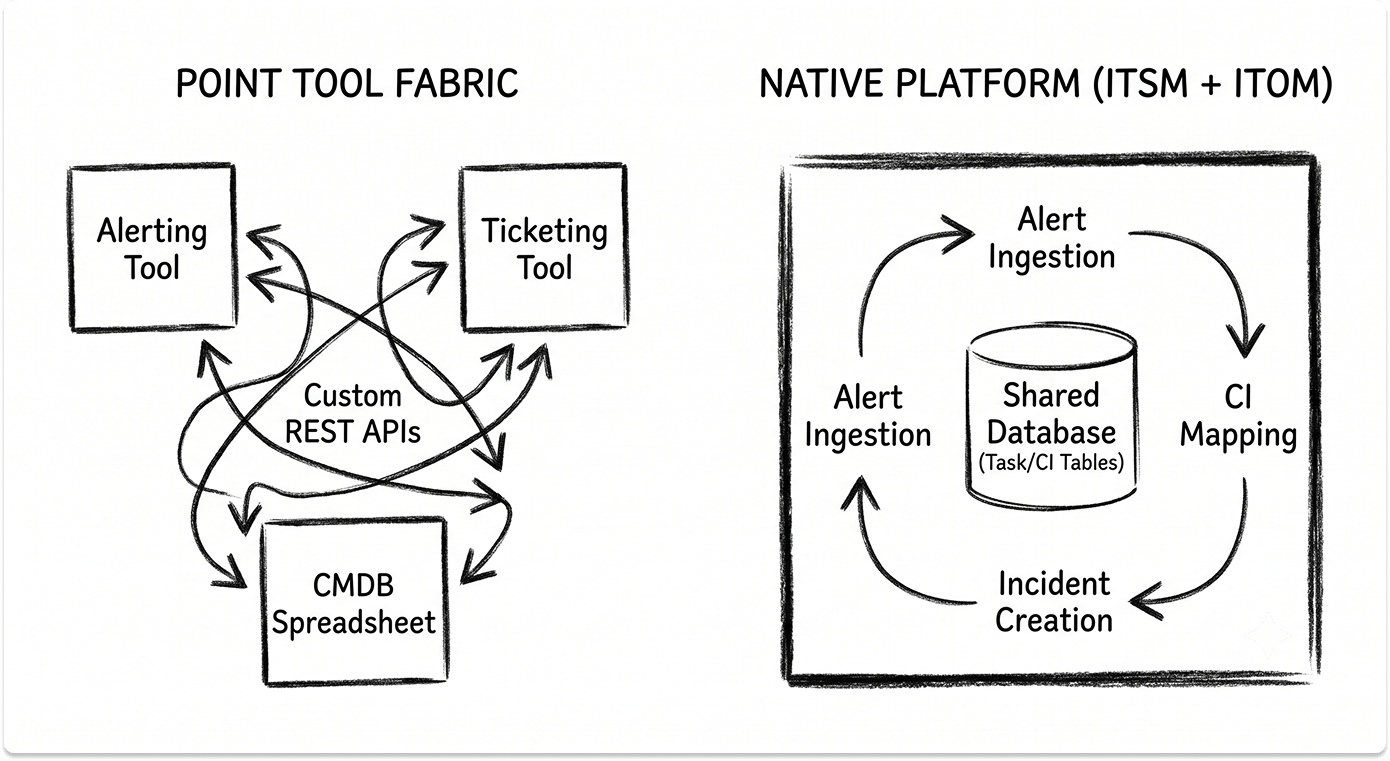
Every module reads and writes the same tables and the same CMDB. An incident, the change that fixes it, the asset it runs on, and the vulnerability that caused it all point to the same CI.
That shared model is why cross-process reporting works without an integration layer, and why each module you add is worth more than the last. A collection of best-of-breed point tools cannot replicate this without building and maintaining the integration fabric yourself.
2. Automation and Orchestration
Business rules, Flow Designer, and the workflow engine let you automate routing, approvals, and state transitions server-side, then chain them across systems through IntegrationHub.
This is where ServiceNow competes directly with dedicated IT process automation tools, with the advantage that the automation runs against records it already owns.
3. Service and Infrastructure Visibility
Discovery and Service Mapping build a live dependency graph in the CMDB. When something breaks, you can trace the affected business service to its supporting CIs before you start guessing.
When you plan a change, you can see what depends on the CI you are about to touch. Visibility is a direct function of how disciplined your Discovery and CSDM implementation is.
4. Governed Extensibility and AI
The App Engine turns ServiceNow into a place to build workflow applications, not just consume them, and scoped apps keep that custom work upgrade-safe. The AI layer then operates on the clean, related data those workflows produce.
The quality of both depends entirely on data governance, which brings us to the honest part.
Is ServiceNow Right for Your Environment?
ServiceNow fits organizations that have accepted they run real operational complexity across IT and beyond. The signals: more than roughly a thousand employees, a formal change process, regulated audit obligations, and a plan to extend past IT into security, HR, or customer service.
For that profile, the single data model and shared CMDB deliver something no set of point tools matches, and the platform earns its cost.
The recurring failure mode is over-customization. The platform makes it easy to script around the out-of-the-box model, and every deviation you make in Global scope raises the cost and risk of your next upgrade.
In the implementations I have watched go sideways, the root cause was almost never the product. It was a team that customized instead of configured, skipped CSDM, and let the CMDB rot until nobody trusted it.
Favor configuration over customization, build in scoped apps, assign a CMDB data owner before go-live, and stand up a governance body before the portal launches and demand spikes.
ServiceNow is overkill when those conditions are absent. A small IT team running standard ITIL processes rarely needs this depth and usually cannot fund the implementation or staff the administration.
In that case, a lighter tool deploys in days rather than months and covers the daily work. Compare the options directly in our ITSM tools comparison and, for larger environments weighing the true enterprise field, our ServiceNow vs BMC Helix vs Jira Service Management decision guide.
The evaluation question is not whether ServiceNow is a capable platform. It plainly is. The question is whether your organization is complex enough, and resourced enough, to make a single shared workflow platform the right architectural decision for the next five years.
The more of your operation you intend to run on one data model, the stronger the case.
Before you commit to a platform this deep, see it side by side
Whether you're weighing ServiceNow against a lighter tool or the true enterprise field, our platform lets you filter vendors that fit your requirements and start conversations on your terms, not theirs. No cold outreach to you and no pressure. Plus it's free.
FAQ
What is ServiceNow used for?
ServiceNow is used to run IT and enterprise workflows on one cloud platform. It stores work as records in shared tables and moves that work through configurable automation, starting with IT service management (incident, problem, change, request) and extending to IT operations, asset management, security response, HR, and custom applications built on the same data model.
Is ServiceNow a database or an application?
Both, deliberately. Underneath it is a relational database exposed through the platform's table model, where every object is a row with a permanent sys_id. On top sits the application layer: workflows, business rules, ACLs, and modules like ITSM and ITOM. Because they share the same tables, an "application" in ServiceNow is a view and a set of logic over the same records other applications use.
What is the CMDB in ServiceNow?
The Configuration Management Database is the platform's inventory of everything IT is responsible for. Each server, application, database, and service is a Configuration Item (CI), and relationships between CIs are stored in a separate table to form a dependency graph. The CMDB is the shared context every other module (change, security, asset, event correlation) reads from, which is why its data quality determines the reliability of the whole platform.
What is a MID Server and do I need one?
The MID Server is a lightweight Java application you install inside your network so ServiceNow's cloud can reach systems behind your firewall. It only makes outbound HTTPS connections on port 443 and polls the ECC Queue for work, so no inbound ports are required. You need one for Discovery, for integrations with internal APIs and databases, and for orchestration against on-prem systems. Deploy at least two in a cluster for production.
How does ServiceNow handle AI?
Through three layers. Now Assist provides generative features like summarization and resolution suggestions. AI Agents execute multi-step tasks with bounded autonomy using tools such as scripts, record operations, and API calls. The AI Agent Orchestrator coordinates teams of agents, while the AI Control Tower governs them and the AI Agent Fabric connects third-party agents over open protocols like MCP and A2A. All of it operates on your CMDB and task data, so data quality is the prerequisite for safe use.
Why do ServiceNow implementations fail?
The most common cause is over-customization combined with a neglected CMDB. Heavy scripting in the Global scope makes upgrades expensive and fragile, and a CMDB that drifts out of accuracy undermines every workflow and AI feature built on it. Configuring rather than customizing, building in scoped applications, following the CSDM, and assigning clear data ownership are what keep an implementation healthy and upgradeable.


