



Best SaaS Management Platforms for IT Leaders (2026)
How the best SaaS management platforms work in 2026: multi-source shadow IT discovery, write-back automation, license reclamation, and shadow AI governance.
.png)
The first time you see your full SaaS estate is usually the worst possible moment to see it. Finance forwards a month of corporate-card statements and asks why the company pays for four separate note-taking apps.
An auditor asks for a list of every application touching customer data, and nobody can produce it on demand.
That blindness has a structural cause. Business units now control 81% of SaaS spend while IT directly manages just 15%, so the people accountable for security and renewals have the least direct line of sight into what gets bought. The portfolio grows under their feet, and they find out at renewal or at audit.
A SaaS management platform (SMP) exists to close that gap. The good ones do it through discovery engines, identity correlation, and lifecycle automation, not dashboards.
This guide focuses on how the leading platforms work under the hood and how each one approaches the problem of SaaS sprawl, so you can pick on technical merit rather than marketing.
What a SaaS management platform controls
An SMP sits across the full application lifecycle and acts as a system of record for software. It pulls signals from finance, identity, endpoints, and the applications themselves, then reconciles them into a single inventory of apps, users, licenses, contracts, and access.
From that inventory it drives four jobs: continuous discovery of sanctioned and unsanctioned apps, license and entitlement optimization, onboarding and offboarding automation, and risk and compliance governance.
The technical quality of a platform comes down to how well it does each, and discovery is the foundation everything else stands on.
How SaaS discovery engines actually find shadow IT
Discovery is a correlation problem. No single data source sees the whole estate, so a discovery engine has to ingest several signals and merge them into one normalized record per application. The platforms that find the most apps run the most signals in parallel.
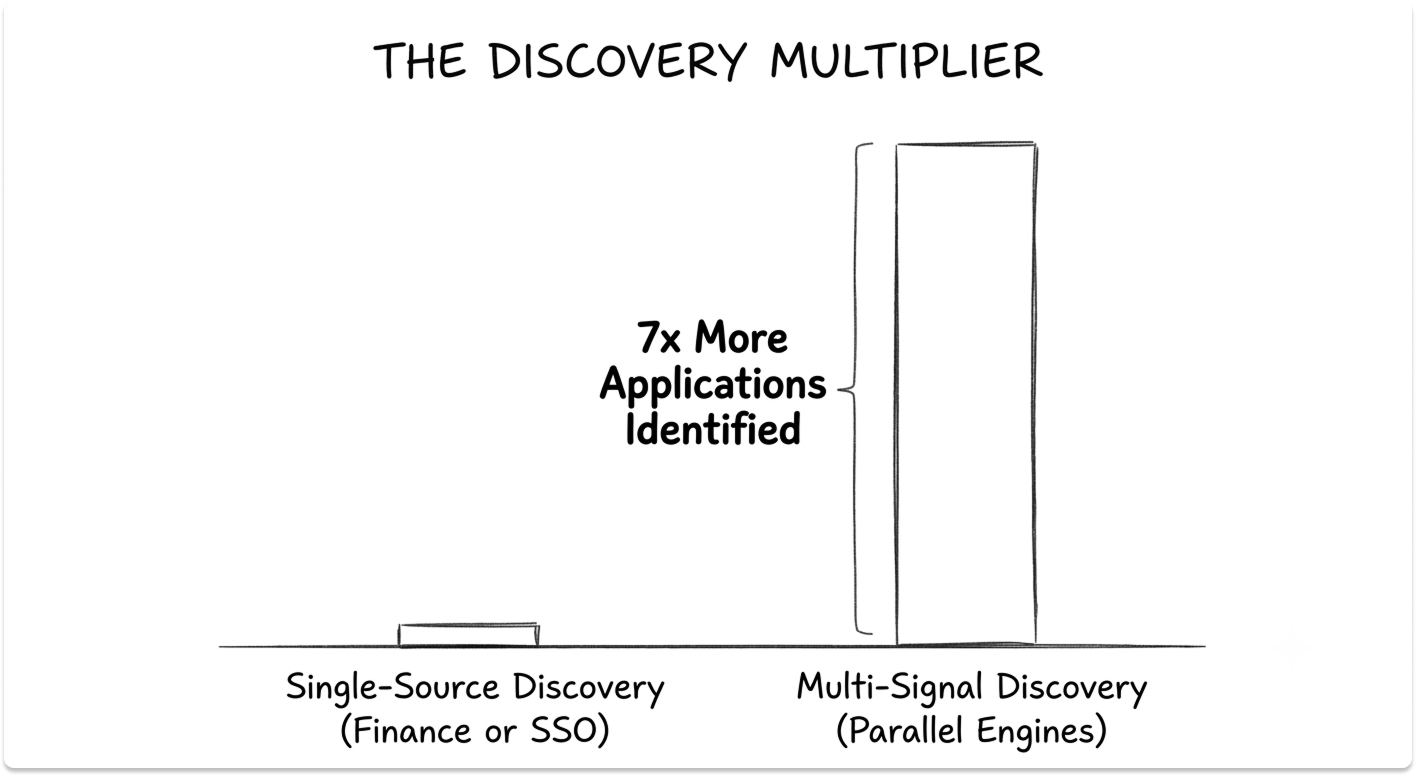
The uplift from multi-source discovery is measurable. Organizations using multiple discovery methods identify over 7x more applications than those relying on a single method, and multi-signal engines routinely surface 2 to 3 times more apps than IT teams expect to find.
Here is what each signal catches and where it goes blind:
The takeaway for evaluation is direct. A platform that discovers only through finance data will miss every free app, and one that discovers only through SSO will miss everything an employee signed up for with a credit card. Ask any vendor exactly which of these signals they run, and treat finance plus SSO plus browser plus direct API as the floor.
The OAuth grant is the signal people forget
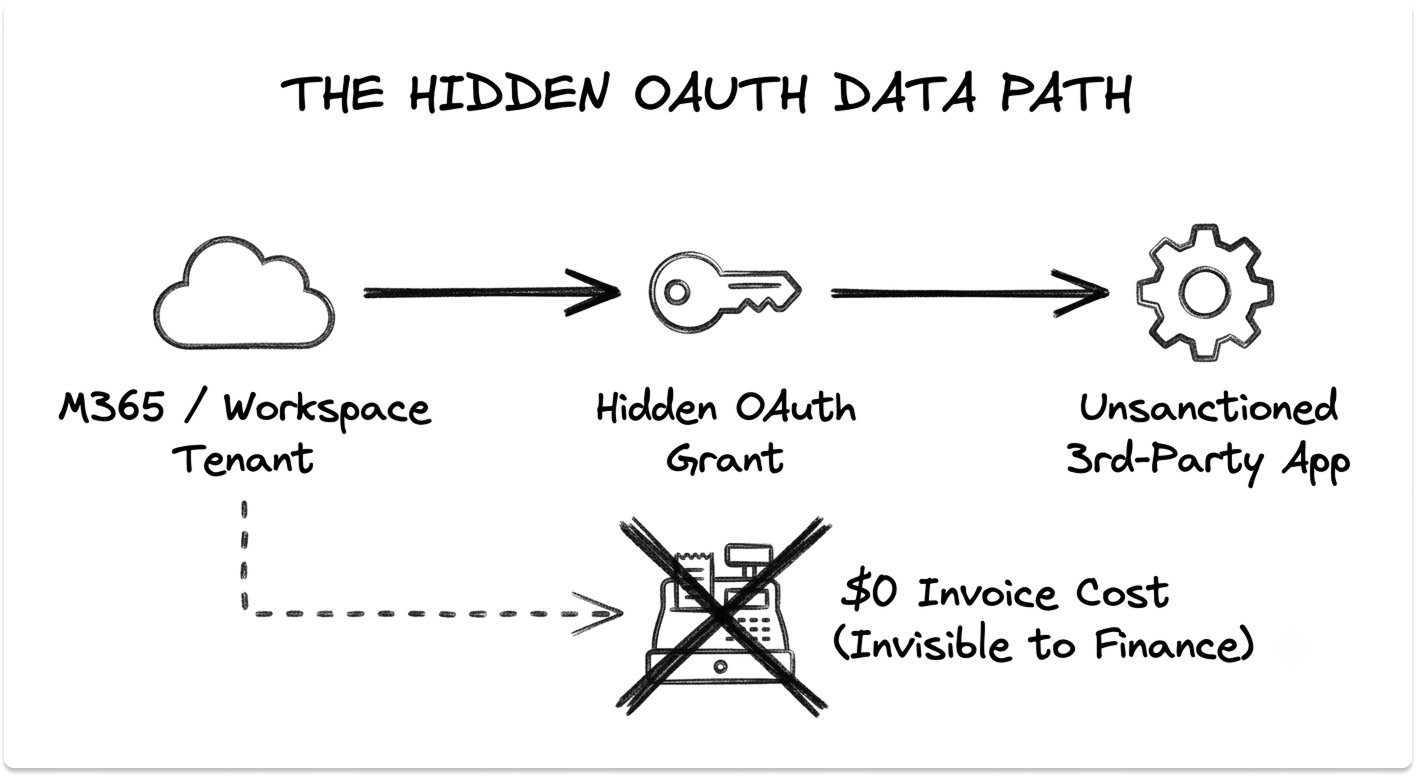
The dangerous apps are rarely the ones on an invoice. They are the ones an employee connected to your Microsoft 365 or Google Workspace tenant with an OAuth grant, handing a third party a token with read access to mail, files, or calendars.
These connections carry no cost line, so finance-only discovery never sees them. A discovery engine that reads OAuth grants from your identity tenant exposes this entire class of risk, including the long tail of abandoned integrations that still hold live tokens.
This is where SaaS discovery overlaps with the work your CASB and identity stack already does, and a good SMP ingests those tool outputs rather than duplicating them.
The identity and entitlement layer: depth beats breadth
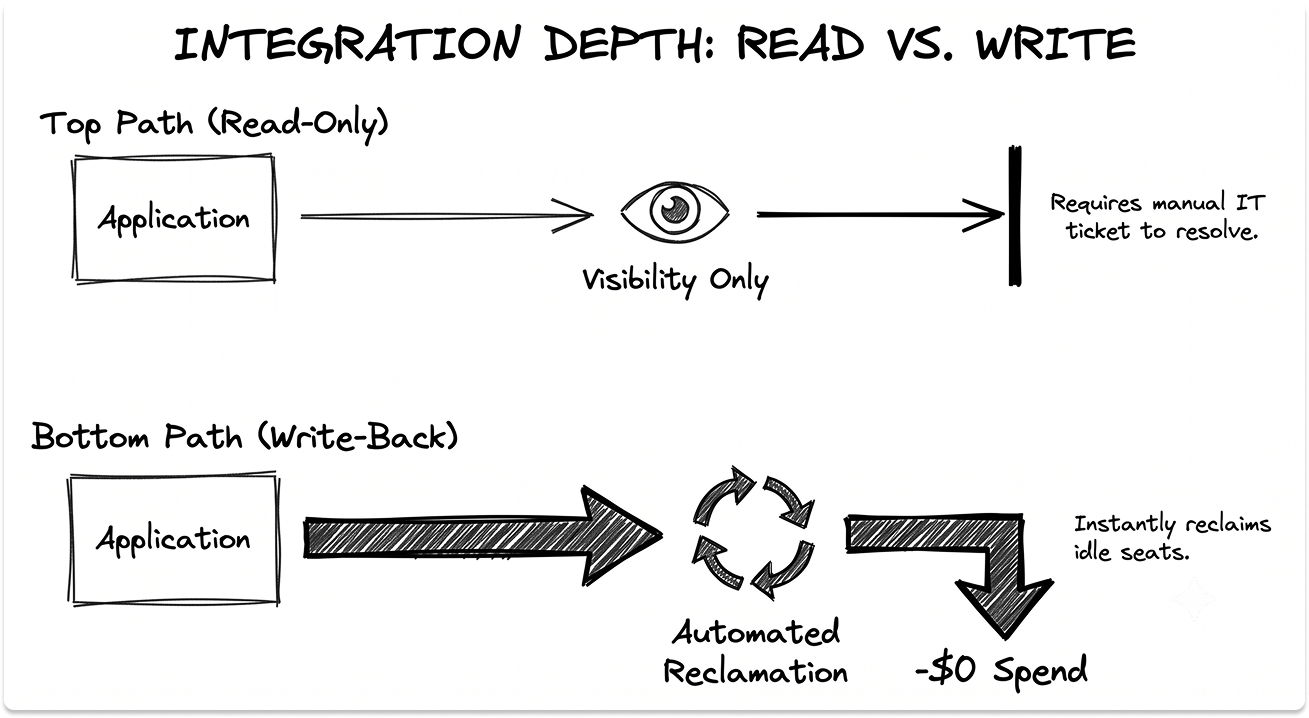
Once an app is discovered, the value shifts to what the platform can do with it. This is where integration counts get misleading. A vendor can advertise 800 integrations, but many connections are read-only: the platform can see a license but cannot provision a user or revoke access without you building a custom workflow.
Write-back depth is the dividing line. A read integration tells you Salesforce has 1,000 seats and 600 active users. A write integration lets the platform reclaim the 400 idle seats automatically. Only the second one reduces spend without a human doing manual clicks.
There is also a structural limit worth naming. Platforms handle the clean 70% of your stack that has documented APIs and SCIM support well, and the messy 30% is where they struggle: legacy internal tools, apps that charge a steep premium to enable SCIM provisioning, and new AI apps with no API at all.
Map your highest-cost and highest-risk apps against each vendor's connector list before you sign, because aggregate integration numbers hide which specific apps you can actually automate.
This layer also dictates how cleanly an SMP fits alongside your identity and access management platform. Some vendors now position themselves as identity governance tools first, running access reviews and entitlement rightsizing on top of discovery. If you are mid-migration to a cloud identity provider like Entra ID, the SMP's IdP integration depth determines how much of your access review burden it can absorb.
Turning visibility into automated action
Discovery and entitlement data are inputs. The output that justifies the spend is automation that runs without a ticket.
The strongest automation engines tie SaaS actions to lifecycle events. When HR marks a termination, the system revokes access across every connected app and transfers file ownership in the same motion; when a new hire is added, role-based provisioning sets up their tech stack in under 60 seconds, and an expensive app left unused for 30 days triggers an automatic license reclaim.
That last rule is where reclaimed-license savings come from, and it only fires if the underlying integration supports write-back.
The technical questions to ask here are concrete. Can the platform trigger workflows from HRIS events, not just on a schedule. Can it run multi-step conditional logic, for example revoke a license, notify the manager, and open a ticket if the user objects.
Can it act across apps in one workflow rather than one app at a time. Shallow automation that only sends an alert leaves the actual work on your plate.
Risk scoring and security posture
A discovered app is also a risk surface, and a mature SMP scores it. The exposure is larger than most security reviews assume: nearly half (46%) of applications in the average portfolio carry a Poor or Low risk rating for lacking basics like SSO, encryption, or audit logging, and only 21% of apps sit behind single sign-on at all.

Risk scoring works by enriching each discovered app with attributes from a vendor data library: SOC 2 and ISO status, data-residency, breach history, and the OAuth scopes the app requested.
The platform flags apps that hold broad token permissions, store regulated data, or fall outside SSO, so you can prioritize remediation instead of reviewing 300 apps by hand.
This is the function that connects SaaS management to your broader data loss prevention and compliance work. When a SOC 2 or HIPAA audit lands, the difference between a scramble and a query is whether an SMP already holds the inventory, the access map, and the risk scores in one place.
How the leading platforms approach SaaS sprawl
The platforms diverge most in their primary discovery method and the layer they are strongest at. That difference, not feature count, should drive your shortlist.
Zylo anchors on financial-first discovery, analyzing expense reports, invoice data, and procurement records to build the spend picture, then layers vendor pricing benchmarks drawn from a large body of enterprise transactions to inform renewal negotiation.
Zluri runs a patented discovery engine across API integrations, SSO data, browser activity, and finance connections, and applies AI to contract ingestion, application-owner determination, and entitlement rightsizing, positioning itself as an identity governance platform on top of SaaS management.
Torii combines discovery across SSO, APIs, browser extensions, and network logs with a no-code automation engine built for custom onboarding and offboarding flows tied to lifecycle events.
BetterCloud leads with a policy engine and event-based automation, with deep write-back into Google Workspace and Microsoft 365 and added file-sharing governance and data-loss controls through its acquisitions.
Productiv reframes the problem as value measurement, tracking feature-level engagement across more than 50 dimensions so you can see whether a team uses all of an app or only a fraction, and it flags which AI apps may use company data for model training.
Flexera approaches SaaS as one domain inside unified IT asset management and cloud cost, which removes the reconciliation work of stitching SaaS data to your hardware and on-prem software estate. Calero takes a similar enterprise-governance and global-delivery angle with a large catalog of direct application integrations.
If your pain is renewal surprises and overspend, a finance-first system of record fits. If it is offboarding gaps and access risk, an identity-governance and automation engine fits. If it is proving software value to leadership, engagement analytics fit.
If you already run unified IT asset management, keeping SaaS in the same platform removes a reconciliation tax. The category does not have one winner, it has a right answer per failure mode. For the asset-tracking adjacency, our guide to IT asset management solutions covers where the two disciplines overlap.
Shadow AI is the next discovery problem
The fastest-growing category in your estate is one your discovery engine may not classify yet. Spend on AI-native applications jumped 108% in a single year, and 393% in organizations over 10,000 employees, with ChatGPT now the most expensed application across the dataset. These tools enter through employee cards and expense reports before IT can vet them.
Shadow AI is a subset of shadow IT with sharper risk. It carries distinct exposure around data leaving the company and EU AI Act compliance, which is why a discrete AI category in the platform has moved from optional to expected.
The technical requirement is twofold: discover the AI tool, and determine whether it uses your prompts and uploads to train its models.
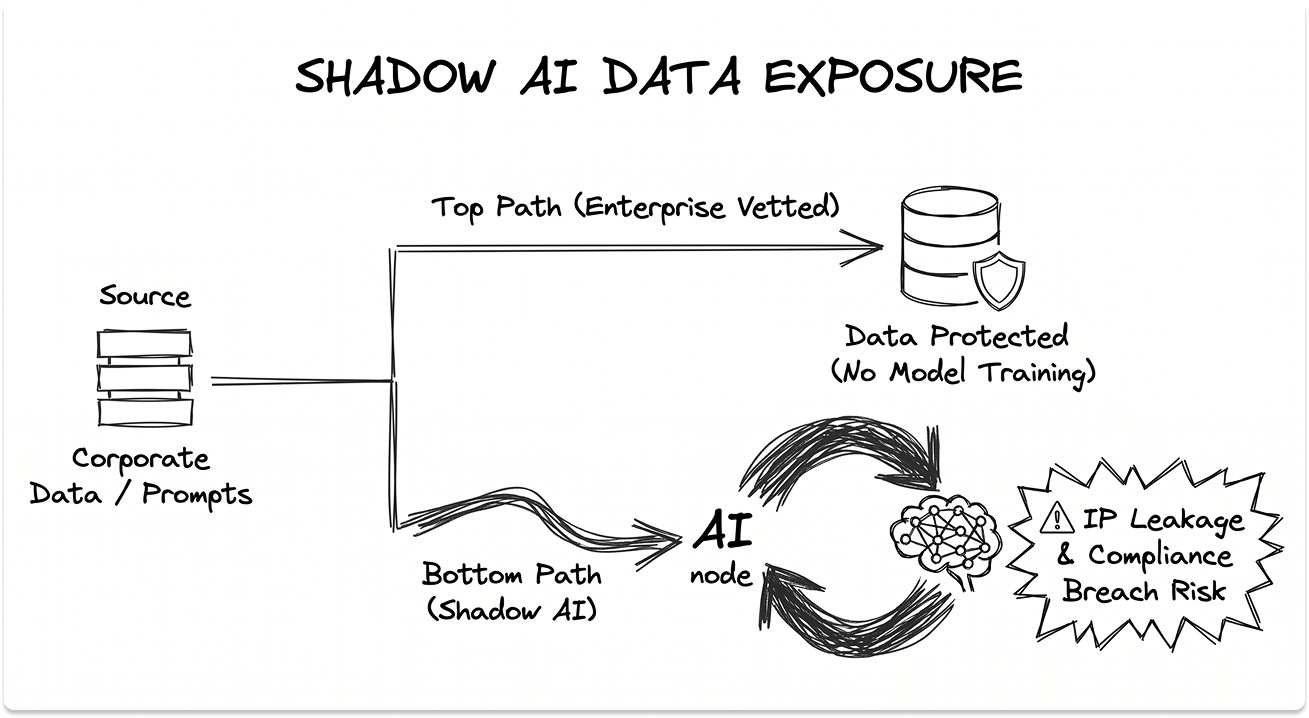
A modern SMP should classify AI apps separately, flag which ones train on customer data, and feed that into the same risk score it applies to any other app. This is the operational backbone for the policy work covered in why shadow AI will outpace shadow IT and for preventing generative AI data loss.
It also intersects with consumption-based pricing, where AI features bill on usage rather than seats, the same dynamic that drives AI workloads breaking cloud budgets. If a platform still models everything as a fixed per-seat license, it will misread your AI spend.
The questions to ask before you buy
Vendor demos run on the clean 70%. Pressure-test the messy parts:
- Which discovery signals do you run. Get them to confirm finance, SSO, browser, direct API, and OAuth grants by name. Anything less leaves a known blind spot.
- Read or write for my top 20 apps. Hand over your highest-cost and highest-risk apps and ask which support automated provisioning and deprovisioning versus read-only visibility.
- How do you handle non-API and AI apps. The answer reveals whether the messy 30% becomes automation or a manual ticket queue.
- How do you classify and risk-score AI tools. Look for a separate AI category and model-training detection, not AI apps treated as generic SaaS.
- What is the time to first complete inventory. A platform that needs months of configuration before it shows value is a poor fit for a lean team.
Use the questionnaire below to see which SaaS platform suits you
A rollout sequence that holds up
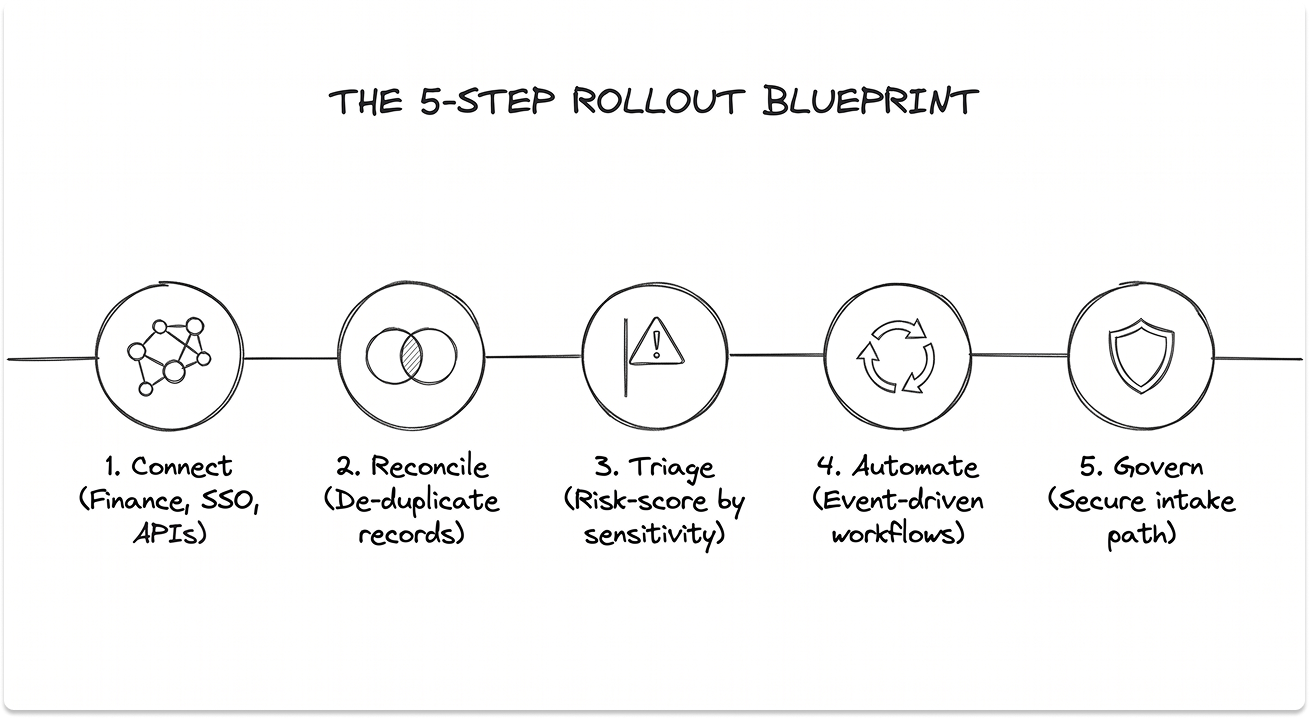
The order of operations decides whether the platform delivers or stalls.
- Connect every discovery source first. Wire in finance, SSO, HRIS, browser, and direct APIs before you judge the inventory. A single-source connect is the most common reason an SMP looks empty and under-delivers.
- Reconcile and de-duplicate. Merge the same app discovered through three signals into one record with one owner, then assign a business owner to each.
- Risk-score and triage. Sort by data sensitivity, OAuth scope, and SSO status, and remediate the worst before touching cost.
- Automate the lifecycle. Turn on event-driven onboarding and offboarding and idle-license reclamation for the apps that support write-back.
- Close the front door. Route new software requests through one intake path with a pre-approved catalog, and require a security check before a card is charged for anything off-catalog.
One caution from the field. You cannot fully offload judgment to the tool. An SMP can flag a high-risk app, but it cannot know your internal policy not to use a given vendor, so standing syncs between IT, finance, security, and HR remain part of the operating model. The platform removes the manual data gathering, not the decisions.
When you do not need one yet
Buying an SMP is itself a SaaS purchase, and it can become shelfware like any other. Roughly half of SaaS implementations fail to meet their original success criteria, usually because the rollout is treated as a technical install rather than a cross-functional process.
If your estate is small enough that SSO admin views and a maintained spreadsheet give you full visibility, you may not need a dedicated platform this year. If you cannot commit an owner to run the weekly governance cadence, an SMP will discover problems nobody acts on.
The platform earns its keep when sprawl has outpaced manual oversight and you have someone accountable for the program. Below that line, fix the intake process and the offboarding checklist first, then revisit when the app count and the access risk justify the investment.
The decision is technical at its core. Match the platform's discovery method to where you are losing visibility, confirm write-back on the apps that cost you the most, and insist on a separate handling path for AI. Get those three right and the platform becomes the system of record your finance team and your auditors stop asking you to reconstruct by hand.
The next audit will ask what your SaaS estate can reach. Have the answer before that.
Every month you wait, duplicate tools keep billing, orphaned accounts stay open, and shadow AI keeps collecting what your team pastes in. Find pre-vetted vendors based on your discovery, write-back, and AI requirements, so can evaluate on technical merit. You choose who to talk to, and buyers never pay.
FAQ
What is a SaaS management platform and how does it work?
A SaaS management platform (SMP) is software that discovers, optimizes, and governs every cloud application across an organization from one console. It ingests signals from finance, identity providers, browsers, endpoints, and direct app APIs, reconciles them into a single inventory of apps, users, licenses, and contracts, then drives discovery of shadow IT, license optimization, onboarding and offboarding automation, and risk governance.
How do SaaS management platforms discover shadow IT?
They correlate multiple data sources because no single signal sees the whole estate. Finance and expense data catch paid apps, SSO catches federated logins, browser extensions catch free and personal-account usage, direct APIs return authoritative license data, and OAuth grant analysis surfaces third-party apps connected to Microsoft 365 or Google Workspace. Running these signals in parallel surfaces 2 to 3 times more apps than IT teams expect.
What is the difference between SaaS management and IT asset management (ITAM)?
ITAM manages hardware and licensed on-premises software, typically centered on the data center and endpoints. SaaS management handles cloud-delivered, subscription applications, their access, and their usage. The two overlap on identity and licensing, and some platforms unify both so SaaS data does not need separate reconciliation against the hardware estate.
How do SaaS management platforms help control shadow AI?
A capable SMP treats AI as a distinct discovery category rather than generic SaaS. It detects AI tools entering through expense reports and OAuth grants, flags which applications use prompts and uploads to train their models, and feeds that into the same risk score applied to any app. This is the operational layer beneath shadow AI policy and generative AI data-loss prevention.
What is the difference between read-only and write-back integrations in an SMP?
A read-only integration only pulls data: it can show that an app has 1,000 licenses and 600 active users. A write-back integration can act on that data, for example automatically revoking the 400 idle seats or deprovisioning a departing employee across every connected app. Only write-back automation reduces spend and closes access gaps without manual work, so confirm it for your highest-cost and highest-risk apps before buying.


