Best Cloud Access Security Brokers (CASB) Vendors for IT Leaders in 2026
Discover 5 reputable CASB vendors beyond the mainstream options. Compare Cato Networks, DoControl, Spin.AI, Menlo Security, and Reco.ai for 2026.

You already know what a CASB is. You're here because you need to choose one and you're tired of seeing the same three names in every article: Netskope, Zscaler, Microsoft.
Those vendors are popular for good reasons. But popular doesn't always mean best for your situation. Sometimes the right CASB is one that fewer people talk about but more people quietly rely on.
This article covers five reputable CASB vendors that deserve your attention. They're not startups experimenting with unproven technology. They're established players with real customers, proven capabilities, and specific strengths that might align perfectly with what you actually need.
By the end, you'll have enough information to decide which vendors deserve a closer look.
Quick Decision Framework
Use this to narrow down your options before reading the full profiles:
If you're consolidating security into a SASE platform → Consider Cato Networks
If you need granular control over SaaS data access and sharing → Consider DoControl
If ransomware protection is as important as access control → Consider Spin.AI
If you want browser isolation integrated with cloud security → Consider Menlo Security
If you need AI-powered threat detection across your SaaS stack → Consider Reco.ai
Still evaluating? The vendor profiles below will help you understand the tradeoffs.
What Makes a CASB Vendor Right for You in 2026
Every CASB vendor claims to deliver four core capabilities:
- Visibility into cloud and SaaS usage
- Compliance monitoring and enforcement
- Data security and loss prevention
- Threat protection against cloud-based attacks
The difference is in how they deliver these capabilities and what else comes with them.
Some vendors integrate CASB into broader security platforms. Others specialize purely in SaaS security. Some focus on preventing data loss. Others prioritize threat detection.
IT leaders are increasingly looking beyond the mainstream options because those vendors have become expensive, complex, and sometimes overbuilt for what smaller organizations actually need. The vendors in this article offer alternatives that might fit better depending on your priorities, budget, and existing security stack.
To explore more CASB vendors, you can checkout our curated marketplace built exclusively for IT leaders.
Cato Networks CASB: SASE Platform with Integrated Cloud Security
What they do best: Deliver CASB as part of a converged SASE platform instead of a standalone product.
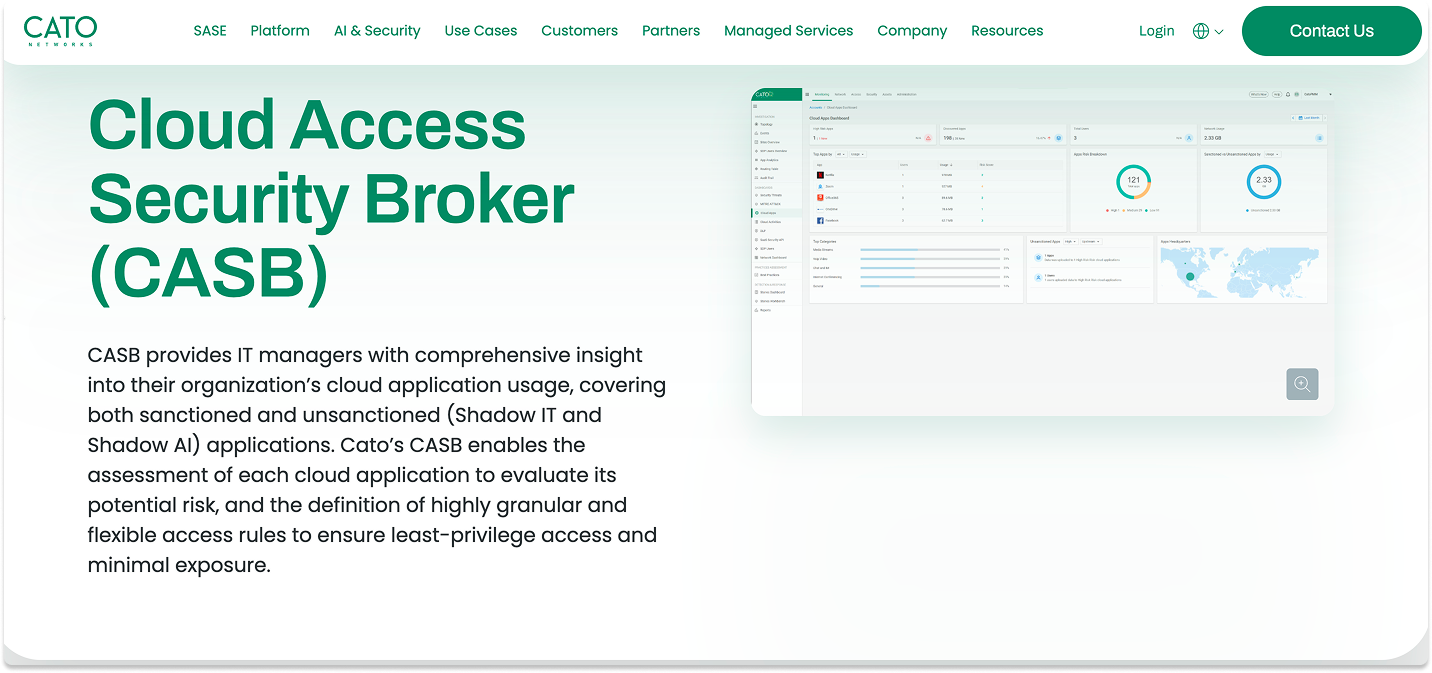
Core CASB Capabilities
- Shadow IT discovery across managed and unmanaged devices
- Granular access controls for cloud applications
- Data loss prevention with customizable policies
- GenAI security controls and monitoring
- Real-time threat detection and blocking
- Compliance monitoring for regulatory frameworks
- Integration with Cato's secure web gateway and firewall
Best Fit For
Company size: Mid-market to enterprise (200+ employees)
Industries: Organizations with distributed workforces, retail, professional services, manufacturing
Security maturity: Teams consolidating multiple security tools into a unified platform
Technical profile: Organizations already using or planning to adopt SASE architecture
Key Differentiator
Cato doesn't sell CASB as a separate product. It's built into their SASE platform alongside secure web gateway, firewall, SD-WAN, and zero trust network access.
This matters if you're tired of managing multiple security vendors. Instead of buying CASB from one vendor, SWG from another, and ZTNA from a third, you get everything from Cato. One platform, one interface, one vendor relationship.
Their GenAI security controls are particularly relevant right now. As employees adopt tools like ChatGPT and Claude, Cato gives you visibility into which AI applications are being used and lets you enforce policies around data sharing with those tools.
The tradeoff is flexibility. If you only need CASB and already have other security tools you're happy with, Cato might be more than you need.
Not Ideal If
You want best-of-breed CASB without changing your existing security architecture. Cato's value comes from convergence. If you're not ready to consolidate, standalone CASB vendors offer more flexibility.
You're a small business with fewer than 100 employees. Cato targets mid-market and enterprise customers. Smaller organizations might find the platform overkill.
Getting Started
Cato typically begins with a network and security assessment. They evaluate your current architecture, identify gaps, and propose a migration path.
Pricing is subscription-based and includes the full SASE platform, not just CASB. This makes direct price comparisons difficult, but organizations often find that consolidating multiple tools into Cato reduces overall security spending.
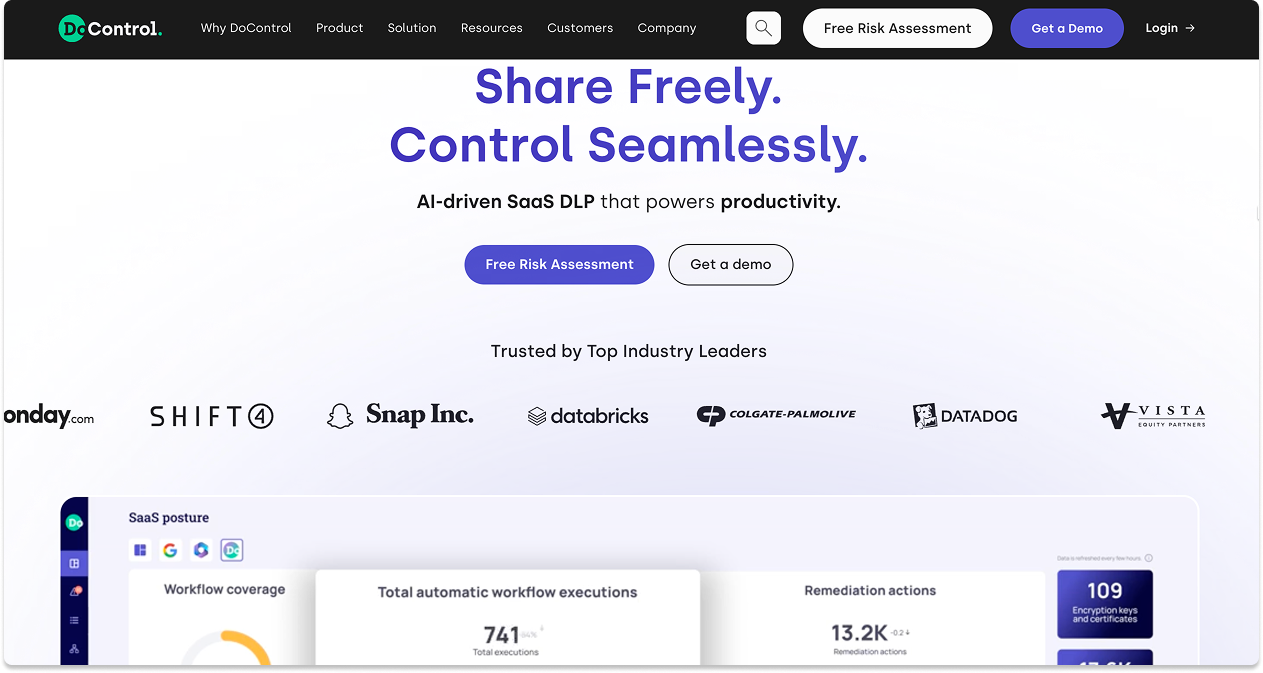
DoControl: SaaS Security Platform with Data Access Governance
What they do best: Give you precise control over who can access, share, and modify data in your SaaS applications.
Core CASB Capabilities
- Comprehensive SaaS security posture management
- Automated data access governance and remediation
- Real-time monitoring of data sharing and permissions
- Identity threat detection and response
- Third-party app risk assessment
- Compliance automation for SOC 2, GDPR, HIPAA
- Integration with major SaaS platforms including Microsoft 365, Google Workspace, Salesforce, Slack, Box
Best Fit For
Company size: Small to enterprise (50+ employees)
Industries: Healthcare, financial services, legal, any organization handling sensitive data
Security maturity: Organizations with mature SaaS adoption facing data governance challenges
Technical profile: Teams struggling with oversharing, excessive permissions, or compliance requirements
Key Differentiator
DoControl focuses specifically on the data access problem. Most CASB vendors give you visibility and threat detection. DoControl goes further by automating the remediation of risky data sharing.
For example, if an employee shares a folder containing customer data with their personal Gmail account, DoControl can automatically revoke that access based on policies you define. If a contractor still has access to sensitive files six months after their contract ended, DoControl flags it and can remove the access.
This level of automated governance is particularly valuable in organizations where data sprawl has gotten out of control. Many IT leaders discover that thousands of files are shared externally or that former employees still have access to critical systems. DoControl helps you find and fix these issues at scale.
Not Ideal If
Your primary concern is threat detection rather than data governance. DoControl excels at access control and compliance. If you're more worried about malware, phishing, or account compromise, other vendors prioritize those threats.
You have a small SaaS footprint. If you're only using one or two SaaS applications with a handful of users, the governance features might be unnecessary.
Getting Started
DoControl offers a risk assessment that scans your SaaS environment and identifies data access issues. This gives you a clear picture of the problem before you commit to a solution.
Pricing is typically based on the number of users and SaaS applications you want to monitor. They offer flexible deployment options and can start with a subset of your environment for proof of concept.
Spin.AI: SaaS Security and Ransomware Protection
What they do best: Combine CASB functionality with ransomware detection and automated backup.

Core CASB Capabilities
- Real-time ransomware detection and response
- Automated backup and recovery for SaaS data
- SaaS security posture management
- DLP with customizable policies
- Compliance monitoring and reporting
- Threat detection across email, file storage, and collaboration tools
- Support for Microsoft 365, Google Workspace, Salesforce, Slack, Dropbox
Best Fit For
Company size: Small to mid-market (10-1000 employees)
Industries: Education, healthcare, professional services, SMBs
Security maturity: Organizations concerned about ransomware targeting SaaS environments
Technical profile: Teams without robust backup solutions for cloud data
Key Differentiator
Spin.AI treats ransomware as a first-class threat in SaaS environments. While most CASB vendors focus on access control and compliance, Spin.AI assumes attackers will eventually get in and prepares you to recover.
Their ransomware detection monitors for suspicious patterns like mass file encryption or unusual deletion activity. When detected, the system can automatically isolate compromised accounts and initiate recovery from backup.
The backup capability is particularly valuable. Many organizations assume their SaaS providers handle backups, but most SaaS vendors only protect against their own infrastructure failures, not user error or malicious deletion. Spin.AI gives you point-in-time recovery for your SaaS data.
This combination of CASB and backup makes Spin.AI appealing to organizations that want comprehensive SaaS protection without buying multiple products.
Not Ideal If
You already have enterprise backup solutions for your SaaS environment. The backup features are a major part of Spin.AI's value proposition. If you're covered there, you might be paying for redundant capabilities.
You need advanced threat intelligence or integration with a broader security ecosystem. Spin.AI focuses on SaaS-specific threats rather than enterprise-wide security orchestration.
Getting Started
Spin.AI offers a free security assessment that scans your SaaS environment for vulnerabilities and provides a risk report. This helps you understand your exposure before committing to the platform.
Pricing is subscription-based per user. They offer different tiers depending on which SaaS applications you want to protect and whether you need backup functionality.
Menlo Security: Browser Isolation with Cloud Security Convergence
What they do best: Prevent threats by isolating web browsing while integrating CASB and secure web gateway capabilities.

Core CASB Capabilities
- Remote browser isolation technology
- Cloud-native secure web gateway
- CASB for SaaS application control
- Data loss prevention across web and cloud
- Phishing and malware protection
- Zero-day threat prevention
- Integration with identity providers and SIEM platforms
Best Fit For
Company size: Mid-market to enterprise (500+ employees)
Industries: Financial services, healthcare, government, any organization with high security requirements
Security maturity: Organizations facing sophisticated phishing attacks or zero-day threats
Technical profile: Teams looking to consolidate web security and cloud security
Key Differentiator
Menlo Security's core technology is remote browser isolation. Instead of trying to detect and block threats, they assume everything on the internet is potentially malicious and isolate all web content in a remote browser.
Users browse normally, but the actual rendering happens in Menlo's cloud environment. Only safe rendering information reaches the user's device. This prevents malware, phishing, and zero-day exploits from ever touching endpoints.
The CASB capabilities integrate into this architecture. When users access SaaS applications, Menlo provides visibility, control, and DLP without requiring separate agents or proxies. Everything runs through the isolation layer.
This approach is particularly effective against phishing. Even if a user clicks a malicious link and enters credentials on a fake login page, the isolation prevents the attacker from accessing the actual account because the session never touches the real application.
Not Ideal If
You're looking for a lightweight CASB solution. Menlo Security is an enterprise platform designed for organizations with serious security requirements. Smaller organizations might find it more complex and expensive than needed.
Your primary concern is SaaS data governance rather than threat prevention. Menlo excels at stopping attacks. If you're more focused on controlling data sharing and permissions, other vendors specialize in that area.
Getting Started
Menlo Security typically engages with a security assessment and proof of concept. They evaluate your threat landscape and demonstrate how isolation prevents attacks that bypass traditional security controls.
Pricing is enterprise-focused and typically involves annual contracts. Expect to work with their sales team to get accurate pricing based on your user count and requirements.
Reco.ai: AI-Powered SaaS Security Platform
What they do best: Use AI to detect threats and risks across your SaaS environment that rule-based systems miss.

Core CASB Capabilities
- AI-driven threat detection and anomaly identification
- Comprehensive SaaS discovery and shadow IT visibility
- Identity and access risk management
- Third-party and fourth-party app governance
- Automated compliance monitoring
- Data exposure and sharing risk analysis
- Integration with Microsoft 365, Google Workspace, Salesforce, Slack, GitHub, and 150+ SaaS applications
Best Fit For
Company size: Mid-market to enterprise (200+ employees)
Industries: Technology, financial services, healthcare, any organization with complex SaaS environments
Security maturity: Organizations with mature security programs looking for advanced threat detection
Technical profile: Teams overwhelmed by false positives from rule-based security tools
Key Differentiator
Reco.ai uses machine learning to understand normal behavior patterns in your SaaS environment and flag anomalies that indicate real threats. Traditional CASB vendors rely on predefined rules and signatures. Reco learns what normal looks like for your organization and alerts you when something deviates.
For example, if an employee who normally accesses files during business hours suddenly downloads hundreds of documents at 3 AM from an unusual location, Reco flags it as suspicious. If a service account that typically makes API calls to Salesforce suddenly starts accessing Google Drive, Reco notices.
This behavioral approach reduces false positives while catching threats that slip past rule-based systems. It's particularly effective at detecting insider threats, compromised accounts, and sophisticated attacks that don't trigger traditional alerts.
Reco also excels at third-party app governance. Most organizations have dozens or hundreds of third-party apps connected to their SaaS platforms. Reco identifies these connections, assesses their risk, and helps you enforce policies around which apps can access your data.
Not Ideal If
You want simple, straightforward security rules. Reco's strength is nuanced threat detection. If you prefer explicit allow/deny policies without AI interpretation, traditional CASB vendors offer more predictable behavior.
You have a small SaaS environment with limited complexity. AI-powered detection provides the most value in complex environments where manual monitoring is impossible. Smaller organizations might not need this level of sophistication.
Getting Started
Reco.ai offers a SaaS security assessment that connects to your environment and provides a risk report within days. This shows you what threats and misconfigurations exist before you commit to the platform.
Pricing is based on the number of users and SaaS applications. They offer flexible deployment options and can start with specific high-risk applications before expanding coverage.
Side-by-Side Comparison
Beyond the Mainstream: Why These Vendors Matter
The mainstream CASB vendors have earned their market position. They're reliable, feature-rich, and battle-tested. But they're not always the best fit.
Emerging and specialized vendors often innovate faster. They're not constrained by legacy architectures or massive enterprise customer bases that resist change. When new threats emerge or new SaaS applications gain popularity, smaller vendors can adapt quickly.
Pricing flexibility is another advantage. Mainstream vendors often have rigid pricing tiers and minimum commitments. The vendors in this article typically offer more flexible terms, especially for smaller organizations or specific use cases.
Customer service also differs. When you're one of thousands of enterprise customers, getting personalized support can be challenging. Smaller vendors often provide more responsive service and direct access to product teams.
Specialization matters too. If your primary concern is data governance, a vendor like DoControl that focuses specifically on that problem might serve you better than a general-purpose CASB that treats governance as one feature among many.
The tradeoff is usually scale and ecosystem integration. Mainstream vendors have massive customer bases, extensive partner networks, and deep integrations with every security tool imaginable. Smaller vendors might have fewer pre-built integrations or less extensive documentation.
Your job is to weigh these tradeoffs against your actual requirements.
Making Your Decision
Before you schedule vendor calls, consider these questions:
What's your primary security concern?
Different vendors prioritize different threats. If you're most worried about data leakage, focus on vendors with strong DLP and governance. If ransomware keeps you up at night, Spin.AI deserves attention. If sophisticated phishing attacks are your concern, Menlo Security's isolation approach might be right.
How complex is your SaaS environment?
Organizations using dozens of SaaS applications with thousands of users need different solutions than companies with a handful of core applications. Reco.ai and DoControl excel in complex environments. Spin.AI works well for simpler deployments.
Are you consolidating or specializing?
If you're trying to reduce the number of security vendors you manage, Cato Networks' converged platform makes sense. If you want best-of-breed CASB without disrupting your existing security stack, API-based vendors like DoControl or Reco.ai integrate more easily.
What's your evaluation process?
Most vendors offer free security assessments that scan your environment and identify risks. Take advantage of these. They give you concrete data about your exposure and help you compare how different vendors would address your specific issues.
Ask for proof of concept trials. CASB capabilities look similar in demos, but real-world performance varies. Testing with your actual SaaS applications and use cases reveals differences that specifications don't show.
What should you prepare?
Before talking to vendors, document:
- Which SaaS applications you use and how many users access each
- Your current security tools and any integration requirements
- Specific compliance frameworks you need to meet
- Recent security incidents or near-misses that motivated this search
- Budget constraints and approval processes
This preparation makes vendor conversations more productive and helps you get accurate pricing and implementation timelines.
Closing Thoughts
The mainstream CASB vendors dominate market share for good reasons. They're proven, comprehensive, and safe choices. But safe doesn't always mean right.
The vendors in this article offer real alternatives worth considering. They're not experimental startups. They're established companies with paying customers and proven capabilities. They just happen to focus on specific problems or serve specific markets better than the mainstream options.
Your next step depends on what matters most. If you want to consolidate security tools, talk to Cato Networks. If data governance is your priority, evaluate DoControl. If ransomware concerns you, look at Spin.AI. If you face sophisticated threats, consider Menlo Security. If you need advanced detection, explore Reco.ai.
Or talk to multiple vendors and let the proof of concepts reveal which one actually solves your problems.
Read more: Best Zero Trust Security Vendors and Solutions, Best IaaS Solutions for IT leaders, Best DRaaS tools for IT leaders.
Looking for IT partners?
Find your next IT partner on a curated marketplace of vetted vendors and save weeks of research. Your info stays anonymous until you choose to talk to them so you can avoid cold outreach. Always free to you.
FAQ
What is the difference between CASB and SSPM?
CASB focuses on controlling access to cloud applications and preventing threats. SSPM focuses on identifying misconfigurations and security risks within your SaaS applications. Many modern vendors like DoControl and Reco.ai combine both capabilities. If you need visibility into how your SaaS apps are configured and who has access to what, SSPM matters. If you primarily need to block threats and enforce policies, traditional CASB is sufficient.
Do I need a standalone CASB or should I use one built into my existing security platform?
It depends on your priorities. Standalone CASB vendors like DoControl and Reco.ai typically offer deeper SaaS-specific features and more flexible integration. Integrated CASB from platforms like Cato Networks simplifies management and reduces vendor sprawl but may have fewer specialized features. If SaaS security is a critical focus area, standalone usually provides better capabilities. If you want to consolidate tools, integrated makes sense.
How much does CASB implementation cost for mid-sized companies?
CASB pricing typically ranges from $5-15 per user per month for mid-market organizations, though enterprise platforms like Menlo Security cost more. API-based solutions like DoControl and Spin.AI often charge based on users and connected applications. Platform vendors like Cato Networks bundle CASB with other security services, making per-feature pricing difficult to isolate. Most vendors offer volume discounts and flexible terms based on commitment length.
Can CASB prevent ransomware attacks on SaaS applications?
Yes, but effectiveness varies by vendor. Spin.AI specifically focuses on ransomware detection and recovery for SaaS environments with automated backup. Other vendors like Reco.ai use behavioral analysis to detect suspicious activity that might indicate ransomware. Traditional CASB vendors focus more on access control and may not catch ransomware until significant damage occurs. If ransomware protection is your priority, choose vendors with specific capabilities in this area.
What SaaS applications do these CASB vendors support?
All five vendors support major platforms like Microsoft 365, Google Workspace, Salesforce, and Slack. DoControl and Reco.ai support 100+ SaaS applications including Box, Dropbox, GitHub, Jira, and ServiceNow. Spin.AI focuses on the most common collaboration and storage platforms. Cato Networks and Menlo Security provide broader cloud application visibility through their inline architecture. Check with vendors about specific applications critical to your environment before committing.