Best IaaS Solutions for 2026: Top 5 Specialized Providers for Enterprise IT
Compare the best IaaS providers for 2026 including Meridian IT, Avaron AI, Datacenters.com, Comport, and Z7 Solutions. A decision-maker’s guide to managed, AI-ready, and specialized infrastructure.
The Shift: From "Cloud First" to "Specialized First"
The narrative has changed. In the early 2020s, the goal was simple: move everything to the hyperscalers. But as we settle into 2026, the strategy for enterprise IT leaders has matured. We are no longer just looking for raw compute. We are looking for specificity.
The "Big Three" hyperscalers still have their place, but the complexity of managing them has grown. Costs have spiraled, and the talent gap for cloud engineers is wider than ever.
For many CIOs and VPs of Infrastructure, the "best" IaaS solution is no longer a utility provider. It is a partner. It is a provider that brings specialized hardware for AI, strict compliance for healthcare, or white-glove management for legacy workloads.
This guide analyzes five top-tier IaaS solutions that offer something the general public cloud cannot. We look at their specific strengths, their operational models, and exactly which IT leaders should be putting them on the shortlist this year.
Meridian IT
The premier choice for global enterprises managing complex, hybrid legacy environments.
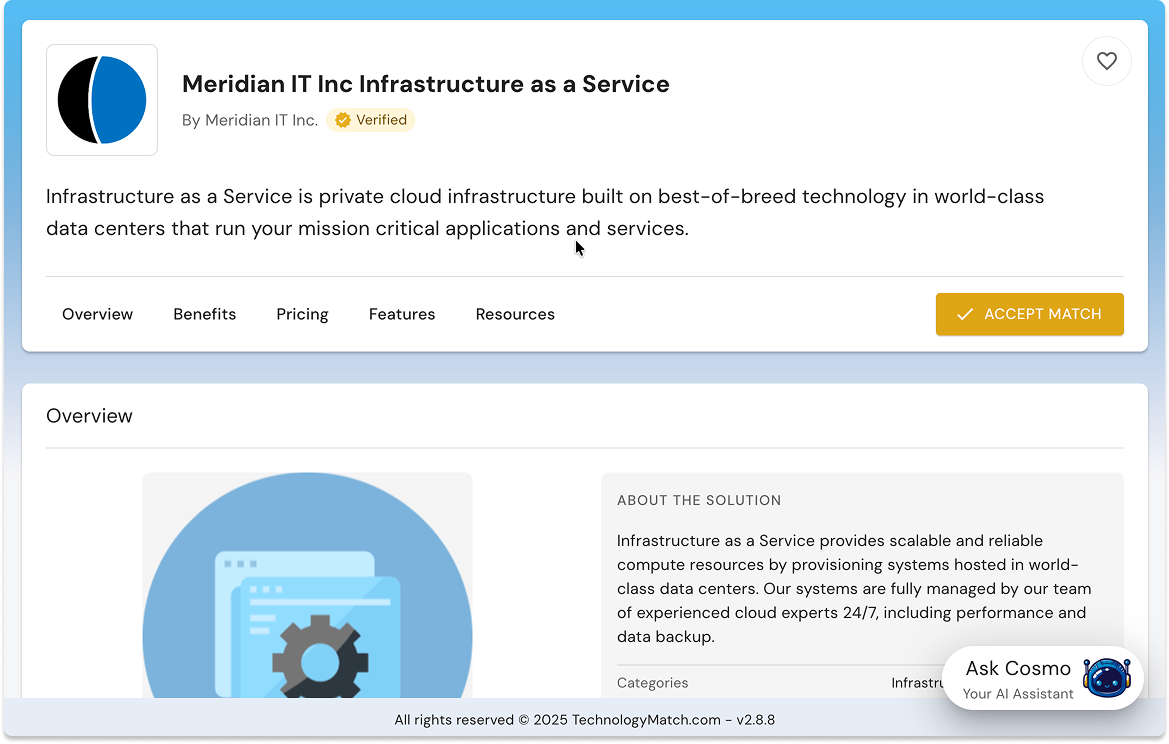
Meridian IT stands out because they do not shy away from complexity. While many providers only want your clean, cloud-native apps, Meridian specializes in the difficult reality of enterprise IT. They handle the mix of modern cloud and critical legacy systems that keep global businesses running.
Core IaaS Offering
Their flagship offering centers on a fully Managed Private Cloud. This includes robust Disaster Recovery as a Service (DRaaS) and High Availability as a Service (HAaaS). They are particularly strong in hosting IBM Power Systems (iSeries/AIX) in the cloud.
Key Features
- Global Footprint: They have a physical presence and owned infrastructure in key regions like the UK, US, Australia, India, and Singapore. This is critical for data sovereignty.
- Power Cloud Leadership: One of the few providers with deep, verified expertise in migrating and hosting IBM Power workloads alongside x86 infrastructure.
- Hybrid Orchestration: They provide a single pane of glass that bridges your on-premise hardware with their private cloud resources.
Pros
- Single-Vendor Accountability: You deal with one team for hardware, software, and managed services. This eliminates the "finger-pointing" common in multi-vendor outages.
- Legacy Support: If your business relies on an AS/400 or mainframe application, Meridian can modernize the infrastructure without forcing you to rewrite the code.
- Compliance Ready: Their global centers are built to handle regional data laws, making them a safe bet for multinational corporations.
Cons
- Engagement Cycle: This is a consultative sale. It takes longer to set up than swiping a credit card on a hyperscaler portal.
- Not for Micro-Startups: Their model is built for scale and complexity. It is likely overkill for small businesses with simple web hosting needs.
Best Suited For
Global CIOs and IT Directors in manufacturing, finance, or logistics. If you have legacy IBM assets that need to move to the cloud without refactoring, Meridian IT is the logical leader.
Avaron AI
The "Next-Gen" choice for leaders focused on autonomous operations and edge computing.
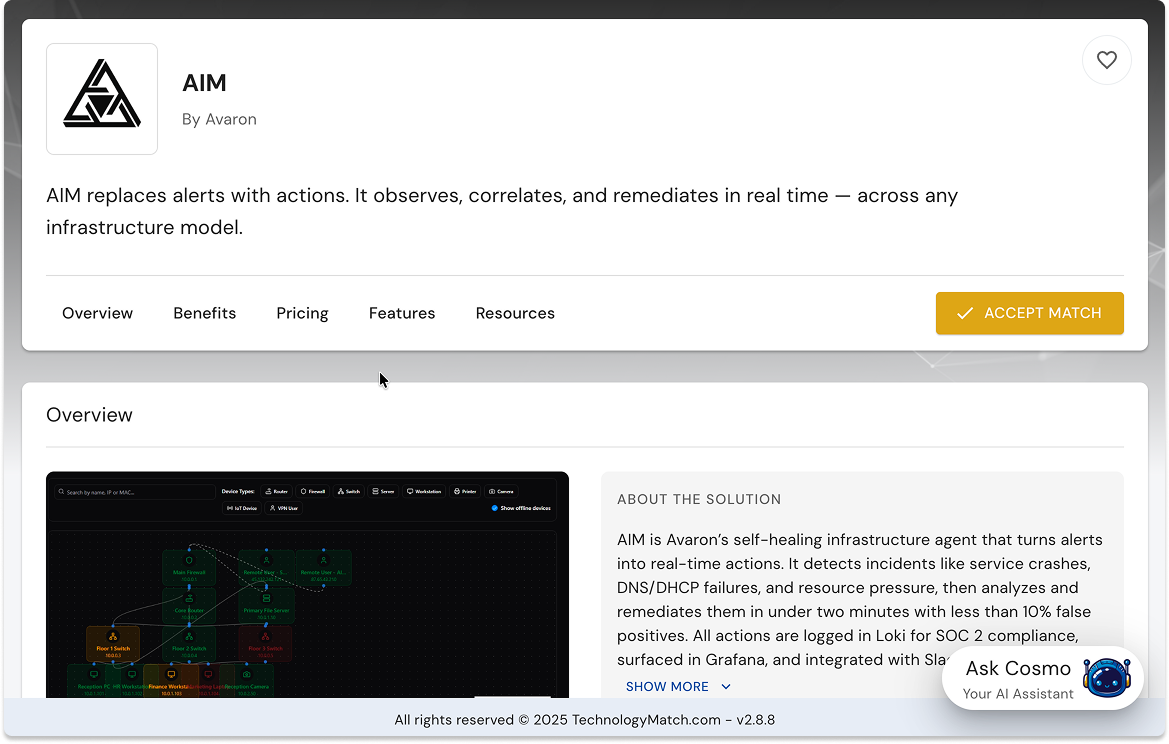
Avaron AI represents where infrastructure is heading in 2026. They are not just renting out servers; they are deploying intelligent systems. Avaron tackles the biggest headache in IaaS: the operational overhead of keeping the lights on.
Core IaaS Offering
Their platform is Ascendia. It is an integrated infrastructure solution designed to span from the enterprise core out to the far edge. The differentiator is their proprietary software that manages the hardware.
Key Features
- A.I.M. (Autonomous Infrastructure Manager): This is their proprietary AI agent. It monitors infrastructure health in real-time. It detects faults and often heals them automatically without human intervention.
- Ascendia Edge: A "drop-in" infrastructure solution for distributed locations. Think factories, retail stores, or logistics hubs where you have no IT staff on site.
- Specialized Silicon: They offer curated access to high-performance compute hardware optimized for AI inference workloads.
Pros
- Reduced Day-2 Ops: The self-healing nature of A.I.M. drastically lowers the man-hours your team spends on patching, rebooting, and troubleshooting.
- Zero-Touch Edge: You can deploy powerful compute to hundreds of remote locations without needing to fly engineers out to manage them.
- High Uptime: Autonomous remediation means problems are fixed before they cause downtime.
Cons
- Newer Market Entrant: They do not have the thirty-year history of legacy providers. This may require a Proof of Concept (POC) to satisfy conservative boards.
- Hardware-Centric Pricing: Their model often involves hardware and subscription components. This differs from the pure "pay-by-the-second" utility model of generic clouds.
Best Suited For
CTOs of AI-driven companies and leaders in Industrial IoT. If you need to run AI models at the edge and want infrastructure that manages itself, Avaron is the top contender.
Datacenters.com
The ultimate marketplace for price transparency, bare metal aggregation, and avoiding vendor lock-in.
Datacenters.com operates differently than a traditional VAR (Value Added Reseller). They act as an aggregator. In 2026, cost control is a primary KPI for IT leaders. Datacenters.com provides the tools to ensure you are getting the best price for performance globally.
Core IaaS Offering
They offer a dual approach. First, a global marketplace to compare colocation and cloud providers. Second, they provide direct access to Bare Metal IaaS that is vendor-agnostic.
Key Features
- Project Management Platform: A powerful tool that allows you to issue RFPs (Requests for Proposals) to hundreds of providers simultaneously. This forces vendors to compete for your business.
- Global Bare Metal: You can provision physical servers globally without virtualization overhead. This is ideal for high-performance workloads.
- Spot Pricing Analysis: They help you find the lowest cost for bandwidth and power across different geographic regions.
Pros
- Maximum Transparency: You see the market rates. You know exactly what you are paying for power, space, and compute.
- No "Hyperscaler Premium": You can often secure bandwidth and egress rates that are significantly lower than AWS or Azure.
- Agility: You can spin up infrastructure in specific regions quickly without being tied to a single major provider's ecosystem.
Cons
- Integration Responsibility: While they help you buy, the integration burden often falls on your internal team. It is less "managed service" and more "infrastructure enablement."
- Support Variance: Your support experience can depend on the underlying facility or vendor you choose through the marketplace.
Best Suited For
VPs of Infrastructure and DevOps Leads. If you know your exact technical specs and want to secure the best price-to-performance ratio for bare metal or colocation, this is your platform.
Comport
The specialist for healthcare and highly regulated industries requiring hybrid cloud agility.
Comport has carved out a massive niche by focusing on one thing: securely managing data for regulated industries. For healthcare leaders in 2026, data privacy is not just a checkbox. It is a survival requirement. Comport builds IaaS around this reality.
Core IaaS Offering
Their primary offering is ComportSecure, a managed cloud solution. They are also a top-tier partner for HPE GreenLake, allowing them to deliver a cloud experience on-premise.
Key Features
- Healthcare Native: Their team speaks the language of EHR (Electronic Health Records), Epic, Meditech, and VNA (Vendor Neutral Archive) storage.
- InfiniOne Protection: A specialized security layer designed to protect medical data from ransomware attacks.
- Audit-Ready Compliance: Their infrastructure is built from the ground up to meet HIPAA and other strict regulatory standards.
Pros
- Sector Expertise: They understand that downtime in a hospital is a safety issue, not just a revenue issue. Their SLAs reflect this.
- Hybrid Flexibility: Through HPE GreenLake, they can give you the financial flexibility of the cloud (pay-per-use) while keeping the data in your own secure facility.
- Disaster Recovery: They offer robust DR specifically architected for complex medical systems.
Cons
- Niche Focus: Their deep specialization in healthcare and regulated sectors means they may be less relevant for a generic e-commerce or gaming startup.
- Enterprise Focus: Their solutions are designed for mid-to-large enterprises, not small private practices.
Best Suited For
Healthcare CIOs and Hospital Administrators. If you need the agility of the cloud but cannot risk the compliance pitfalls of the public hyperscalers, Comport is the safe and smart choice.
Z7 Solutions
A boutique, high-touch provider focused on End-User Computing (EUC) and secure virtual desktops.
Z7 Solutions attacks a specific problem: the workforce. As remote and hybrid work becomes the permanent standard in 2026, delivering secure desktops to employees is a major infrastructure challenge. Z7 solves this with a service-heavy approach.
Core IaaS Offering
They specialize in Managed VDI (Virtual Desktop Infrastructure) and DaaS (Desktop as a Service). They build their IaaS offering around the user experience, leveraging technologies like Citrix and VMware.
Key Features
- Engineer-as-a-Service: Z7 does not just sell you the server. They offer staff augmentation to help run it. This solves the talent shortage problem.
- Secure VDI: They design virtual desktop environments that comply with high security standards like NIST and CMMC.
- Migration Services: They offer white-glove migration to move your on-premise user workloads to a hybrid or cloud environment without disrupting operations.
Pros
- Exceptional Service: As a boutique firm, they offer a level of responsiveness and personalized attention that Global SIs cannot match.
- VDI Expertise: They are true experts in making virtual desktops perform well. They eliminate the "lag" that frustrates employees.
- Flexible Staffing: The ability to add their engineers to your team is a massive value add in a tight labor market.
Cons
- Scale Limits: They are excellent for the mid-market and regional enterprise. However, for a massive global deployment of 100,000 seats, you might look elsewhere.
- Specific Focus: If you are looking for pure high-performance compute for AI training, this is not their primary lane.
Best Suited For
Mid-Market IT Directors. If your current VDI deployment is slow or if you are struggling to secure a remote workforce, Z7 Solutions offers the expertise to fix it immediately.
Comparison Table: At a Glance
Buying Guide: How to Select an IaaS Partner in 2026
Making the final decision requires looking at three internal factors.
1. The Talent Gap Analysis
Be honest about your internal capabilities. Do you have a full team of certified cloud architects and site reliability engineers? If the answer is no, do not buy raw infrastructure.
- Choose: Meridian IT or Z7 Solutions.
- Why: You need a partner that wraps the infrastructure in services. Buying raw AWS or bare metal when you lack the staff to run it is a recipe for security breaches and cost overruns.
2. The Workload Specificity
What is the primary driver for this investment?
- If it is Generative AI or Edge Automation: Look at Avaron AI. Their self-healing tech handles the complexity of distributed AI so you don't have to.
- If it is Cost Reduction: Look at Datacenters.com. Their ability to source bare metal globally can cut your cloud bill by 30% or more compared to virtualized instances.
3. The Compliance Factor
Are you regulated? General purpose clouds can be made compliant, but it takes work.
- Choose: Comport.
- Why: They bake compliance into the foundation. You aren't paying extra to configure the security; it is the default state of the infrastructure.
Closing Thoughts
In 2026, the best IaaS solution is the one that aligns with your specific business outcome. The era of "One Cloud Fits All" is over.
If you need to secure patient data, Comport is your partner. If you need to manage a global IBM footprint, call Meridian IT. If you are pushing the boundaries of autonomous AI, pilot Avaron. If you want to optimize spend on bare metal, use Datacenters.com. And if your workforce needs a better remote experience, engage Z7 Solutions.
Navigating these options can be time-consuming, but you don’t have to do it alone. You can connect with all these IaaS solutions or partners directly on the TechnologyMatch platform.
Looking for IT partners?
Find your next IT partner on a curated marketplace of vetted vendors and save weeks of research. Your info stays anonymous until you choose to talk to them so you can avoid cold outreach. Always free to you.
FAQ
Why choose a boutique IaaS provider over AWS or Azure?
Responsiveness and specialization. With a provider like Z7 or Meridian, you have direct access to senior engineers. You are not routed through a call center. Furthermore, they tailor the contract and the hardware to your exact needs, rather than forcing you into a standard "T-shirt size" instance.
Which solution is best for legacy IBM workloads?
Meridian IT is the clear leader here. They have specialized expertise in IBM Power Systems that most cloud-native providers simply do not possess.
What is the benefit of "Self-Healing" infrastructure?
It reduces operational costs (OpEx). Solutions like Avaron AI use software agents to fix common server issues automatically. This means your IT team sleeps through the night, and your system uptime increases.
Is Bare Metal better than Virtualized Cloud?
For high-performance tasks, yes. Bare metal (available via Datacenters.com) eliminates the "noisy neighbor" problem and the virtualization tax. This makes it superior for AI training and massive database workloads.