Best IT Process Automation Vendors to Consider in 2026
IT process automation streamlines repetitive tasks through RPA, AI, and workflow orchestration. Compare specialists in RPA implementation, legacy integration, and intelligent automation.
IT process automation isn't a single solution. It spans robotic process automation for repetitive tasks, workflow orchestration across departments and systems, intelligent document processing for unstructured data, legacy system integration without replacement, cloud infrastructure automation, and AI-powered decision making. The right automation partner depends on what you're trying to solve.
This analysis covers five providers with different strengths. RPA specialists who build bots and Centers of Excellence. Enterprise platforms that connect legacy systems to modern apps. Strategic consultancies that align automation with digital transformation. IBM automation experts for regulated industries. AI-focused firms that handle documents and cognitive tasks.
We evaluate what matters for execution. Service models, industry expertise, technology platforms, implementation approaches, and proof requirements before commitment.
We also use scenario-based analysis to show which provider fits which automation challenge.
The goal is straightforward. Match your automation challenge to the right provider type. Verify they deliver in your environment. Confirm you can sustain results with your team and budget. The analysis below gives you the technical details to make that decision with confidence.
Let’s get started with the vendors/solutions.
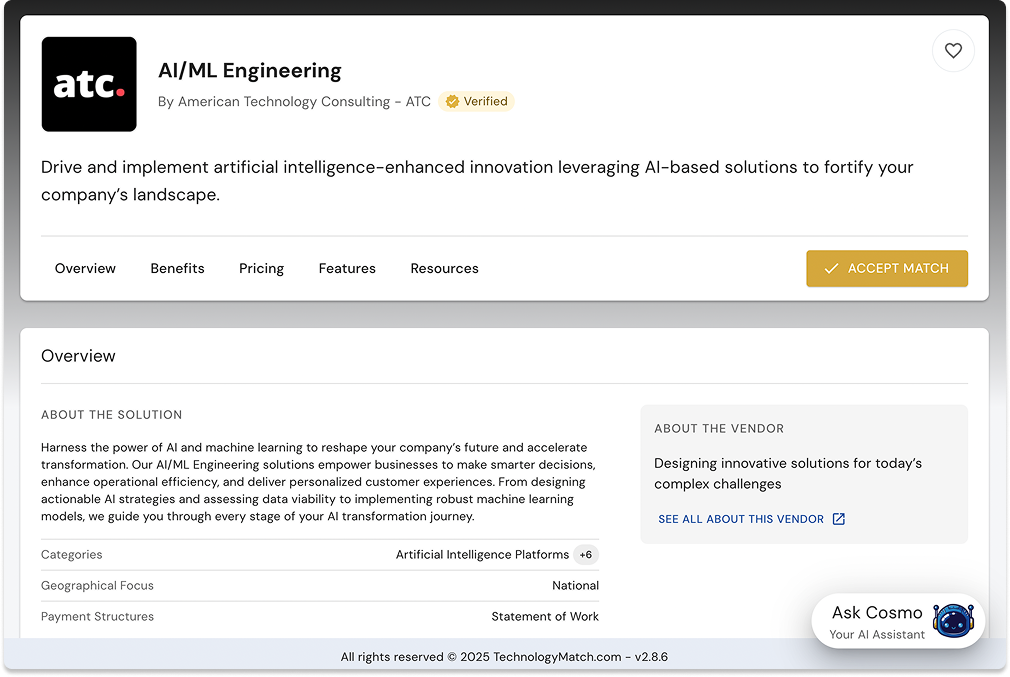
American Technology Consulting (ATC)
Key Features
- End-to-end RPA implementation using UiPath, Automation Anywhere, Blue Prism, and Microsoft Power Automate
- Intelligent automation combining RPA with AI, machine learning, document processing, and predictive analytics
- Process discovery and assessment with automation opportunity identification and ROI analysis
- Center of Excellence development for internal automation capabilities, governance frameworks, and bot lifecycle management
- Hyperautomation services combining RPA, AI, process mining, low-code platforms, and API integration
- Industry focus on healthcare, financial services, manufacturing, retail, and public sector
- Agile delivery with proof-of-concept pilots, phased rollouts, and managed services for bot operations
Considerations
ATC is a services firm, not a platform vendor. You'll need to license RPA platforms separately. Success depends on process standardization and data quality. Poorly defined processes yield poor automation outcomes. CoE development requires executive sponsorship and cross-functional participation to sustain beyond initial implementations.
Pros
Deep RPA expertise across multiple platforms with platform-agnostic advisory. Strong focus on intelligent automation combining RPA with AI and machine learning for cognitive tasks. CoE development ensures long-term automation capability and governance. Process discovery identifies high-ROI automation opportunities before investment. Agile, pilot-driven approach reduces risk and proves value quickly.
Cons
Requires separate platform licensing and ongoing maintenance costs. CoE buildout takes time and internal commitment. Not a quick fix. Hyperautomation complexity can increase if not properly governed and architected.
Best Suited For
Mid-market to enterprise organizations seeking end-to-end RPA implementation, intelligent automation with AI and machine learning, and internal CoE development to scale automation capabilities across business units.
Evaluation questions for the vendor
- What's your process discovery methodology, and how do you prioritize automation opportunities?
- Which RPA platforms do you recommend for our use cases, and what's your experience with each?
- How do you structure CoE development, including timeline, governance model, and success metrics?
- What's your approach to intelligent automation and AI/ML integration with reference implementations?
- How do you handle bot lifecycle management, monitoring, and exception handling at scale?
- Can you provide case studies in our industry showing measurable automation ROI?
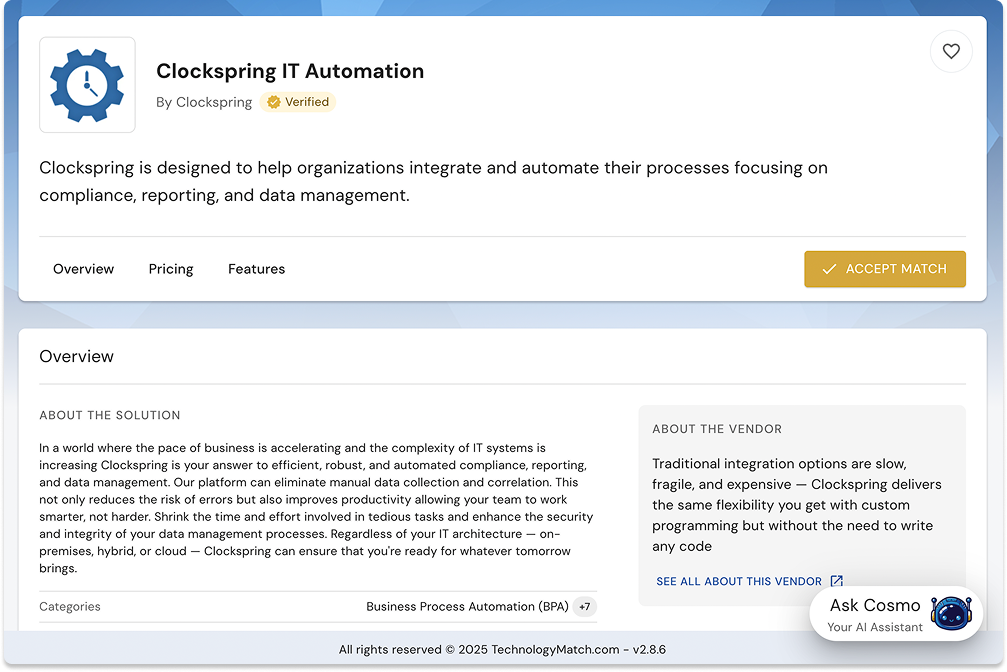
Clockspring
Key Features
- Proprietary low-code/no-code platform for workflow automation, data integration, and process orchestration
- Data integration and ETL connecting disparate systems, databases, APIs, and applications with real-time synchronization
- Visual workflow designer for multi-step business processes across systems and departments
- Legacy system integration to modernize legacy applications without replacement, using screen scraping, API creation, and middleware
- Pre-built connectors for common enterprise systems, including ERP, CRM, databases, and cloud apps
- Custom automation development for unique business processes and industry-specific workflows
- Flexible deployment with on-premises, cloud, or hybrid options
Considerations
Clockspring is a platform vendor with professional services. Licensing costs and platform lock-in should be evaluated. Low-code/no-code capabilities depend on user technical literacy. Complex workflows may still require developer support. Less market visibility than major RPA platforms. Validate stability, roadmap, and support.
Pros
Proprietary platform provides end-to-end control and customization for unique workflows. Strong legacy system integration without costly rip-and-replace projects. Data integration and ETL capabilities go beyond typical RPA to include real-time synchronization. Visual workflow designer enables business users to build and modify automations. Flexible deployment for regulated industries or security requirements.
Cons
Platform lock-in with high switching costs once workflows are built. Smaller ecosystem and community compared to major RPA vendors. May require Clockspring professional services for complex implementations, increasing dependency.
Best Suited For
Organizations needing enterprise workflow automation and data integration across legacy and modern systems, especially in regulated industries requiring on-premises or hybrid deployment.
Evaluation questions for the vendor
- What's the learning curve for business users versus developers on your platform?
- How do you handle version control, testing, and deployment for workflows?
- What's your approach to legacy system integration, including screen scraping versus API creation?
- Can you demonstrate real-time data synchronization across our key systems?
- What's your platform roadmap for AI/ML integration or advanced analytics?
- What are typical licensing models and the total cost of ownership over 3 to 5 years?
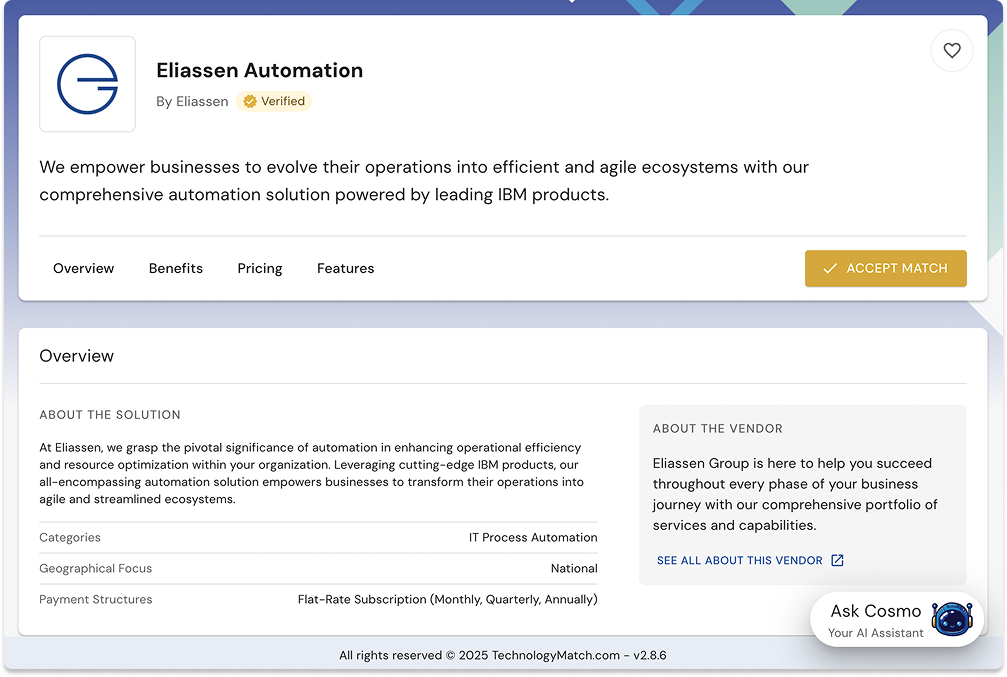
Eliassen Group
Key Features
- Strategic consulting for IT strategy, digital transformation, and technology roadmap development with automation as a key pillar
- Automation advisory, including process assessment, technology selection, vendor evaluation, and automation strategy development
- Implementation services for RPA, workflow automation, and intelligent automation across platforms
- Cloud and infrastructure automation, including Infrastructure as Code, CI/CD pipeline automation, and cloud orchestration
- Data and analytics automation with ETL automation, data pipeline orchestration, and analytics workflow automation
- Talent and staffing for contract and permanent placement of automation specialists, RPA developers, and process analysts
- Industry expertise in life sciences, healthcare, financial services, technology, and manufacturing
Considerations
Eliassen is a broad IT consultancy. Automation is one service among many, including cloud, data, cybersecurity, and talent. Less specialized in pure-play RPA or process automation compared to ATC or STEPS. Best leveraged for strategic automation initiatives tied to broader digital transformation programs.
Pros
Strategic consulting approach aligns automation with business objectives and digital transformation. Cross-domain expertise in cloud, data, and infrastructure enables holistic automation beyond RPA. Strong talent and staffing capabilities to augment internal teams with automation specialists. Industry expertise in life sciences and healthcare with regulatory compliance experience.
Cons
Less depth in pure-play RPA implementation compared to specialists. Broader consulting model may have higher costs for straightforward automation projects. Success depends on clear scoping. Strategic projects can expand without disciplined governance.
Best Suited For
Organizations seeking strategic automation consulting tied to broader digital transformation, cloud migration, or data modernization programs, especially in life sciences, healthcare, and financial services.
Evaluation questions for the vendor
- How do you approach automation strategy development, and what are the deliverables?
- What's your methodology for aligning automation initiatives with business outcomes?
- Which automation platforms do you most commonly implement, and what's your depth of expertise?
- How do you integrate infrastructure automation with business process automation?
- Can you provide case studies showing automation ROI within broader transformation programs?
- What's your staffing model for consulting teams versus staff augmentation versus managed services?
DAI Source

Key Features
- IBM Platinum Partner focused on IBM automation portfolio including IBM Automation, IBM RPA, and IBM Business Automation Workflow
- IBM Business Automation Workflow for end-to-end workflow automation, case management, and business process management
- IBM RPA with Automation Anywhere for robotic process automation using IBM's RPA solution
- IBM Operational Decision Manager for business rules management and decision automation for complex logic and compliance
- IBM FileNet and Content Services for document management, content automation, and intelligent capture
- Integration services with IBM App Connect, API management, and enterprise service bus for system integration
- Industry solutions for financial services, insurance, healthcare, government, and manufacturing
Considerations
IBM-centric approach. If you're not committed to IBM automation platforms, DAI Source isn't the right fit. IBM automation portfolio is comprehensive but can be complex and costly. Validate total cost of ownership. IBM RPA is powered by Automation Anywhere. Consider direct Automation Anywhere licensing versus IBM-wrapped solution.
Pros
Deep IBM automation expertise with Platinum Partner status and proven implementations. Comprehensive automation stack including RPA, workflow, decision automation, and content management under one vendor. Strong in regulated industries with compliance and security focus. Integration capabilities enable enterprise-wide automation across legacy and modern systems.
Cons
Platform lock-in to IBM ecosystem with high switching costs. IBM licensing can be complex and expensive. Validate pricing and total cost of ownership. Smaller automation community and ecosystem compared to UiPath or Microsoft Power Automate.
Best Suited For
Enterprises already invested in IBM infrastructure or seeking comprehensive automation platforms for regulated industries with complex workflow, decision automation, and content management needs.
Evaluation questions for the vendor
- What's your implementation methodology for IBM Business Automation Workflow?
- How do you integrate IBM RPA with IBM Workflow and Decision Manager for end-to-end automation?
- What's the total cost of ownership for IBM automation stack versus alternatives?
- How do you handle IBM FileNet and content automation for document-heavy processes?
- Can you demonstrate decision automation for complex business rules and compliance logic?
- What managed services do you offer post-implementation, including SLAs and support models?
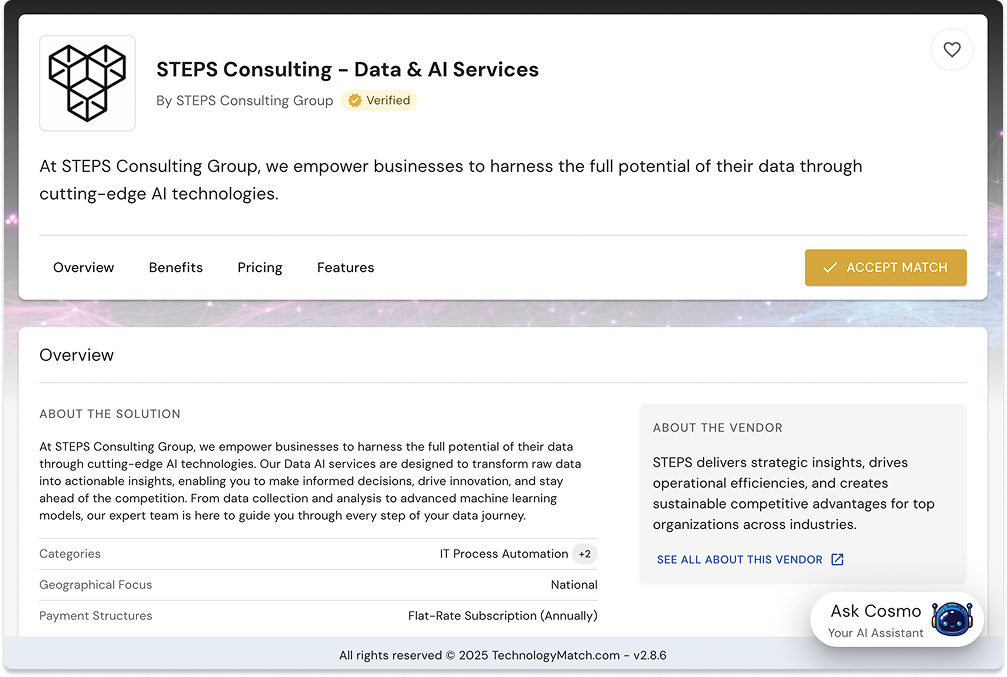
STEPS Consulting
Key Features
- AI and automation specialist focusing on AI-powered automation, intelligent process automation, and cognitive automation
- Process optimization with business process reengineering, process mining, and automation opportunity assessment
- Multi-platform RPA implementation, including UiPath, Automation Anywhere, Blue Prism, and Microsoft Power Automate
- Intelligent document processing with AI-powered document extraction, classification, and processing for unstructured data
- AI/ML integration, including predictive analytics, natural language processing, computer vision, and machine learning models
- Hyperautomation combining RPA, AI, process mining, low-code platforms, and integration tools
- CoE development for building internal automation capabilities, governance frameworks, and scaling strategies
- Industry focus on financial services, healthcare, insurance, manufacturing, and professional services
Considerations
STEPS is a services firm, not a platform vendor. Platform licensing is separate. AI/ML integration requires quality training data and clear use cases. Not all processes benefit from cognitive automation. Hyperautomation complexity requires strong governance and architecture to avoid sprawl.
Pros
Strong focus on intelligent automation and AI/ML integration for cognitive tasks beyond simple RPA. Process optimization and mining identify high-value automation opportunities before implementation. Multi-platform expertise provides flexibility and platform-agnostic recommendations. CoE development ensures sustainable automation capability and governance. Hyperautomation approach addresses end-to-end processes, not just isolated tasks.
Cons
Requires separate platform licensing and ongoing maintenance. AI/ML integration increases complexity and may require data science expertise. Success depends on process standardization and data quality. Poorly defined processes yield poor outcomes.
Best Suited For
Organizations seeking intelligent process automation with AI/ML integration, especially for document-heavy processes, unstructured data, and cognitive tasks, with a focus on building internal automation capabilities.
Evaluation questions for the vendor
- What's your process mining and optimization methodology, including tools and approach?
- How do you identify automation opportunities that benefit from AI/ML versus standard RPA?
- What's your approach to intelligent document processing, and what accuracy rates do you achieve?
- How do you integrate AI/ML models with RPA workflows, including development and deployment?
- What's your CoE development framework, including timeline, governance model, and success metrics?
- Can you demonstrate hyperautomation use cases in our industry with measurable ROI?
Which IT Process Automation Tool Suits You Best
Scenario 1: High-Volume Transactional Processing and Document-Heavy Workflows
Challenge: Manual data entry across multiple systems, invoice processing, employee onboarding, claims processing, and contract review. High volume, rules-based tasks often involving unstructured documents like PDFs, emails, and scanned forms.
Best Fit: STEPS Consulting or ATC
STEPS excels when documents are involved. Their intelligent document processing extracts data from invoices, claims, medical records, and contracts using AI-powered classification and extraction. Natural language processing handles unstructured data, including handwriting and complex layouts. Integration with RPA creates end-to-end automation from extraction to validation to processing.
ATC works best for high-volume transactional processes without heavy document requirements. Their process discovery identifies high-ROI opportunities, and CoE development ensures scalable, governed automation. Multi-platform expertise provides flexibility as your automation needs evolve.
DAI Source is an alternative if you're on IBM infrastructure. IBM FileNet and Content Services with intelligent capture handle document lifecycle automation with strong compliance and audit trails for regulated industries.
Scenario 2: Legacy System Modernization and Complex Workflow Orchestration
Challenge: Decades-old mainframe or green-screen applications that can't be replaced. Need to automate data extraction, integrate with modern cloud apps, and orchestrate multi-step approval workflows spanning departments and systems.
Best Fit: Clockspring or DAI Source
Clockspring specializes in legacy system integration without replacement. Screen scraping, API creation, and middleware capabilities modernize legacy workflows. Real-time data synchronization between legacy and modern systems like ERP, CRM, and cloud apps. Visual workflow designer handles complex, multi-step processes across departments. On-premises or hybrid deployment works for regulated industries or security requirements.
DAI Source works if legacy systems are IBM-based or if you need complex case management. IBM Business Automation Workflow is purpose-built for multi-step approval processes with decision automation using business rules. Strong audit trails and compliance capabilities for regulated industries.
ATC and STEPS can handle legacy integration via RPA, but Clockspring's platform is purpose-built for this scenario. Eliassen could design the strategy, but lacks a specialized workflow platform.
Scenario 3: Enterprise-Wide Digital Transformation with Cloud and Infrastructure Automation
Challenge: Multi-year digital transformation involving cloud migration, data modernization, infrastructure automation, and business process automation across business units. Need strategic alignment, not just tactical automation.
Best Fit: Eliassen Group
Eliassen's strategic consulting approach aligns automation with broader transformation objectives. Cross-domain expertise in cloud, data, infrastructure, and automation enables holistic planning. Cloud and infrastructure automation capabilities include Infrastructure as Code, CI/CD pipeline automation, and cloud orchestration across AWS, Azure, and GCP. Talent and staffing capabilities augment internal teams with specialists. Strong in life sciences, healthcare, and financial services with regulatory compliance experience.
ATC and STEPS are strong on automation execution but less strategic on broader transformation. Clockspring is a platform play, not a strategic consultancy. DAI Source is IBM-focused, not cross-platform transformation.
Scenario 4: Rapid Automation Scaling Across Business Units
Challenge: Initial RPA success in one department. Now need to scale automation across the enterprise with governance, reusable components, bot lifecycle management, and internal capability building.
Best Fit: ATC or STEPS Consulting
Both specialize in Center of Excellence development with governance frameworks. ATC's multi-platform expertise ensures flexibility as automation scales across different business units with different needs. STEPS' hyperautomation approach combines RPA, AI, process mining, and low-code for enterprise-wide scaling. Both provide bot lifecycle management, monitoring, exception handling, and reusable component libraries.
Without CoE development, automation sprawls and becomes unmanageable. Define clear ownership, governance policies, and success metrics from day one. Both providers emphasize knowledge transfer and internal capability building to reduce long-term dependency.
Clockspring is a platform, not a CoE development partner. Eliassen could advise strategically, but lacks pure-play CoE implementation depth. DAI Source is IBM-focused and less flexible for a multi-platform CoE.
Scenario 5: IBM Infrastructure and Regulated Industries
Challenge: Already invested in the IBM ecosystem, including IBM Cloud, FileNet, Db2, and WebSphere. Need automation that integrates natively with IBM stack. Operating in regulated industry like financial services, healthcare, or government with strict compliance, audit trails, and security requirements.
Best Fit: DAI Source
IBM Platinum Partner with deep expertise in IBM automation portfolio. Native integration with IBM FileNet, App Connect, Operational Decision Manager, and IBM Cloud. Comprehensive automation stack including RPA, workflow, decision automation, and content management under IBM umbrella. IBM's enterprise-grade security, compliance certifications, and audit capabilities purpose-built for regulated industries.
IBM Operational Decision Manager handles complex business rules and decision automation for compliance logic. IBM FileNet provides document lifecycle management with full audit trails. Strong in government and financial services with regulatory experience.
ATC, STEPS, and Eliassen can integrate with IBM systems but lack IBM-native depth. Clockspring could integrate but isn't IBM-specialized. If you're not committed to IBM infrastructure, consider platform-agnostic providers like ATC or STEPS.
Takeaways For Your Next Step
Start with process, not platform. All providers emphasize process discovery and optimization before automation. Poorly defined processes yield poor automation outcomes regardless of technology.
Match provider type to your automation maturity. Early stage with first automation initiatives, choose ATC or STEPS for RPA implementation with quick wins. Scaling stage expanding across business units, select ATC or STEPS for CoE development. Enterprise-wide transformation, go with Eliassen for strategic alignment. Legacy-heavy environment, pick Clockspring. IBM-centric infrastructure, choose DAI Source.
Platform lock-in matters. Clockspring and DAI Source create platform lock-in. Validate long-term commitment before proceeding. ATC and STEPS are platform-agnostic with flexibility to change RPA vendors.
CoE development is critical for scaling. Without governance, automation sprawls and becomes unmanageable. Define clear ownership, bot lifecycle management, and reusable components from day one.
Intelligent automation requires quality data. STEPS' AI/ML integration and document processing depend on quality training data and clear use cases. Not all processes benefit from cognitive automation. Validate ROI before investing. Start with rules-based RPA, then layer AI/ML where it adds measurable value.
Measure outcomes, not just automation volume. Track FTE savings, error reduction, cycle time improvement, and compliance risk reduction. Require proof of measurable ROI in pilots and reference cases before full commitment.
How Can You Use TechnologyMatch to Find The Right IT Automation Partner
IT process automation spans RPA, workflow orchestration, legacy integration, and intelligent automation. Each requires specialized expertise.
ATC and STEPS deliver end-to-end RPA and intelligent automation with CoE development. Clockspring provides enterprise workflow automation and legacy integration. Eliassen aligns automation with strategic transformation. DAI Source implements IBM automation for regulated industries.
Your automation challenge and infrastructure determine your partner. Match the provider to your need, verify delivery in your environment, and confirm you can sustain results.
Here's how you can use the TechnologyMatch platform to search and connect with potential partners:
1. After you signup to TechnologyMatch, search for "IT Automation" or "Automation" on the dashboard.

2. Navigate through the solutions providers and their offerings. Accept the Match with the potential partner or vendor.

3. The new match will show up in the “My Matches” section of your dashboard. You can now message them or schedule a meeting. The meeting then shows up in your calendar.
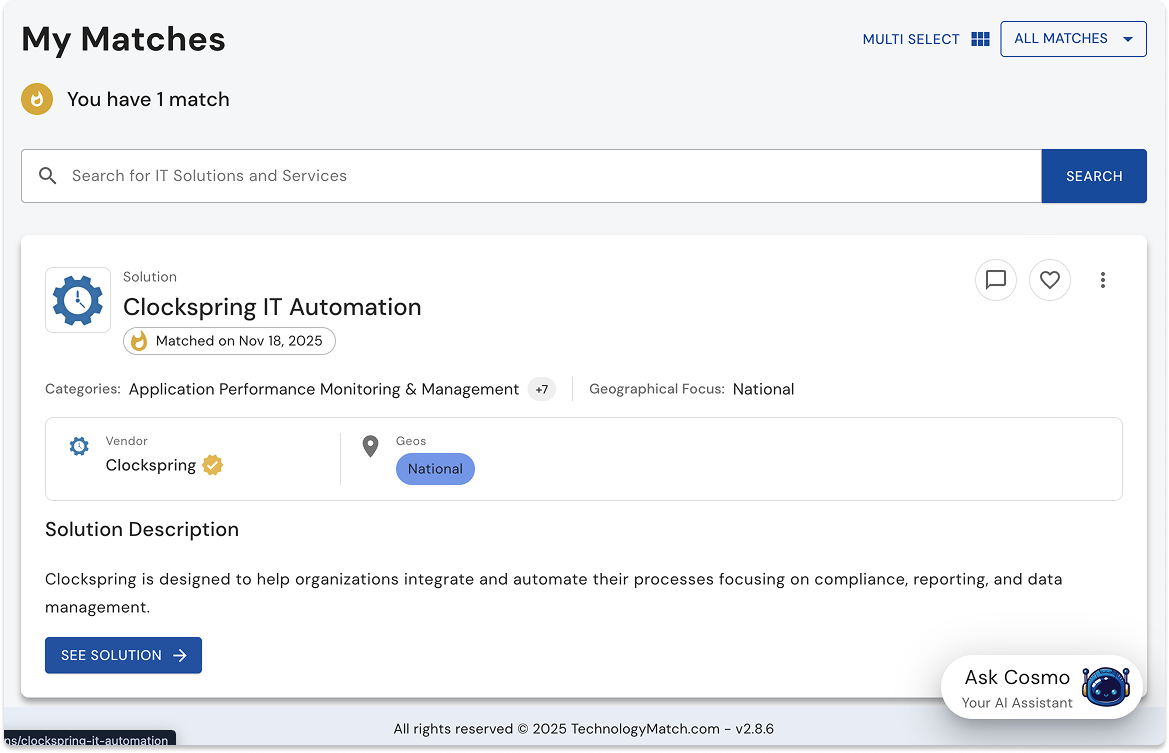
We know how difficult it is to find and work with the right partners in the market today. There’s too much noise and not enough reliable solution providers. Which is why we built TechnologyMatch:
- Our platform is buyer-first so potential partners have no way of spamming with you cold outreach.
- Only you can make the first move by messaging them and scheduling calls.
- All your potential partners can be managed and evaluated from a single dashboard, without having to switch platforms or sift through emails.
- You get access to potential partners, resellers, vendors, and solution providers who have been verified through a strict vetting process.
Looking for IT partners?
Find your next IT partner on a curated marketplace of vetted vendors and save weeks of research. Your info stays anonymous until you choose to talk to them so you can avoid cold outreach. Always free to you.
FAQ
What IT process automation services does ATC provide?
ATC specializes in robotic process automation implementation across platforms including UiPath, Automation Anywhere, Blue Prism, and Microsoft Power Automate. They provide intelligent automation with AI/ML integration, process discovery and mining, Center of Excellence development, and hyperautomation combining RPA, AI, process mining, and low-code platforms for healthcare, financial services, manufacturing, retail, and public sector.
What does Clockspring's automation platform offer?
Clockspring provides a proprietary low-code/no-code enterprise automation platform for workflow orchestration, data integration, and legacy system modernization. Key capabilities include visual workflow design, real-time data synchronization across systems, pre-built connectors for enterprise apps, screen scraping and API creation for legacy systems, and flexible deployment including on-premises, cloud, and hybrid for regulated industries.
How does Eliassen Group approach IT automation?
Eliassen Group provides strategic consulting for automation tied to digital transformation including automation advisory, technology selection, RPA and workflow automation implementation, cloud and infrastructure automation with IaC and CI/CD, data pipeline orchestration, and talent staffing for automation specialists. They focus on life sciences, healthcare, financial services, technology, and manufacturing.
What IBM automation solutions does DAI Source implement?
DAI Source is an IBM Platinum Partner specializing in IBM Business Automation Workflow, IBM RPA powered by Automation Anywhere, IBM Operational Decision Manager for business rules and decision automation, IBM FileNet and Content Services for document management and intelligent capture, and IBM App Connect for integration. They serve regulated industries including financial services, healthcare, and government.
What intelligent automation capabilities does STEPS Consulting provide?
STEPS Consulting specializes in AI-powered automation including intelligent document processing with OCR and machine learning, AI/ML integration with NLP and computer vision, multi-platform RPA implementation, process mining and optimization, hyperautomation combining RPA, AI, process mining, and low-code, and CoE development for financial services, healthcare, insurance, manufacturing, and professional services.
%20Cannot%20Do%20Out%20of%20the%20Box.png)