Cisco vs Aruba vs Arista: Which Network Infrastructure Vendor Should IT Leaders Choose?
Compare Cisco, Aruba, and Arista for enterprise network infrastructure. Learn which vendor offers the best value, performance, and capabilities for IT leaders.

Your network infrastructure is the foundation of digital transformation, cloud migration, AI workloads, and security posture. When you're choosing between Cisco, Aruba, and Arista, you're making a decision that will affect performance, security, and operational costs for years.
These three vendors dominate enterprise networking but serve different needs. Cisco offers the most comprehensive ecosystem with premium pricing. Aruba, owned by HPE, provides cloud-native simplicity with a focus on wireless and campus networking. Arista specializes in high-performance data center switching for cloud and AI infrastructure.
This comparison shows what each vendor does well, where they fall short, and which one fits your infrastructure needs, team skills, and budget.
What IT Leaders Need to Know About Network Vendors
Generic spec sheets don't tell the whole story. Here's what actually matters.
Ecosystem breadth vs. specialization. Cisco provides end-to-end solutions across switching, routing, wireless, security, and collaboration. Aruba specializes in wireless and campus with strong cloud management. Arista focuses exclusively on data center and cloud networking.
Hardware vs. software differentiation. Traditional vendors compete on hardware specs like throughput and port density. Modern differentiation happens in software: automation, AI, cloud management, and analytics.
Management complexity and operational overhead. You need to consider on-premises controllers versus cloud-managed platforms. Think about CLI-heavy configuration versus GUI-driven automation. Factor in vendor-specific certifications and training requirements.
Total cost of ownership. Hardware costs are just the beginning. Add licensing models, support contracts, training costs, and operational overhead for realistic comparison.
Cisco
Cisco dominates enterprise networking with the broadest portfolio and deepest enterprise relationships. It's the safe choice with the highest costs.
What Cisco Does Well
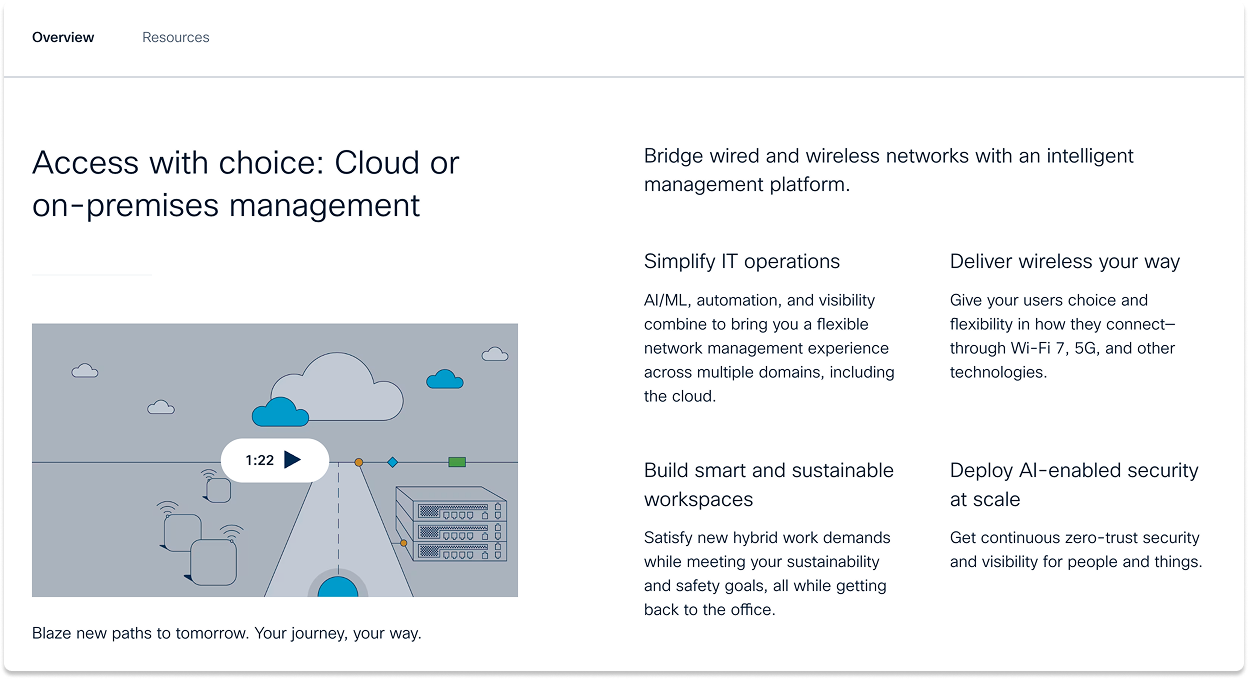
Comprehensive product portfolio. Cisco offers solutions across every networking domain:
- Switching: Catalyst and Nexus families for campus, data center, and core
- Routing: ISR, ASR, and NCS platforms for branch, WAN, and service provider
- Wireless: Catalyst wireless and Wi-Fi 7 access points
- SD-WAN: Viptela-based SD-WAN with integrated security
- Security: Firepower, Umbrella, Duo, and integrated threat defense
- Collaboration: Webex, voice, and unified communications
You can standardize on Cisco across your entire infrastructure.
Market leadership and proven reliability. Cisco's market dominance provides confidence for risk-averse IT leaders. Extensive case studies, reference customers, and proven deployments at massive scale reduce perceived risk.
Deep enterprise features. Cisco delivers advanced capabilities including comprehensive VLAN and QoS support, robust routing protocols, extensive security integration, and high availability options.
Largest talent pool. CCNA, CCNP, and CCIE certifications are industry standards. Finding Cisco-skilled engineers is easier than alternatives.
Strong partner ecosystem. Thousands of partners provide implementation, support, and specialized services.
Where Cisco Falls Short
Premium pricing. Cisco is typically 20 to 40 percent more expensive than competitors. Licensing complexity adds ongoing costs beyond hardware. DNA licensing, smart licensing, and subscription models create expenses that continue after initial purchase.
Complexity and steep learning curve. Cisco's CLI-centric configuration requires significant expertise. This creates dependency on certified engineers and longer training cycles.
Slower innovation. While Cisco acquires innovative companies, integration takes years. Cloud management and AI-driven operations lag behind Aruba and Arista in some areas.
Vendor lock-in. Proprietary protocols like EIGRP and StackWise create switching costs. Many customers use proprietary features that complicate multi-vendor strategies.
Support quality varies. TAC support quality is inconsistent according to user reviews. Premium support contracts are expensive.
When Cisco Makes Sense
Choose Cisco when you need enterprise-wide standardization on a single vendor. Use it when risk aversion and proven reliability matter more than cost.
Cisco works when complex requirements need comprehensive features across networking, security, and collaboration. It makes sense with existing Cisco investment and team expertise. Choose it when budget accommodates premium pricing.
Aruba
Aruba built its reputation on wireless excellence and has expanded into comprehensive campus and branch networking with cloud-native management. In July 2025, parent company HPE closed its $14 billion acquisition of Juniper Networks and folded both into a single HPE Networking business unit.
That deal doubled HPE's networking business and added Juniper's data center switching, service provider routing, and Mist AIOps platform to the portfolio, marketed under both the HPE Aruba and HPE Juniper brands.
For buyers, it reframes Aruba from a wireless-and-campus specialist into part of a full-stack networking challenger to Cisco.
What Aruba Does Well
Industry-leading wireless. Aruba's core strength is wireless networking with excellent Wi-Fi performance and reliability. Advanced mobility features enable seamless roaming. Strong support exists for high-density environments like stadiums, campuses, and hospitals.
ClientMatch technology steers devices to the best access point automatically. For organizations where wireless is critical, Aruba outperforms competitors.
Cloud-native management with Central. Aruba Central provides true cloud-native management:
- Simple, intuitive interface accessible from anywhere
- AI-powered insights and recommendations
- Unified management for wireless, switching, and SD-WAN
- Significantly easier to use than Cisco DNA Center
IT teams can manage networks without deep CLI expertise.
Competitive pricing. Aruba typically costs 20 to 30 percent less than Cisco for comparable solutions. Licensing is more straightforward with fewer hidden costs.
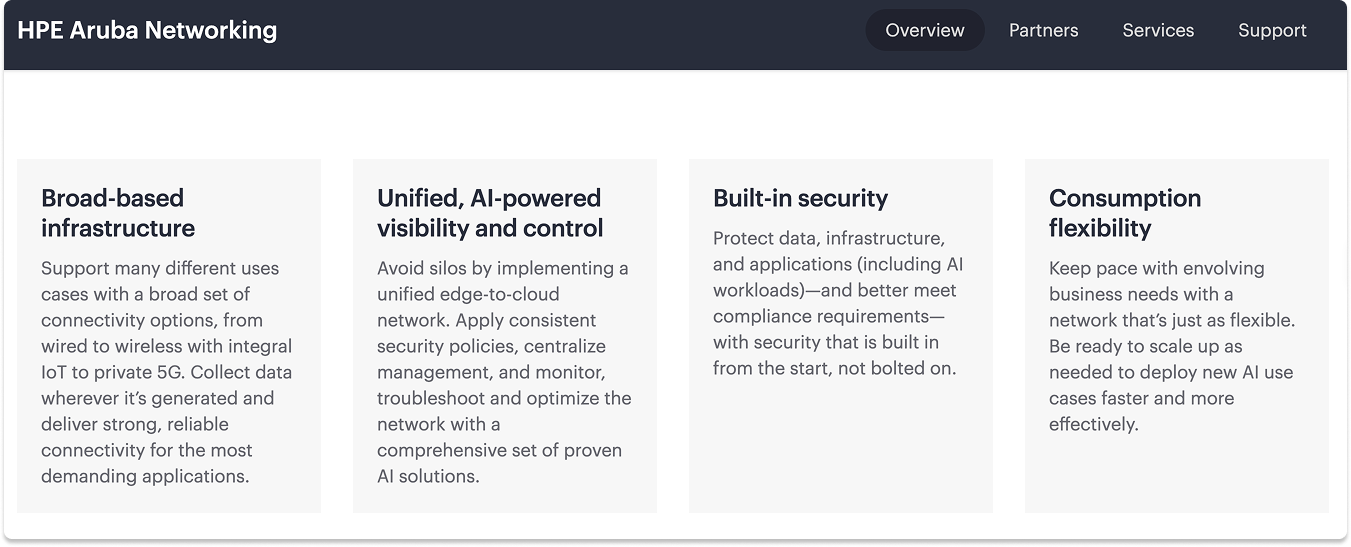
Strong focus on edge networking. Aruba's edge-first strategy includes AI-powered operations, strong IoT support and device visibility, dynamic segmentation for zero-trust security, and ClearPass for policy enforcement.
Simplified operations. Aruba prioritizes simplicity with faster deployment times, lower operational overhead, less dependency on certified engineers, and good documentation.
Modern CX switching. The CX switch family uses AOS-CX operating system with microservices architecture. Cloud-managed or on-premises options exist with good automation support through APIs.
Where Aruba Falls Short
Portfolio gaps the Aruba brand is still closing. The Aruba-branded line covers switching, wireless, and SD-WAN well, with historic gaps in data center switching, complex WAN routing, and security integration. Juniper's portfolio now addresses much of this under the HPE Networking umbrella, though product-line consolidation is ongoing, so confirm roadmap and support continuity for any specific platform. No collaboration or unified communications.
Smaller market share. Aruba's smaller market presence means fewer reference customers for large-scale deployments and a smaller partner ecosystem.
Aruba switching is campus-first. The Aruba CX line is optimized for campus and branch rather than data center spine-leaf or high-performance AI fabrics. Juniper's QFX and PTX platforms cover the data center within HPE Networking, but that is a separate product family with its own operating system (Junos), not a unified Aruba stack.
Less mature for complex routing. For complex routing including MPLS, BGP, and advanced traffic engineering, Aruba's capabilities lag Cisco and Arista.
When Aruba Makes Sense
Choose Aruba when wireless and mobility are critical priorities. Use it when cloud-native management and operational simplicity matter. Select it when budget constraints require better value than Cisco.
Aruba works best for campus and branch networking. It's ideal when your team has limited networking expertise. Choose it for edge networking and IoT focuses.
Arista
Arista focuses exclusively on data center and cloud networking with software-defined approaches, high-performance hardware, and automation-first design.
What Arista Does Well
Data center switching excellence. Arista dominates data center switching with purpose-built platforms for spine-leaf architectures, AI and machine learning workloads, cloud-scale networking, and high-frequency trading environments.
Major hyperscalers including Meta, Microsoft Azure, and AWS use Arista extensively.
Superior performance for AI fabrics. Arista's Etherlink portfolio spans 400G, 800G, and now 1.6T platforms, with the 7060XE7 series targeting rack-scale AI infrastructure and validated by hyperscalers including Meta, Microsoft, and Oracle.
The platforms are compatible with the Ultra Ethernet Consortium standard Arista helped lead, positioning Ethernet as a direct alternative to InfiniBand for GPU clusters. Ultra-low latency, strong power efficiency, and a high performance-per-dollar ratio make this the strongest case in the comparison for AI and cloud-scale workloads.
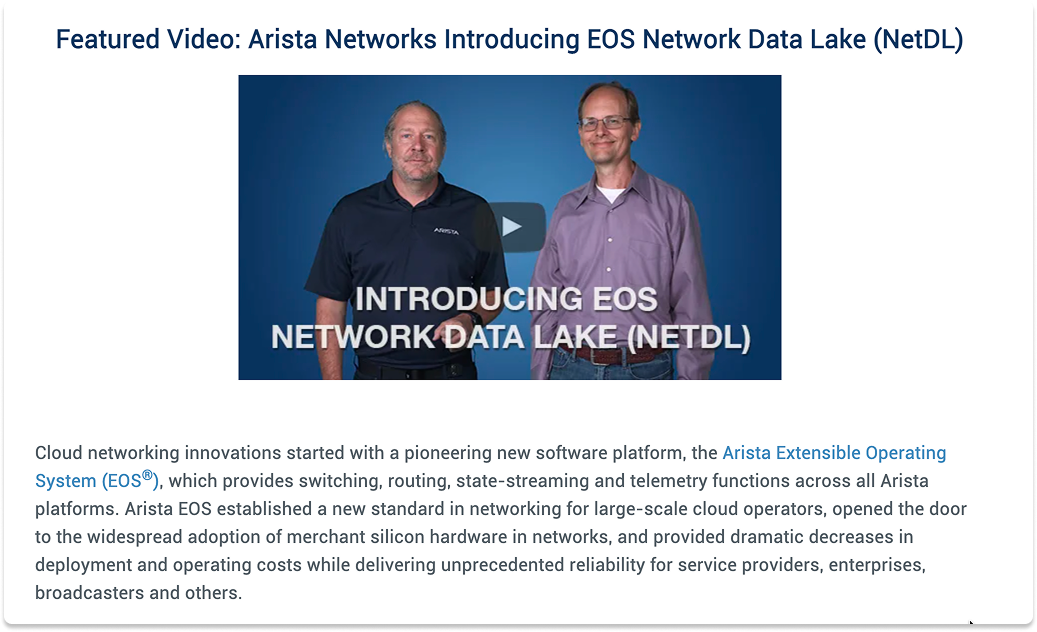
Single operating system. Arista EOS runs on every switch from campus access to data center spine. Consistent CLI and configuration syntax work everywhere. Skills transfer easily across product lines. Modular architecture based on Linux provides stability.
This consistency reduces training requirements and operational complexity compared to Cisco's multiple operating system variants.
CloudVision for automation. CloudVision provides network-wide telemetry and visibility, zero-touch provisioning and automation, change control and compliance tracking, and programmable workflows.
It's more modern and automation-focused than Cisco DNA Center.
Best-in-class automation. Arista was built for automation with comprehensive APIs and integrations, excellent support for Ansible, Terraform, and Python, event-driven automation frameworks, and streaming telemetry for real-time visibility.
Aggressive pricing for data center. Arista typically costs 15 to 25 percent less than Cisco Nexus for comparable data center switching. Some customers report up to 40 percent savings.
Software-defined networking leadership. Arista pioneered software-defined approaches in data center networking. EOS provides flexibility and programmability that traditional vendors struggle to match.
Where Arista Falls Short
Limited security portfolio. Arista offers network detection and response and zero-trust segmentation, but nothing approaching Cisco's security and collaboration breadth. You will still need dedicated security vendors.
Smaller market presence. While growing rapidly, Arista has smaller overall market share than Cisco. Fewer reference customers outside data center and cloud. Smaller partner ecosystem for implementation services.
Limited campus presence. Arista recently expanded into campus networking but the portfolio is new. Less proven for traditional enterprise campus deployments. Smaller install base and fewer case studies.
Customer concentration risk. Significant revenue comes from hyperscalers like Meta and Microsoft. This creates questions about focus on traditional enterprise customers.
No wireless expertise. Unlike Aruba's wireless leadership or Cisco's comprehensive wireless portfolio, Arista has minimal wireless capabilities. You need another vendor for wireless.
Learning curve for Cisco-trained teams. While EOS is consistent and well-designed, it differs from Cisco IOS. Teams trained on Cisco need retraining. The automation-first approach assumes technical maturity.
When Arista Makes Sense
Choose Arista when data center networking is your primary focus. Use it when high-performance switching for AI, machine learning, or cloud workloads is needed. Select it when automation and programmability are priorities.
Arista works when better price-performance matters for data center investments. It makes sense for organizations with DevOps culture and automation maturity. Choose it when software-defined networking and modern architecture are strategic goals.
Comparing Network Infrastructure Vendors
Total Cost of Ownership
Winner: Arista for data center with 15 to 40 percent savings versus Cisco Nexus.
Winner: Aruba for campus and branch with 20 to 30 percent savings versus Cisco.
Cisco's premium pricing is hardest to justify on cost basis alone.
Wireless and Mobility
Winner: Aruba for enterprise wireless excellence and high-density environments.
Limited: Arista has minimal wireless portfolio.
Cisco wireless is capable but more expensive with less innovation than Aruba.
Data Center Switching
Winner: Arista for cloud-scale performance, AI workloads, and automation.
Runner-up: Cisco for comprehensive features and proven deployments.
Aruba has limited data center portfolio.
Automation and Programmability
Winner: Arista with best-in-class APIs, EOS consistency, and CloudVision automation.
Runner-up: Aruba with good APIs and cloud-native management.
Cisco supports automation but legacy complexity makes it harder.
Comprehensive Ecosystem
Winner: Cisco with broadest portfolio spanning networking, security, and collaboration.
Aruba and Arista have focused portfolios. Choose Cisco for single-vendor strategy.
Campus and Branch Networking
Winner: Aruba for cloud-native management and wireless excellence.
Runner-up: Cisco for comprehensive features.
Arista has limited campus portfolio.
Risk Aversion
Winner: Cisco with largest market share and most reference customers.
Runner-up: Arista for data center deployments used by major hyperscalers.
Conservative IT leaders choosing Cisco face less procurement scrutiny.
Limited Networking Expertise
Winner: Aruba with cloud-native management and intuitive interfaces.
Avoid: Arista requires technical maturity and automation skills.
Cisco requires most specialized expertise overall.
Making Your Decision
By Network Priorities
Data center modernization and cloud networking: Choose Arista for performance, automation, and cost savings.
Campus and branch with wireless focus: Choose Aruba for wireless excellence and cloud management.
Enterprise-wide standardization: Choose Cisco for comprehensive ecosystem at premium cost.
Hybrid needs: Use multi-vendor approach with Arista for data center and Aruba for campus and wireless.
By Team Capabilities
Limited networking expertise: Choose Aruba for cloud-native simplicity.
Traditional Cisco-trained teams: Cisco minimizes retraining but consider long-term costs.
DevOps-mature with automation skills: Choose Arista for programmability and software-defined networking.
By Budget Reality
Tight budgets: Choose Arista for data center (up to 40% savings) or Aruba for campus (20-30% savings).
Flexible budgets: Cisco's premium is justified if comprehensive ecosystem is needed.
Performance per dollar: Choose Arista for data center investments.
By Strategic Direction
Cloud-first and data center focus: Arista's software-defined, cloud-scale approach fits best.
Wireless-first and edge computing: Aruba's edge-first strategy and wireless leadership fit best.
Multi-domain integration: Cisco's comprehensive portfolio across networking, security, and collaboration fits best.
Common Mistakes to Avoid
Choosing based on brand alone. Cisco's brand doesn't justify premium pricing if Aruba or Arista meet requirements at lower cost.
Ignoring total cost of ownership. Factor in licensing, support contracts, training costs, and operational overhead.
Not considering team skills. Switching vendors requires retraining. Factor this into timeline and budget.
Underestimating wireless importance. Wireless is critical for modern work. Aruba leads here.
Overlooking data center performance. If data center networking matters, Arista often outperforms Cisco at lower cost.
Failing to negotiate. All vendors discount heavily. Expect 20 to 40 percent off list prices.
Not planning for multi-vendor reality. Few organizations use only one vendor. Ensure interoperability.
Ignoring cloud management benefits. Cloud-native platforms reduce operational overhead significantly.
The Multi-Vendor Strategy
Most organizations benefit from multi-vendor approaches.
Common pattern:
- Arista for data center switching (performance and cost)
- Aruba for campus wireless and edge (excellence and simplicity)
- Selective Cisco where ecosystem integration matters
This approach optimizes cost, performance, and capabilities while avoiding complete vendor lock-in.
Key considerations:
- Use open standards at boundaries (BGP, OSPF, 802.1Q)
- Avoid proprietary protocols for inter-vendor connections
- Plan management strategy across multiple platforms
- Ensure team has skills or partner support
Closing Thoughts
Clear patterns emerge based on your priorities.
Choose Cisco when enterprise-wide standardization, comprehensive ecosystem, and proven reliability matter more than cost. It's the safe choice for risk-averse IT leaders with budgets that can absorb premium pricing.
Choose Aruba when wireless excellence, campus networking, and operational simplicity are priorities. It's ideal for organizations where wireless is critical and teams prefer cloud-native management.
Choose Arista when data center performance, cloud-scale networking, and automation capabilities are critical. It's perfect for data centers, AI workloads, and teams with automation maturity seeking best price-performance.
Most organizations benefit from multi-vendor strategies. Use Arista for data center performance. Deploy Aruba for campus wireless and edge. Apply selective Cisco where ecosystem integration matters.
Your decision should align with network priorities, team capabilities, budget constraints, and strategic direction. Choose vendors that match your requirements and operational maturity.
Read more: Zscaler vs. Netskope vs. Palo Alto vs. Cato: The SASE Selection Guide, Best Zero Trust Security Vendors to Work With in 2026
Looking for Network Infrastructure?
Before you commit to a network infrastructure, it's worth seeing your options and exploring if there are vendors who might be a better fit. Tell us what you're working with. We'll match you with the the ones worth your time.
FAQ
Is Cisco worth the premium price for network infrastructure?
Cisco's premium pricing, typically 20 to 40 percent higher than Aruba or Arista, is justified when you need comprehensive ecosystem integration across networking, security, and collaboration, or when risk aversion and proven reliability are top priorities. For campus and wireless, Aruba delivers comparable quality at lower cost. For data center switching, Arista provides better price-performance. Cisco's brand value doesn't automatically justify the premium unless specific ecosystem requirements exist.
Which vendor has the best wireless networking for enterprises?
Aruba leads enterprise wireless with industry-best performance, high-density support, and mobility features including ClientMatch technology. Cisco wireless is capable but typically more expensive with less innovation. Arista has minimal wireless portfolio and is not competitive in this space. For healthcare, education, hospitality, and retail where wireless is critical, Aruba is the clear choice.
Should IT leaders choose Arista or Cisco for data center networking?
Choose Arista for data center networking when performance, automation, and cost-effectiveness are priorities. Arista delivers 15 to 40 percent cost savings versus Cisco Nexus with superior performance, better automation through CloudVision and APIs, and software-defined networking leadership. Major hyperscalers including Meta and Microsoft use Arista extensively. Choose Cisco Nexus when you need comprehensive ecosystem integration with Cisco security and collaboration, or when existing Cisco investment and team expertise justify premium pricing.
Can IT leaders mix Cisco, Aruba, and Arista in the same network?
Yes. Multi-vendor strategies are common and often optimal. A typical approach uses Arista for data center switching for performance and cost, Aruba for campus wireless and edge for excellence and simplicity, and selective Cisco where ecosystem integration with Cisco security or collaboration matters. All three support open standards including 802.1Q, BGP, OSPF, and LLDP enabling interoperability. Plan integration carefully and use standards-based protocols at vendor boundaries.
Which network vendor is best for cloud-native and automation-focused organizations?
Arista is best for cloud-native and automation-focused organizations with its software-defined networking approach, comprehensive APIs and automation frameworks, CloudVision for network-wide automation, and EOS consistency across all platforms. Aruba Central offers good cloud-native management for campus and wireless but is less sophisticated for data center automation. Cisco supports automation but legacy complexity makes it harder than Arista's purpose-built approach.