



Zscaler vs Netskope vs Palo Alto vs Cato Networks: The SASE Comparison Guide (2026)
Compare Zscaler, Netskope, Palo Alto, and Cato Networks on architecture, federal authorization, AI security, and fit. A vendor-neutral SASE guide for IT leaders.

Summary:
Zscaler, Netskope, Palo Alto (Prisma SASE), and Cato Networks are the four platforms that dominate enterprise SASE shortlists, and they differ on architecture (proxy overlay versus cloud firewall versus private backbone), native SD-WAN, data and AI security depth, and federal authorization.
The right choice depends on how your network team depth, cloud-versus-hybrid traffic, global performance needs, and compliance ceiling interact, with FedRAMP High and DoD IL5 requirements narrowing the field to Zscaler and Palo Alto.
Most SASE decisions come down to which gap you are closing first: the cost of MPLS circuits, data leaking into unmanaged cloud apps, or a VPN that grants far more access than any user needs.
For IT leaders, this is an architectural decision that dictates how your organization connects users to applications for the next five to ten years.
Zscaler approaches security from a pure cloud-proxy perspective (Security Service Edge or SSE), focusing on the user-to-app connection. Netskope uses the same proxy model for its security inspection layer, but delivers a complete single-vendor SASE platform that includes native SD-WAN.
Palo Alto Networks and Cato Networks approach the problem from a networking foundation, aiming to secure the traffic flow itself.
This guide provides a technical, operational, and strategic comparison of these four platforms to assist CIOs, CISOs, and network architects in making an informed decision.
IT Leaders Report 2026
What are your IT peers investing in 2026?
We spoke to about 1,300 IT leaders from various organisations to understand what they're evaluating. Insights about what they're prioritising, where they're moving, and how they're spending.
Read the report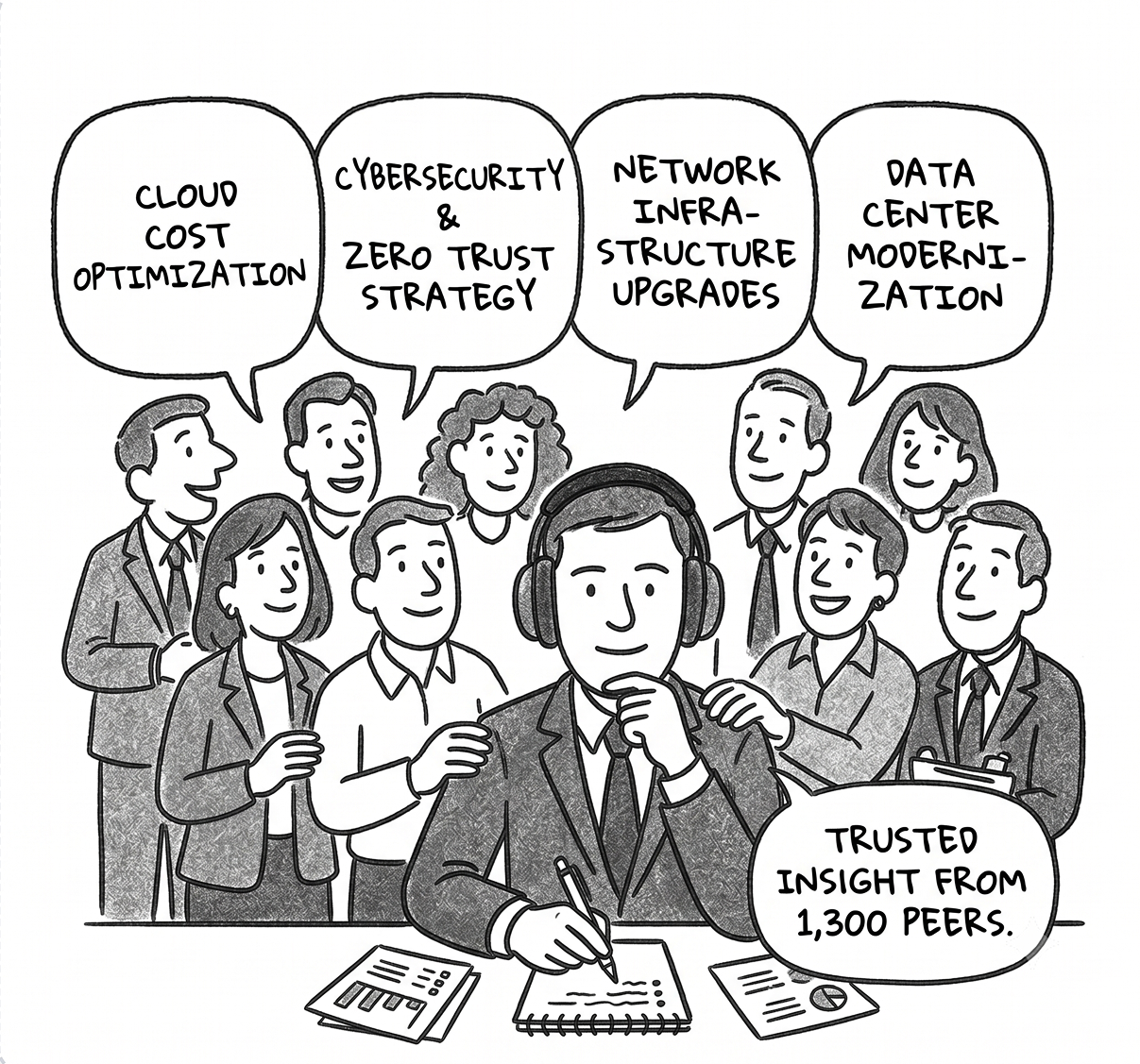
The Core Architectural Differences
Before analyzing individual vendors, it is critical to understand the two primary architectural approaches in this market. Your choice between them will determine your network’s capabilities and limitations.
The Proxy Architecture (Zscaler & Netskope)
Zscaler and Netskope both use a proxy overlay for security inspection. In this model, the user's device does not connect directly to the destination application. The connection is terminated at the vendor's cloud edge. The security cloud inspects the traffic, applies policy, and establishes a separate connection to the destination.
- Primary Benefit: This architecture offers superior security for web and SaaS traffic. Because the connection is terminated, threats cannot pass through the way they might with a packet-filtering firewall. It masks the user's IP address and prevents direct network access.
- Primary Limitation: Proxies can break non-standard applications. Legacy applications that use hardcoded IP addresses, server-initiated flows such as certain VoIP setups, or proprietary protocols often require complex workarounds or bypasses.
The Route-Based Architecture (Palo Alto & Cato Networks)
Palo Alto Networks (Prisma SASE) and Cato Networks operate closer to a cloud firewall and router model. While they perform deep inspection, they handle traffic as a flow. They maintain routing constructs, subnets, and network address translation (NAT) tables that are familiar to network engineers.
- Primary Benefit: These platforms offer broader application compatibility. If an application worked over a traditional VPN or MPLS circuit, it will likely work here without modification. They are better suited for "East-West" traffic where servers need to communicate with each other.
- Primary Limitation: Managing these environments requires more traditional networking knowledge (routing, peering, subnets) compared to the abstract "user-to-app" logic of a pure proxy.
Zscaler: The Market Leader in Zero Trust
Zscaler is the pioneer of the Security Service Edge (SSE) market. Their platform, the Zero Trust Exchange, is purpose-built to eliminate the corporate network entirely, replacing it with direct user-to-app connections.
Technical Architecture and Capabilities
Zscaler is split into two primary products: Zscaler Internet Access (ZIA) for securing external web traffic, and Zscaler Private Access (ZPA) for internal applications.
Zscaler Internet Access (ZIA):
ZIA is a mature, massive-scale secure web gateway. It routes user traffic to the nearest Zscaler data center, where it undergoes SSL inspection, sandbox analysis, and URL filtering. Its strength lies in inspecting encrypted traffic at scale without the performance penalty inline inspection usually carries.
Zscaler Private Access (ZPA):
ZPA replaces the traditional VPN concentrator. It uses lightweight virtual machines called App Connectors that sit inside your data center or cloud environment (AWS, Azure). These connectors dial out to the Zscaler cloud. When a user requests access to an app, the Zscaler cloud stitches the user’s connection and the App Connector’s connection together.
- Security Implication: No inbound firewall ports are ever open to the internet. This creates a "darknet" where applications are invisible to unauthorized users.
Zscaler Digital Experience (ZDX):
ZDX is an endpoint monitoring tool that provides hop-by-hop visibility into user connectivity. It can isolate whether latency is caused by the local WiFi, the ISP, the Zscaler cloud, or the application itself.
Zscaler has since extended access into the browser, adding lightweight extensions for Chrome and Edge that reach unmanaged and BYOD devices without a full agent. It has paired this with an AI protection layer that Zscaler states secures data moving to and from generative AI tools across prompts, models, and outputs.

Operational Reality: Pros and Cons
Pros:
- Attack Surface Reduction: ZPA’s outbound-only architecture is theoretically more secure than any solution requiring inbound listeners.
- Scalability: Zscaler states it processes hundreds of billions of requests daily across 160+ points of presence. That proven capacity is why it remains a default choice for Global 2000 enterprises.
- Threat Intelligence: Due to its massive user base, Zscaler’s security cloud updates rapidly when new threats are detected globally.
Cons:
- Application Friction: ZPA does not support server-to-client initiated traffic well. For example, if an on-premise management server needs to push a patch to a remote client, ZPA’s architecture makes this difficult without additional configuration (Zscaler B2B).
- Support Challenges: Customer feedback consistently highlights difficulties with technical support. Organizations below the "Enterprise" tier often report slow response times and difficulty reaching Level 3 engineers for complex routing issues.
- Management Complexity: Historically, ZIA and ZPA were managed in separate portals with different policy structures. While Zscaler is working to unify this, admins often have to duplicate objects or identity definitions across the two distinct platforms.
Best Suited For:
Zscaler is the optimal choice for large enterprises committed to a pure Zero Trust strategy. If your goal is to treat the internet as the corporate network and you have the resources to re-architect legacy application flows, Zscaler offers the most mature security overlay.
Netskope: The Data and AI Security Leader
Netskope began as a Cloud Access Security Broker before expanding into a full single-vendor SASE platform. That origin shapes its core strength: understanding not just where traffic is going, but what data is inside it and what the user is doing with it.
The platform, Netskope One, converges SSE and native SD-WAN into a single cloud-native architecture built across four integrated components: the Zero Trust Engine, the One Client, the NewEdge Network, and the One Console.
Technical Architecture and Capabilities
Netskope's security inspection layer operates as a proxy overlay built on its NewEdge network, a purpose-built private cloud.
Netskope states NewEdge runs full compute across 80+ regions, so the complete SASE stack runs at every point of presence with no backhauling to a central inspection point. Netskope reports the network now carries more than 12,000 peering adjacencies to over 750 autonomous systems, with a 99.999% uptime SLA.
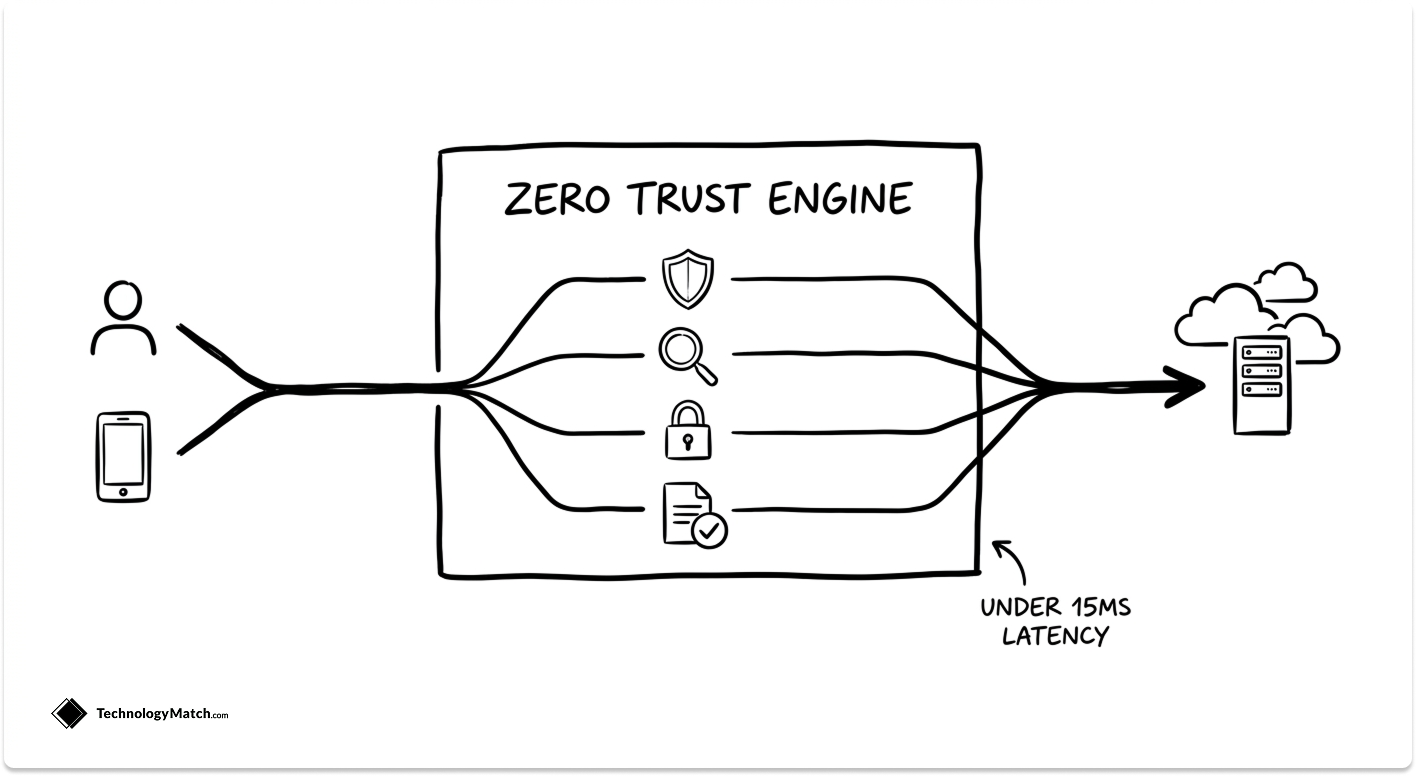
Zero Trust Engine
The Zero Trust Engine performs single-pass inspection across SWG, CASB, ZTNA, DLP, FWaaS, and SD-WAN simultaneously, which Netskope times at under 15 milliseconds.
It provides what Netskope calls "Layer 8" visibility, covering 50+ contextual variables including instance awareness, action awareness, and behavioral anomalies. It decodes all traffic in real time, including full JSON decoding.
Policies move beyond binary block/allow to include user coaching, step-up authentication, and dynamic access isolation based on real-time risk scoring.
Netskope Private Access (NPA) — Universal ZTNA
NPA is Netskope's Universal ZTNA solution, designed to replace VPNs, NAC, and VDI. It uses a "Publisher" connector model to broker access to private applications without opening inbound firewall ports. A Local Broker extends ZTNA to on-premises and OT environments with built-in disaster recovery, supporting latency-sensitive and air-gapped use cases.
Cloud Confidence Index (CCI) and CASB
Netskope scores more than 75,000 cloud applications using 50+ attributes based on the CSA Cloud Controls Matrix framework. Patented instance awareness distinguishes between a corporate and personal account on the same application, blocking uploads to a personal OneDrive while permitting the same action on a corporate account. The CCI uses large language models to automatically categorize newly discovered cloud and AI applications.
Unified DLP
The DLP engine covers data at rest, in motion, and in use across all vectors. Netskope states the engine draws on 3,000+ data identifiers and 50+ AI/ML patents. Coverage spans PII, payment card numbers, financial data, and intellectual property.
Native SASE
Netskope One includes native Secure SD-WAN, Endpoint SD-WAN, Micro Branch, Wireless WAN, and Multi-Cloud Networking. A single management console covers SSE, SD-WAN, AI security, and data security across all environments. Organizations building a full SASE architecture on Netskope do not need a third-party SD-WAN vendor.
Operational Reality: Pros and Cons
Pros:
- CASB and DLP depth: The CCI scores 75,000+ cloud applications and the DLP engine uses 3,000+ data identifiers with 20 patented detection techniques. For organizations managing data exfiltration risk, insider threats, or shadow IT exposure, this is the most granular enforcement in this comparison.
- Complete single-vendor SASE: Native SD-WAN removes the need for a separate networking vendor. One console, one agent, and one contract cover the full stack.
- Proven business case: AI-aware routing: Netskope's NewEdge AI Fast Path peers directly with major AI destinations including AWS, Microsoft, Google, Anthropic, and OpenAI, which Netskope states shortens the path to those services and lowers inference latency.
Cons:
- Endpoint resource usage: Some user reports indicate the client can be resource-intensive on older hardware during heavy file transfers or complex steering rules.
- Proxy limitations for non-standard traffic: Like Zscaler, the proxy inspection model can create friction for applications using hardcoded IPs, non-standard ports, or server-to-client initiated connections. These scenarios require additional configuration or architectural workarounds.
- Breadth demands multi-domain expertise: The platform spans DLP, CASB, ZTNA, SD-WAN, and AI security in a single stack. Extracting full value requires skills across both security and networking, which not every team has in-house.
Best Suited For:
Netskope is the primary choice for data-sensitive, cloud-first organizations where the core risk is data leakage, insider threat, or uncontrolled SaaS usage. Its complete SASE stack and granular data security capabilities make it particularly relevant for regulated industries managing sensitive data across distributed cloud environments.
Palo Alto Networks (Prisma SASE): The Integrated Platform
Palo Alto Networks is the dominant player in the enterprise firewall market. Their SASE offering, Prisma SASE, combines their cloud security platform (Prisma Access) with their SD-WAN acquisition (Prisma SD-WAN, formerly CloudGenix).
Technical Architecture and Capabilities
Prisma Access differentiates itself by lifting the full Layer 7 inspection capabilities of a Next-Generation Firewall (NGFW) into the cloud.
Single-Pass Parallel Processing (SP3):
Palo Alto uses a unique processing architecture that inspects traffic for App-ID (application identity), User-ID (user identity), Content-ID (DLP/Threats), and WildFire (sandboxing) in a single pass. This ensures that enabling additional security features does not exponentially increase latency.
Service Connections:
Unlike the lightweight connectors of Zscaler or Netskope, Prisma Access uses Service Connections to link the cloud to your data center. These are high-bandwidth IPSec tunnels that effectively extend your corporate network backbone into the cloud. This supports complex routing, multicast, and server-to-client flows that proxy-based tools struggle with.
WildFire:
Palo Alto's threat intelligence cloud draws on telemetry from millions of physical firewalls and cloud endpoints to identify and block zero-day malware. Palo Alto positions WildFire as one of the fastest engines of its kind, and it remains a core reason large security teams standardize on the platform.
Prisma SASE has since added agentic-AI controls, including SaaS security posture management and a secure browser that Palo Alto states discovers and governs several thousand AI applications in use across an organization.

Operational Reality: Pros and Cons
Pros:
- Security Consistency: For organizations that already use Palo Alto physical firewalls (PA-Series), Prisma Access allows for a unified security policy. A rule created for the headquarters firewall can be applied instantly to remote users.
- Application Compatibility: Because it behaves like a cloud firewall rather than a strict proxy, Prisma Access handles legacy applications, proprietary protocols, and complex routing scenarios with fewer "hacks" or workarounds.
- Single-Vendor SASE: Palo Alto offers both the physical SD-WAN hardware and the cloud security stack, allowing for a single support contract and tighter integration than mixing vendors.
Cons:
- Complexity: Prisma Access is complex to deploy. It requires deep networking knowledge (BGP, IPSec, routing domains). Moving from a legacy on-premise model to Prisma Access is often a multi-month project requiring specialized certification or external consultants.
- Cost and Licensing: Palo Alto is consistently the most expensive option. Furthermore, the licensing model can be intricate, often charging for bandwidth capacity on Service Connections in addition to per-user licensing.
- Management Transition: Palo Alto is currently transitioning customers from their legacy management console (Panorama) to the new Strata Cloud Manager. This transition has led to feature parity gaps and interface confusion for some administrators.
Best Suited For:
Palo Alto Networks is the ideal choice for hybrid enterprises with high security requirements. If you have a significant on-premise footprint, rely on legacy applications, and already trust the Palo Alto ecosystem, Prisma Access provides the most robust and consistent security posture.
Also read: How does Prisma Cloud compare to Wiz, Orca and FortiCNAPP
Cato Networks: The Converged Challenger
Cato Networks was founded with a mission to simplify enterprise networking. Cato built its entire stack, including SD-WAN, Firewall as a Service, and a global backbone, from scratch as a single converged software service.
Technical Architecture and Capabilities
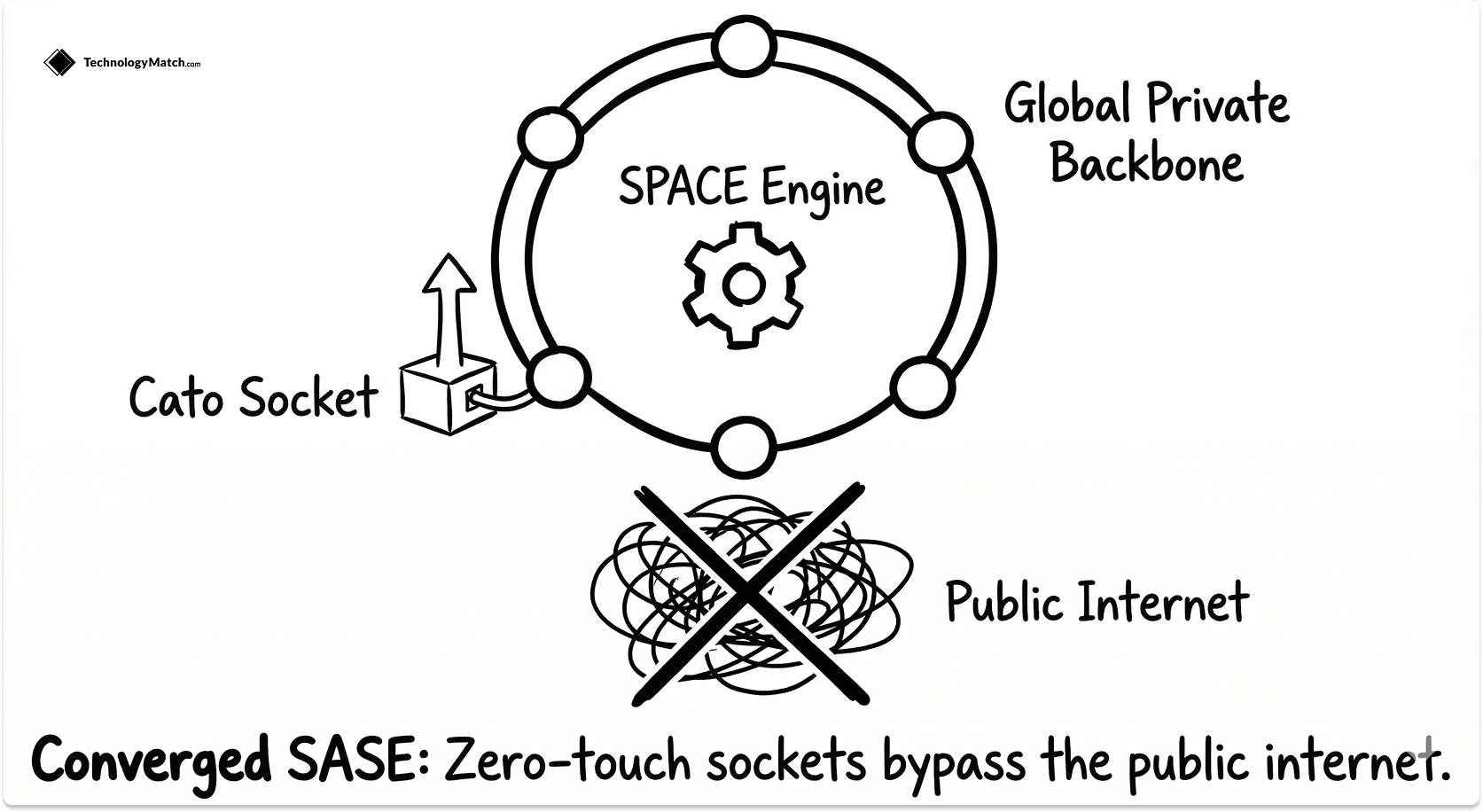
Cato’s defining feature is its Global Private Backbone. Cato owns a network of Points of Presence (PoPs) globally, connected by a private fiber network with WAN optimization built-in.
The "Network" Replacement:
When a customer connects to Cato (via a lightweight edge device called a "Socket" or a software client), their traffic is immediately routed onto Cato’s private backbone. This bypasses the unpredictability of the public internet. This architecture effectively replaces MPLS circuits, firewalls, VPN concentrators, and WAN optimizers with a single service.
Single-Pass Cloud Engine (SPACE):
Every packet hitting the Cato cloud undergoes all inspections (routing, optimization, decryption, anti-malware, IPS) in a single processing pass. Because the software was written as a unified stack, there is no "integration tax" between the SD-WAN and the security layer.
App Connectors:
Cato supports outbound App Connectors for private application access. A lightweight connector deployed inside your environment establishes an inside-out connection to the Cato cloud. Internal applications are never exposed on the internet, and users connect only to the specific application they are authorised to reach, not to the broader network.
This is architecturally equivalent to Zscaler's ZPA. Cato no longer requires a third-party ZTNA product to secure private app access. For organisations already running Cato for branch connectivity and internet security, private app access is now native to the same platform and managed from the same console.
Cato's 2026 additions center on AI. Cato states its backbone now spans 85+ points of presence, and it has begun embedding GPUs across that backbone, which it calls Cato Neural Edge, to run real-time AI inspection at the edge. It has also added a native AI security module that governs how staff use public AI tools and how AI applications reach company data.
Operational Reality: Pros and Cons
Pros:
- Operational Simplicity: Cato is significantly easier to deploy and manage than Palo Alto or Zscaler. A small IT team can manage a global network with complex security rules from a single, intuitive console.
- Global Performance: For companies with offices in regions with poor local internet (e.g., China, Brazil, India), Cato’s private backbone offers superior performance compared to relying on the public internet transport used by Zscaler or Netskope.
- Speed of Deployment: "Cato Sockets" are zero-touch devices. You can ship them to a branch office, have a non-technical person plug them in, and have the site online and secured in minutes.
Cons:
- The "Black Box" Effect: Cato’s simplicity comes at the cost of granularity. Advanced engineers may find they lack access to deep configuration knobs (such as tuning specific TCP window sizes or writing custom IPS signatures) that are available in Palo Alto.
- Layer 7 Granularity: While Cato has strong application awareness, its ability to control micro-functions within apps (e.g., "Allow Facebook View but Block Facebook Post") is generally less granular than Netskope or Palo Alto.
- Perception: While Cato serves multi-billion dollar enterprises, it is sometimes perceived as a mid-market solution because it lacks the massive ecosystem of third-party integrations that Zscaler and Palo Alto maintain.
- Federal readiness: Cato began its FedRAMP High authorization process in 2026 and is not yet authorized. For agencies or contractors with a day-one FedRAMP High or DoD requirement, that timeline can rule it out for now.
Best Suited For:
Cato Networks suits lean IT organizations and mid-to-large enterprises that value agility. You can still replace MPLS, firewalls, and private-access tooling in one move, and Cato now also supports a staged rollout, starting with one capability such as SD-WAN or SSE and adding the rest over time. For teams that weigh ease of management over deep customization, it is a strong fit.
Finding the Right SASE Vendor for Yourself
Use the questionnaire below to find out which SASE vendor from this list best suits your IT infrastructure.
How to Decide a Cybersecurity Tool
In the time that we've worked with IT leaders across industries and organizations, the following framework is what affects how a appropriate decision can be made about which SASE vendor best suits your architecture, constraints, capabilities, and budget.
Question 1: What is the state of your Network Team?
- If you have a large, specialized team of CCIE-level network and security engineers.
- Recommendation: Palo Alto Networks. Your team has the skill to utilize the granular controls and manage the complexity of BGP routing and Panorama policies effectively.
- If you have a lean team of generalists who need to do more with less.
- Recommendation: Cato Networks. The unified console and "it just works" architecture will prevent your team from drowning in maintenance tickets.
Question 2: What is your primary security anxiety?
- If your biggest fear is ransomware and lateral movement within the network.
- Recommendation: Zscaler or Palo Alto. Zscaler’s zero-trust architecture prevents infected machines from scanning the network. Palo Alto’s WildFire and threat prevention engine are industry-leading for stopping active attacks.
- If your biggest fear is sensitive data leaving the company via cloud apps (Shadow IT).
- Recommendation: Netskope. Their ability to understand the context of data movement (e.g., differentiating between personal and corporate instances of OneDrive) is unmatched.
Question 3: How does your traffic flow?
- If you are 90% cloud. Our data center is empty or shrinking.
- Recommendation: Zscaler or Netskope. These proxy-based architectures are designed for internet-centric workflows and remove the overhead of maintaining a network backbone.
- If you are hybrid. We have heavy server-to-server traffic, VoIP, and legacy apps.
- Recommendation: Palo Alto or Cato Networks. Their flow-based architectures handle non-web traffic and site-to-site routing naturally without breaking applications.
Question 4: Is latency a critical business inhibitor?
- If your users in remote geographies complain about slow access to centralized apps.
- Recommendation: Cato Networks. Their private backbone cures the "middle mile" latency issues inherent in the public internet.
- If you just need to know why it's slow."
- Recommendation: Zscaler (ZDX) or Netskope (DEM). These tools provide excellent visibility to prove that the issue lies with the user's home ISP, not the corporate network.
Comparing Zscaler, Netskope, Palo Alto, and Cato
The following table summarizes the key differentiators for a quick reference.
Closing Thoughts
There is no single "best" cybersecurity tool among these four. The "right" choice depends entirely on your architectural philosophy.
- Choose Zscaler if you want a proven, scalable shield that effectively disconnects users from the network, provided you have the budget and influence to re-architect your application flows.
- Choose Netskope if your strategy centers on data protection and cloud visibility, particularly if you are navigating the risks of Generative AI and Shadow IT.
- Choose Palo Alto Networks if you require a fortress. It is the heavy-duty option for organizations that demand the deepest inspection capabilities and consistency across a hybrid environment.
- Choose Cato Networks if you value operational efficiency and performance. It is the pragmatic choice for organizations that want to modernize their network and security in one move without expanding their IT headcount.
We strongly recommend conducting a Proof of Concept (POC) with at least two of these vendors. Test them not just on feature checklists, but on operational realities: break a policy, try to fix it, and call their support. The results of that test will tell you more than any datasheet can.
Also read: What is Cloudflare, How it Works, and What it Does for IT Leaders, Microsoft Purview vs Forcepoint DLP vs Broadcom Symantec: Comparing DLP Tools
Looking for SASE partners?
Before you commit to an architecture, it's worth seeing your options and exploring if there are vendors who might be a better fit. Explore our catalog of pre-vetted vendors and talk to them only when you want to. It's free and private.
FAQ
Which SASE platform is best: Zscaler, Netskope, Palo Alto, or Cato Networks?
The "best" SASE platform depends on your specific infrastructure goals. Zscaler is the industry standard for large enterprises seeking a pure Zero Trust proxy architecture. Netskope is the leader for cloud-first organizations prioritizing Data Loss Prevention (DLP) and CASB. Palo Alto Networks (Prisma SASE) is best for hybrid environments requiring deep security inspection and consistency with on-premise firewalls. Cato Networks is the optimal choice for organizations wanting to replace MPLS and security appliances with a single, easy-to-manage global cloud service.
What is the main difference between Zscaler and Netskope?
The primary difference lies in their architectural focus: Zscaler focuses on securing the connection, while Netskope focuses on securing the data. Zscaler is a massive-scale proxy designed to stop threats from reaching the network. Netskope, born as a CASB (Cloud Access Security Broker), offers deeper visibility into user actions inside SaaS apps (e.g., distinguishing between "Login" and "Upload"), making it superior for preventing data exfiltration and managing Shadow IT.
Do I need a separate SD-WAN with Zscaler or Netskope?
The answer differs by vendor. Zscaler is a pure SSE provider. It secures the user-to-app connection but does not provide SD-WAN or branch networking. Pairing it with a third-party SD-WAN is typically required for a full SASE architecture. Netskope is a different case. Its Netskope One platform includes native SD-WAN, meaning the full SASE stack, security and networking, is available from a single vendor without a separate networking product. Cato and Palo Alto also offer converged SASE including SD-WAN as part of their platform.
Is Cato Networks a good alternative to Palo Alto Prisma SASE?
Cato Networks is a strong alternative to Palo Alto for organizations prioritizing simplicity and speed over granular customization. While Palo Alto offers deeper "knobs and dials" for complex security tuning, Cato provides a "set-it-and-forget-it" experience with a built-in global private backbone. Cato is often preferred by lean IT teams who want to deploy a global network in days rather than months, whereas Palo Alto is preferred by large security teams requiring highly specialized threat prevention policies.
Why is "Proxy Architecture" important in choosing a SASE tool?
A Proxy Architecture (used by Zscaler and Netskope) terminates every user connection at the cloud edge, inspecting traffic before re-establishing it to the destination. This offers better security by hiding IP addresses and preventing pass-through attacks. However, it can break legacy apps (like VoIP or hardcoded server flows). Route-based architectures (like Palo Alto and Cato) handle traffic like a cloud firewall, offering better compatibility for legacy applications but requiring more traditional network security management.
The evaluation process can be overwhelming. To ensure you have the right support during your POC, we recommend reading our guide on finding IT partners and vendors. The right partner can often be the difference between a successful deployment and a costly failure.
.png)