Apptio Cloudability vs CloudHealth vs Vantage: FinOps and Cloud Cost Comparison for IT Leaders
Apptio Cloudability vs CloudHealth vs Vantage compared on multi-cloud coverage, cost allocation, rightsizing, commitment automation, and pricing for IT leaders.

What Cloudability, CloudHealth, and Vantage actually are in 2026
Apptio Cloudability is now IBM Cloudability, and that matters for reasons beyond branding. IBM has assembled it into a stack alongside Turbonomic and Kubecost, which changes what the platform can do.
Cloudability handles the financial layer of visibility, allocation, and forecasting. Turbonomic supplies automated resource optimization, and Kubecost (built on the open-source OpenCost project) handles container cost. When people describe Cloudability as an enterprise FinOps platform, they increasingly mean this combination rather than the standalone product.
CloudHealth began as CloudHealth by VMware and now sits under Broadcom as Tanzu CloudHealth. Its commercial reality is the first thing you need to know as a buyer: since May 2024, Broadcom sells it exclusively through Arrow Electronics, which handles sales, support, and onboarding while Broadcom retains ownership and development.
The product is still live and actively updated, and Broadcom shipped a refreshed interface with generative-AI features in 2025. My honest read for an IT leader is that CloudHealth remains a capable governance and allocation platform, but you are buying through a distributor, and the development momentum I see across the market has shifted toward the other two. Weigh that as roadmap risk, not as a reason to dismiss it outright.
Vantage is the independent option. It is engineer-first, self-serve, publishes its pricing openly, and has moved fastest on ingesting spend from outside the three big clouds. It carries the least organizational baggage and the fewest strings, and it shows in how quickly you can stand it up.
Data ingestion, multi-cloud coverage, and granularity
Everything a FinOps platform does rests on how it ingests and normalizes billing data. All three pull from the standard cost-and-usage exports and align to the FinOps Foundation's FOCUS specification, which means their core data models are converging even where their features diverge.
On raw provider breadth, CloudHealth covers the most ground for visibility. It reads AWS, Azure, Google Cloud, Oracle Cloud, Alibaba Cloud, and VMware vSphere, which makes it the natural fit if you carry private cloud or a genuinely mixed provider set.
The caveat is that its AWS support runs deeper than the rest, and its optimization features concentrate on AWS and Azure even where visibility extends further.
Cloudability covers the three major clouds with strong normalization and adds several others, again with the most depth on AWS.
Vantage supports the big three plus Oracle Cloud and around twenty-five other integrations, though its Oracle support still lacks amortization and provider-specific recommendations, and I did not find Alibaba Cloud in its coverage.
Data freshness is where you should read the fine print. None of these platforms is truly real-time, because all of them are bound by how often the cloud providers publish billing data.
Vantage ingests AWS data two to three times a day with a processing lag of roughly fifteen to twenty minutes, and hourly granularity is available if you request it. CloudHealth is estimate-based and refreshes as the provider updates the bill, with the previous month locking after the tenth.
Cloudability supports hourly and daily granularity through its normalized dataset. If sub-daily anomaly detection is central to your case, test the actual latency in a trial rather than trusting the marketing number.
Cost allocation: tagging, virtual tags, showback, and chargeback
Allocation is the real work of FinOps, and it is where these platforms show their design philosophies most clearly. Every environment has untagged resources, shared costs, and spend that maps to no obvious owner. How each tool handles that gap determines how much manual cleanup lands on your team.
Cloudability uses rule-based Business Mappings to allocate spend to cost centers, products, and environments, with tag normalization and both showback and chargeback.
It claims full allocation of every dollar and leans toward a finance-facing model, which fits organizations that already run a technology-business-management practice.
CloudHealth introduced the allocation pattern most of the industry copied. Its Perspectives build dynamic business groupings from tags, metadata, and asset attributes, and its cost-reallocation rules distribute indirect costs like support fees across the groups that consumed them.
Role-scoped access means finance sees chargeback while engineering sees rightsizing, which is a genuine strength for larger, siloed organizations.
Vantage's differentiator is virtual tagging. You apply allocation tags to providers that do not natively support them, increase coverage where they do, and normalize inconsistencies, all without a re-tagging project or engineering involvement.
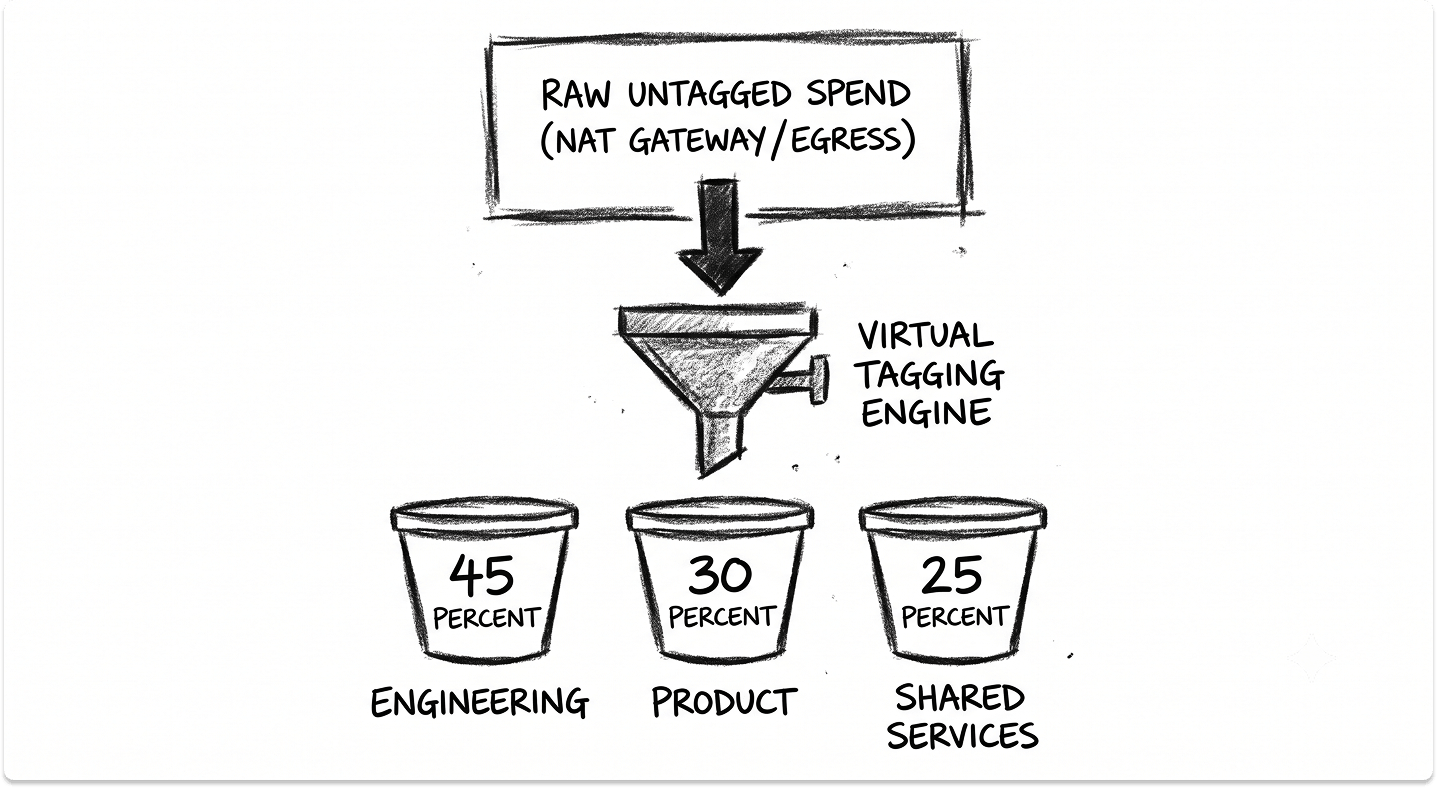
It handles the resources that resist tagging entirely, such as NAT Gateway data transfer and cross-cloud egress, and it supports two shared-cost models: proportional to usage, or mapped to business metrics like revenue or feature.
Vantage cites customer allocation coverage above 90 percent using virtual tags, a vendor-stated figure that will depend heavily on your own tagging discipline.
If your tags are already clean, all three will serve you. If they are a mess and you cannot fund a tagging cleanup, Vantage's virtual tagging will get you to a defensible allocation faster than the rule engines in the other two.
Optimization: rightsizing, commitment management, and anomaly detection
Visibility tells you where the money went. Optimization tells you how to stop it going there, and this is where the gap between advisory and automated action becomes the deciding factor.
All three generate rightsizing recommendations for compute, storage, and databases, drawing on utilization metrics from the providers and, in Cloudability's case, from connected observability tools.
The difference is execution. Cloudability on its own is advisory, and it lets you push recommendations into Jira as tracked tasks with cost impact attached. Paired with Turbonomic, it moves from telling you what to change to changing it, with continuous automated resourcing decisions. CloudHealth and Vantage are advisory for rightsizing: they surface the recommendation, and your engineers execute.
Commitment management is where I see the sharpest practical divergence. Reserved Instances, Savings Plans, and Committed Use Discounts are the single largest lever most teams have, and automation here directly affects your effective discount rate.
Cloudability and CloudHealth both track coverage and utilization and recommend purchases, but leave the buying to you. Vantage's Autopilot actually purchases and manages AWS Compute Savings Plans and Reserved Instances automatically, priced separately at 5 percent of the savings it generates.
The limit is that Autopilot is AWS-focused, so multi-cloud commitment automation or full RI lifecycle management across providers still points you toward a dedicated commitment tool.
For anomaly detection, all three apply machine-learning baselines and alert on deviations. Broadcom describes CloudHealth's engine as detecting near-real-time anomalies with seasonality awareness and root-cause analysis down to usage type and resource ID.
Vantage routes anomaly and budget alerts to Slack, Jira, and Microsoft Teams, and its agent can act on configured policies. The honest caveat across all three is that anomaly quality depends on your data latency and your tolerance for false positives, so validate it against your own spend patterns before you trust it to page anyone.
Kubernetes and container cost visibility
Container spend is the fastest-moving line in most modern estates, and standard billing exports cannot see inside a cluster. Cost per namespace, per workload, and per team lives at the Kubernetes layer, so each platform runs an in-cluster agent to collect it.
Cloudability deploys a metrics agent that compares requests against limits per namespace and quantifies the cost of idle CPU, and the IBM stack backs it with Kubecost for deeper container allocation.
CloudHealth uses a Helm-based collector that allocates by request, by actual CPU and memory usage, or both, and in 2025 it aligned to the OpenCost standard so that persistent volumes, load balancers, and network egress fold into container costs automatically. Its container support currently targets AWS and Azure clusters.
Vantage runs its own Kubernetes agent, evolved from the CNCF OpenCost project, as a single in-cluster deployment. It breaks cost down by service, namespace, and label, does per-container rightsizing on vCPU and memory, and shows in-cluster cost next to the out-of-cluster resources those clusters depend on.

If Kubernetes is a large and growing share of your spend, all three are viable, and your choice should follow which managed Kubernetes service and cloud mix you run.
SaaS, AI, and non-cloud spend
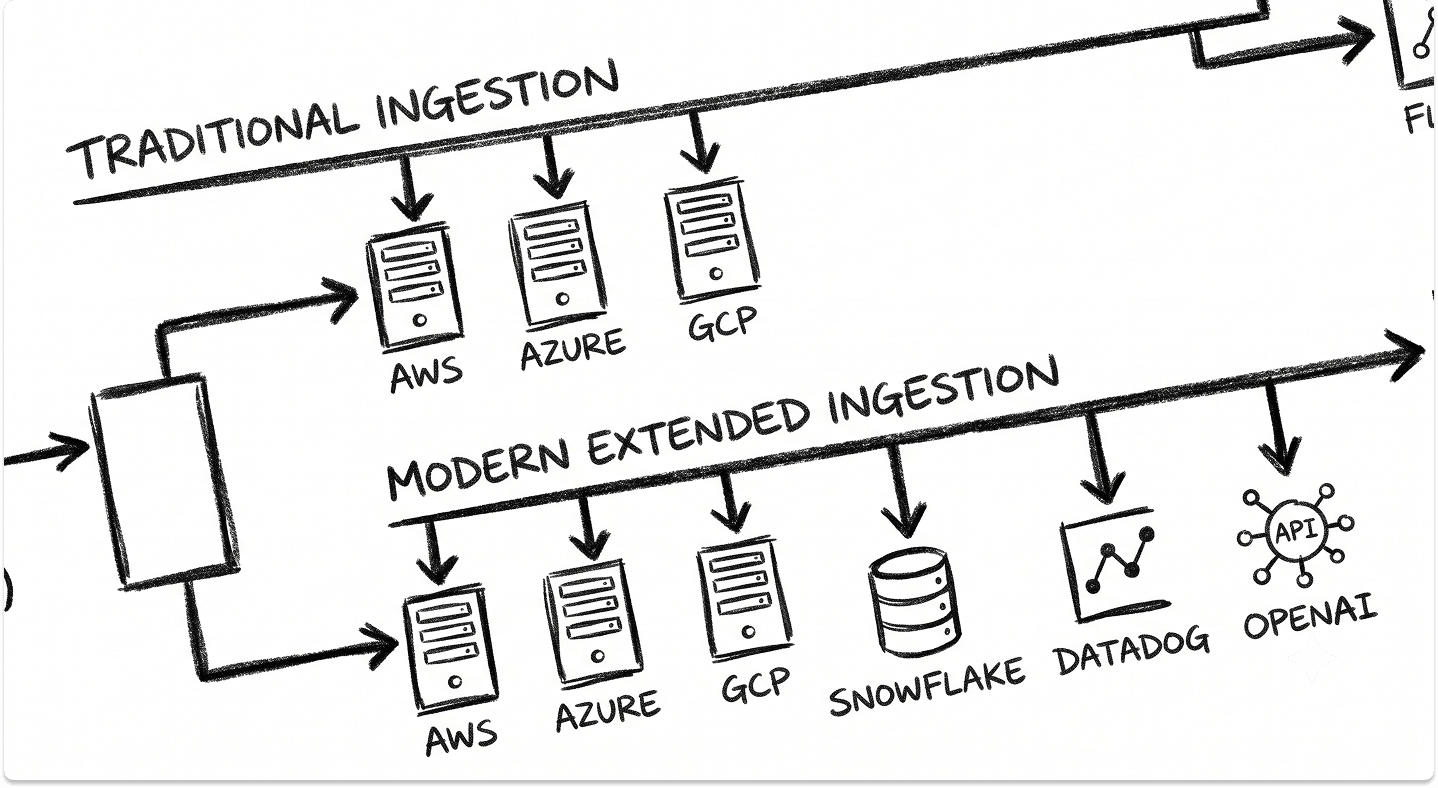
Cloud infrastructure is no longer the whole bill. Observability, data warehousing, and AI inference now consume budgets large enough that finance treats them the same as compute, and this is the clearest line of separation between the three tools.
Vantage ingests spend from a wide set of non-cloud services natively, including observability platforms like Datadog, data platforms such as Snowflake, MongoDB Atlas, Databricks, and the AI providers OpenAI and Anthropic.
For Datadog specifically, it can associate host costs back to the underlying cloud resources, which closes a gap most infrastructure tools leave open. This breadth is Vantage's strongest single argument.
Cloudability and CloudHealth are both extending toward SaaS and licensing cost, and Cloudability adds AI spend visibility, but neither matches the depth or the engineer-friendly setup Vantage offers for third-party services today. If a meaningful share of your spend sits outside the three hyperscalers, that gap will decide the evaluation on its own.
APIs, automation, and FinOps as code
For any team that treats cost as an engineering concern, the integration surface matters as much as the dashboard. All three expose REST APIs and integrate with the tools your engineers already live in.
Cloudability offers a REST API covering reporting, business mappings, rightsizing, anomalies, and budgets, plus Jira and ITSM integration for embedded tasks. CloudHealth exposes both REST and GraphQL, with a live GraphQL explorer and a policy engine for automated remediation workflows.
Vantage goes furthest toward treating cost as code. Alongside its REST API, it ships a Terraform provider so you can define budgets, reports, and alerts declaratively, plus Slack, Jira, and Microsoft Teams integrations and an MCP server that lets you query costs from an AI assistant.
If you want cost governance to live in your existing infrastructure-as-code pipeline, Vantage is the most direct fit.
Deployment, security, and compliance
All three run as SaaS with read-oriented access to your billing data, and for regulated environments the compliance posture becomes a gating question rather than a nice-to-have.
Apptio holds ISO 27001 certification, publishes SOC reports, and carries FedRAMP authorization, which makes Cloudability the clear choice if you serve US public-sector requirements.
Vantage holds SOC 2 Type 2 and SOC 1 Type 2 reports, uses read-only service accounts, and runs regular third-party penetration tests, but it states plainly that it is not formally ISO 27001 certified and only broadly aligns to that standard.
CloudHealth historically held SOC 2, but I could not confirm its current ISO 27001 or FedRAMP status from an authoritative source, so treat those as items to verify directly with Broadcom or Arrow before you sign. Do not assume a certification carried over through the ownership changes.
Pricing models and what you actually pay
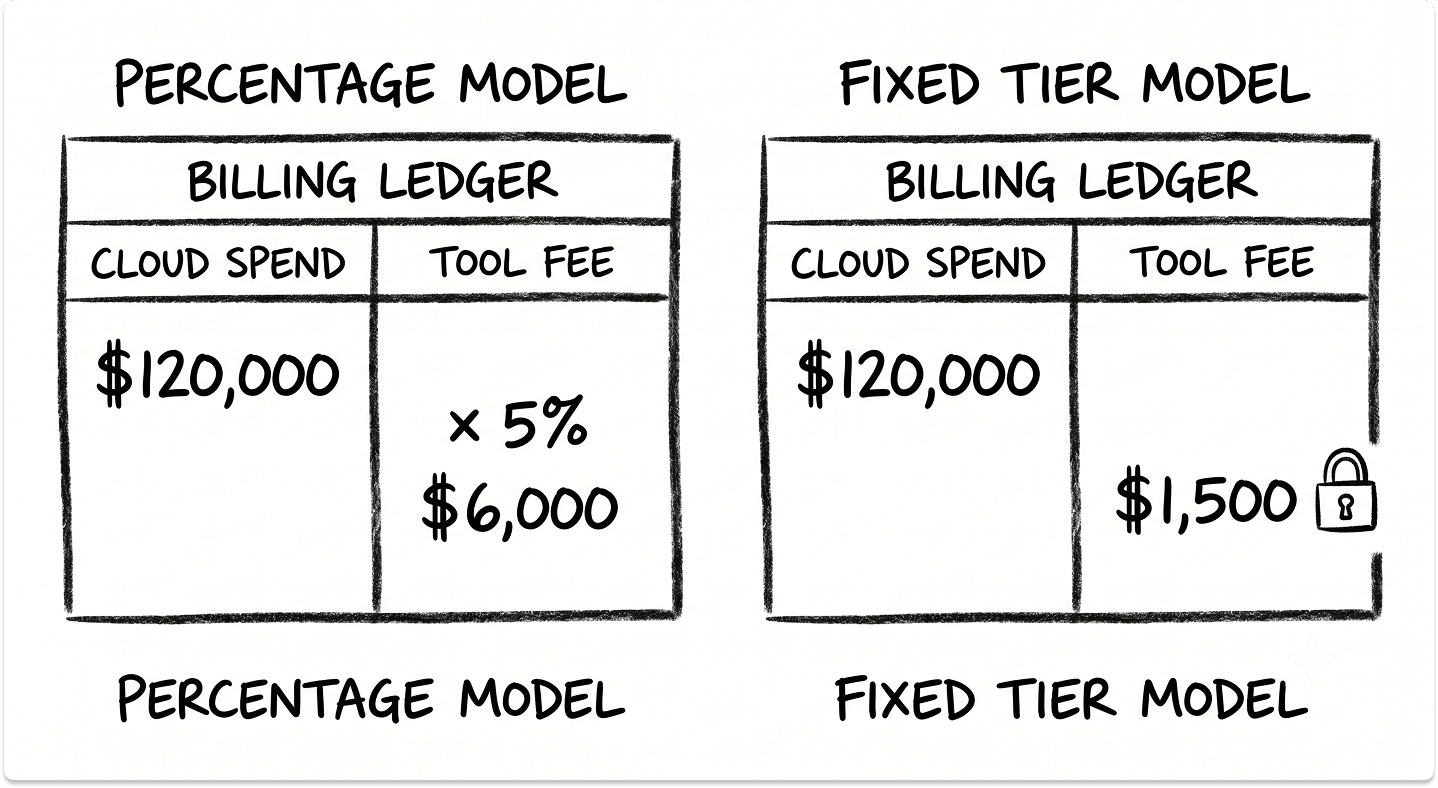
Pricing structure is a technical decision as much as a financial one, because it shapes how the tool's cost scales with your cloud growth. The three take different approaches, and the model matters more than any single quoted number.
Cloudability and CloudHealth both price as a percentage of the annual cloud spend they manage, negotiated per contract, with no public self-serve rate. Third-party transaction data suggests Cloudability lands roughly in the one-to-three-percent range depending on volume and term, with the rate declining as managed spend rises.
Those are external estimates, not published figures, so use them for sizing rather than budgeting. CloudHealth follows a similar percentage-of-spend model, transacted through Arrow.
Vantage is the most transparent. It charges a fixed monthly subscription based on tracked spend, with unlimited users at every tier and a free tier for smaller estates, and Autopilot priced separately at 5 percent of savings generated. The structural point is that a percentage-of-spend model grows your tooling cost in lockstep with the bill you are trying to cut, while a fixed model does not. For fast-growing estates, that difference compounds.
See which FInOps or Cloud Cost platform best suits your needs
How to choose: matching the tool to your environment
The decision comes down to your scale, your operating model, and how much of your spend sits outside the big three clouds.
Choose Cloudability if you run a large multi-cloud estate with a mature FinOps or technology-business-management practice, you want automated optimization through Turbonomic rather than advice you have to action by hand, or you carry public-sector compliance requirements that need FedRAMP. The honest trade-off is implementation weight and a percentage-of-spend contract, so it earns its cost above roughly the multi-million-dollar annual spend mark and feels heavy below it.
Choose CloudHealth if you already operate inside the VMware ecosystem, you buy through partners, or you need the broadest provider visibility including Oracle Cloud, Alibaba, and vSphere in one view. Go in clear-eyed that you transact through Arrow and that the market's development momentum has moved elsewhere, and press for firm roadmap and certification commitments before you commit.
Choose Vantage if you are an engineering-led team that wants visibility running within the hour, transparent fixed pricing, and real coverage of SaaS and AI spend. Its ceiling is allocation depth at the largest enterprise scale and AWS-centric commitment automation, so very large or heavily reserved estates may outgrow parts of it.
One benchmark cuts across all of this: if your effective discount rate sits below about 25 percent, commitment automation should weigh heaviest in your decision, which favors Cloudability with Turbonomic or a dedicated commitment tool over an advisory-only platform.
And whichever you pick, the platform is the instrument, not the outcome. The savings come from the cloud cost optimization decisions your team makes with the data, including the harder questions about what to re-architect or move during your next cloud migration.
Not sure which FinOps platform fits your estate?
We match IT teams with pre-vetted cloud cost tooling based on your provider mix, spend profile, and how automated you need the optimization to be. No sales pitch, no obligation, just a shortlist grounded in your requirements.
FAQ
Is CloudHealth being discontinued?
No. CloudHealth is still a live, actively updated product under Broadcom, and it shipped an interface refresh with generative-AI features in 2025. The change that affects you as a buyer is distribution: since May 2024, Broadcom sells and supports it exclusively through Arrow Electronics, so you transact with a distributor rather than the vendor directly. Development continues, though the market's momentum has shifted toward other platforms, which is worth weighing as roadmap risk.
Do these tools actually cut my cloud bill, or just report on it?
Most of what they do is visibility and advice. The exception is automated action. Cloudability paired with Turbonomic executes rightsizing changes rather than only recommending them, and Vantage Autopilot automatically buys and manages AWS Savings Plans and Reserved Instances for 5% of the savings it generates. CloudHealth and standalone Cloudability surface recommendations that your engineers then action manually.
Which platform has the best multi-cloud and hybrid coverage?
CloudHealth reads the widest set for visibility, including AWS, Azure, Google Cloud, Oracle Cloud, Alibaba Cloud, and VMware vSphere, which suits mixed or private-cloud estates. Cloudability covers the three major clouds with strong normalization plus several others. Vantage supports the big three, Oracle Cloud with some limits, and around 25 further integrations. All three run deepest on AWS.
Which tool is best for tracking SaaS and AI spend alongside cloud?
Vantage, by a clear margin. It natively ingests spend from Datadog, Snowflake, MongoDB Atlas, Databricks, and the AI providers OpenAI and Anthropic, and for Datadog it can tie host costs back to the underlying cloud resources. Cloudability adds AI spend visibility and both incumbents are broadening toward SaaS, but neither matches Vantage's breadth or setup speed for third-party services today.
How do the pricing models compare, and which scales best?
Cloudability and CloudHealth both price as a negotiated percentage of the cloud spend they manage, with no public self-serve rate. Vantage charges a fixed monthly subscription based on tracked spend, with unlimited users and a free tier for smaller estates. The structural difference is that a percentage-of-spend model grows your tooling cost in step with the bill you are trying to reduce, while a fixed model does not, which compounds for fast-growing estates.