Snowflake vs Databricks vs BigQuery A Guide for IT Leaders in 2026
Snowflake vs. Databricks vs. BigQuery: which data platform should IT leaders pick in 2026? A strategic guide for CIOs on AI capabilities, pricing models, and architectural fit.
In 2024, the choice was between a data warehouse or a data lake. In 2026, the lines have blurred. All three major platforms, Snowflake, Databricks, and BigQuery, now support SQL, Python, and AI workloads.
For IT leaders, the decision is no longer about where you store data. It is about how your team works and how you intend to build your AI strategy.
This guide analyzes the three dominant data architectures in 2026:
- Snowflake: The polished, easy-to-use platform built for SQL analysts.
- Databricks: The flexible, code-first platform built for engineers.
- BigQuery: The scalable, serverless platform built for the Google ecosystem.
The Core Architectural Difference
To choose the right tool, you must understand how each platform manages data and resources.
Snowflake
Snowflake separates storage from computing power. You pay for virtual warehouses that spin up instantly to run queries and shut down when finished. It uses a proprietary storage format that requires zero maintenance. You load data, and it is instantly ready for analysis without manual tuning.
Databricks
Databricks is built on open standards like Apache Spark and Delta Lake. You store your data in your own cloud buckets (like AWS S3 or Azure Blob) in an open format. Databricks provides the engine to process it. This approach gives you full ownership of your files but requires more configuration to optimize performance.
Google BigQuery
BigQuery is a true serverless warehouse. There are no clusters to manage. You submit a query, and Google allocates resources instantly to process it. It separates computing and storage geographically, allowing you to scan massive datasets in seconds without configuring servers.
Snowflake
Best For: Organizations with strong Business Intelligence teams who want to adopt AI without hiring specialized engineers.
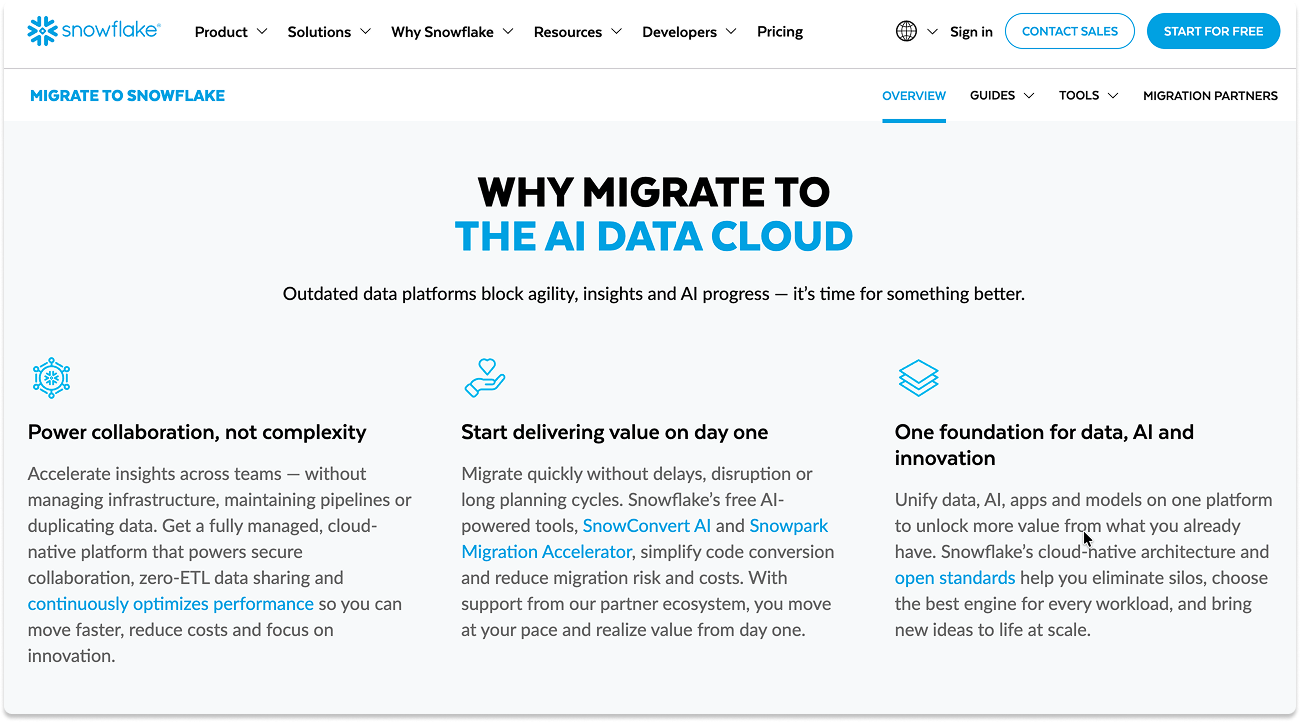
Snowflake focuses on simplicity. In 2026, its strategy is to run AI models directly inside the database, allowing analysts to use advanced features without leaving their SQL environment.
Technical Capabilities
- Cortex: This fully managed service allows analysts to use Generative AI through simple SQL commands. You can summarize text or translate languages directly in your queries without setting up external infrastructure.
- Unistore: This feature allows Snowflake to handle both transaction processing and analytics. You can build applications directly on Snowflake without needing a separate operational database.
Drawbacks
- Cost Management: Snowflake is premium software. If you accidentally leave a large warehouse running, costs accumulate quickly.
- Proprietary Storage: While it supports some open formats, the platform performs best when data is stored in Snowflake’s own format. Moving large amounts of data out of Snowflake can be slow and expensive.
Databricks
Best For: Organizations building custom AI models or complex data engineering pipelines.
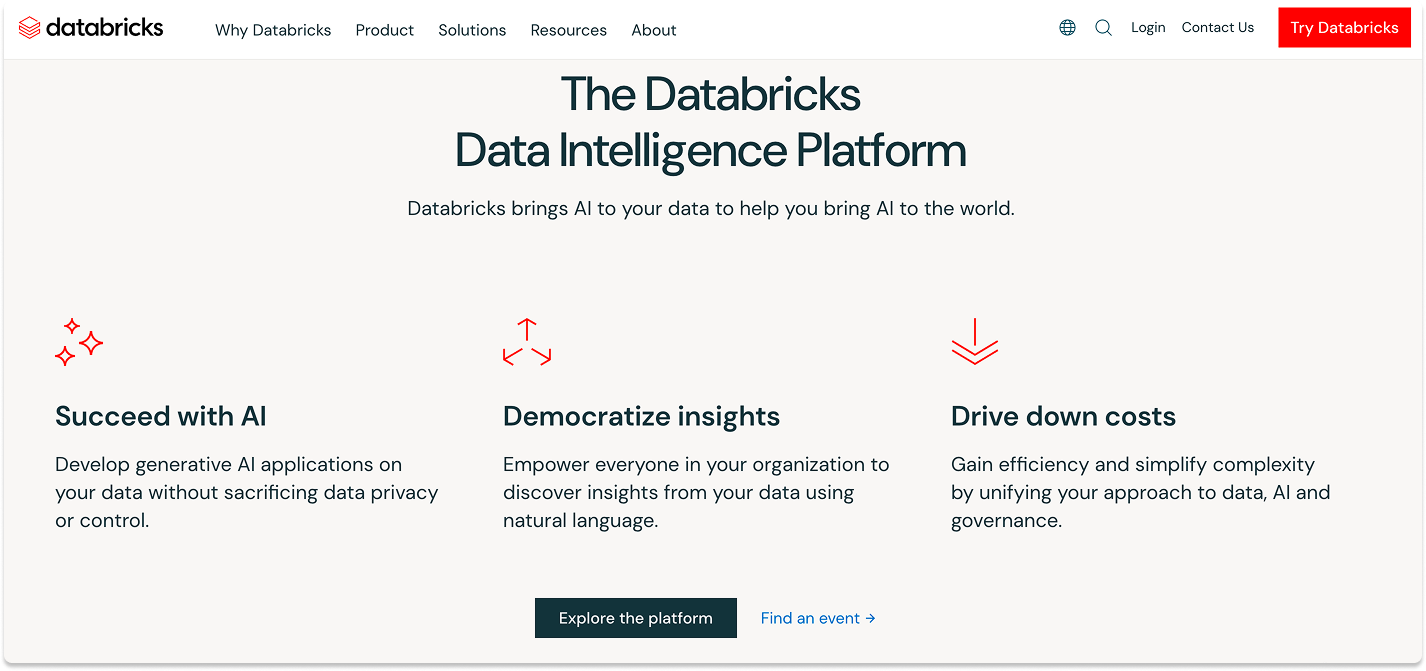
Databricks is designed for teams that want to look under the hood. If your goal is to train a custom Large Language Model on your own data, Databricks provides the best tools for the job.
Technical Capabilities
- Mosaic AI: This is a unified toolchain for developing Generative AI. Unlike the pre-packaged models in Snowflake, Mosaic AI gives you full control to fine-tune open-source models on your specific data.
- Unity Catalog: This governance layer manages permissions across your files, tables, and AI models. It solves the historical security challenges of data lakes by providing a single view of who has access to what.
Drawbacks
- Learning Curve: Databricks is built for engineers. The interface relies on notebooks and code, which can be difficult for business analysts who prefer simple SQL editors.
- Configuration: Even with serverless options, you often need to manage policies and instance types to keep costs low.
Google BigQuery
Best For: Teams already using Google Cloud and those who want effortless scalability.
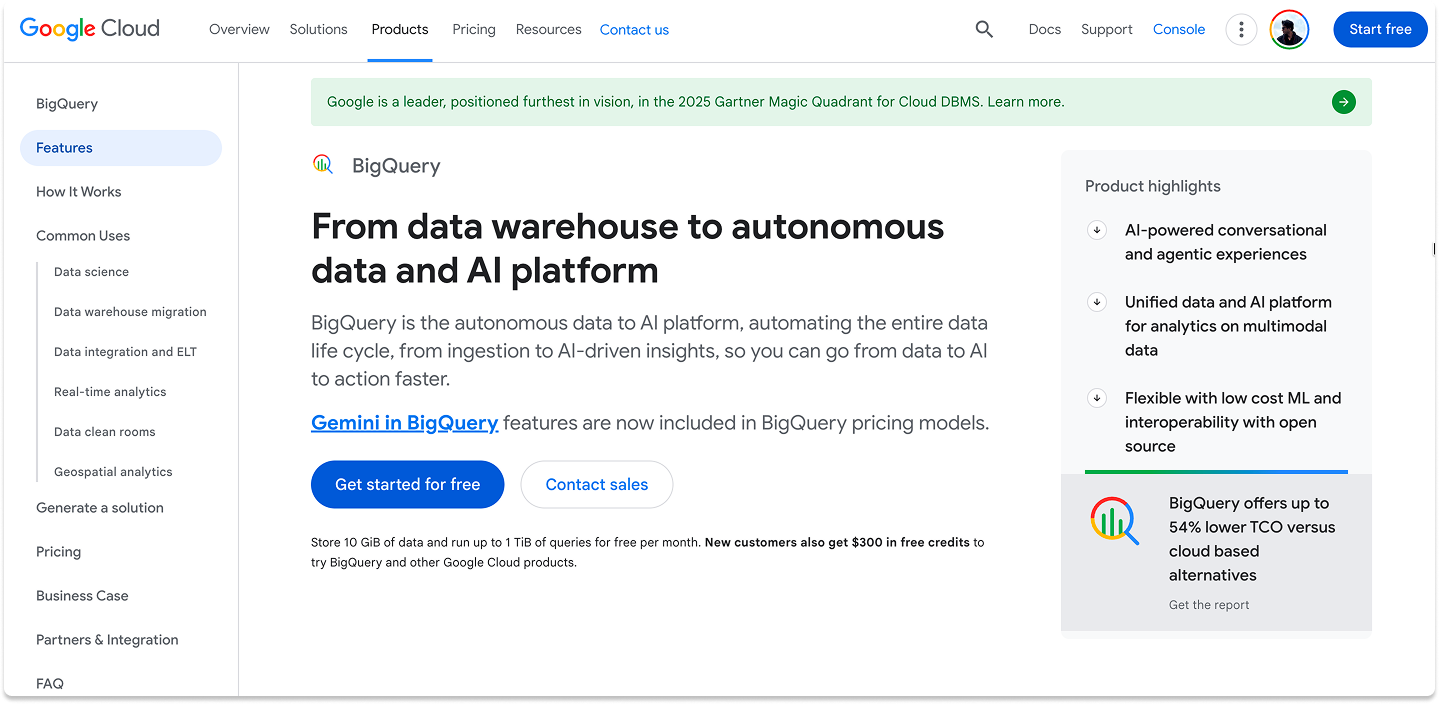
BigQuery is the default choice for the Google ecosystem. It integrates deeply with Google Ads, YouTube, and Google Analytics. In 2026, it functions as an AI engine powered by Gemini.
Technical Capabilities
- Gemini Integration: You can analyze unstructured data, like images or PDF documents, directly within the warehouse. You can use SQL queries to ask questions about the content of images stored in your tables.
- BigLake: This engine allows BigQuery to access data stored in AWS or Azure without moving it. This helps break down data silos in multi-cloud organizations.
Drawbacks
- Cost Predictability: The on-demand pricing model charges based on the amount of data scanned. A poorly written query can accidentally scan terabytes of data, leading to unexpected bills.
- Ecosystem Reliance: While BigQuery can run on other clouds, its advanced AI features work best when your data resides natively within Google Cloud.
How to Decide
Use these three scenarios to select the right platform for your organization.
Scenario 1: The Analytics Team
Context: You have a large team of Tableau or PowerBI users and very few data engineers. Your goal is fast, reliable reporting.
Winner: Snowflake.
Why: It requires the least maintenance. Your analysts can self-serve using SQL, and the AI features allow them to do advanced work without learning Python.
Scenario 2: The Engineering Team
Context: You are building a product that relies on custom AI models. You have a team of Python developers and data scientists.
Winner: Databricks.
Why: Your team needs direct access to raw data files and the ability to fine-tune models. The notebook environment is built for collaboration between engineers and scientists.
Scenario 3: The Marketing Team
Context: Your business runs on Google Ads, YouTube, and Google Analytics 4. You need to analyze customer behavior across these channels.
Winner: BigQuery.
Why: The native data transfer service from Google Marketing Platform to BigQuery is seamless. You can ingest terabytes of ad data with a few clicks and no code.
Comparing Data Platforms
Closing Thoughts
- Choose Snowflake for a reliable platform that is easy to manage and ideal for business intelligence.
- Choose Databricks for a flexible platform that gives engineers full control over data and custom AI models.
- Choose BigQuery for a scalable platform that integrates perfectly with the Google Cloud ecosystem.
Strategic Advice: Align the tool with your team's skills. If your team knows SQL, Snowflake will be faster to adopt. If your team uses Python, Databricks provides the environment they need.
Also read:
Looking for storage vendors?
Before you commit to an architecture, it's worth seeing your options and exploring if there are vendors who might be a better fit. Tell us what you're working with. We'll match you with the the ones worth your time.
FAQ
Is Databricks cheaper than Snowflake?
It depends on the workload. For heavy data processing and machine learning tasks, Databricks is often cheaper because its engine is optimized for those jobs. For standard business reporting, Snowflake's ability to automatically suspend warehouses can be more cost-effective.
Can I use BigQuery if I am on AWS?
Yes, using BigQuery Omni. This allows you to run BigQuery analytics on data stored in AWS S3 without moving the data. However, performance and features are generally better when the data resides natively in Google Cloud.
Does Snowflake support Python?
Yes. Developers can use Snowpark to write Python, Java, and Scala code that executes inside Snowflake. This makes Snowflake more competitive with Databricks, although Databricks still offers a better native notebook experience for Python developers.
What is the difference between a Data Warehouse and a Data Lakehouse?
A Data Warehouse like Snowflake stores structured data for reporting. A Data Lake stores raw, unstructured files. A Lakehouse like Databricks combines both, storing raw files but adding a management layer that lets you query them like a warehouse. In 2026, both platforms offer Lakehouse capabilities.
Which platform is best for Generative AI?
If you want to use existing AI models to summarize text or answer questions, Snowflake Cortex and BigQuery Gemini are the easiest options. If you want to build or fine-tune your own AI models, Databricks Mosaic AI provides the most robust tools for engineers.