



What is Cloudflare, How It Works, and What It Does for IT Leaders
Cloudflare is a connectivity cloud platform that delivers DDoS protection, Zero Trust security, WAF, SASE, and application performance from a single global network. This guide covers how Cloudflare works, what each product layer does, and how IT leaders are using it to replace VPNs, protect infrastructure, and consolidate security tools.

What Is Cloudflare?
Cloudflare is a connectivity cloud platform that delivers security, networking, and application performance services from a single global network, instead of through a collection of on-premises appliances and point tools. It sits across multiple categories simultaneously: Security Service Edge (SSE), SASE, DDoS mitigation, CDN, and developer infrastructure.
The core premise behind what Cloudflare does: every service runs on every server in every one of its 335+ global data centers. Traffic is routed into Cloudflare's network, inspected and policy-enforced in a single pass, and delivered without bouncing through a chain of separate tools.
In practice, Cloudflare:
- Sits between your users, your applications, and the internet
- Routes all traffic through its global network using Anycast, directing requests to the nearest data center automatically
- Inspects and enforces security policies inline, in a single pass, before traffic reaches your infrastructure
- Connects users only to the specific applications they are authorized to reach, with no exposure to the broader network
- Protects your public-facing IP infrastructure from volumetric network attacks before they touch your perimeter
- Delivers applications globally with built-in performance optimization and redundancy
What is Cloudflare used for across the enterprise? Replacing VPNs, securing web applications and APIs, protecting network infrastructure from DDoS, governing SaaS and cloud access, and consolidating security and networking tools under one control plane.
It's budget season; let's see how you do
Budget comes up in about 88% of the thousands of conversations we have with IT leaders. So we made a game about it. Play to find out what your year-end board meeting looks like.
Play game
How Does Cloudflare Work?
At a high level, Cloudflare replaces the model where traffic flows between users, infrastructure, and the internet through a chain of appliances. Instead, it operates as a global proxy network where every security and performance function runs at the same point, close to the user.
1. Traffic Routing via Anycast
When a user or device makes a request to a website, SaaS application, internal app, or API, Anycast routing directs that traffic to the nearest Cloudflare data center automatically.

You onboard traffic to Cloudflare using:
- A lightweight device agent (WARP client) for user traffic
- Tunnels (Cloudflare Tunnel) from servers, applications, or data centers
- BGP prefix announcements for on-premises network infrastructure
- DNS delegation for application-layer protection
Every Cloudflare data center runs every service. There is no regional hub for specific functions. Inspection, firewall rules, DLP, and Zero Trust policies all execute at whichever location receives the traffic.
2. Identity and Context Verification
For Zero Trust access, Cloudflare integrates with your identity provider (Microsoft Entra ID, Okta, Google, etc.) and evaluates:
- Who the user is (identity, group membership, role)
- What device they are on (managed/unmanaged, device posture, OS compliance)
- Where they are connecting from (location, network, IP reputation)
- What they are trying to reach (specific application, resource path)
Every request is evaluated per session, continuously, not just at login.
3. Single-Pass Inspection and Policy Enforcement
Cloudflare does not route traffic through separate tools in sequence. All policy evaluation, including threat inspection, identity checks, data loss prevention, firewall rules, and DNS filtering, happens in a single pass at the Cloudflare network layer.
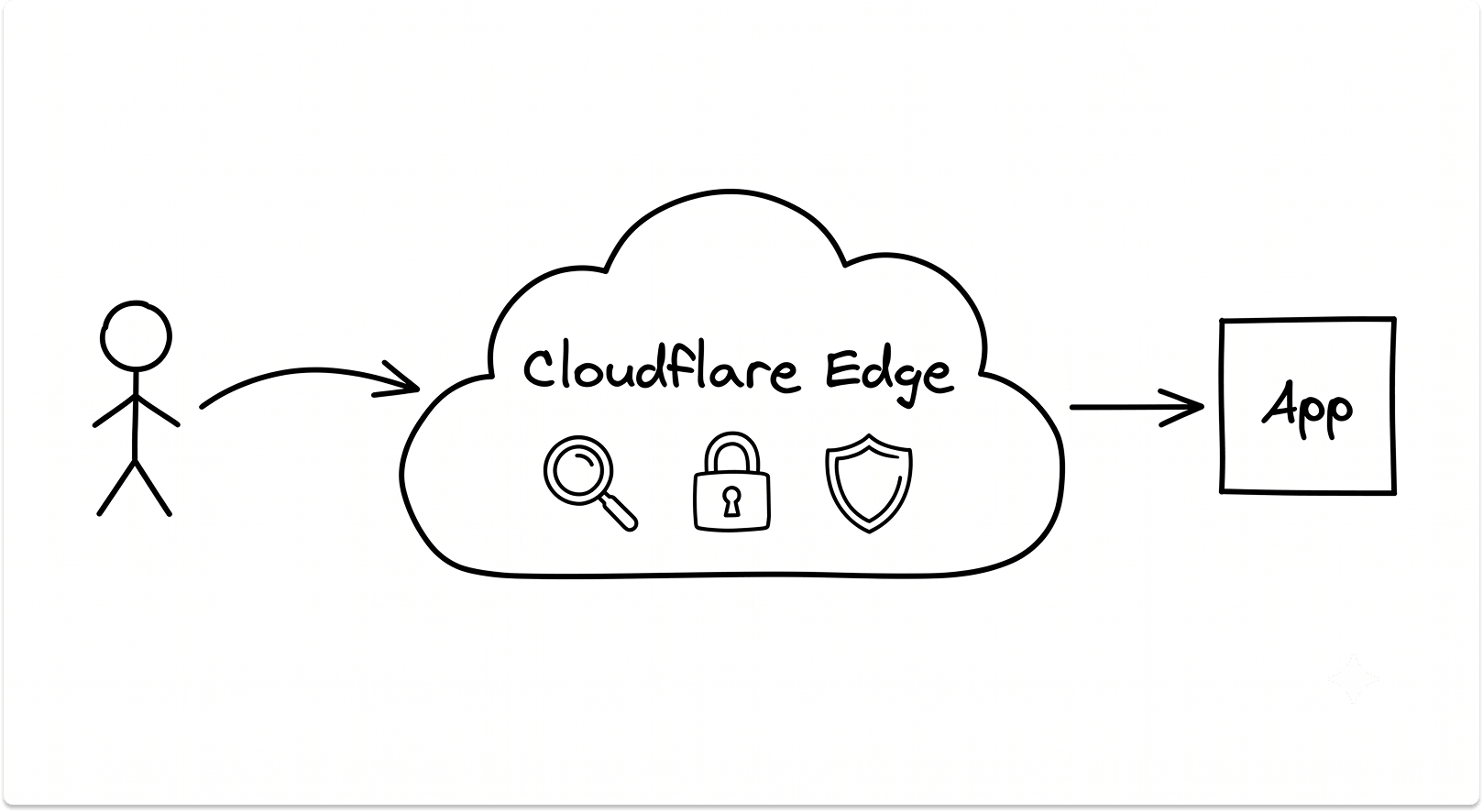
For each request, Cloudflare decides:
- Allow, block, or step-up challenge
- Apply DLP controls, WAF rules, or rate limits
- Route to the appropriate destination (internet, SaaS, private application)
Policy decisions are based on the full context of the request: identity, device, application, and content.
4. Inline Inspection
Where applicable, Cloudflare acts as a full proxy:
- Decrypts TLS traffic for inspection
- Applies threat detection: malware, phishing, command-and-control, DNS tunneling
- Runs DLP policies against outbound content
- Enforces WAF rule sets and API schema validation against inbound traffic
- Re-encrypts and forwards traffic
All of this happens inline, at the Cloudflare edge closest to the user or the application.
5. Application or Network Delivery
For internet and SaaS traffic: Cloudflare forwards inspected, policy-compliant traffic to the destination.
For private applications (Zero Trust access):
- Cloudflare Tunnel connectors deployed inside your environment make outbound-only connections to Cloudflare
- Applications are never exposed to the internet. No open inbound ports, no VPN gateways
- Cloudflare brokers a connection from the authenticated, verified user to the specific app, without the user ever touching the network
For network infrastructure (Magic Transit):
- Cloudflare announces your IP prefixes via BGP
- All inbound traffic is absorbed at Cloudflare's network edge, scrubbed, and clean traffic is forwarded to your infrastructure
- Your environment never sees the raw attack traffic
Cloudflare Product Architecture: Cloudflare One, Application Security, and Magic Transit
Cloudflare is not a single product. It is three distinct layers, each solving a different problem, often licensed and deployed independently. Most evaluation conversations treat Cloudflare as one thing without clarifying which layer is actually relevant.
Cloudflare One (Zero Trust and SASE)
What it does: Secures how users connect to applications by replacing VPN, SWG appliances, CASB tools, and email security gateways with a unified cloud-delivered stack. Cloudflare One covers the full SSE surface: ZTNA, Secure Web Gateway, CASB, DLP, Remote Browser Isolation, and Email Security.
Problems it replaces:
- VPN concentrators and remote access infrastructure
- On-premises secure web gateways and proxy appliances
- Standalone CASB tools for SaaS visibility
- Separate email security gateways
- Network-level access that grants more connectivity than users need
When you need it: Organizations replacing VPN, enforcing Zero Trust access for remote or contractor users, governing SaaS and cloud data movement, or consolidating their security stack onto fewer platforms. Cloudflare One is typically the entry point for enterprise Cloudflare deployments.
Key capabilities in Cloudflare One:
- ZTNA (Cloudflare Access): Per-application access control with continuous identity and device posture verification. Clientless or agent-based, with no network exposure.
- Secure Web Gateway (Cloudflare Gateway): DNS, HTTP, and network traffic filtering. Blocks malware, enforces acceptable use policies, and prevents data exfiltration. Operates against 4.3 trillion DNS queries processed daily.
- CASB: Inline and API-based SaaS visibility. Detects shadow IT, misconfigurations, and unauthorized third-party OAuth connections across Microsoft 365, Google Workspace, Salesforce, and others.
- DLP: Data movement policies enforced inline across SaaS and cloud applications, with no reliance on endpoint agents.
- Email Security: AI-powered detection and blocking of phishing, business email compromise, brand impersonation, and malware. 43% of emails fail SPF and 46% fail DMARC across the internet, meaning most organizations are relying on perimeter tools to catch what the sending side is already failing to prevent.
- Magic WAN: SD-WAN replacement that routes branch, data center, and cloud traffic over Cloudflare's private backbone without MPLS.
- Remote Browser Isolation (RBI): Executes web browsing in a cloud container and sends only a safe visual stream to the user's device. Isolates zero-day threats and unmanaged device risk without blocking access.
Application Security (WAF, DDoS, API Shield, Bot Management)
What it does: Protects internet-facing applications and APIs from external threats. This layer sits between the public internet and your web applications, filtering malicious traffic before it reaches your origin.
Problems it replaces:
- On-premises WAF appliances
- Separate DDoS scrubbing services
- Standalone bot mitigation tools
- Manual API security review processes
When you need it: Any organization running public-facing web applications, APIs, or customer portals, particularly those experiencing volumetric attacks, API abuse, or bot-driven credential stuffing. This is often the first Cloudflare layer deployed for organizations that already proxy their web traffic through a CDN.
Key capabilities:
- WAF (Web Application Firewall): Blocks OWASP Top 10 threats, zero-day exploits, and custom rule sets inline. Rules update globally in under 30 seconds.
- API Shield: Discovers and inventories APIs automatically. Enforces schema validation and JWT authentication, and flags endpoints receiving requests outside their defined parameters.
- Bot Management: Classifies and controls bot traffic by type, covering search crawlers, automated scrapers, credential stuffers, and attack bots. 30% of all HTTP traffic originates from bots, and 94% of all login attempts are bot-driven.
- L7 DDoS Protection: Inline HTTP DDoS mitigation against request floods, slow POST attacks, and HTTP/2 rapid reset, sitting in the same inspection pass as the WAF.
Magic Transit (Network-Layer Protection)
What it does: Protects on-premises and data center network infrastructure from volumetric L3/L4 DDoS attacks. Magic Transit announces your organization's IP address space via BGP from Cloudflare's network, absorbs inbound attack traffic before it reaches your infrastructure, and returns clean traffic through a GRE or CNI tunnel.
Problems it replaces:
- On-premises DDoS mitigation hardware
- Carrier-level scrubbing services with long activation times
- Over-provisioned transit capacity purchased purely as a DDoS buffer
When you need it: Organizations with public-facing IP infrastructure: data centers, financial trading systems, gaming platforms, DNS infrastructure, or any environment that is a realistic DDoS target. Also relevant for organizations that have experienced mitigation gaps where attack volume exceeded their existing hardware capacity.
Key capabilities:
- BGP-based IP prefix announcement with 500 Tbps mitigation capacity
- Always-on or on-demand mitigation modes
- Magic Firewall: packet-level filtering rules enforced at the Cloudflare edge before traffic enters your network
- Programmable Flow Protection: custom DDoS mitigation rules for organizations with specific traffic profiles
- Full visibility into traffic flows, attack patterns, and mitigation actions
What Cloudflare Offers IT Leaders
Cloudflare is broad. For IT leaders, it is most useful to examine what it offers through four lenses:
- DDoS and network-layer threat defense
- Zero Trust security and access control
- Application performance and reliability
- Security consolidation and operational efficiency
DDoS and Network-Layer Threat Defense
The threat surface at the network layer has changed structurally. Defending it with on-premises hardware is now an architecture problem, not a configuration problem.
DDoS Protection Workflow
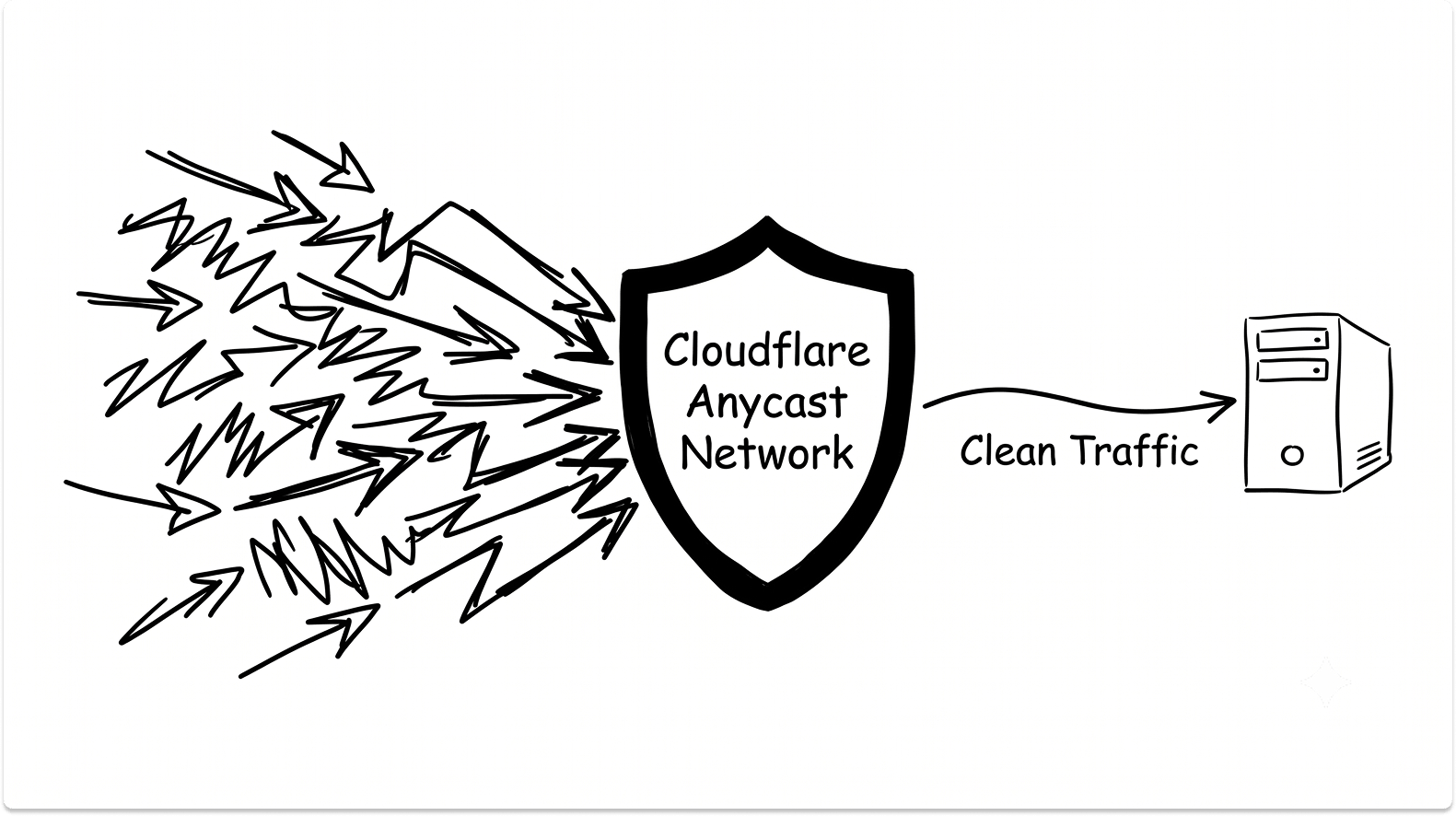
ATTACK TRAFFIC → BGP ANNOUNCEMENT → CLOUDFLARE EDGE (500 Tbps scrubbing) → CLEAN TRAFFIC → YOUR INFRASTRUCTURE
1. The Volume Has Outpaced On-Premises Mitigation
Cloudflare mitigated 47.1 million DDoS attacks in 2025, more than double the previous year, with network-layer attacks tripling year-over-year. The largest single attack, recorded in November 2025, reached 31.4 Tbps, nearly six times the scale of 2024's largest observed attack. That is a volume no on-premises appliance absorbs. It requires a network with upstream capacity measured in terabits.
The average attack duration in 2025 was under 10 minutes. Human-in-the-loop mitigation, raising a ticket and escalating to the carrier to activate scrubbing, does not fit inside that window. Always-on, automated mitigation is the only architecture that covers it.
2. How Magic Transit Works at the Network Layer
Magic Transit announces your organization's IP prefixes from Cloudflare's Anycast network via BGP. From that point:
- All traffic destined for your IP space arrives at Cloudflare first
- Attack traffic is absorbed and dropped at the Cloudflare edge
- Clean traffic is forwarded to your infrastructure through a tunnel
- Your routers, firewalls, and servers never see the attack volume
500 Tbps of mitigation capacity means Cloudflare absorbs the largest currently observed attacks without introducing capacity constraints on your end.
3. Application-Layer DDoS Protection
L7 DDoS attacks, including HTTP floods, slow POST, and API endpoint exhaustion, don't generate the raw packet volumes that trigger network-layer detection thresholds. They target the application logic directly.
Cloudflare's L7 DDoS mitigation runs inline with the WAF, rate limiting, and bot management stack. It detects and blocks request-layer floods before they reach your origin, without requiring separate scrubbing infrastructure or a different configuration layer.
Zero Trust Security and Access Control
1. Replacing VPN with Per-Application Access
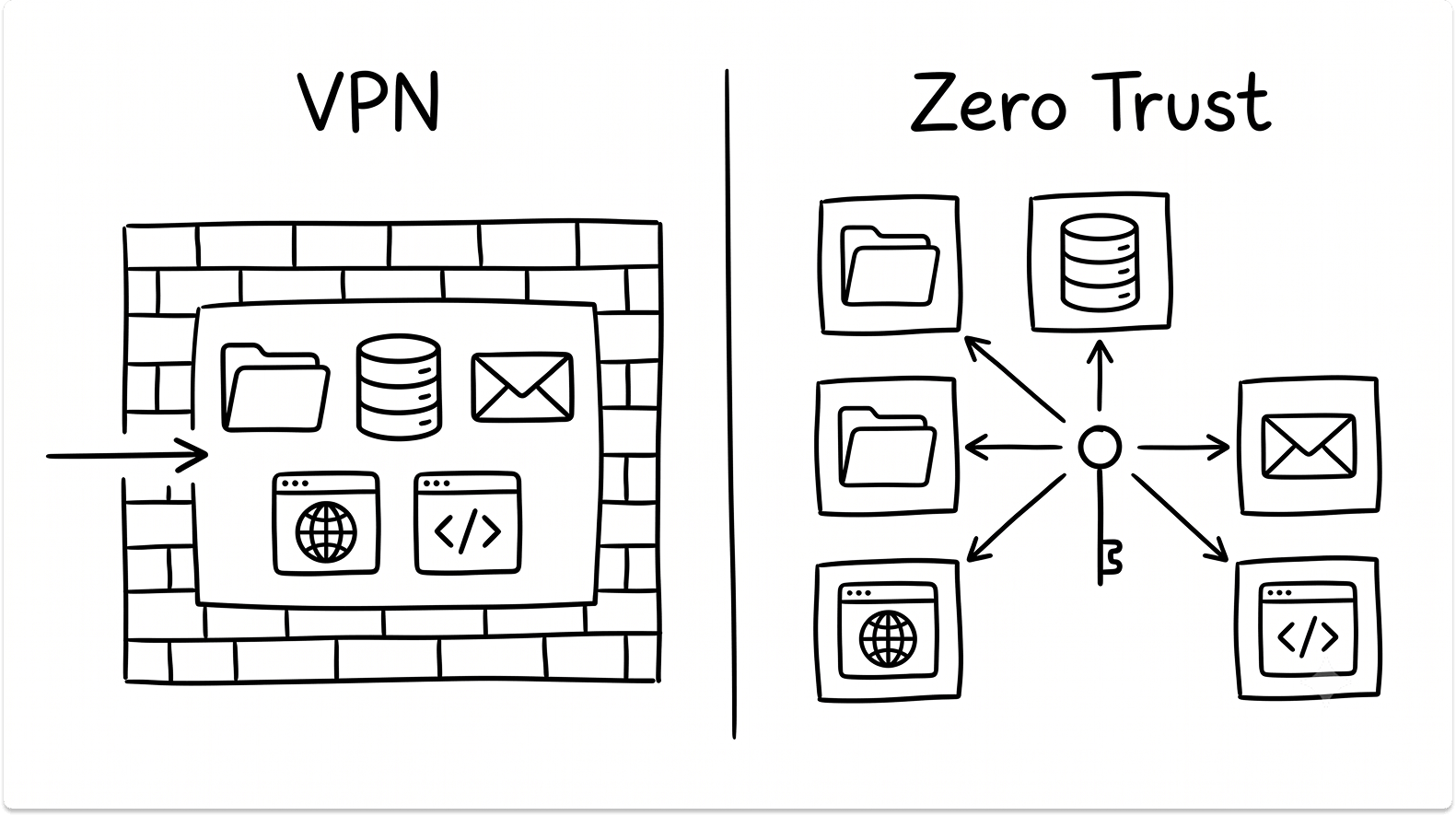
VPN grants network access. Once authenticated, the user reaches everything their network segment allows, including systems with no relationship to their job function. That lateral movement exposure is a concrete operational risk.
63% of all human logins involve credentials already compromised elsewhere. MFA is being actively bypassed via session token theft. Infostealers harvest live tokens and use them to authenticate without ever touching the user's password. Perimeter-only enforcement doesn't stop this.
Cloudflare Access brokers per-application connections:
- Users authenticate with your identity provider
- Device posture is checked: OS version, disk encryption, endpoint agent status
- A connection is brokered to the specific application, with no network-level access granted
- If posture degrades mid-session, access is revoked without waiting for re-authentication
A compromised credential on a VPN exposes the network segment. On Cloudflare Access, it exposes one application. The blast radius is structurally different.
2. SaaS Visibility and Data Governance
Most organizations don't have a complete inventory of which SaaS applications their users are accessing, which third-party OAuth connections have been granted to corporate accounts, or which SaaS configurations are exposing data externally.
Cloudflare's CASB:
- Scans your Microsoft 365, Google Workspace, Salesforce, and Slack environments for misconfigurations and data exposure
- Inventories all third-party OAuth integrations and flags over-privileged connections
- Detects shadow IT: applications in active use that your security policies don't cover
DLP runs inline against this traffic. Policies governing what data leaves through which channel are enforced at the Cloudflare network layer, with no dependency on endpoint agents that may be absent on contractor or BYOD devices.
3. Securing AI Agents and GenAI Usage
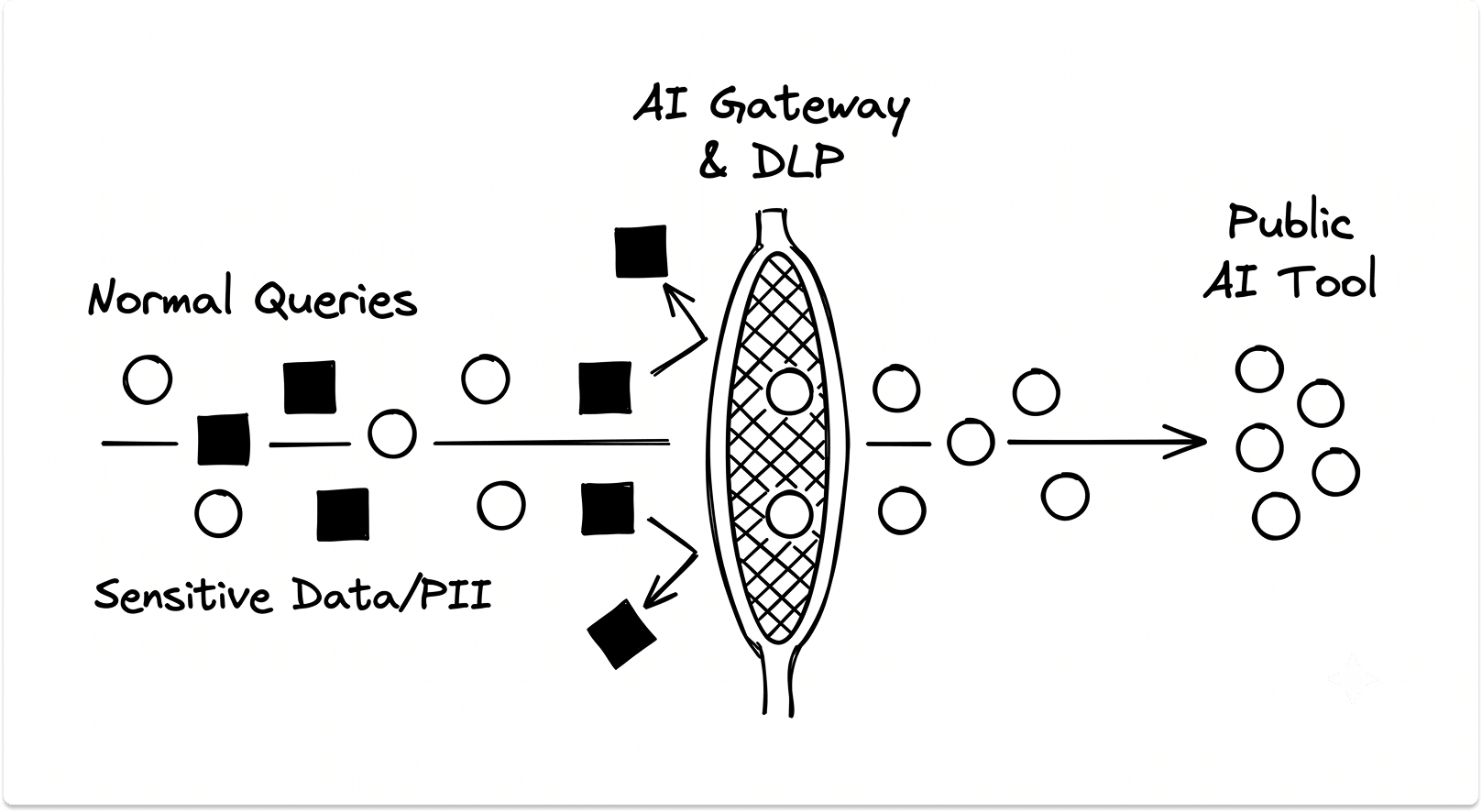
Shadow AI is now the same category of problem that shadow IT was five years ago. Users are sending data to AI tools that IT has not reviewed, has not contracted with, and cannot audit.
AI Gateway sits in the request path between your users and any AI API, covering OpenAI, Anthropic, Google Gemini, and others. Every prompt and response is logged. Rate limits are enforced. Sensitive data patterns in outbound prompts are flagged by DLP. 74% of leading organizations plan to double down on AI integration in the next year, which makes AI governance an active operational requirement.
CASB also performs shadow AI discovery, surfacing which AI tools are in use across the organization before they have been reviewed or approved.
Application Performance and Reliability
1. CDN and DNS at Global Scale
Cloudflare's CDN caches and serves content from the data center nearest to each end user. Origin requests drop. Time to first byte improves globally, not just in regions where you have infrastructure. For organizations serving international users or running latency-sensitive applications, this is a structural improvement.
Cloudflare's DNS resolver is consistently benchmarked as one of the fastest globally. DNS resolution latency is the first tax on every connection your applications make, and at scale, it compounds.
2. Argo Smart Routing and Load Balancing
The public internet routes traffic based on BGP, not based on real-time congestion or latency conditions. Argo Smart Routing monitors internet path performance in real time and routes traffic over Cloudflare's private backbone when a faster path exists.
Load balancing distributes traffic across origins with health checks, geographic steering, and latency-based routing. Traffic only goes to healthy origins. Failover is automatic, without DNS propagation delays.
3. Digital Experience Monitoring
When a remote user reports that an application is slow, the default troubleshooting question is: where in the path is the problem?
Digital Experience Monitoring (DEM) maps performance across every segment:
- The user's device and ISP connection
- The path to the nearest Cloudflare data center
- The Cloudflare-to-origin path
- The application response time at origin
It tells you which segment is degraded before users raise support tickets, and it tells you whether the issue is affecting one user, a regional subset, or your entire user base.
Security Consolidation and Operational Efficiency
1. One Control Plane, One API
Every Cloudflare service, covering Zero Trust policies, WAF rules, DNS configuration, network firewall rules, DLP policies, and email security settings, is managed from a single dashboard and a single API. Policy changes propagate globally in under 30 seconds. Log exports to your SIEM are unified. Automation via Terraform covers the entire platform.
This matters operationally for security teams managing multiple tools with separate configuration states. Configuration drift, where the WAF rule and the firewall rule and the DLP policy are each independently maintained and gradually diverge, is one of the primary sources of exploitable security gaps. A single control plane eliminates that category of risk.
2. The Cost Case for Consolidation
A Forrester Total Economic Impact™ study of Cloudflare's platform found a 238% ROI over three years, with payback in under six months. The specific efficiency improvements measured:
- 29% improvement in security team efficiency
- 13% improvement in IT team efficiency
- 25% reduction in breach risk
TELUS consolidated networking and security functions onto Cloudflare and reduced its security budget by over C$11 million. That outcome is not primarily from software license savings. It comes from the operational overhead reduction of running fewer tools, fewer vendors, and fewer management planes.
3. Post-Quantum Readiness
Cloudflare has deployed post-quantum cryptography across its network and supports post-quantum TLS between users, Cloudflare, and origins. This addresses the "harvest now, decrypt later" threat model, where state-level adversaries collect encrypted traffic today to decrypt it once quantum computing reaches sufficient scale.
Post-quantum cryptography readiness is listed as a top CxO infrastructure priority in Cloudflare's 2026 App Innovation Report. Most organizations cannot implement post-quantum TLS at the application layer without significant development effort. Cloudflare handles it at the network layer, transparently.
See Which Cloudflare Architecture and Offering Best Suits Your Needs
Is Cloudflare Right for Your Environment?
Cloudflare fits organizations dealing with the operational consequences of assembling their security and networking stack tool by tool over the last decade, and are now looking for a platform that covers multiple layers without requiring a separate management interface for each.
If you are replacing VPN, Cloudflare One is worth a direct evaluation against Zscaler and Palo Alto Prisma Access. Start with ZTNA and Gateway. Add CASB and DLP once access policy is established.
If DDoS protection for network infrastructure is the trigger, Magic Transit addresses that independently. It does not require deploying the rest of the Cloudflare stack first.
If application security is the entry point, covering WAF, API protection, and bot management, the Application Security layer can be deployed in front of existing infrastructure without any changes to your network architecture.
Cloudflare is a strong fit if:
- You are consolidating security and networking vendors onto fewer platforms
- You are replacing VPN with Zero Trust access for remote or contractor users
- You are under active or anticipated DDoS pressure on public-facing IP infrastructure
- You have a global user base that needs consistent application performance and security enforcement regardless of location
- Your security team is managing too many tools with too little cross-tool visibility
- You are operationalizing AI adoption and need governance over GenAI API usage
Consider alternatives or supplement with other tools if:
- Your primary gap is endpoint detection and response. Cloudflare does not replace EDR or XDR agents
- You require deep on-premises next-generation firewall inspection with complex stateful routing. Hardware-native vendors remain more applicable at the physical network edge
- You need SIEM or SOAR capabilities. Cloudflare generates telemetry and exports logs but is not a detection and response platform
The evaluation question is not whether Cloudflare covers a wide surface area. It does. The question is which layer your current environment needs most and whether the consolidation case justifies deploying it as a platform.
Also read: How does Cloudflare compare to Akamai and Fastly for CDN and Edge Security
Considering Cloudflare?
Explore and compare before you make a decision. Find and compare pre-vetted vendors across SASE, ZTNA, and DDoS protection on TechnologyMatch. You remain anonymous until you engage first so no cold calls and emails. And it's free.
FAQ
What does Cloudflare do?
Cloudflare is a connectivity cloud platform that delivers security, networking, and performance services from a single global network. It protects and accelerates traffic between your users, your applications, and the internet, enforcing Zero Trust access policies, blocking threats inline, protecting network infrastructure from DDoS attacks, and delivering applications from 335+ global locations. It replaces on-premises firewalls, VPN concentrators, web proxies, DDoS appliances, and CDN infrastructure under one management plane.
What is Cloudflare used for in enterprise environments?
The most common enterprise use cases are: replacing VPN with Zero Trust network access, protecting web applications and APIs from external attacks, absorbing volumetric DDoS attacks on network infrastructure, governing SaaS and cloud data movement through CASB and DLP, securing email against phishing and BEC, and consolidating security tools onto a single control plane. Developer teams also use Cloudflare Workers and R2 for global application deployment.
Is Cloudflare a firewall?
Cloudflare replaces specific firewall functions, including DNS filtering, HTTP traffic inspection, network-layer packet filtering via Magic Firewall, and Firewall-as-a-Service for branch and cloud traffic. For environments with complex on-premises stateful inspection requirements or hardware-dependent routing, Cloudflare typically complements physical next-generation firewalls at the network edge rather than replacing them outright.
How does Cloudflare's Zero Trust differ from a traditional VPN?
A VPN places the user on the corporate network and grants broad access to everything that network segment permits. Cloudflare Access grants per-application access, evaluated continuously against identity, device posture, and policy, without the user ever reaching the network. The application connectors make outbound-only connections to Cloudflare, with no inbound firewall rules, no open ports, and no VPN gateway published to the internet.
How does Cloudflare integrate with existing security tools?
Cloudflare integrates with identity providers (Microsoft Entra ID, Okta, Google Workspace) for user authentication, EDR platforms (CrowdStrike, Microsoft Defender) for device posture signals, and SIEM tools (Splunk, Microsoft Sentinel, Sumo Logic) for log forwarding. SD-WAN vendors (Cisco, VMware, Palo Alto) can steer branch traffic to Cloudflare for inspection. All integrations are pre-built through the Cloudflare dashboard or API.


