Ping Identity vs Okta vs OneLogin: An IAM Comparison Guide for 2026
Compare Okta, Ping Identity, and OneLogin on architecture, deployment model, pricing structure, and hybrid environment support. Includes Microsoft Entra ID, JumpCloud, CyberArk, and Cisco Duo as alternative IAM solutions in 2026.

Picking an identity and access management platform is one of the decisions that tends to get made once and lived with for a long time.
IAM sits underneath everything — SSO, MFA, directory services, lifecycle management, privileged access — which means replacing it later is expensive, disruptive, and politically difficult. Getting the evaluation right matters more than moving fast.
Three variables determine which platform fits your environment:
- Infrastructure model. If your environment is cloud-first and SaaS-heavy, you need a platform built around API-driven integrations and fast connector deployment. If you carry significant on-premises infrastructure — legacy web apps, header-based authentication, Active Directory forests from acquisitions — you need a platform engineered for hybrid complexity, not one that handles it as an afterthought.
- User population type. Workforce IAM (employees, contractors, internal apps) and customer identity and access management (CIAM) are different engineering problems. Platforms that excel at one often compromise on the other. Know which you are solving for before you build a shortlist.
- Operational capacity. Some platforms are built for experienced IAM engineers with time to tune policies and manage complex rule sets. Others prioritise rapid deployment and lower administrative overhead. The right answer depends on your team's current capacity, not the vendor's feature checklist.
Three vendors dominate the enterprise IAM shortlist: Okta, Ping Identity (now consolidated with ForgeRock), and OneLogin (now part of One Identity). Each is covered below with architecture, key capabilities, pricing structure, and the specific environment each is built for.
Microsoft Entra ID, JumpCloud, CyberArk Identity, and Cisco Duo are covered in the alternatives section — depending on your infrastructure, one of them may be the better fit before you even evaluate the headline three.
The Core Architectural Differences
Before evaluating features, it is critical to understand the architectural philosophy of each vendor. Your choice will dictate how much engineering effort is required to deploy and maintain the solution.
Okta: The "Integration-First" Platform
Okta’s philosophy is Vendor Neutrality. It is designed to be the "Switzerland" of identity, connecting any user to any technology without bias.
- Architecture: Cloud-native, agentless (mostly), and API-driven.
- Primary Goal: Speed of integration. The Okta Integration Network (OIN) contains over 7,500 pre-built connectors, allowing IT teams to deploy apps like Salesforce, Slack, or Workday in minutes rather than days.
Ping Identity: The "Hybrid Scale" Platform
Following its merger with ForgeRock, Ping Identity has positioned itself as the platform for Complex Enterprise Identity.
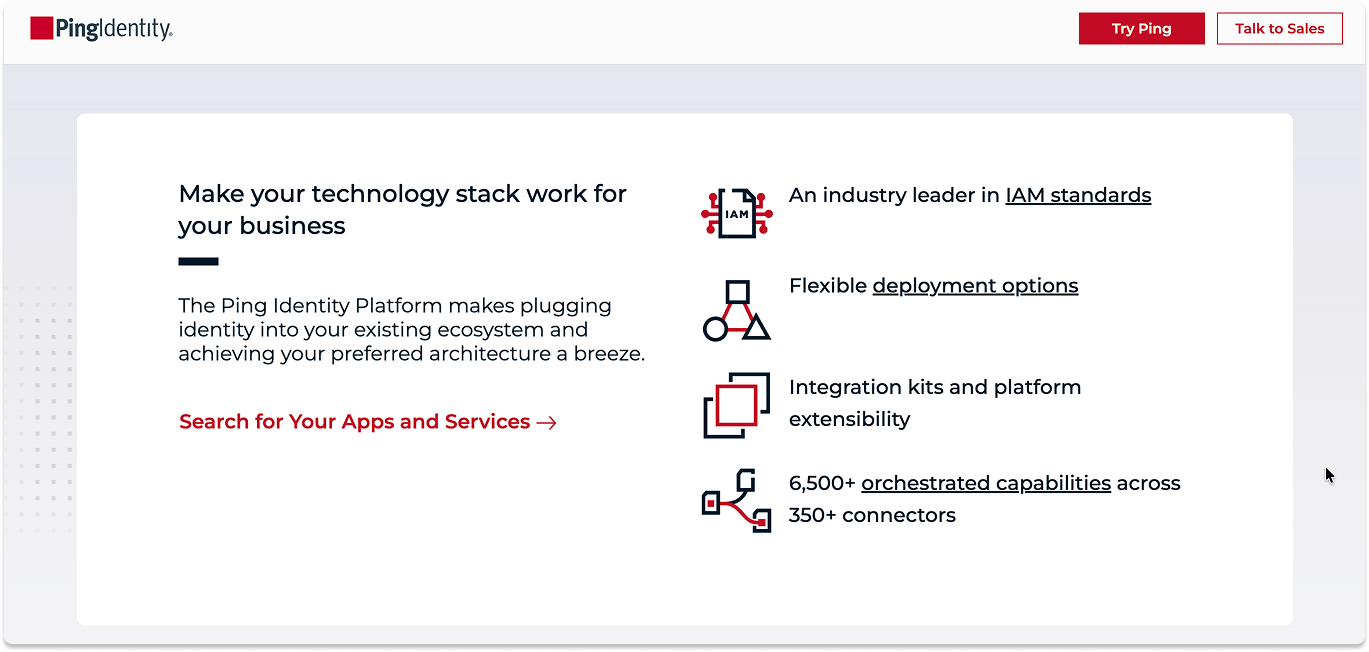
- Architecture: Flexible deployment. Ping allows for cloud (PingOne), private cloud, or on-premise software deployments. This is unique in a market moving entirely to SaaS.
- Primary Goal: Flexibility and Scale. Ping excels in environments that rely on legacy headers, on-premise web applications (WAM), and massive consumer-facing portals (CIAM) with millions of users.
OneLogin: The "Value & Simplicity" Platform
Now part of One Identity, OneLogin focuses on Price-Performance.
- Architecture: Cloud-first, focused on ease of use.
- Primary Goal: Democratizing security. OneLogin aims to provide robust Single Sign-On (SSO) and Multi-Factor Authentication (MFA) to mid-sized enterprises that need enterprise-grade security but lack the budget or dedicated engineering teams required for Ping or Okta.
Okta
Best For: Rapidly scaling, cloud-first enterprises.
Specifically, organizations with a "best-of-breed" IT strategy (using AWS, Slack, Zoom, Google Workspace, Salesforce) that want to avoid vendor lock-in with Microsoft. It is the ideal choice for teams prioritizing Developer Experience and rapid onboarding of SaaS applications.
Okta remains the market leader for pure Workforce Identity. Its Universal Directory abstracts the complexity of managing users across multiple Active Directory domains or HR systems (like Workday).

Key Features & Strengths:
- Okta Workflows: A no-code automation engine that handles Joiner/Mover/Leaver (JML) processes. For example, when HR marks a user as "terminated" in Workday, Okta automatically revokes access to all 50 downstream SaaS apps instantly.
- FastPass: A mature passwordless authentication experience that uses device biometrics to eliminate login friction.
- ThreatInsight: Okta leverages data from its massive customer base to identify and block credential stuffing attacks automatically at the edge.
Where It Lacks:
- Cost: Okta is widely considered the most expensive option. Its modular pricing model (charging separately for MFA, Lifecycle Management, and API Access) often leads to higher-than-expected renewal costs.
- On-Premise Support: While Okta can connect to on-premise apps via lightweight access gateways, it does not offer the same depth of legacy support as Ping Identity.
Ping Identity (w/ ForgeRock)
Best For: Global 2000 enterprises with "messy" hybrid environments.
Specifically highly regulated industries like Banking, Healthcare, and Aerospace. Ideally suited for organizations dealing with complex M&A scenarios (consolidating multiple legacy AD forests) or those needing to secure on-premise applications (using header-based authentication) without rewriting the code.
In 2026, the combined Ping + ForgeRock platform is the "industrial strength" option. If you are a bank, a government agency, or a large retailer with legacy technical debt, Ping is often the only viable choice.
Key Features & Strengths:
- PingOne DaVinci: A powerful orchestration engine that allows architects to design visual user journeys. You can create complex logic flows (e.g., "If user is on a new device AND accessing a finance app, require FIDO2 key; otherwise allow SMS").
- Legacy App Support: Ping excels at protecting non-standard on-premise applications using header-based authentication or proprietary protocols, allowing you to secure legacy apps without rewriting code.
- CIAM Scalability: Thanks to the ForgeRock integration, Ping can handle massive Consumer Identity workloads (100M+ users) with granular privacy and consent management capabilities that outpace Okta’s customer identity offering.
Where It Lacks:
- Complexity: Ping is not a "click-and-go" solution. It requires skilled identity architects to design and deploy effectively. The learning curve is steep compared to Okta.
- Merger Friction: As Ping and ForgeRock consolidate their codebases into the PingOne Advanced Identity Cloud, customers may occasionally navigate overlapping product names or migration paths.
OneLogin
Best For: Value-conscious Mid-Market organizations (500–5,000 users).
Specifically organizations that need "set it and forget it" security. It is ideal for IT Directors managing mixed fleets of Windows and Mac endpoints who need Desktop SSO capabilities but lack the budget for a full enterprise suite like Ping.
OneLogin proves that you don't need to overpay for IAM. It offers a robust feature set that covers 90% of the use cases for the average company.

Key Features & Strengths:
- SmartFactor Authentication: OneLogin includes an AI-driven risk engine that adjusts authentication requirements based on user behavior and location. This feature is often an expensive add-on with competitors but is more accessible here.
- Desktop SSO: OneLogin offers strong capabilities for extending identity management to Mac and Windows endpoints without requiring a full Active Directory infrastructure.
- Deployment Speed: Because it lacks the extreme customization options of Ping, OneLogin is often faster to deploy. A standard implementation can be completed in weeks rather than months.
Where It Lacks:
- Governance Depth: OneLogin lags behind Okta and Ping in Identity Governance and Administration (IGA) features. If you need complex certification campaigns or separation-of-duties enforcement, you may outgrow the platform.
- Ecosystem: While OneLogin integrates with thousands of apps, its catalog of deep API integrations is smaller than Okta’s Integration Network.
IAM Alternatives Worth Evaluating in 2026
Okta, Ping Identity, and OneLogin are not the right answer for every environment. Four platforms consistently appear on shortlists alongside them, and in certain infrastructure contexts they are the stronger choice.
Microsoft Entra ID
Best for: Organisations already running Microsoft 365 E3 or E5 licences.
Microsoft Entra ID (formerly Azure Active Directory) is the default choice for any organisation deeply embedded in the Microsoft stack. If your users are already in Microsoft 365, Teams, and Azure, Entra ID provides SSO, MFA, Conditional Access, and identity governance at no additional licence cost — those capabilities are included in E3 and E5.
Where Entra ID competes directly with Okta is in Microsoft-centric environments. For cloud-native identity in a Microsoft shop, the total cost of ownership case for Entra ID is difficult to argue against. Where it loses ground is in multi-cloud or best-of-breed environments where your application estate is predominantly non-Microsoft SaaS. Entra ID's connector ecosystem is narrower than Okta's 7,500+ integrations, and managing identity across AWS workloads, Google Workspace, and Salesforce requires more configuration effort than it does in Okta.
JumpCloud
Best for: Organisations replacing Active Directory entirely, or those running Mac and Linux-heavy fleets.
JumpCloud is built as a cloud-native directory service — it replaces Active Directory rather than sitting on top of it. For organisations moving away from on-premises infrastructure, or those that never built it, JumpCloud provides unified device management, SSO, and directory services from a single cloud platform.
Its strongest differentiator is cross-platform endpoint management. Where Entra ID and Okta treat Mac and Linux devices as secondary, JumpCloud treats them as first-class. If your fleet is predominantly MacBooks or runs significant Linux workloads, JumpCloud's device management capability is materially better than what Okta or Entra ID deliver without additional tooling layered on top.
The ceiling is scale and governance depth. JumpCloud is well-suited to organisations from 50 to around 5,000 users. Above that, enterprises with complex access certification requirements or large regulated workforces typically need a platform with deeper IGA capability.
CyberArk Identity
Best for: Organisations where privileged access management is the primary security driver — defence, financial services, research.
CyberArk's foundation is PAM. Its identity platform extends that capability into broader workforce IAM, but the security posture it enforces is noticeably stricter than Okta or Entra ID. Every access decision is evaluated through a risk lens, with continuous authentication and session isolation built into the architecture rather than added on.
For defence contractors, financial institutions, and organisations handling sensitive IP, CyberArk's approach to identity matches the threat model. The trade-off is operational friction. CyberArk Identity is not designed for fast, low-friction access. If your users include developers, customers, or anyone with standard access patterns, the overhead it introduces is disproportionate to the risk it mitigates for those populations.
Cisco Duo
Best for: Organisations that want to enforce MFA and Zero Trust access on top of an existing directory without replacing it.
Duo is not a full IAM replacement. It is an access security layer. If your existing directory — Active Directory, Entra ID, or LDAP — is working and the requirement is to add strong MFA, device trust, and Zero Trust Network Access (ZTNA) without a platform migration, Duo is the most operationally straightforward way to do it.
Its deployment model is additive. That is both its strength and its ceiling. Duo does not provide lifecycle management, identity governance, or CIAM. If those capabilities are on your requirement list, you need a different platform. But if the question is "how do we enforce MFA and device posture across all applications quickly and without disruption," Duo delivers that faster than any full IAM platform.
A Questionnaire to Help You Choose an IAM Solution
Comparative Analysis
Okta vs. Ping Identity vs. Microsoft Entra ID: the head-to-head matchups
Most identity decisions come down to two platforms, not seven. Here is how the most common matchups compare.
Okta vs. Ping Identity
Okta is the stronger choice for cloud-first organizations with a wide SaaS estate that want fast integration and low deployment effort. Ping Identity is the stronger choice for large, regulated, or hybrid enterprises with legacy on-premises applications and identity needs that reach into the millions of users. Choose Okta for speed and the breadth of its connector ecosystem. Choose Ping Identity when you need native governance, deep legacy support, and enterprise-scale customer identity.
Okta vs. Microsoft Entra ID
Microsoft Entra ID is the better fit if your organization already runs Microsoft 365 E3 or E5, because core identity is included and you avoid a separate platform cost. Okta is the better fit if you run a best-of-breed, multi-vendor SaaS estate and want to stay independent of Microsoft. Choose Entra ID to consolidate on Microsoft licensing you already pay for. Choose Okta for a neutral platform with the widest set of pre-built integrations.
Ping Identity vs. Microsoft Entra ID
Ping Identity suits global enterprises that need native identity governance, customer identity at scale, and deep hybrid support across mixed and legacy environments. Microsoft Entra ID suits Microsoft-aligned organizations that want strong identity built into their existing Azure and 365 estate. Choose Ping Identity for regulated, hybrid, and CIAM-heavy requirements. Choose Entra ID when most of your stack is already Microsoft.
Okta vs. OneLogin
OneLogin is the more affordable, simpler option for mid-market teams up to roughly 5,000 users that want transparent per-user pricing and a lean rollout. Okta is the better fit for larger, cloud-first organizations that need a deeper connector ecosystem and room to scale well past that ceiling. Choose OneLogin for value and simplicity. Choose Okta for breadth and headroom.
Closing Thoughts
The decision between Ping Identity, Okta, and OneLogin comes down to your technical debt and your budget tolerance.
- Choose Ping Identity if you are a large enterprise with a complex mix of on-premise legacy apps and modern cloud needs. It is the only platform flexible enough to handle the "messy middle" of digital transformation.
- Choose Okta if you prioritize speed and neutrality. If your goal is to enable your business to adopt new SaaS tools as fast as possible, Okta’s integration network is unmatched.
- Choose OneLogin if you need a reliable, secure "front door" for your workforce but cannot justify the premium price tag of Okta.
- Choose Microsoft Entra ID if you are already paying for Microsoft 365 and want to consolidate vendors to reduce costs.
For a broader look at how to select technology partners for your identity journey, refer to our guide on the Best Tools for Vendor Selection and Evaluation and Best IAM Solutions for IT Leaders in 2026.
Looking for IAM vendors?
Find your next IAM vendor on a curated marketplace of vetted vendors and save weeks of research. Your info stays anonymous until you choose to talk to them so you can avoid cold outreach. Always free to you.
FAQ
What is identity and access management (IAM)?
Identity and access management is the set of policies, processes, and technology that controls who can access which systems, applications, and data within an organisation — and under what conditions. A modern IAM platform handles user authentication (verifying identity), authorisation (determining what a verified identity can access), single sign-on across multiple applications, multi-factor authentication, and user lifecycle management — provisioning and deprovisioning access as roles change. In regulated industries, IAM is also the primary mechanism for demonstrating compliance with frameworks like SOC 2, ISO 27001, HIPAA, and PCI-DSS.
What is the difference between workforce IAM and customer identity and access management (CIAM)?
Workforce IAM manages access for employees, contractors, and internal systems. The priorities are security, policy enforcement, and administrative efficiency. Customer identity and access management (CIAM) manages access for external users — customers, partners, and consumers interacting with public-facing applications. The priorities shift to user experience, scale (potentially millions of concurrent users), consent management, and data privacy compliance. Platforms like Okta and Ping Identity serve both use cases but optimise differently. Ping Identity's CIAM capability scales to 100 million or more users with native privacy controls. Okta's CIAM offering (Customer Identity Cloud, formerly Auth0) is stronger for developer-first and SaaS product teams.
What is the difference between Okta and Ping Identity?
Okta is built for cloud-first environments with a large SaaS application estate. Its core strength is integration breadth — over 7,500 pre-built connectors in the Okta Integration Network — and no-code automation for user lifecycle management. It is the lower-complexity choice for organisations without significant on-premises infrastructure. Ping Identity (merged with ForgeRock in 2023) is built for hybrid and legacy complexity. If your environment includes on-premises web applications using header-based authentication, legacy Active Directory forests from acquisitions, or a customer identity workload at scale, Ping has native capabilities that Okta handles only through additional modules and configuration. The trade-off is operational complexity — Ping requires more experienced IAM engineers to deploy and maintain.
When does it make more sense to use Microsoft Entra ID instead of Okta?
If your organisation runs Microsoft 365 E3 or E5 licences and the majority of your application estate is Microsoft-native — Azure, Teams, SharePoint, Dynamics — Entra ID delivers comparable workforce IAM capabilities at no additional licence cost. The decision to add Okta on top of Entra ID is justified when your application estate is predominantly non-Microsoft SaaS and you need the breadth of Okta's connector ecosystem and lifecycle automation. For Microsoft-heavy organisations, Okta is often an unnecessary cost layer.
What is the status of the Ping Identity and ForgeRock merger?
Ping Identity acquired ForgeRock in 2023. As of 2026, the two platforms are being consolidated under PingOne Advanced Identity Cloud. Existing ForgeRock customers should expect continued product support during the transition period, but new evaluations should be assessed against the PingOne roadmap rather than the legacy ForgeRock platform. Organisations with existing ForgeRock deployments should request a formal migration timeline from Ping Identity before making long-term architecture commitments.
How does OneLogin compare to Okta, Ping Identity, and Microsoft Entra ID?
OneLogin sits in the mid-market and fits teams of roughly 500 to 5,000 users that want transparent per-user pricing and a simple rollout. Against Okta and Ping Identity it trades depth for value, with a lower scalability ceiling and thinner governance, CIAM, and privileged-access capabilities. Against Microsoft Entra ID the deciding factor is your stack: Entra ID is cheaper to adopt if you already pay for Microsoft 365 E3 or E5, while OneLogin is the more neutral choice for organizations that are not Microsoft-centric.
Okta vs. Ping Identity vs. Microsoft Entra ID: which should you choose?
Choose Okta if you run a broad, best-of-breed SaaS estate and want the widest connector ecosystem without Microsoft lock-in. Choose Ping Identity if you are a large or regulated enterprise with legacy on-premises apps, hybrid infrastructure, or customer identity at scale. Choose Microsoft Entra ID if most of your stack is already on Microsoft 365 and Azure, since core identity is included in E3 and E5 and advanced features come through the P1 and P2 tiers.
How does Okta's pricing compare to Ping Identity's for a large deployment?
Ping Identity does not publish pricing and sells through negotiated enterprise agreements, so a fixed-headcount comparison from list rates alone is not possible. Okta uses modular per-user pricing that compounds as you add products like governance or privileged access, and at several thousand users it also moves into negotiated enterprise terms. For a deployment of that size, expect both to be custom-quoted and budget for add-on modules rather than the base SSO price. If cost is the main constraint and you already run Microsoft 365 E3 or E5, Entra ID is usually the lowest-cost path because core identity is already included.
What are the main alternatives and competitors to Ping Identity?
The closest alternatives are Okta for cloud-first workforce identity, Microsoft Entra ID for Microsoft-aligned organizations, and ForgeRock, which is now part of Ping itself. For governance-heavy or privileged-access requirements, SailPoint and CyberArk are common comparisons. The right alternative depends on whether your priority is SaaS breadth, Microsoft consolidation, or deep governance, so it helps to shortlist against your specific requirements rather than by brand.