OneTrust vs TrustArc vs Securiti: Comparing Data Privacy Management Platforms
OneTrust vs TrustArc vs Securiti compared on data discovery, DSAR, consent, and AI governance. A technical guide to choosing the right privacy platform.

Data privacy enforcement stopped is no longer just a documentation exercise. Nineteen US states now run comprehensive privacy laws with no federal layer to harmonize them. The tool you buy has to operate against that pressure, and the operational quality comes from architecture.
OneTrust and TrustArc build a privacy program on top of an inventory. The platform runs assessments, generates records of processing, routes data subject requests, and publishes consent, and it acts on whatever the inventory says exists.
Securiti inverts that. It connects to the data systems themselves, discovers and classifies the records in place, and treats the inventory as a live output rather than a maintained document.
This is the fork that determines whether a deletion request reaches every copy of a person's data, whether a breach assessment captures the right systems, and whether you can see which training sets hold regulated data.
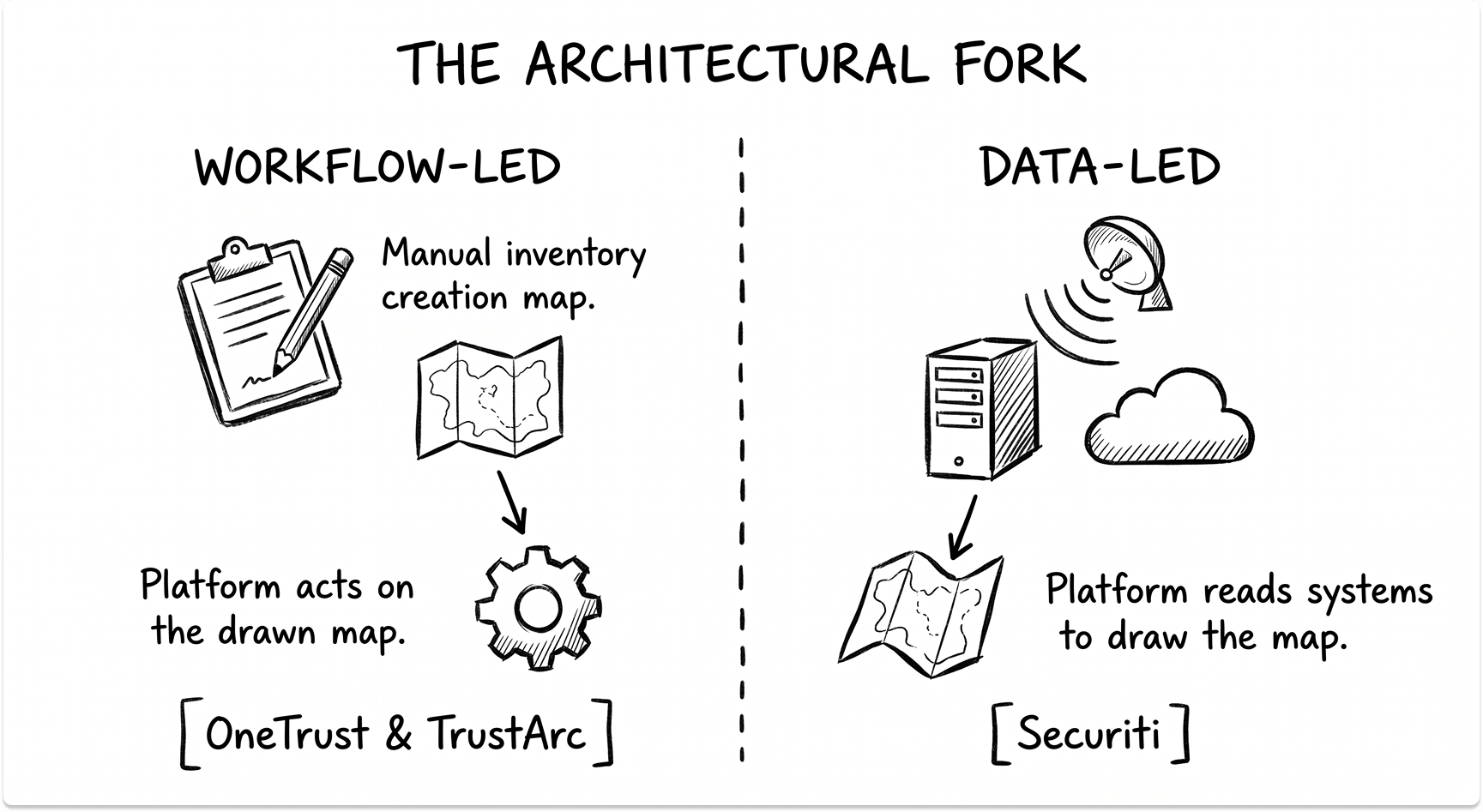
Workflow platforms act on the map your team drew. Data-led platforms draw the map by reading the systems. Both models work; they fail in different places.
How each platform discovers and classifies data
This is the capability where the three diverge most, and it follows directly from the architecture. It is the same classification problem that sits under data loss prevention, applied to the full data estate rather than egress points.
Securiti runs agentless, API and connector-based scanning across AWS, Azure, GCP, OCI, Snowflake and Databricks, SaaS apps, and on-prem stores, and it surfaces shadow and dark data assets that no one cataloged.
Classification runs as a layered pipeline rather than a single pass. Out-of-the-box classifiers and regex handle known patterns, Exact Data Match fingerprints actual values through non-reversible hashing to kill false positives on identifiers like SSNs and account numbers, and a proprietary NER and NLP layer reads structured, semi-structured, and unstructured layouts.
A final machine-learning contextual stage resolves ambiguous detections by weighing nearby terms and assigning confidence levels. The honest limit: agentless scanning at petabyte scale runs into API throttling, which pushes some deployments toward sampling rather than full-byte coverage, and connector tuning is real work.
OneTrust discovers across 200+ data sources, spanning structured databases, big-data stores like Redshift and BigQuery, SaaS like Salesforce and Workday, and unstructured file shares like S3 and SharePoint, with a low-code SDK for custom connectors. Classification is AI-driven across structured and unstructured data. Its differentiator is enforcement rather than detection.
OneTrust pushes machine-readable policy down into Snowflake through row access policies and into Databricks through Unity Catalog, applying native column masking and consent-based row filtering, then verifies the last mile through its own audit logs.
It can also apply do-not-train labels to keep consent-restricted data out of model pipelines. The recurring caution from practitioners: connecting it to a complex estate takes meaningful engineering effort, and cross-module data flow is not always as clean as the feature list implies.
TrustArc takes the lightest native approach. Its Data Mapping and Risk Manager builds data flow maps primarily through surveys sent to system owners, enriched by AI Autofill, a Record Exchange of pre-built third-party records, and a Third-Party Discovery scan that reads public websites to suggest embedded vendors.
Live data-store scanning comes through partners whose findings feed the TrustArc inventory rather than through a native engine. The result is strong context and defensible records, with the thinnest first-party discovery depth of the three.
How the inventory and RoPA stay current
The discovery model decides how the data inventory ages. TrustArc and OneTrust produce point-in-time records that reflect declared processing, which is good for legal defensibility and gives auditors a clean line of sight into intent. The cost is drift. A survey-built map is accurate the day it is signed off and decays as systems change, so it depends on a refresh discipline your team has to enforce.
Securiti's inventory refreshes off the Data Command Graph, the knowledge graph that links data assets to identities, entitlements, AI models, and regulatory obligations. Because the graph reads the systems continuously, the record reflects observed data rather than declared data.
TrustArc claims meaningful reductions in manual RoPA effort through automation, and OneTrust maintains an evergreen map fed by its discovery engine, but both still describe what was reported. Securiti describes what is there. That gap is the entire argument for the data-led model, and it is also why Securiti carries a heavier operational footprint.
DSAR and data subject rights fulfillment internals
A data subject request turns privacy work operational, and the fulfillment engine is where architecture becomes visible. The mechanic that matters is how each platform links a person to every record about them.
Securiti builds a People Data Graph, using machine learning to discover and connect an individual's personal data across hundreds of structured and unstructured systems in real time.
The graph then auto-generates the tasks and subtasks to fulfill access, deletion, and correction, and the same structure powers breach impacted-user identification. Deletion runs against data the platform discovered and linked, which is the structural reason a data-led tool reaches copies a maintained inventory never captured.
OneTrust runs regulatory-aware workflow automation across intake, identity verification, discovery, deletion, redaction, and secure response, and it pairs that workflow with data integration to automate fulfillment, with identity validation that scans connected systems for matching emails, phone numbers, and logins.
Its targeted discovery retrieves from relevant systems by jurisdiction and request type. Completeness still tracks the connected inventory, and default configurations often ship with the automation unused, so the value depends on the integration work you put in.
TrustArc orchestrates through Individual Rights Manager, with multilingual intake, proportionate identity verification, and dynamic routing to system owners by request type and jurisdiction, executed through 300+ no-code connectors and an API.
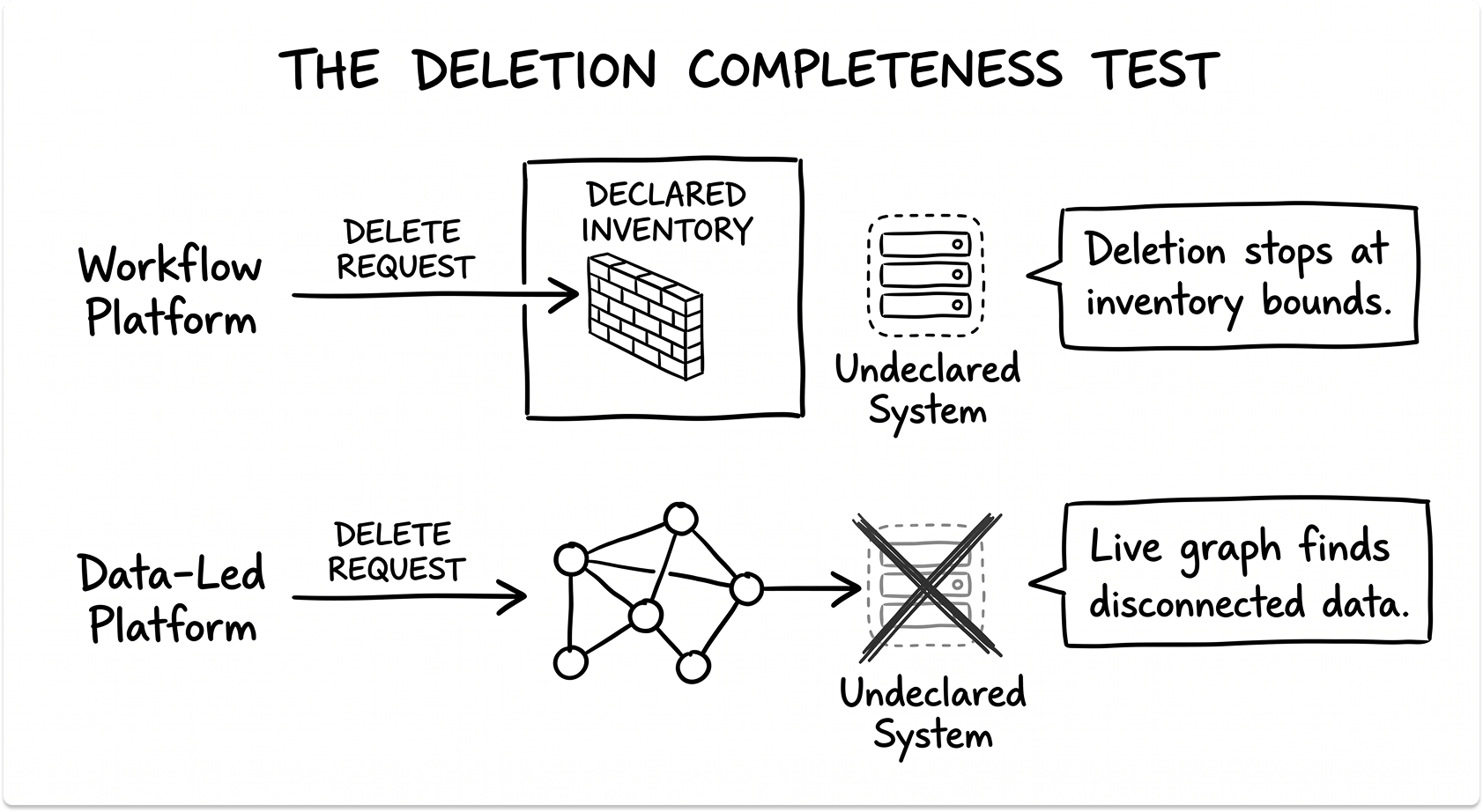
It routes and coordinates well. Deletion across downstream systems happens through those connectors and owners rather than through a discovery-built identity graph, so an undeclared system stays out of reach.
The practical test is deletion completeness. If a system never made it into the inventory, a workflow platform cannot delete from it, while a discovery-built graph can still find it. Workflow platforms answer back with deeper jurisdictional logic and legal-hold handling, which is its own kind of correctness.
Consent and preference management
Consent is the most common trigger for US enforcement, and it has moved well past banner placement. Eleven states now require websites to honor the Global Privacy Control signal as a binding opt-out, and Firefox and Brave send it by default.
Enforcement is active, including a $2.75 million settlement in early 2026 over a streaming service failing to apply opt-outs across all its devices and services.
OneTrust runs the deepest web-consent stack. It groups trackers by purpose against a database of more than 45 million pre-categorized cookies, auto-blocks scripts by category, ships native mobile and CTV SDKs, and supports IAB TCF v2.2 and GPC.
One implementation trap is worth knowing: its auto-blocking can misclassify Google Tag Manager and break Google Consent Mode if GTM gets blocked, so the deployment needs care.
Securiti treats consent as a data infrastructure problem. Collecting a preference is the easy part, and keeping that preference attached to data as it flows through warehouses, analytics, AI pipelines, ad tech, and third parties is the harder one, which its consent agent addresses by capturing signals and enforcing them downstream. If your concern is honoring revocation deep in the pipeline, this is the differentiated position. If you mainly need a clean banner, the depth is more than you need.
TrustArc delivers solid table-stakes consent. Its Consent and Preference Manager centralizes choices across sites and apps, automates cookie and tracker management, and supports GPC, without OneTrust's database scale or Securiti's downstream-enforcement thesis.
AI governance: runtime control, program workflow, or assessment
AI governance is the fastest-moving part of this category and the place where the three platforms differ most in philosophy. It overlaps directly with the work of stopping AI from compromising data privacy and with shadow AI sprawl.
Securiti governs at the data and model layer. It discovers sanctioned and shadow AI models, scans vector databases, and runs context-aware LLM firewalls inline at three points: a prompt firewall, a retrieval firewall sitting next to the vector store to catch poisoning and indirect prompt injection, and a response firewall, mapped to the OWASP Top 10 for LLMs.
It also classifies and masks sensitive data before it gets embedded into a vector database, which closes a gap most privacy tools never touch.
OneTrust governs at the program layer. It maintains a unified inventory of models, agents, and datasets, applies risk tiering and evaluation gates before systems reach production, and aligns assessments to the EU AI Act, NIST AI RMF, and ISO 42001, which earned it a Visionary placement in the inaugural 2026 Gartner Magic Quadrant for AI Governance Platforms. It governs agents with purpose-based permissions across MCP environments. The trade-off is depth at the model layer, where drift, bias, and lineage are lighter than a specialist tool, and the workflows can feel heavy to engineers.
TrustArc governs AI as an assessment and attestation discipline. Its Assessment Manager scores AI risk alongside privacy impact assessments, and Arc Intelligence layers explainable AI guidance that returns full source citations, drawn from a regulatory research base, and never trains on customer data. That base, Nymity, holds more than 50,000 expert-written references updated daily. It documents and certifies AI use well; it does not enforce at runtime.
Deployment, integration, and who runs it
The operating model follows the architecture, and getting this wrong is how a six-figure platform ends up shelfware.
Securiti is SaaS with more than 1,000 prebuilt integrations and an agentless scan model, and it sits closest to the security and data-engineering side of the house. It functions as much as a data security posture management tool as a privacy platform, which is the same data-first discipline that separates DSPM from infrastructure-level cloud posture management.
Veeam completed its $1.725 billion acquisition of Securiti in December 2025, folding it into a data resilience portfolio, so confirm current availability of newer agent features during evaluation.
OneTrust offers SaaS plus on-prem and EU-cloud deployment for data residency, uses self-hosted worker nodes for scanning, and integrates into 500-plus security and governance tools.
It carries the heaviest configuration burden and is run by privacy or GRC teams with steady IT partnership. TrustArc is SaaS with 300-plus no-code connectors and the lightest engineering lift, operated by privacy and legal with minimal IT involvement, which is its strongest practical advantage for a lean team.
How to choose: a decision framework
Step one, diagnose your estate. Answer one question honestly: can your team produce, today, a complete list of every system holding regulated data?
If the answer is no, and you run sprawling multi-cloud, large unstructured repositories, or live AI pipelines, your binding constraint is discovery, and a data-led platform is the correct default. If the answer is yes, and your pain is workflow, jurisdictional nuance, and audit evidence, a workflow-led platform fits.
Step two, match the buyer to the operator.
- Security or data engineering will own it, and AI or vector-database exposure is a board concern: Securiti.
- Privacy or GRC owns it, and you need the deepest regulatory automation, the largest consent stack, and in-warehouse enforcement: OneTrust.
- A lean privacy team wants fast assessment and RoPA automation with the strongest embedded regulatory research and the lightest IT lift: TrustArc.
Step three, pressure-test on the three consequences of architecture. Make every shortlisted vendor demonstrate these against your environment, not a sandbox.
- Deletion completeness. Leave one system out of the inventory on purpose, then run a deletion. A discovery-built graph should still find it.
- Breach scoping. Simulate an exposure in an unstructured store and ask for impacted-individual identification. A live graph computes this; a maintained inventory depends on being complete.
- AI data exposure. If you run retrieval-augmented generation, require an inline retrieval-firewall and pre-embedding masking demo, versus an inventory-and-gate demo, versus an assessment-and-attestation demo.
Use the Questionnaire below to see which Ddata Privacy Platform suits you
A few thresholds shift the call. If you already run OneTrust for GDPR and CCPA, adding its AI Governance module is the path of least resistance despite the lighter model-layer depth.
If you already run a dedicated model-layer AI tool, you need an inventory and program layer rather than another runtime control, which favors the workflow platforms.
And many large enterprises end up running one data-led platform for discovery and security alongside one workflow platform for legal-grade program management, so budget for that pairing rather than forcing a single tool. The same discipline applies here as in any vendor risk evaluation: test the claim against your data, and weight the result by who has to operate it.
Ready to shortlist for an AI-era privacy program?
Explore and compare privacy, data-security, and AI-governance vendors on our platform based on your data estate. No vendors calls or messages you simply for browsing. Match with vendors who fit and start conversations when your ready. For free.
FAQ
What is the core technical difference between OneTrust, TrustArc, and Securiti?
OneTrust and TrustArc are workflow-led platforms that run a privacy program on top of an inventory your team maintains. Securiti is data-led, connecting to your systems to discover and classify data, then computing DSAR, breach scope, and AI exposure off a live graph. The split drives how complete deletion and breach scoping can be.
Which platform has the strongest data discovery?
Securiti, by design. It scans cloud, data-cloud, SaaS, and on-prem stores agentlessly and classifies with exact data matching, NER and NLP, and contextual ML. OneTrust does native discovery across 200-plus sources and adds in-warehouse enforcement on Snowflake and Databricks. TrustArc relies mostly on surveys and partner scanners, making it the lightest of the three on native discovery.
Which is best for AI governance and the EU AI Act?
It depends on the layer you need to control. Securiti governs at runtime with LLM firewalls and vector-database scanning. OneTrust governs at the program layer with model inventory, risk tiering, and framework alignment. TrustArc treats AI as an assessment and certification discipline. With high-risk enforcement under the EU AI Act expected in 2026, choose runtime controls if you run production AI, and program controls if your priority is documentation and approval gates.
Does TrustArc scan live data stores the way Securiti does?
Not natively at the same depth. TrustArc builds its data map through surveys, AI autofill, and a third-party record exchange, and it delivers live store scanning through partners whose findings flow into its inventory. Securiti runs a first-party scanning engine across the estate.
Which team should own the platform?
Securiti tends to sit with security and data engineering because it is a data security posture tool with privacy on top. OneTrust and TrustArc are run by privacy, legal, and GRC teams, with TrustArc asking the least of IT. Match the tool to the team that will operate it daily, or it underdelivers regardless of capability.