How to Make an IT Vendor Shortlist Without Talking to Sales (Until You Want To)
Build an IT vendor shortlist through anonymous, rep-free evaluation. A self-service workflow to research, validate, and compare vendors before you ever talk to sales.

Summary:
IT buyers now build vendor shortlists almost entirely through anonymous self-service research before contacting any salesperson.
A disciplined process runs in four stages: frame the requirement, source candidates from peers and independent sources, validate capability, security, and pricing anonymously, then rank the shortlist. Reps still add value, but late, and only after the buyer sets the agenda.
Why IT buyers now research vendors anonymously
The shift toward rep-free IT buying is easy to explain once you look at how the numbers moved. 6sense found that the balance between independent research and seller engagement flipped from roughly 70/30 to 60/40 in a single year.
Buyers now reach out to vendors at 61% of journey completion, down from 69%, and they make first contact several weeks earlier in absolute time than they used to.

That gap between when research starts and when a vendor finds out about it is the dark funnel. It is the part of the buying journey that happens in Slack threads, Reddit posts, peer DMs, and browser tabs the vendor never sees.
Buyers deliberately ignore unsolicited outreach until they are ready, which is why cold calls and cold emails land on people who have already trained themselves to delete them on sight.
Two forces drive buyers into that dark funnel. The first is a trust problem. In the same Gartner research, 49% of buyers said they were more likely to encounter misleading information from a sales rep, almost the same share who said the same of generative AI.
When you treat every source as potentially self-serving, you go looking for information the source cannot control, which means peers, documentation, and hands-on testing.
The second force is control. A rep-led process runs on the vendor's calendar and the vendor's framing. An anonymous process runs on yours. This is the practical core of staying in control of vendor selection, and it starts long before a contract is on the table.
None of this means sales has no value. It means the value shows up later than vendors want, and the early research now belongs to you. It also reflects a genuine shift in IT buyer behavior that has been building for years.
The four stages of a self-service vendor evaluation
A disciplined self-service vendor evaluation moves through four stages. The first two get you a list of candidates. The third is where the real work happens and where you can validate almost everything anonymously. The fourth is where you decide who earns a spot and, later, who earns a conversation.
Stage 1: Frame the requirement before you look at a single vendor
Every wasted evaluation I have run started the same way, by looking at products before defining the problem. When you shortlist against vendor feature lists instead of your own requirements, you inherit the vendor's framing, and every option starts to look reasonable.
Write down the outcome you need, the metrics that prove it, your hard constraints, and your non-negotiables before you open a single product page. For an IT purchase, the non-negotiables usually include compliance boundaries, data residency, existing integrations, and the identity stack you already run. A structured IT business outcomes worksheet turns this from a mental note into a scorecard you can hold every vendor against.
Gartner found buyers now use an average of seven information sources during a purchase, and 45% used generative AI to gather information on vendors and products.
An LLM is genuinely useful here for structuring requirements and drafting a scoring rubric. It is far less reliable as a source of vendor truth, which matters in the next stage.
Stage 2: Build a candidate list from peers, not forms
Discovery has moved almost entirely into channels that require no identification. You can assemble a strong candidate list without submitting your details anywhere, and this is where anonymous vendor research starts to pay off.
The sources that carry the most weight for technical buyers are the ones vendors cannot influence:
The mechanics of using AI tools well for this deserve their own treatment, and there is a detailed walkthrough of building a shortlist with ChatGPT, Perplexity, Gemini, and Claude that goes deeper than I can here.
If you are still mapping out where to look in the first place, the guide to the best ways to find IT vendors in 2026 covers the discovery sources in full.
Stage 3: Validate capability, security, and pricing anonymously
You can validate the majority of what you need to know without a demo, an NDA, or a phone call. The trick is knowing exactly where each answer lives.
Break validation into four questions. Can it do the job. Is it secure. What does it cost. Do real users trust it.
Capability and architecture live in the vendor's own technical material, which is usually public and rarely read carefully. Product documentation, API references, changelogs, and status pages tell you more about a product's real maturity than any deck.
A frequently updated changelog and a transparent status history signal a healthy product. A documentation site last touched eighteen months ago tells you something too.
Self-service trials and sandboxes let you test the product against your own scenarios. Forrester found that more than 60% of business buyers now run some form of trial before committing, and many vendors let you complete most of an evaluation without ever talking to a person.
Use the trial to confirm the things that break deals later, such as SSO support, integration with your existing tools, and how the product behaves at the edges of your use case. When a trial alone cannot settle a question, that is a signal to plan a proper vendor proof of concept rather than to sit through a scripted demo.
Security posture has become one of the easiest things to validate anonymously, thanks to the rise of public trust centers. A trust center, built on platforms like Vanta or Drata, publishes a vendor's SOC 2 Type II report, ISO 27001 certification, penetration test summaries, subprocessor list, and increasingly its AI governance disclosures.
A well-run trust center answers most security questions publicly and gates only the sensitive material behind a click-through NDA.
For a SOC 2, insist on the Type II report rather than Type I. Type I confirms controls existed on a single day. Type II confirms they operated correctly over a period of months, which is the difference between a photograph and a track record. For anyone buying in a compliance-heavy industry like healthcare or finance, this step is where a shortlist quietly loses half its candidates.
Pricing is where vendors resist self-service hardest, and where you have to work a little. When the pricing page is empty, three channels still give you numbers.
Public cloud marketplaces such as AWS and Azure often list pricing the vendor omits from its own site. Independent benchmarking services publish real transaction data on what other companies actually paid. And peers in your community will frequently tell you their ballpark if you ask privately, which is worth more than any list price.
Peer proof closes the loop. Reviews tell you the average experience, but a short conversation with a real user tells you the truth about implementation time and support quality. The high-value move is to find users the vendor did not hand you. A reference the vendor selects is a marketing asset. A user you found in a community is a witness.
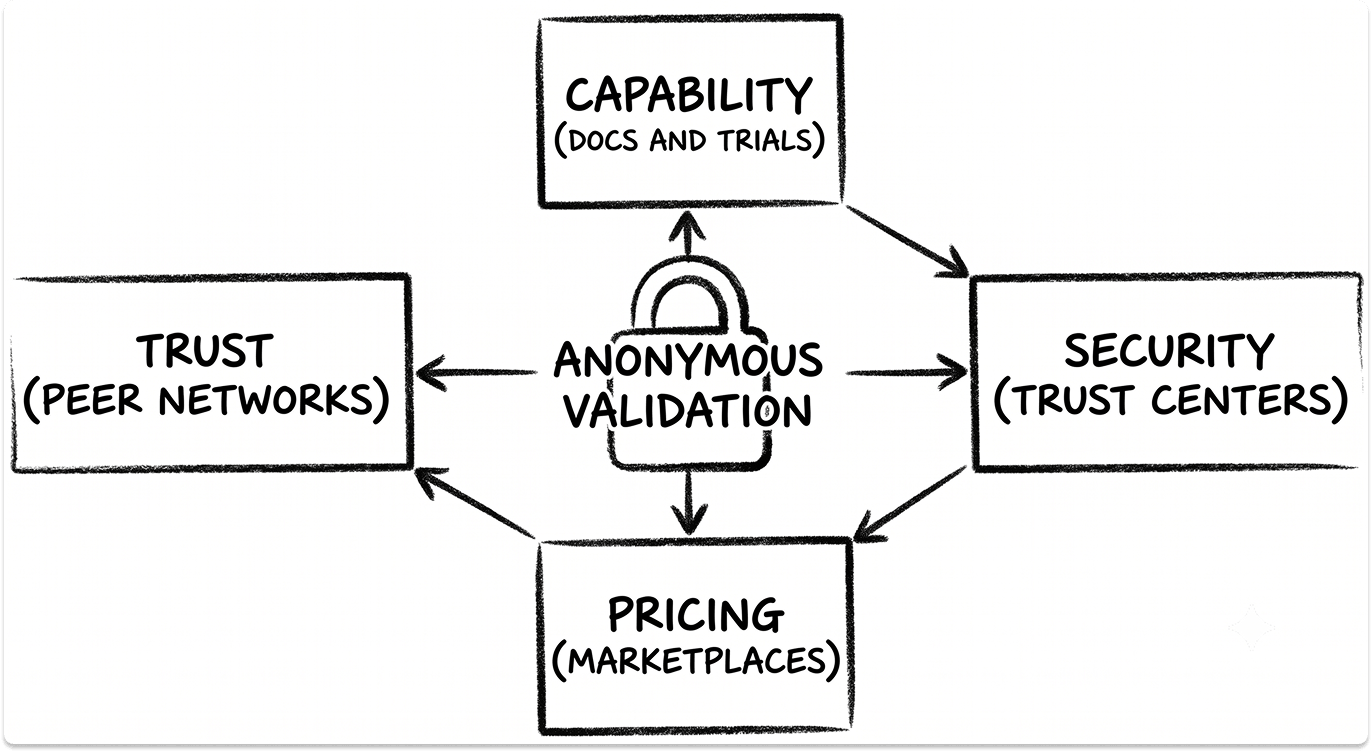
Here is how the anonymous validation matrix comes together in practice:
The friction here is not finding the information. It is that the information sits scattered across a dozen tabs, PDFs, review sites, and analyst notes, and you end up stitching apples-to-oranges comparisons in a spreadsheet that goes stale by the time you finish it.
A buyer-first platform such as TechnologyMatch pulls vetted vendors into one place so you can filter by your own constraints, such as workload, timeline, and budget, and compare candidates side by side against your requirements rather than against each vendor's marketing.
You browse and shortlist without identifying yourself, and no vendor can reach out until you decide to make the first move. It runs the same anonymous validation described above, with the legwork of gathering and normalizing the information already done for you.
Stage 4: Decide who makes the shortlist
By the time you finish Stage 3, you have enough to rank candidates against your own rubric. This is the norm now, not an edge case. 6sense found that 94% of buyers rank their shortlist in order of preference before they contact a single seller.
Score each candidate against the requirements you wrote in Stage 1, not against the features each vendor happens to promote. This is the discipline behind building a technology vendor shortlist that survives scrutiny from your CFO and your security team. Where you have gaps you could not close anonymously, mark them clearly. Those gaps become your agenda for the one conversation that is actually worth having.
How to stay anonymous during vendor research
Staying anonymous is less about secrecy and more about not leaking intent before you are ready to act on it. A few habits keep your research quiet:
That last point is worth sitting with. Perfect anonymity is not the goal, and chasing it wastes time. Controlling when a real conversation starts is the goal, and that is very achievable.
When talking to a sales rep actually helps
A rep-free process is about sequencing, so the honest question is when a human earns your time. The research is clear that reps still matter, and they matter most for a narrow set of high-context tasks late in the evaluation.
Gartner found that 69% of buyers prefer to validate AI-generated insights with a human rep. The pattern is consistent across the data. Self-service gets you the facts, and a good human helps you apply them to your specific situation, particularly when a decision carries real risk.
The trick is to arrive with your homework done, which is exactly what to tell a vendor before the first demo so the meeting starts where your research left off.

Certain tasks genuinely reward a conversation:
The reframe that makes this work is simple. You initiate the contact, you set the agenda, and you come in with a ranked shortlist and a specific list of gaps to close. 6sense found that buyers now initiate contact roughly 80% of the time and reach out to their top-ranked vendor first.
The conversation confirms a decision you have already reasoned your way toward, which is a far better use of everyone's time than a discovery call that starts from zero. When it comes to price, walking in with benchmarks and alternatives is the whole basis of negotiating for real value.
The self-service vendor evaluation checklist
Pull the process together into a repeatable sequence you can run on any purchase:
The balance to hold
Self-service will not answer everything, and pretending otherwise creates its own risk. The anonymous phase builds a credible IT vendor shortlist.
It does not sign a de-risked contract on its own, which is why the same Forrester research shows buyers leaning harder on trials and trusted human validation exactly as the stakes rise.
Skipping that final validation step is how a clean-looking shortlist turns into a purchase you regret, and avoiding that outcome is the entire point of choosing a vendor you will not second-guess later.
For an IT purchase, the timing is yours to set. Do the quiet work first, build the shortlist on evidence you gathered yourself, and reserve the conversation for the questions that genuinely need a person on the other end.
When you finally pick up the phone, you will know more about the product than the rep expects, and the discussion will be about closing your last few gaps rather than sitting through a pitch you did not ask for.
Build your shortlist on your own terms
You have done the hard part: defined the requirement and learned how to validate a vendor without tipping off sales. TechnologyMatch gives you one place to find pre-vetted IT vendors, compare them against your needs, and decide who is worth a conversation. You stay anonymous until you choose otherwise, and it costs you nothing.
FAQ
Can you research IT vendors without talking to sales?
Yes. Most of what you need to evaluate a vendor is now public: product documentation and API references, free trials and sandboxes, security trust centers, and independent reviews. You can build and rank a shortlist entirely from these sources and only contact a vendor once you have a specific question that self-service cannot answer.
What does "rep-free" IT buying actually mean?
Rep-free buying means completing the research, comparison, and validation stages of a purchase on your own, without a sales rep guiding the process. It does not mean never speaking to a vendor. It means you decide when that conversation happens, usually after you have already chosen a preferred option. Gartner found 67% of B2B buyers now prefer this approach.
How do you build an IT vendor shortlist anonymously?
Start by defining your requirements before looking at any product. Source candidates from peer communities, review platforms, and AI answer engines rather than lead forms. Validate each one through its documentation, a free trial, its trust center, and public pricing. Then rank everything against your own criteria. None of these steps requires you to identify yourself to a vendor.
What is the dark funnel in B2B buying?
The dark funnel is the part of the buying journey that vendors cannot see: the peer conversations, community threads, review reading, and independent research a buyer does before ever making contact. It matters because buyers now form their preferences here. By the time a vendor learns it is being considered, the shortlist is often already set.
How do you check a vendor's security without signing an NDA?
Look for a public trust center. Most security-conscious vendors now publish their SOC 2 Type II report, ISO 27001 certification, penetration test summaries, and subprocessor list there, with only the most sensitive documents gated behind a click-through NDA. Insist on the SOC 2 Type II rather than Type I, because Type II proves controls worked over time, not just on one day.
When should you actually talk to a sales rep?
Bring a human in once self-service runs out of road. That means custom architecture questions specific to your environment, a proof of concept on your own data, verifying how AI features actually behave, and pricing or contract negotiation. Reach out with a ranked shortlist and a short list of gaps to close, so the conversation confirms your decision rather than starting it.
Can vendors see you researching them if you never fill out a form?
Sometimes, at the company level. Intent-data platforms track account-level signals based partly on your corporate IP address, so several people on your network researching the same category can register as a surge, even with no form submitted. Personal anonymity does not always mean your organization is invisible. The realistic goal is controlling when a real conversation starts, not achieving perfect secrecy.