What to Tell IT Vendors Before the First Demo or Meeting
Most first vendor demos waste everyone's time because vendors walk in cold. A vendor briefing document sent 48-72 hours before the call fixes that. This guide covers exactly what to include, how to use the vendor's response as a pre-qualification filter, and when to get outside help to move the evaluation faster.

Why the First Vendor Call Produces Almost No Useful Signal
One of the most common frustrations I hear from IT leaders who've been through multiple vendor evaluations is that the first demo rarely tells them anything useful.
In the call, the vendor rep asks "can you tell us a bit about your environment?" and the next fifteen minutes get spent explaining context the vendor should have come prepared with. Then comes the polished, generic demo that covers everything the vendor does well and nothing that's specific to the situation at hand.
By the time the call ends, nobody learned anything they couldn't have read on the vendor's website. And this isn't a one-off. It happens across almost every first call, with almost every vendor, in almost every evaluation I've come across.
The root cause is simple: vendors walk into first calls cold. They don't know the stack, the compliance requirements, the integration constraints, or the specific reason the evaluation is happening now. So they default to the pitch that works for the average buyer.
The fix is sending a vendor briefing document before the first call. It takes a few hours to put together, and it changes the quality of every conversation that follows.
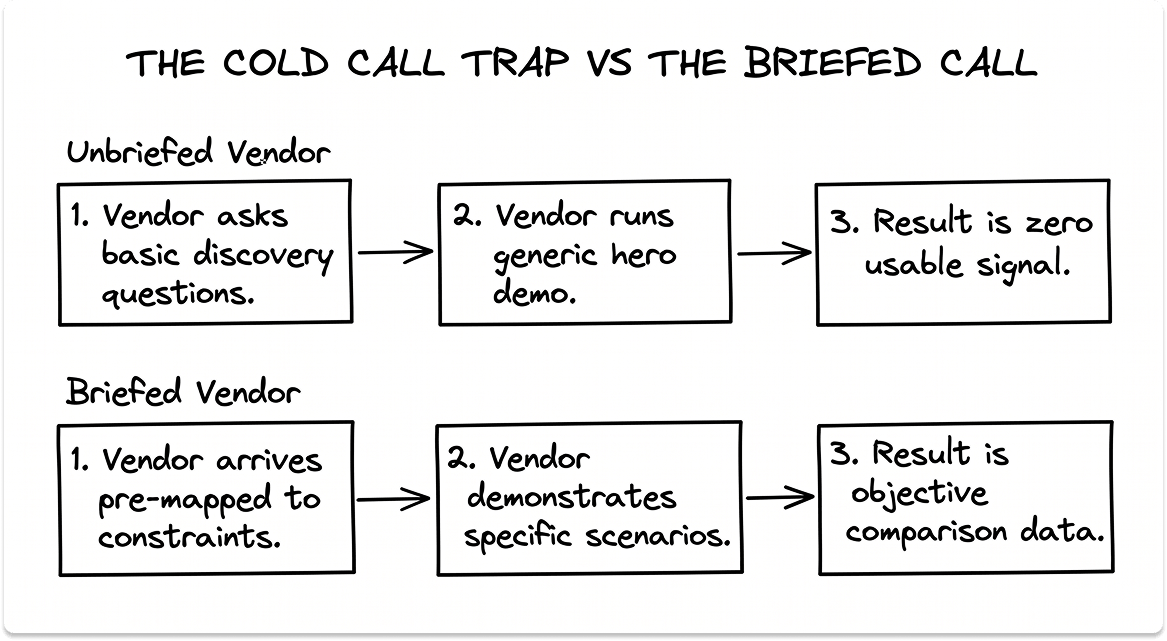
There are three specific ways the first call tends to fail an IT evaluation, and they compound each other.
Vendors show you their hero demo. Without knowing the environment, a vendor will demonstrate the features that impress the average prospect. Those features may have nothing to do with the actual requirements on the table.
Discovery flows the wrong way. The vendor spends the first half of the call figuring out who they're talking to and whether the deal is real. The evaluation team ends up answering questions instead of getting answers.
Comparison becomes structurally impossible. If Vendor A spends 40 minutes on architecture and Vendor B spends 40 minutes on the UI, the vendor evaluation criteria defined before the demos becomes almost irrelevant. Scoring different presentations against the same rubric produces noise, not signal.
Gartner research shows B2B buyers spend only 17% of their purchase journey talking to vendors, and of that time, the conversations that actually move evaluations forward happen late, when the buyer already has specific, detailed context to bring to the table. A vendor briefing document is what gets the first call closer to that standard.
If the shortlist isn't locked yet, how to build a technology vendor shortlist is worth reading before writing the brief.
What a Vendor Briefing Document Actually Is
A vendor briefing document is a structured, 1-2 page asset sent to every vendor on the shortlist 48 to 72 hours before the first call. It tells the vendor what problem is being solved, sets the demo agenda, and creates a level playing field so every vendor is evaluated on the same dimensions rather than whatever they chose to cover.
The practical effect shows up quickly. Vendors who receive a proper brief arrive having pre-mapped their capabilities to the stated constraints. Some will already know whether they're a strong fit before the call starts. A few will flag limitations in advance, which is exactly the kind of early signal that saves evaluation time.
The vendors who can't engage meaningfully with a two-page document are also revealing something useful — before anyone has spent 60 minutes on a call finding that out the hard way.
The 5 Things Every Vendor Briefing Document Should Include

1. The Problem Statement, Written as a Business Problem
The brief should open with the specific operational problem being solved — what's failing, what the business impact is, and what a successful outcome looks like in 12 months. A statement like "we are evaluating SASE vendors" gives a vendor essentially nothing to work with. Something like "our current perimeter-based model is creating inspection bottlenecks for 4,000 remote users and we need a solution that integrates with Okta and supports Zero Trust segmentation by Q3" gives them everything they need to prepare something relevant.
Vendors use this to decide who to send. A problem statement that's specific enough pulls in technical resources rather than a generalist sales rep. The evaluation benefits either way.
2. Your Current Stack and Hard Integration Requirements
List every tool the new solution has to work alongside: identity provider, ticketing system, SIEM, cloud environment, EDR, backup platform. Separate what's a hard requirement from what's a preference.
When a vendor discovers a critical integration gap during the demo, they tend to either hide it or spend the call managing around it. Finding it in the brief beforehand forces a different outcome — they either solve it before the call or remove themselves from the process, and both of those are better than discovering it in a live demo with three stakeholders watching. For a structured checklist of what to capture, the essential IT vendor selection criteria and checklist is a good reference.
3. Your Evaluation Criteria and How You're Weighting Them
Sharing how vendors will be evaluated isn't giving away leverage — it removes the guesswork that produces demos built around what the vendor wants to show rather than what the evaluation actually needs to see. The specificity of the criteria directly determines the specificity of the demo received in return. "Security" is not a useful criterion. "Ability to generate compliance-ready audit logs for SOC 2 Type II without custom engineering" is.
The 5 key supplier evaluation criteria is a useful starting point for building out the scoring dimensions.
4. The Decision Context
Who has sign-off, what the timeline looks like, and the approximate budget range. Vendors use this to calibrate the call — whether to bring a solutions architect, whether to prepare a pricing scenario, whether the evaluation is live and moving. The downstream effect is that vendors who aren't a commercial fit tend to say so before the call rather than after it, and the ones who do show up arrive having already self-qualified.
5. Three Specific Scenarios to Be Demonstrated
Rather than "show us the dashboard," the brief should include three real scenarios from the actual environment. "Show us how a tier-2 analyst triages a lateral movement alert in your console." "Walk us through a full restore from a ransomware snapshot in your test environment." "Show us how a policy change is pushed to 500 endpoints across three regions."
Scenario-based demos surface product gaps that a polished product tour is specifically designed to avoid. They also show how well a vendor knows their own product when it's running outside a prepared script and under the pressure of a real use case.
What the Vendor's Response to the Brief Tells You
This part rarely gets covered in IT vendor evaluation guides, but it's one of the more useful signals in the entire process.
How a vendor responds to the brief is an early preview of their post-sale behavior.
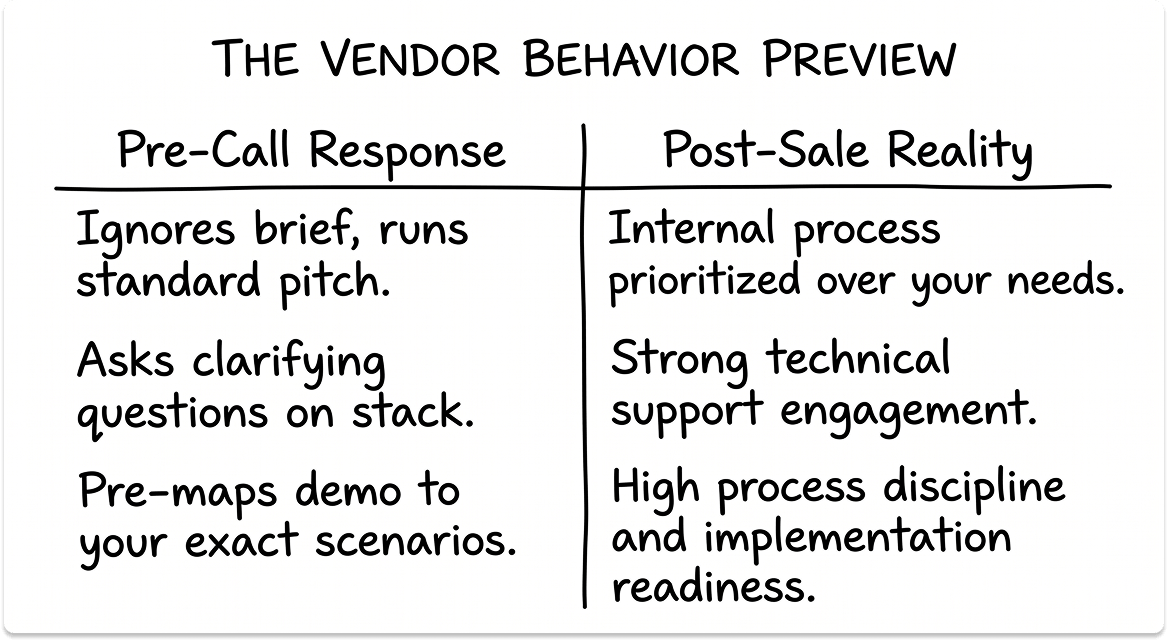
A vendor who comes back with specific, scenario-mapped preparation is demonstrating the kind of technical depth and process discipline that matters most in an implementation team six months after the contract is signed. A vendor who ignores the brief and runs their standard deck is telling you that their internal process takes priority over the buyer's, and in my experience that pattern doesn't change once they have the deal. A vendor who responds with clarifying questions about the stack or the scenarios is showing you how their support team will operate when there's a real problem on the table.
The brief functions as a pre-qualification filter. For a broader view of the selection signals worth tracking, mistakes to avoid in your vendor selection process covers the patterns that tend to get missed until it's too late.
How to Use the Briefing Document After the Call
The brief doesn't stop being useful when the call ends but it becomes the scoring baseline for the rest of the evaluation.
Score vendors on the same rubric. Because every vendor responded to the same document, the scorecard becomes a genuine comparison. The measure is how well each vendor addressed the specific scenarios in the brief, not how impressive the general demo felt in the moment. The IT vendor scorecard and template is worth completing immediately after each call before impressions blur.

Flag every gap the vendor skipped. Any criterion a vendor deflected or glossed over in the demo should become a specific follow-up question before they're advanced to the next stage. A second skip is the answer.
Use the brief as the baseline for proposal requests. When formal proposals come in, vendors who engaged seriously with the brief will produce specific, contextual responses. When comparing vendor proposals, the vendors who treated it as background noise will be immediately apparent.
When Writing the Brief Becomes the Bottleneck
The process works. The problem that comes up most often is that writing a proper brief — across a shortlist of three or four vendors, with real specificity — takes 3 to 4 hours done well. For a CIO or infrastructure head already running at capacity, that time is genuinely hard to find, and the result is that most teams either skip the brief entirely or send a generic one-pager that strips out most of the value.
Three situations make this harder than it needs to be.
Evaluating a category for the first time. When a team hasn't run a SASE evaluation or a cloud backup replacement before, the right criteria aren't obvious. What are the standard integration points? What does a realistic implementation timeline look like? What does a red flag in a vendor's response actually signal? Writing a useful brief requires benchmarks that take real time to develop, and the vendor selection process guide covers a lot of that foundational context.
A longlist with more than four vendors. Writing a tailored brief for five or six vendors is close to a week of structured work, and most IT teams simply don't have that bandwidth mid-quarter.
A shortlist sourced primarily from vendor marketing. When the vendors under evaluation were found through their own websites, a paid review platform, or an inbound campaign, there's a reasonable chance that better-fit options haven't been seen at all. A well-written brief sent to the wrong shortlist still produces the wrong outcome. The best tools for vendor selection and evaluation covers the sourcing channels that surface vendors outside the usual set.
Tell us your requirements: stack, constraints, category, and timeline. We'll send you a vetted shortlist of vendors worth evaluating, including ones that may not have come up through the usual channels.
If you want to move forward with any of them, we brief the vendors before your first call so the conversation starts with your context.
Let's start with the survey below we can get to you a little too before speaking to you.
What Happens to Evaluations That Skip the Briefing Step
Evaluations that skip vendor briefing to save time tend to take longer overall. According to Gartner, the average B2B software purchase now involves 6 to 10 decision-makers. When that group attends demos that each went in a different direction, alignment breaks down fast and a second round gets scheduled.
Three consequences show up consistently in evaluations that lack a briefing structure.

Timeline extension. The first demo round produced no comparable data, so a second round becomes necessary — typically adding 4 to 6 weeks to an already stretched process. How long an IT vendor RFP should take gives a realistic benchmark for what structured timelines actually look like.
Stakeholder fragmentation. Different people attended different demos and came away with different impressions of different products. Getting back to a shared view takes meetings that shouldn't have been necessary in the first place.
Selection on presentation quality. When there's no shared scoring rubric and no common demo structure, the vendor with the most polished pitch tends to win. That measures sales team quality, not product fit.
You should also, always take vendor PoC into account. Read this article on how to run an IT vendor Proof og Concept.
After the Calls: Due Diligence and Proposals
Once the demos are scored, the evaluation moves into due diligence and formal proposals, and this is where the brief becomes a different kind of tool. A vendor who can't match their demo performance in a formal proposal is showing a gap worth investigating before any commitment is made.
How to do vendor due diligence as an IT leader covers the financial, technical, and contractual checks that should happen before a vendor makes the final shortlist, and vendor due diligence best practices covers the automation opportunities that reduce that workload. If the evaluation escalates to a formal RFP, what is an RFP in vendor selection and how to write it walks through the structure and the questions that actually produce useful vendor responses.
Want to move faster through your current evaluation?
We work with IT leaders to build vetted shortlists and brief vendors before the first call. Your conversations start with your requirements. We make sure you only talk to vendors you want to.
FAQ
What should I send a vendor before the first demo?
A structured vendor briefing document covering the problem statement, current stack and integration requirements, evaluation criteria with weightings, decision context (timeline, budget, stakeholders), and three specific scenarios to be demonstrated in the call.
What is a vendor briefing document?
A vendor briefing document is a 1 to 2 page structured asset sent to every vendor on the shortlist 48 to 72 hours before the first call. It sets the demo agenda, provides environment context, and ensures every vendor is evaluated on the same dimensions rather than whatever they chose to cover.
How do you compare vendors fairly across multiple demos?
Send all vendors the same briefing document before the calls, then score each one against the same criteria using a structured vendor scorecard. Evaluating vendors on different dimensions because each demo went in a different direction is one of the most common reasons IT evaluations produce no clear winner.
How do I prepare for an IT vendor evaluation call?
Define the problem statement, map integration requirements, set evaluation criteria, and write three scenario-based demonstration requests before the call. Send all of it to the vendor 48 to 72 hours in advance, then review any pre-call response they send and use it to sharpen the questions going in.
How long should IT vendor evaluation take?
A structured IT vendor selection process from longlist to signed contract typically runs 3 to 6 months for enterprise software. Without structured pre-call preparation, evaluations regularly take longer because the first demo round produces no comparable data and a second round becomes necessary.