



You answer for the meeting you weren't in
When leads don't convert, revenue teams audit the ICP, the scoring, the follow-up and the source — everything except the forty-five minutes where the outcome was decided. Here's why, and what it costs
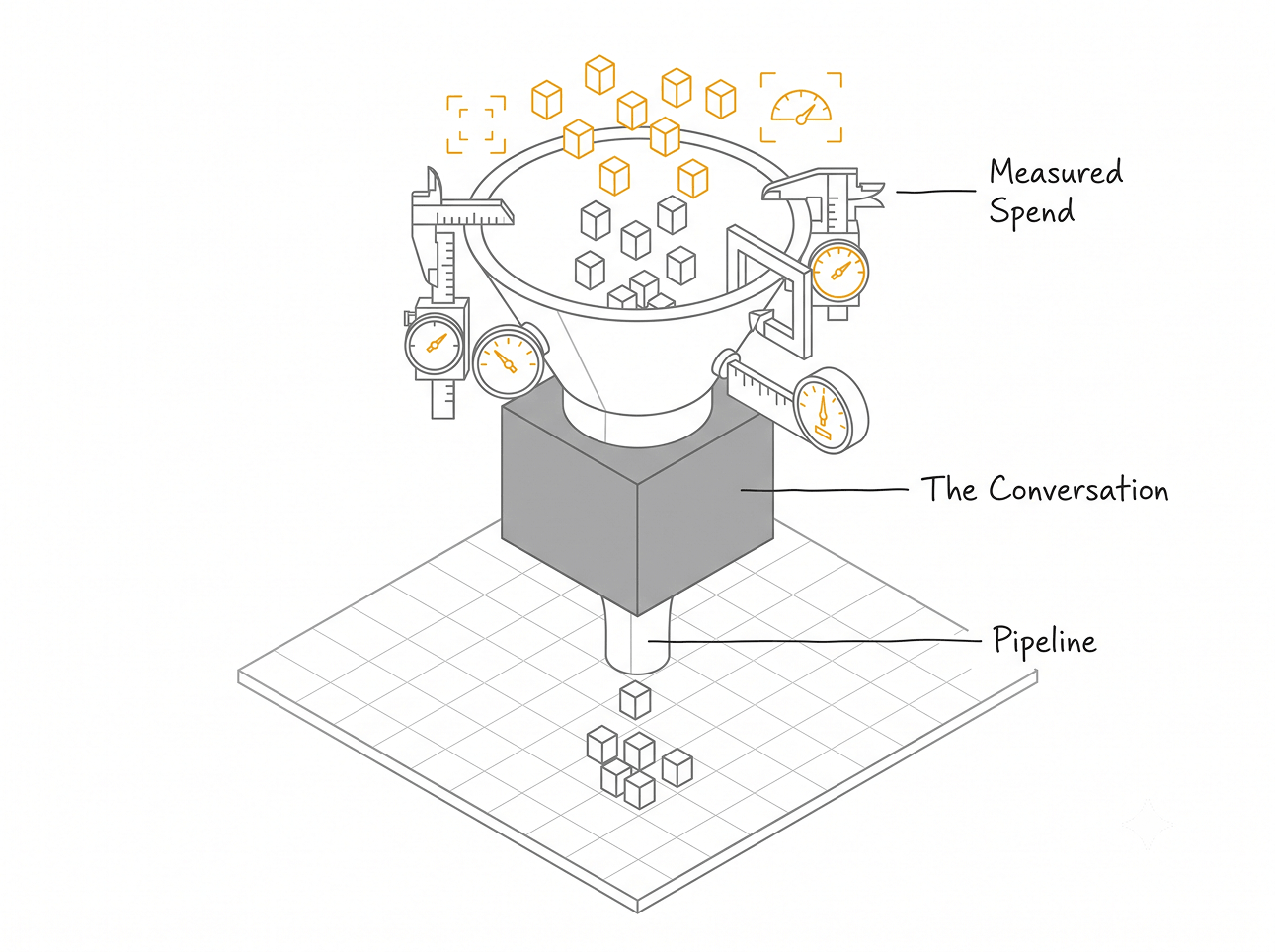
When purchased meetings don't convert, everyone investigates the campaign. Almost nobody investigates the conversation.
A version of the same call reaches me every few weeks. A marketing leader, or sometimes a CRO, and the opening line is close to identical each time: the leads aren't converting.
What follows is always a hunt. We go through the ICP together. The titles. The scoring model. How fast leads get assigned, and to whom. The follow-up cadence, the sequence, the territory splits, the messaging on the campaign that generated them.
Serious people asking serious questions, and I take them seriously, because sometimes the answer really is in there.
But I noticed something about that hunt over the years. It searches everywhere except one place. It goes carefully through everything that happened before the meeting and everything that happened after it, and it steps straight over what goes on sales calls — the part where somebody from their company sat down with a buyer and the outcome was actually decided.
I did exactly the same thing for years, so I am not being clever at anyone's expense here. I have run sales teams. When my numbers missed, I looked at the list. Then the territory. Then the messaging, the comp plan, the coverage model.
I was not deliberately avoiding the conversation. I skipped it because it was the one part of the process I had no information about at all. It was a blank space in the middle of the funnel, and you cannot investigate a blank space.
What changed for us was recording and scoring those conversations properly — enough of them, consistently, against a standard.
What we found was not that our people were bad at their jobs. It was that we had spent years debugging every component of the system except the one that determined the result.
That is the position most demand generation leaders are in right now. You are held to a number that gets decided in a room you are not in, by somebody who does not report to you, and when it goes wrong the investigation has nowhere to look but around it.
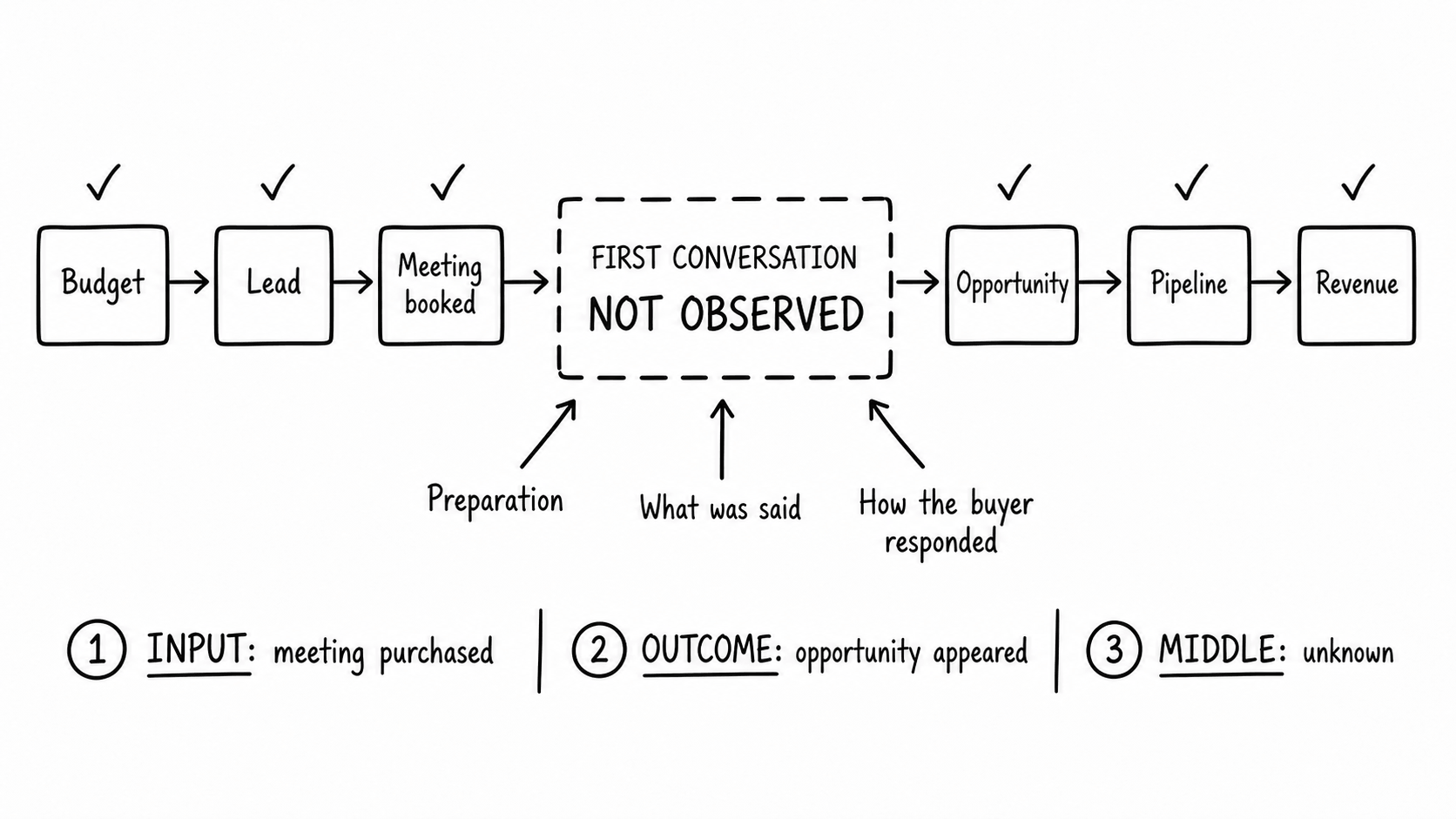
The percentage nobody asked you to defend
Your job runs on one equation, whether or not anyone has written it down.
You are given a budget. You turn that budget into meetings — from us, from other vendors, from events, from paid media. You are banking on some percentage of those meetings becoming pipeline, and some percentage of that pipeline becoming revenue.
That percentage is the most important number in your plan, and it is almost never a number you chose. You inherited last year's, adjusted it a little, and built a budget request on top of it. Nobody has ever asked you to defend the percentage directly. What they ask you to defend is the spend that rests on it.
While it holds, nobody mentions it. When it slips two points, the money you were responsible for spending becomes the money you wasted. And the thing on the table is not the meeting. It is your judgment in having bought it.
What follows is familiar enough. Budget gets clawed back the following quarter, so you chase the same target with fewer resources. And you go back into that room, month after month, to explain why money became meetings and meetings became nothing.
Two leads, priced identically
Late in 2013, we sold Hitachi Vantara a fifty-thousand-dollar enterprise storage lead. A hospital in New York City running Epic, out of storage capacity, having system failures, short of money.
The hospital chose EMC. Closed lost.
By any report a marketing leader would run, that lead failed. It sits in the column marked lost.
Ten years later, that same lead had produced millions of dollars in business.
I am going to leave the how hanging for a moment, and come back to it near the end. Because the mechanism is the actual argument of this article, and if I give it to you now it will read as a nice story about a persistent salesperson. It is not that. It is the most transferable thing I know about this problem.
For now, put a second fact beside it.
Across nearly thirty years I have sold thousands of meetings at close to that same price, against close to that same qualification standard, into the same market, that produced nothing at all. Not a bad outcome — no outcome. The meeting happened, everybody was polite, and the thread went quiet.
Both of those were the same product. I know, because I sold both of them.
I am not claiming lead quality does not matter. It does, and I have delivered weak ones.
The claim is narrower and harder to dismiss: lead quality cannot be the dominant variable in that outcome, because a dominant variable would not permit a spread that wide.
Something downstream of the handover is doing most of the work.
Dan Ross, who took that Hitachi call as National Partner Manager, put it to us more bluntly: you can hand over a grade-A lead, and if the rep does not know how to handle it and move it into a real meeting, it fails.
He is right.
You have the invoice and the verdict
Consider what your organization can tell you about the money.
Cost per lead. Cost per qualified meeting. Source and channel performance. Show rate. Lead-to-meeting conversion. Meeting-to-opportunity conversion. Pipeline coverage. Stage velocity. Win rate by segment. Most revenue teams can produce all of it inside a day, broken out by rep, going back years.
Now consider what it can tell you about the conversation those dollars bought. In an earlier piece I worked through the arithmetic: at 200 meetings a year, the spend comes to around $2000 per hour of conversation, or about $33 a minute.
About those minutes, your organization can tell you two things. That they were purchased. And whether an opportunity appeared afterward.
An input and an outcome, and nothing at all about the event in between.
No other capital purchase in your business works like this. You would never approve $200K of equipment and then decline to measure whether it was switched on.
Because utilization is an ordinary thing for a company to know about an asset it paid for.
Why the blame lands on the lead source
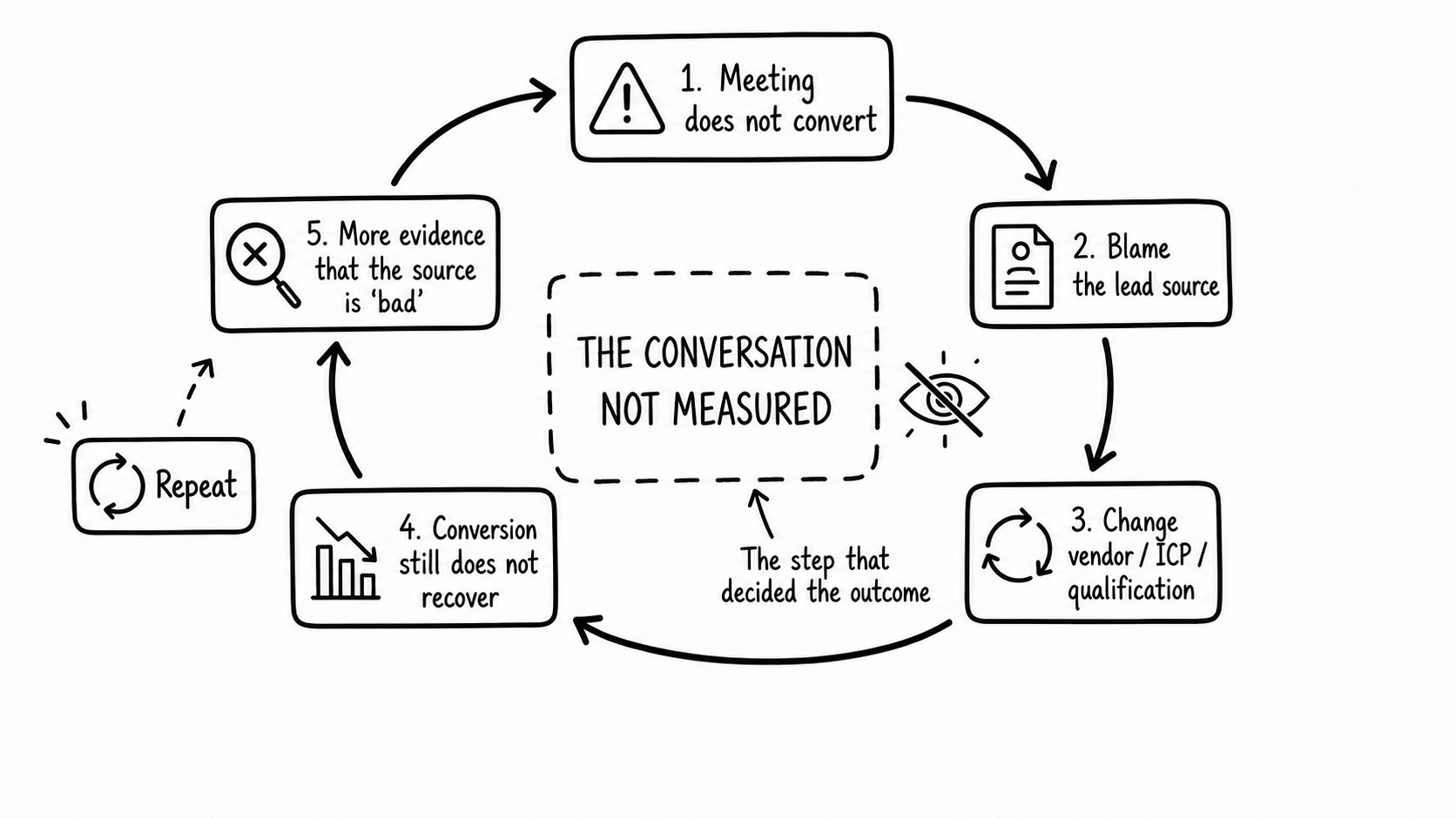
When a step in a process cannot be observed, its failures get attributed to the nearest step that can be. That is not politics. It is what reasoning does under missing information: you explain an outcome using the evidence you actually hold.
And all the evidence you hold is about the lead. The lead has a source, a cost, a date, a channel, a score, and a row in a report. The conversation has none of those. It left no record.
So the diagnosis assembles itself, and it even feels rigorous, because it is the only part of the story with data attached. The leads are not good enough.
What follows from that diagnosis is expensive. You change vendors. You re-cut the ICP. You tighten qualification criteria. You raise volume to compensate for a rate you cannot move. You shift channel mix. Every one of those decisions is defensible on its own.
None of them touches the step that decided the outcome.
So the rate does not recover. And now next quarter's diagnosis has more evidence for the same wrong conclusion: we changed the source and it still did not convert, so the source still is not good enough.
That is the trap. It is a loop that produces more confidence in a wrong answer every time it runs.
I have watched what it does to a sales floor. Chris Miller, CTO at Advizex, described the end state of it to us before we ever worked together: reps who had stopped believing the lead sheets in front of them, and an erosion that eventually generalized until nobody trusted anything in the pipeline at all.
I have been on the receiving end of that loss of faith, sometimes deservedly. What I would say now is not that the source is never the problem. It is that you cannot tell which it was, and the default resolves to whichever one is visible.
The two ways this resolves, and the quiet one is worse
We have been running structured interviews with revenue and marketing leaders in funding positions. Two of them described this gap from opposite ends.
At the first, a cybersecurity vendor, blame flows upward and the marketing side answers for it. In their own words: constantly having to answer to leadership for why this did not convert. Budget gets clawed back. It is painful, and it is career-relevant.
At the second, nothing happens at all. Unconverted meetings simply go dormant. No post-mortem, no argument, no clawback. The list ages, the quarter closes, the next campaign launches.
I think the second organization is in more trouble, and theirs is the version that never feels like trouble. The loud version at least produces a question, and a question occasionally produces somebody going and listening to a call.
Silence produces repetition. A company can run the same failing first meeting a thousand times without ever discovering that it fails, because nothing forces anyone to ask.
Which version you get is a function of culture rather than the size of the loss. The money leaves either way.
Nobody in this story is lying
It would be easy to read all of that as sales withholding something from marketing. That is not what is happening, and getting it wrong sends you looking for a fix that cannot work.
Ask a sales leader whether the rep was prepared for the meeting. The honest answer is I think so. That is not evasion. Preparation leaves no artifact. There is nothing to produce.
And that leader is standing in the same blind spot you are, one seat over. One CRO told us plainly that preparation across his team is not consistent, and that he cannot see who does it. He was not defending anyone. He was describing the same missing instrument.
You would think so the rep is the problem but that's not the case either.
Preparing properly for a first meeting with a mid-sized enterprise is around forty-five minutes of real work — the company, the technology environment, the stakeholders and what each of them is measured on, the questions worth asking this account and no other.
A seller with five meetings tomorrow does not have four hours tonight. In thirty years I have met very few sellers who would not prepare, and a great many who could not, because they had been asked to do something arithmetically impossible.
So the fix is not a conversation about accountability. Accountability is already assigned, and it is assigned to you. What is missing is the record that would make it mean something.
Control is the wrong ask
The instinct is to reach for control. A seat in the first meeting. Mandated call reviews. Preparation checklists policed from the marketing side.
I have watched that attempted. It fails on politics, and frankly it deserves to. You are not going to run that meeting, and you should not. It is not your job, and you would be worse at it.
The right ask is much narrower, and much duller.
Did the thing we paid for get used properly?
That is all. Not authority over the conversation — evidence about it. And notice that it is a question you can answer about every other dollar you spend, and cannot answer about the most expensive one.
Framed that way, it stops being a turf claim. Your counterpart in sales is missing the same instrument, and they would like it too.
Which brings me back to the hospital
After losing that first deal, Dan called them back — to ask why, and then to listen.
What he learned was that the problem he had been selling into was a fraction of the problem they actually had. So he offered a no-cost assessment: two or three days scrubbing their data flows, then a red-amber-green view of what was exposed and what would happen to the business if it went down.
When the next opportunity arrived that genuinely fit, they did not run an RFP against five vendors. They called Dan.
That is the story people usually take away, and it is the less useful half. The more useful half is his standing process, which he applied to every meeting, not just that one.
- A mandatory pre-call with the partner before any prospect meeting.
- Read the lead notes properly and do not wing the call.
- Lead with questions rather than a pitch.
- Earn the right to propose before proposing.
Our own intelligence prepared him, and that he took a step back and followed the guide.
There was no software in any of this. It was 2013. A partner manager decided what prepared meant, required it of himself before every meeting, and turned a lead that closed lost into a decade-long account.
Then he did the one thing most good sellers never do: as a leader, he made that pre-call standard across every MDF-funded program he ran.
Every organization already has a Dan Ross
This is the part I would most like demand generation and revenue leaders to sit with, because it changes what you are actually asking for.
The knowledge you need is already inside your company. It is not missing. In almost every sales team I have worked with over thirty years, somewhere between one and three people already know how to run a first meeting properly.
They know what to read before they dial. They know the three questions that open up a storage conversation with a hospital CIO and how those differ from the ones that work on a bank. They know when to stop presenting. Their conversion rate is visibly better than the rest of the team's and everybody knows it.
And that knowledge does not travel. It sits inside one person, gets partially absorbed by whoever happens to sit near them, and leaves the building when they do.
The usual explanations for that are wrong, or at least incomplete.
It is not that top performers hoard. Most will tell you everything they know over a coffee. It is not that training does not exist — you have probably bought plenty. The reason it does not travel is more basic than either.
Their method has never been written down in a form anyone could follow, because most of it is tacit and they could not tell you all of it if they tried. There is no standard, so there is nothing for a manager to hold anyone to.
And critically, nobody can see the meetings where the method is applied and the meetings where it is not, so nobody can tell the difference between a rep who is genuinely working the process and a rep who says they are.
Your best performer's approach and your weakest performer's approach look identical from the outside. Both produce a calendar entry and a CRM note.
That is why "our reps should prepare better" never changes anything. It is a request without a definition, aimed at behaviour nobody can observe, with no feedback afterward.
What Dan had was one person's judgment, applied consistently, for a decade. What his company never had was a way to make it anyone else's.
Giving the whole team what one rep already has
That is the problem worth solving, and it is a systems problem rather than a training problem.
It needs four things connected to each other, and connected is the operative word — each one on its own has been sold into your market already and none of them individually moved the number.
Run those four as a loop and something changes structurally. The judgment that used to live in one person becomes the standard the organization operates to.
New hires start closer to your best performer instead of closer to your worst. And you, holding the budget, can finally see the middle of your own funnel.
That is what we are building the Evolve Suite to do.
What a system like this can do is make preparation happen reliably, make what happened in the conversation visible, and turn that visibility into coaching that shows up in the next call.
Preparation changes the first ten minutes. Better first conversations convert at a higher rate than worse ones. Each of those links stands on its own and I will defend each one separately.
You are going to keep answering for a meeting you were not in. That part is not going to change, and it probably should not. The only real question is whether you can see what happens in it — and whether what you learn gets to everyone, or stays with the one person who already knew.
If this describes your funnel, we are opening early access.
Evolve Edge and Evolve Coach handle the preparation and the conversation analysis described above — a brief before every meeting, an objective read of the conversation afterward, and coaching that carries into the next one. We are currently onboarding a limited number of enterprise technology teams.
FAQ
Why don't purchased B2B leads convert to pipeline?
Often for reasons that have nothing to do with the leads. Outcomes from a single source vary enormously: one fifty-thousand-dollar lead we sold Hitachi Vantara in 2013 closed lost and then produced twelve to fifteen million dollars over the following decade, while thousands of comparably priced meetings against the same qualification standard produced nothing at all. A variable that determined outcomes would not permit that spread, which locates most of the causation downstream of the handover — in the first conversation. The difficulty is that the conversation is the only step in the funnel that leaves no record, so it never gets examined.
Who is responsible when qualified appointments don't convert — sales or marketing?
In practice marketing usually answers for it, because marketing chose the source and signed for the spend. But the outcome is decided in a meeting they are not in, run by a seller who does not report to them, with preparation nobody can see. That is a structural gap rather than a conflict between two functions, and sales leadership generally has no more visibility into preparation than marketing does. One CRO we interviewed volunteered that preparation across his team is not consistent and that he cannot see who does it.
Why doesn't our best rep's approach spread to the rest of the team?
Because it has never been made observable. A top performer's method is largely tacit — they could not fully articulate it if asked — so it has never been written down in a form anyone could follow. Without a written standard there is nothing for a manager to hold anyone to, and without visibility into what actually happens in calls, a rep working the process and a rep skipping it look identical from the outside. Both produce a calendar entry and a CRM note. Coaching in that environment is opinion rather than instruction.
How do you measure whether a sales rep prepared for a first meeting?
In most organizations you do not, which is why "our reps should prepare better" never produces a change. It takes a written definition of prepared that is specific to each meeting type rather than a general principle, an artifact attached to each meeting so preparation becomes checkable before the call instead of inferred afterward, and a read on how the conversation actually ran against that standard. Without the artifact, preparation is managed on trust, because it leaves no evidence behind.
Does changing lead vendors improve conversion?
Sometimes, and sometimes the source genuinely is the problem. The difficulty is that you usually cannot tell. When one step in a process cannot be observed, its failures get attributed to the nearest step that can be, and the lead source is the most thoroughly documented object in the funnel. So the diagnosis defaults to the source whether or not the source caused it — and if it did not, the rate does not recover, which tends to get read as evidence that the new source is not good enough either.


