The most expensive ten minutes in enterprise technology sales
Everything upstream of the first meeting gets measured. The ten minutes where the money is actually won or lost usually doesn't.
I have spent close to thirty years in enterprise technology sales — not analyzing it from the outside, but doing the work. Building the campaigns. Finding the buyers. Setting the appointments. Coaching the reps who took them. And, across thousands of occasions, sitting on the first conversation myself.
This is why I can write this article, so let me be clear about what it does and doesn't allow me to claim.
It doesn't make me right about everything.
It does mean that when I describe what happens in the opening minutes of a first meeting between a technology vendor and a technology buyer, I am describing something I have watched thousands of times rather than something I read in a report.
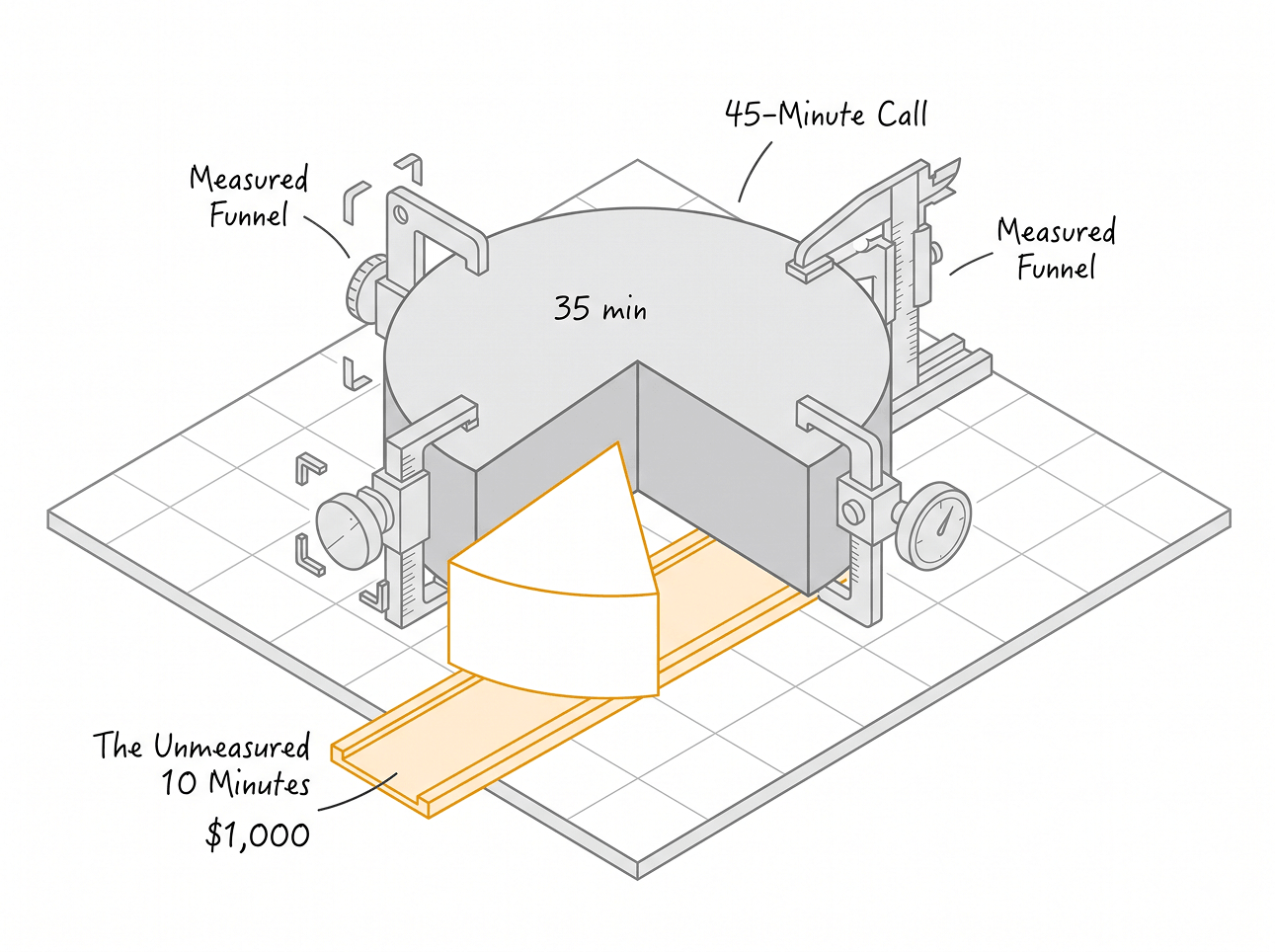
The first ten minutes of a first meeting is the most expensive ten minutes in the entire revenue funnel, and in most organizations it is also the only part of the funnel nobody measures.
Here's why.
What a first meeting actually costs
Most revenue leaders I meet can tell me their cost per lead to the dollar. Very few have ever calculated their cost per minute of conversation.
It's worth doing, because the number changes how the problem looks.
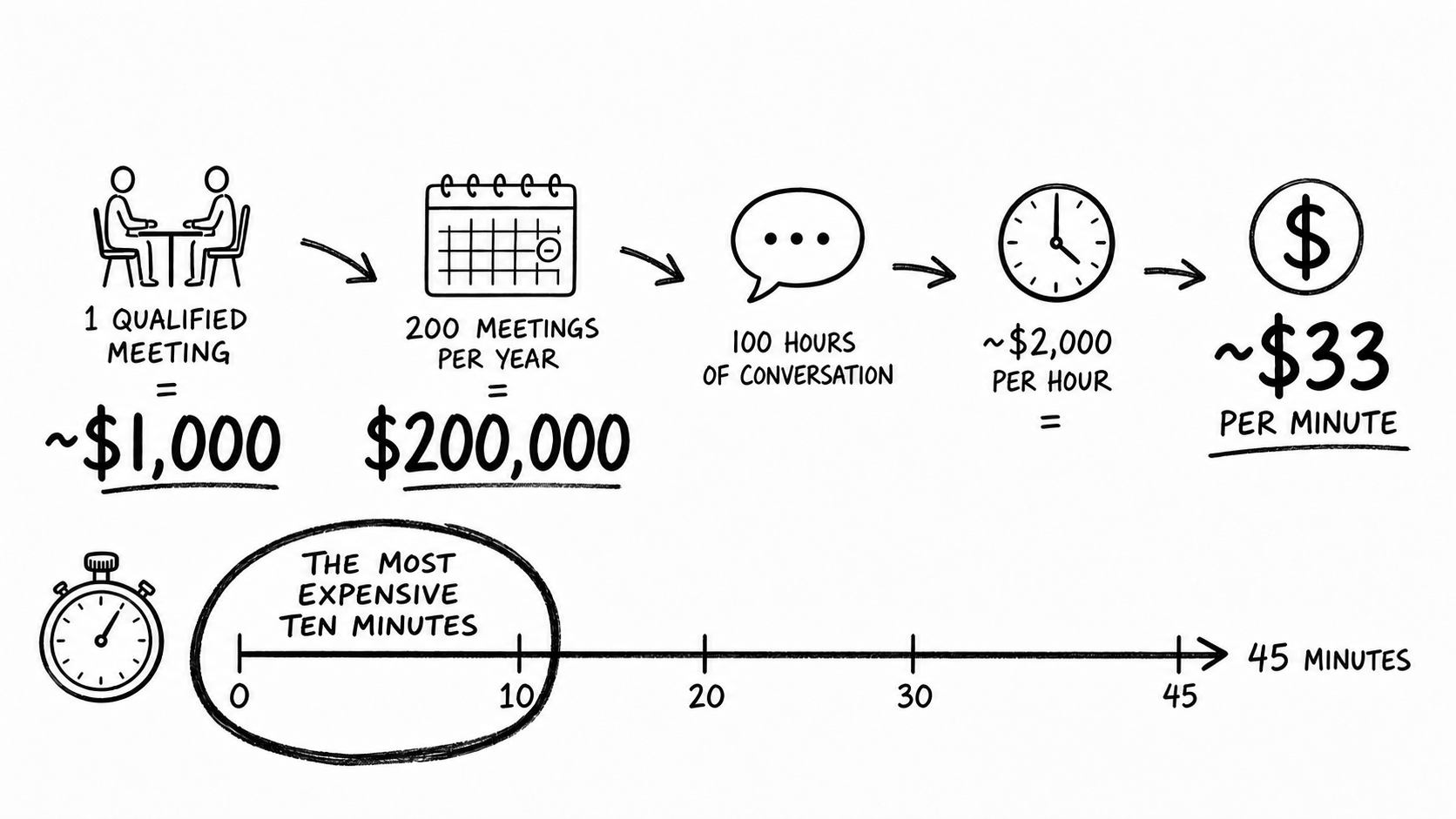
A qualified first appointment with an enterprise technology buyer costs somewhere in the region of $1,000. That figure holds fairly consistently whether the meeting comes from outbound, paid media, an event, or an appointment-setting partner like us — the channels differ, the blended cost per meeting lands in a similar place.
Say you book 200 first meetings across a year. That's $200,000 spent to create roughly 100 hours of conversation. Around $2,000 an hour. Call it $33 a minute.
Now put that against how the spend is treated internally. The $200,000 gets scrutinized line by line — source performance, cost per qualified meeting, channel attribution, quarterly ROI review. The 100 hours it purchased get almost no scrutiny at all.
And the money isn't spread evenly across those hours. It's concentrated at the front, for a reason that has changed in the last decade.
Why the money sits at the front of the call
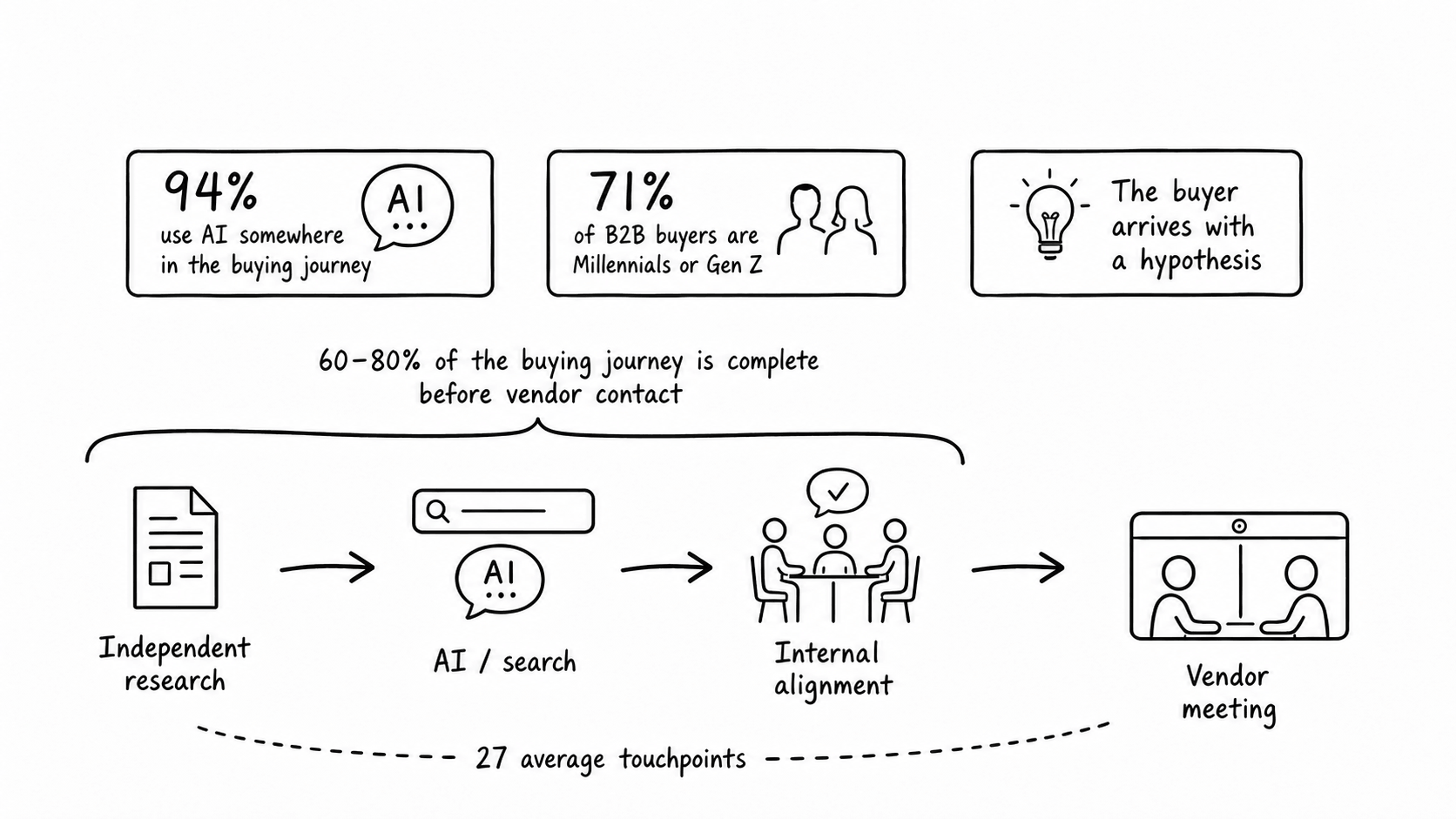
The buyer who joins your first meeting has already done most of the work you think you're there to do.
Roughly 60% of the buying cycle is complete through independent research before a buyer engages a sales rep, and a single IT buying journey now spans an average of 27 touchpoints — most of them occurring before any conversation happens.
By some measures the figure runs higher: 6Sense's 2025 research puts roughly 80% of the journey complete before a vendor is engaged, with 94% of B2B buyers now using AI and large language models somewhere along the way.
The demographic shift compounds it. 71% of B2B buyers are now Millennials or Gen Z — people whose default response to a question about a vendor is a search box or a prompt.
So the buyer arrives informed. They are not attending your meeting to learn what your company does. They know. They are attending to find out whether you know something they don't.
That makes the opening minutes a test, and the buyer grades it fast.
85% of buyers report feeling overwhelmed when they are pitched, and 75% now say they would prefer a rep-free buying experience entirely (Gartner, 2025).
Meanwhile 64% of IT buyers will eliminate a vendor from consideration outright if that vendor cold calls them, and cold-outreach conversion has fallen from around 15% to around 5% — the old motion produces roughly a third of what it used to.
Read those numbers together and a picture emerges that I recognize from the calls themselves. The buyer has done the research, spent political capital internally to justify the meeting, and arrived with a hypothesis they want tested. Then the seller opens with the company overview.
In my experience, the room turns in about three minutes. Not dramatically — the buyer is polite, the call runs its full forty-five minutes, everyone thanks each other. But the decision has been made, and the remaining time is theatre.
What follows is the "let me think about it" close, and then silence.
That silence is where the $1,000 goes.
How I know this
I want to be specific about the basis for what follows, because "in my experience" is a claim anyone can make, and the difference between an opinion and evidence is whether you'll show your work.
For nearly three decades, TechnologyMatch has run first-meeting programs for enterprise technology vendors.
Over roughly six years of systematic capture, that has produced a corpus of about 35,000 recorded first conversations across more than 1,200 vendors — introductions, discovery calls, and early qualification, between real technology buyers and real sellers, in live commercial situations rather than training environments.
Every recording is first-party, collected in the ordinary course of the business, with the consent of both parties on the call. The corpus grows by roughly 15% a year, because the conversations are still happening.
Several years ago we stopped assessing those calls on impressions and started scoring them against a fixed methodology — a 0–100 composite built from measurable conversation behaviors: rep talk-to-listen ratio, number and quality of discovery questions, whether the opening led with insight or credentials, whether a mutual next step was agreed before the call ended.
That work is what turned three decades of instinct into something I can put in a table (and the Evolve Suite model that we've built but more on that later).
Two limitations you should weigh.
First, these are qualified appointments generated through structured programs. They are not a random sample of all B2B sales calls, and a vendor whose meetings come from inbound demand may see a different baseline.
Second, the corpus is strongest at the front of the deal and thinner at the back of it — competitive displacement, late-stage negotiation, and re-engaging a stalled buying committee are underrepresented. Everything I say here concerns first conversations, which is where I have evidence.
What actually happens in those ten minutes
Read the first row twice. In the average enterprise technology first meeting, the person who already did the research spends two-thirds of the call listening, and the person who needs the information does the talking. We have inverted the conversation.
The second row is the one that troubles me more. Four questions is not weak discovery — it is barely discovery at all. Four questions cannot establish a business problem, map a buying committee of six to thirteen stakeholders (Gartner / Forrester, 2024), surface a budget path, or produce anything a champion could carry into an internal meeting on your behalf. Four questions produces a call that felt fine and generated nothing.
But there is a genuinely hopeful finding in the same dataset, and it's the reason I think this problem is worth writing about rather than just complaining about.
Within the same teams, running the same programs, with the same reps — calls where the seller talked 55% or less, or asked six or more questions, scored 66 on the composite against 46 for the pitch-heavy calls.
Roughly twenty points of difference. No new headcount. No new tooling. No change in the offer, the territory, or the lead source.
Note the threshold: six questions, not fourteen. The improvement doesn't require your team to become elite. It requires them to clear a bar most calls currently don't clear.
The capability is already inside these organizations. It just isn't reliably present, and nothing in the operating rhythm makes it reliably present.
The two versions of the same forty-five minutes
Here is the same meeting run two ways. I have watched both hundreds of times.
This is a system problem, not a people problem
It would be easy to read the table above as a verdict on sellers. It isn't, and the operational detail matters more than the judgment. And if you're not sure, take the test yourself.
Two things have moved at the same time.
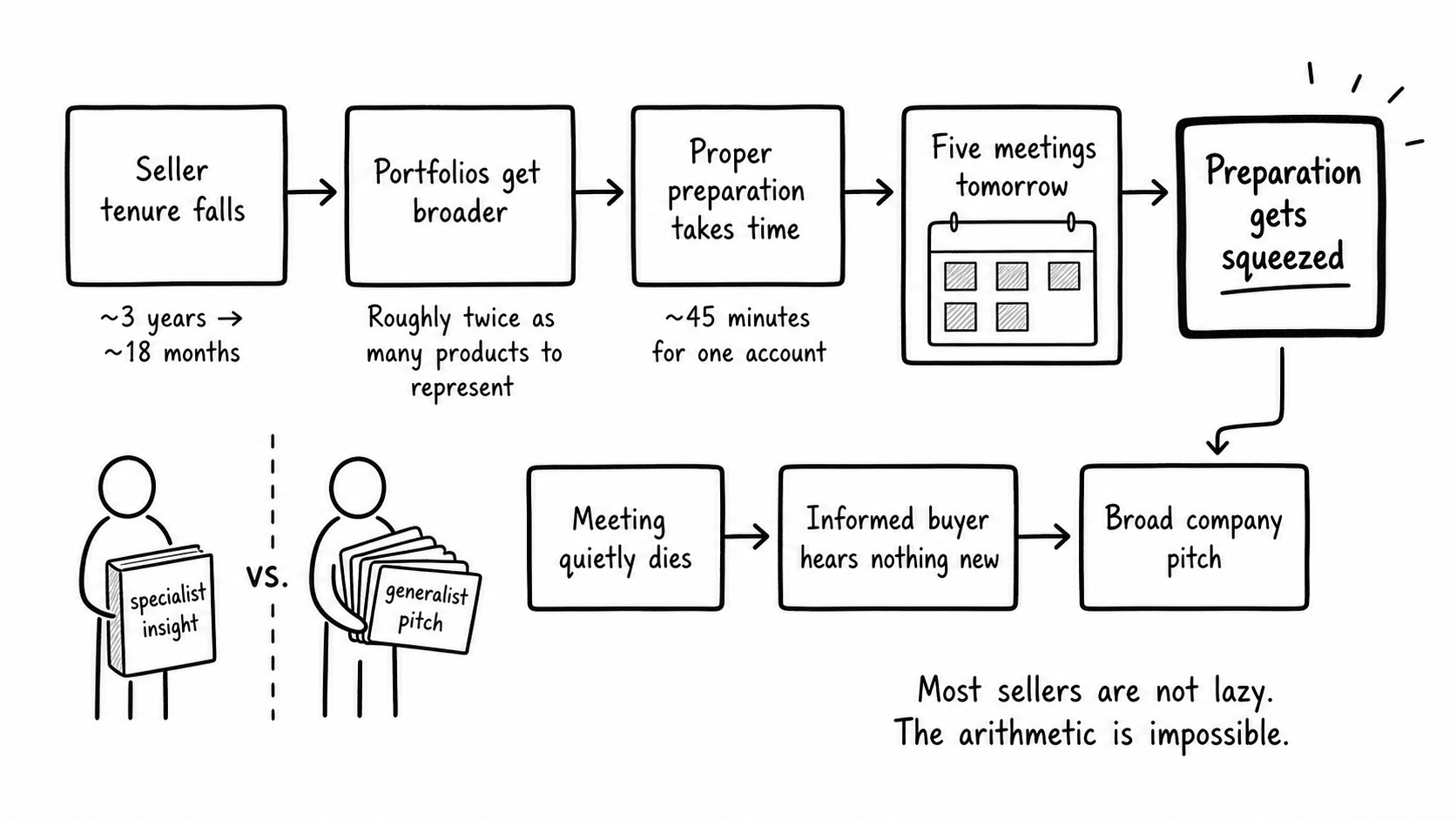
Average seller tenure has compressed to roughly 18 months, down from around three years. A meaningful share of reps now leave before they ever reach peak performance, which means the population of sellers taking your first meetings is permanently weighted toward the inexperienced end.
Simultaneously, the portfolios they're asked to represent have roughly doubled in breadth. Think of the difference between a specialist dealership and a used-car lot: the specialist knows one product intimately, while the generalist carries scores of models and cannot go deep on any of them. Broader portfolios and shorter tenure push sellers toward a shallow, generalist pitch at precisely the moment informed buyers will accept nothing less than specialist insight.
Now add the arithmetic of preparation. Preparing properly for a first meeting with a mid-sized enterprise — the company, the technology environment, the public initiatives, the stakeholders and what each one is measured on, the likely pressures, and three questions worth asking this account specifically — is around 45 minutes of real work. A seller with five meetings tomorrow does not have four hours tonight.
So sales call preparation becomes the variable that flexes. It's the only input to a meeting with no deadline attached, no artifact produced, and nobody checking.
Most sellers can't prepare at that depth. Very few won't. In thirty years I have met very few lazy sellers and a great many sellers asked to do something arithmetically impossible.
The part nobody measures
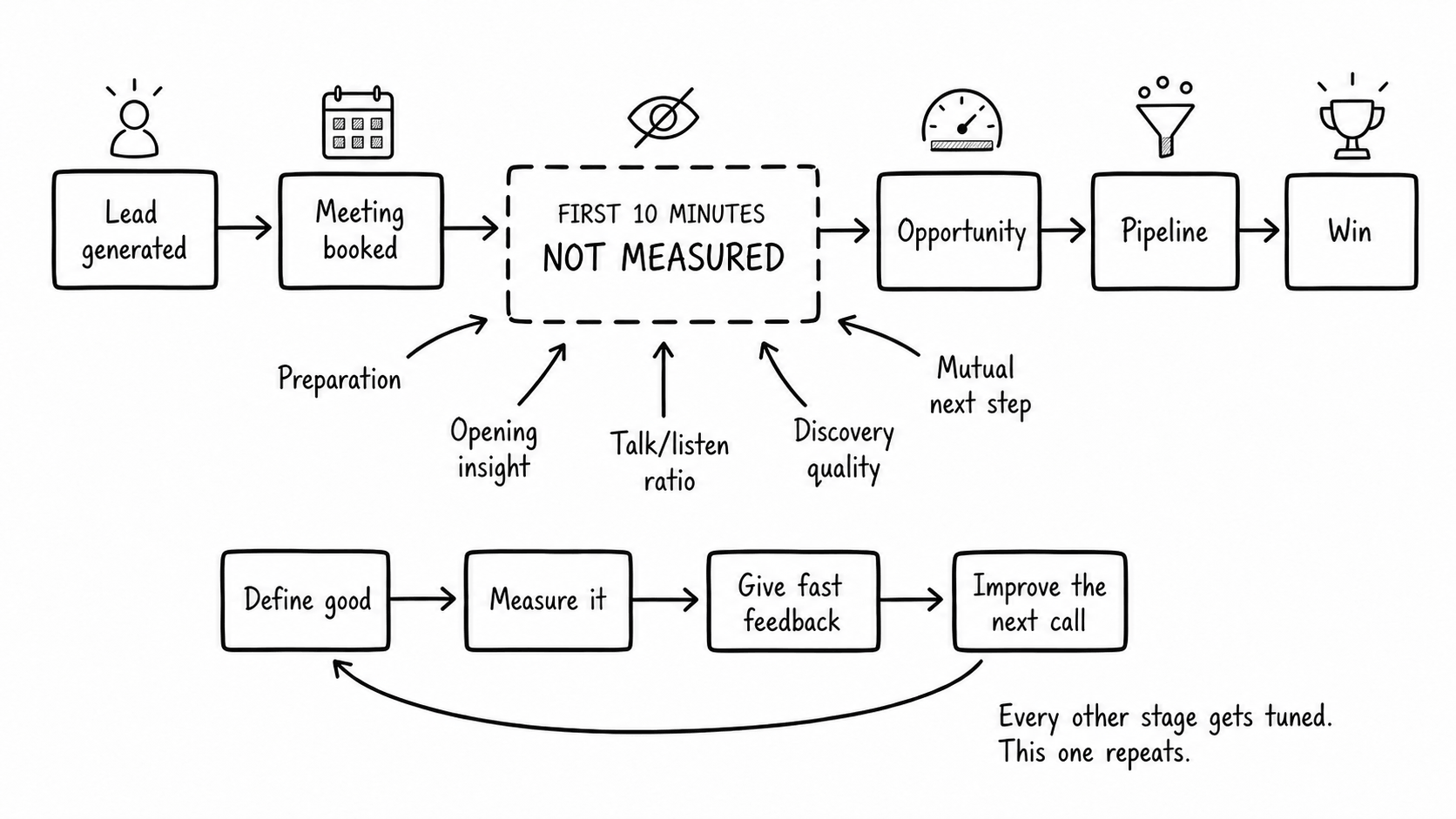
Consider how thoroughly we instrument everything around this conversation. Cost per lead. Cost per meeting. Source and channel performance. Show rates. Lead-to-meeting conversion. First-meeting-to-opportunity conversion. Pipeline coverage. Stage velocity. Win rate by segment. Most revenue organizations can produce all of it inside a day, broken out by rep.
Now consider what's measured about the ten minutes those dollars actually buy.
- Whether the seller prepared: not measured.
- What preparation should consist of: usually never defined.
- Whether the opening led with insight or with credentials: not recorded.
- How much the seller talked: unknown unless somebody happened to listen.
- Whether real discovery occurred: unknown.
- Whether a mutual next step was agreed: sometimes captured, rarely enforced.
The single most expensive step in the funnel is the only one running without instruments.
That has one unavoidable consequence, and it's the reason this doesn't self-correct: it cannot improve.
Improvement requires a definition of good, a measurement against that definition, and feedback that arrives soon enough to change the next attempt.
Without all three, an organization can run the same flawed first meeting several thousand times and never learn that it's flawed. Every other step in the funnel gets tuned quarterly. This one just repeats.
There's a second consequence I've watched play out in a lot of rooms. The person who fought for the lead budget, chose the source, and answers for the conversion number is very often not the person in the meeting. They can't see the preparation, can't hear the opening, and can't influence the ten minutes their number depends on.
One demand generation leader at a cybersecurity vendor put his version of it to me plainly: he is constantly having to answer to leadership for why the leads didn't convert. He buys the meeting. The outcome gets decided in a conversation he isn't in, run by a seller who doesn't report to him, with preparation he has no visibility into.
That is a structural accountability gap and not a personality conflict between sales and marketing. And it is why in most companies nobody owns this ten minutes — sales owns the conversation, marketing owns the number, and the gap between them is where the money goes.
What closing the gap actually takes
None of this requires new software. It requires four things, in order, and the order matters.
The honest caveat: all four are straightforward for one team of five and hard for an organization of two hundred. Sustaining 45 minutes of genuine preparation across every meeting, every rep, every week is a capacity problem before it's a discipline problem. How a company chooses to solve that — process, headcount, tooling, or some combination — is a separate decision from whether it needs solving.
What we did about it
We ran into the capacity wall ourselves. For most of three decades we solved it with people — analysts building briefs by hand, managers listening to calls on evenings and weekends, a scoring methodology maintained in spreadsheets. It worked, and it did not scale past a point. Every organization we ran programs for hit the same wall at the same place.
So we built the four steps above into software, and that became the Evolve Suite. I'd rather describe how it came about than what it does, because the sequence is the whole point.
We didn't build a model and then go looking for a market. We ran the conversations first. We generated the leads, set the appointments, hosted roughly 35,000 first calls across more than 1,200 technology vendors, scored every one of them, and watched pipeline succeed and fail at close range for years.
By the time the technology was capable enough to be useful, we already had the answer key — an evidence-based definition of what a good first conversation looks like, and thousands of examples of what happens when the definition isn't met.
Everyone in this market has access to the same AI models. Very few have 30 years of first-party recordings to ground them in.
Every benchmark in the product — including the numbers in the table earlier in this article — came out of that corpus rather than out of a product manager's judgment.
Which means what we're actually doing is narrower than the category language suggests. We're taking a repeatable model that we developed by selling for a living, tested across tens of thousands of conversations, and making it available to teams who shouldn't have to spend thirty years rediscovering it.
Preparation that used to take 45 minutes of a seller's evening. A conversation standard that doesn't live in one manager's head. Coaching that arrives before the next call rather than after the quarter.
I want to be careful not to overstate the chain, because this market has been overpromised to enough. Software doesn't generate pipeline. What it can do is make preparation happen reliably, and preparation changes the first ten minutes, and better first conversations convert at a higher rate than worse ones. Each of those links is defensible on its own. Anyone who skips straight from a product to a pipeline number is selling you something.
The ten minutes after a first meeting begins will remain the most expensive ten minutes in your funnel either way. The only real question is whether it stays the part nobody measures.
If this describes your funnel, we're opening early access.
Evolve Edge and Evolve Coach handle the preparation and the scoring described above — a brief before every meeting, and an objective read of the conversation afterward. We're onboarding a limited number of enterprise technology teams for now.
FAQ
What does a B2B sales meeting cost?
A qualified first appointment with an enterprise technology buyer costs somewhere in the region of $1,000. That figure holds fairly consistently across outbound, paid media, events, and appointment-setting partners, because the channels differ while the blended cost per meeting lands in a similar place. At 200 first meetings a year, that is $200,000 spent to create roughly 100 hours of conversation. Around $2,000 an hour, or about $33 a minute. Most revenue leaders can quote their cost per lead to the dollar and have never calculated their cost per minute of conversation.
What is a good talk-to-listen ratio for a sales call?
Rep talk time at or below 45%, which puts the majority of the conversation with the buyer. Gong's analysis of recorded calls places top performers at around 43%. Across roughly 35,000 first conversations in our corpus, the average rep talked 68.5% of the time, and on more than half of calls the rep talked for over 70%. That inverts the conversation: the person who already did the research spends two-thirds of the call listening, and the person who needs the information does the talking.
How many discovery questions should a first sales call include?
Between 11 and 14, based on Gong's aggregate analysis of more than 100,000 recorded calls. The average in our corpus is four, and two-thirds of calls ask four or fewer. Four questions cannot establish a business problem, map a buying committee of six to thirteen stakeholders, surface a budget path, or produce anything a champion could carry into an internal meeting. The practical threshold matters more than the ideal, though. Calls that asked six or more questions scored 66 on our composite methodology against 46 for pitch-heavy calls, roughly twenty points of difference with the same reps running the same programs.
How much of the B2B buying journey happens before a buyer talks to a vendor?
Roughly 60% of the buying cycle completes through independent research before a buyer engages a sales rep, across an average of 27 touchpoints in a single IT buying journey. 6Sense's 2025 research puts the figure closer to 80%, with 94% of B2B buyers now using AI and large language models somewhere along the way. Forrester's 2024 data adds the demographic driver: 71% of B2B buyers are Millennials or Gen Z, whose default response to a question about a vendor is a search box or a prompt. The buyer arrives informed, and they are attending to find out whether you know something they don't.
How long does it take to prepare for a first sales meeting?
Around 45 minutes of real work for a first meeting with a mid-sized enterprise. That covers the company, the technology environment, the public initiatives, the stakeholders and what each one is measured on, the likely pressures, and three questions worth asking that account specifically. A seller with five meetings tomorrow does not have four hours tonight, which is why preparation becomes the variable that flexes. It is the only input to a meeting with no deadline attached, no artifact produced, and nobody checking.