



Do You Have a Lead Problem or a Sales System Problem?
A lead problem and a sales system problem look identical in the numbers. One query — first-meeting conversion by source, then by seller — tells you which you have.
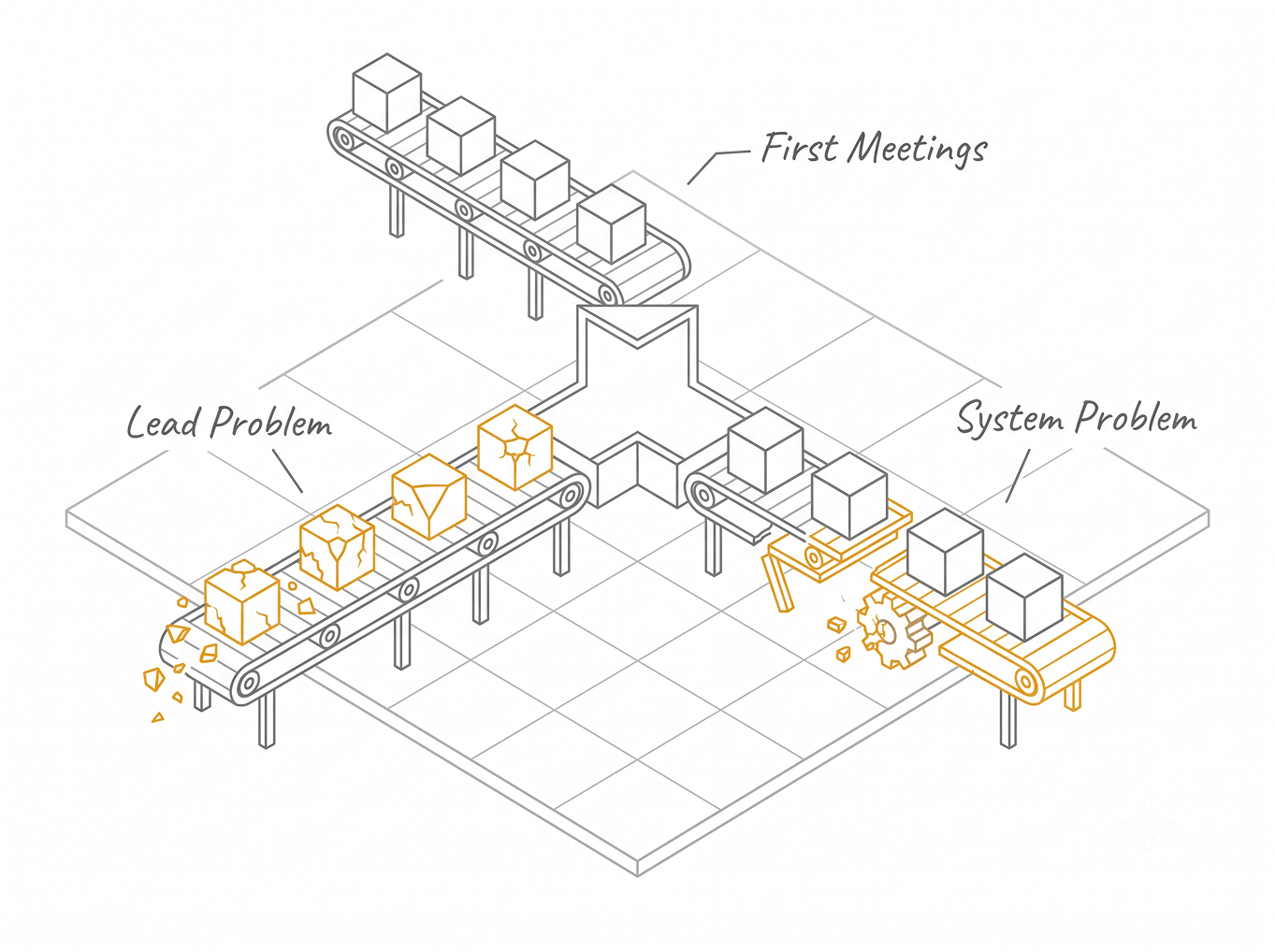
What is a lead problem vs. a sales system problem?
A lead problem means the meetings arriving in your calendar were unlikely to convert regardless of who took them — wrong seniority, wrong timing, wrong fit, or qualified against criteria that don't match what your sellers can work with. The failure happened before the conversation started.
A sales system problem means the meetings were workable and your organization couldn't reliably convert them — because sellers walked in without a view of the account, because no agreed standard exists for what a good first meeting looks like, or because what the buyer disclosed during qualification never reached the person who took the meeting. The failure happened during the conversation, and it was structural rather than personal.
The distinction matters because the two have opposite remedies. One says move budget and tighten qualification. The other says leave the budget alone and change what happens inside the meetings you're already buying.
Almost every organization guesses which one it has. The guess usually follows whichever function has more political weight, and it is wrong about as often as it's right.
How to test whether it's your leads or your sales system
Two cuts of one metric: first-meeting-to-qualified-opportunity conversion.
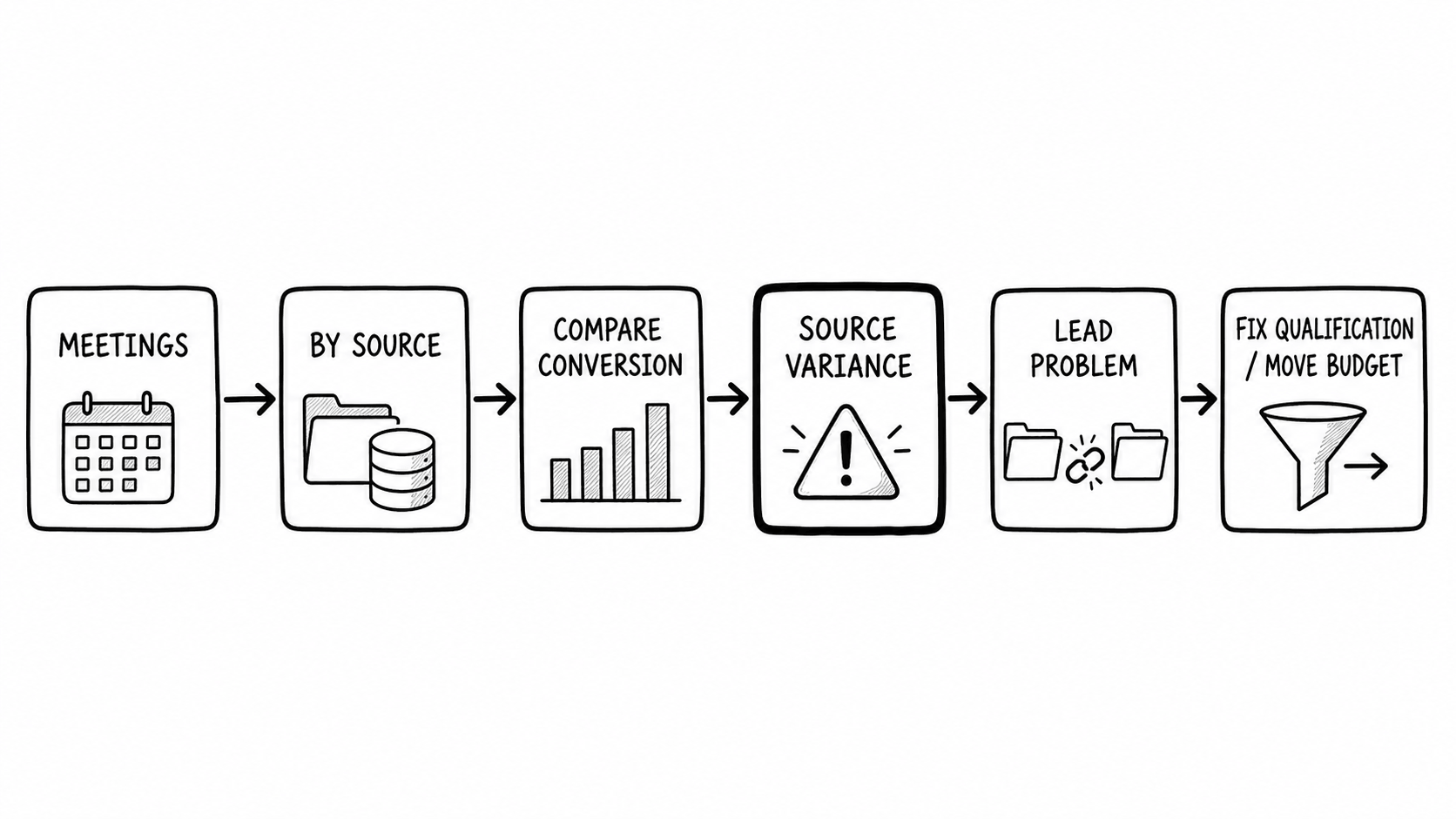
Cut one — by lead source. Group every first meeting from the last two to four quarters by where it came from. Paid, content syndication, events, partner or channel, SDR outbound, inbound, agency-sourced, vendor-funded program. Calculate the percentage that became a qualified opportunity, per source.
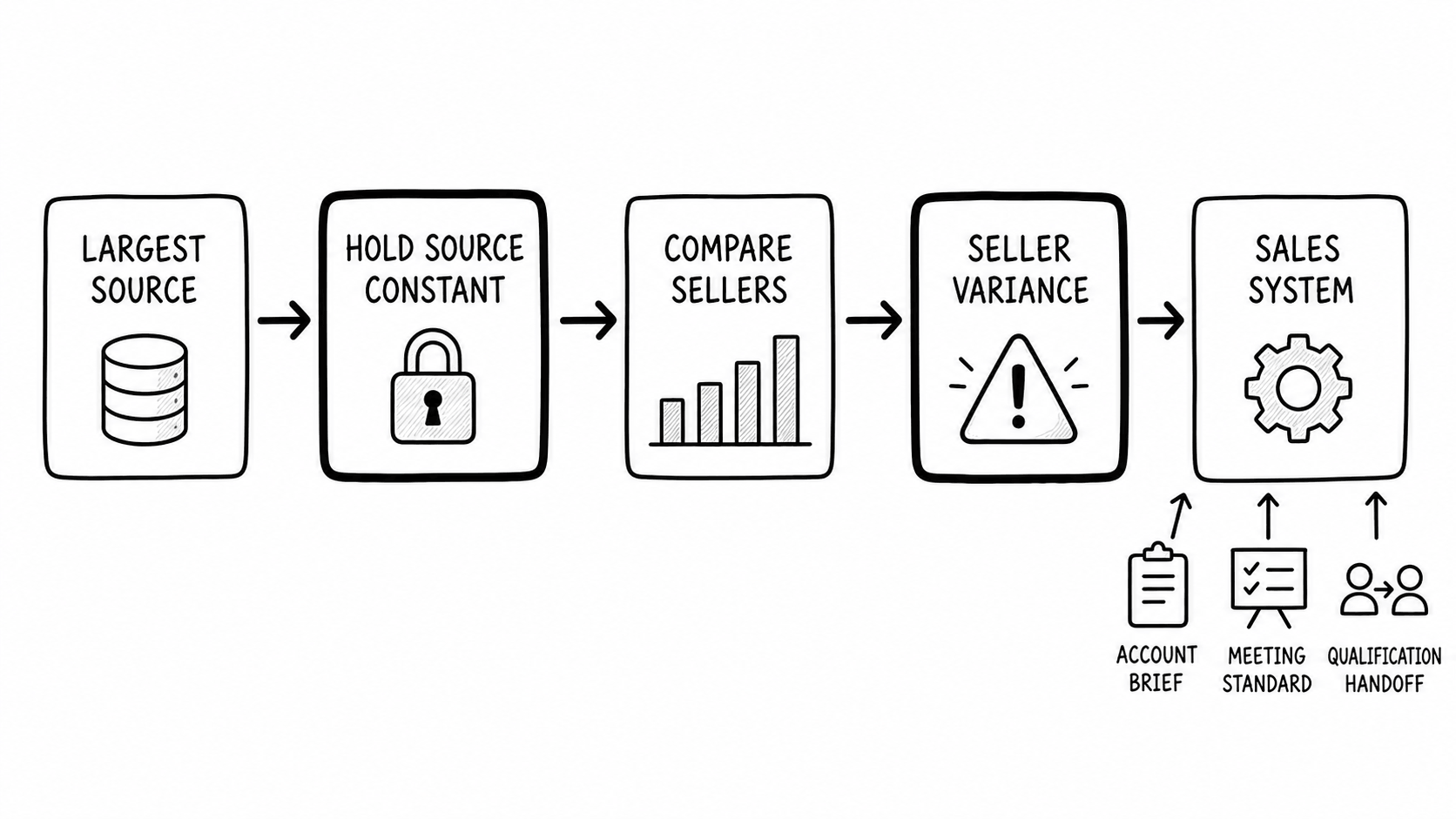
Cut two — by seller, source held constant. Take your single highest-volume source. Within that source only, calculate the same conversion rate per individual seller.
Holding the source constant is the part people skip, and skipping it invalidates the whole exercise. A raw by-seller cut tells you nothing, because your sellers aren't working comparable meetings — one may be fed mostly from events and another mostly from outbound. Only when the source is fixed does the comparison mean anything.
What you need: meeting date, lead source, assigned seller, and the qualified-opportunity flag with its creation date. Four fields. If your CRM holds those, this is a single query and an afternoon.
Then read which dimension the variance sits on. Not whether conversion is good — whether it varies more between sources or between sellers working the same source. That's the entire diagnosis, and it's why the test works even if you have no benchmark to compare against. You're not asking whether your number is normal. You're asking where your number comes apart.
What first-meeting conversion variance tells you
Four outcomes. They point in different directions, and three of them mean something quite different from what people expect.
If variance clusters by lead source: it's a lead problem
Conversion differs sharply between sources and stays roughly flat across sellers within any given source.
This is a lead problem. Some channels are delivering meetings that were never going to convert — wrong seniority, wrong timing, wrong fit, or qualified against a definition that doesn't match what your sellers can actually work with. Your sellers are performing consistently. They're being handed inconsistent material.
The work here is sourcing: tighten qualification criteria with whoever produces the meetings, or reallocate spend toward the channels that already convert. Nothing else in this article applies to you, and I'd stop reading here.
If variance clusters by seller: it's a sales system problem
Conversion is roughly consistent across sources, and inside your largest source, individual sellers convert at meaningfully different rates.
The same meetings are producing different outcomes depending on who takes them. That's not a lead problem — the material was comparable. It's a system problem, and it decomposes three ways:
- The seller didn't know enough going in. They walked into a first meeting without a view of the account, so the conversation became an introduction rather than a business discussion. More on that here.
- No agreed standard exists for what a good first meeting looks like. Each manager coaches toward something different, so "good" is whatever your best seller happens to do. More on that here.
- The handoff dropped something. The buyer told someone what they needed during qualification, and that never reached the person who took the meeting. This one is the cheapest to fix and the most frequently overlooked.
Note what all three have in common. None of them is a statement about your sellers' capability. A capable seller with no account picture, no standard, and no handoff will underperform a less capable one who has all three. The variance you're looking at is a property of the system they're working inside.
If variance appears on both: sequence the fixes
Conversion differs by source and differs by seller within sources. This is the most common result and the least written about.
Sequence it. Fix the sourcing first — it's faster, it's cheaper, and it's usually a conversation rather than a program. Then re-run cut two on your largest remaining source once the mix has stabilized. The seller variance will either persist, in which case it's real, or it will collapse, in which case it was an artifact of uneven source mix all along.
Don't attempt both at once. You'll change two variables and learn nothing.
If there's no clear variance: you're diagnosing the wrong stage
Conversion is flat across sources and flat across sellers. Two possibilities, and they're very different.
Either your volume is too low to read — see the confounds below — or the loss isn't happening at the first meeting at all. If first meetings convert consistently and you're still missing, your leak is downstream: in stage progression, in competitive losses, in pricing, in deals going to no decision. You've been diagnosing the wrong stage, which is worth knowing before you spend anything trying to fix it.
What makes a lead quality diagnosis unreliable
The test is simple, which makes it easy to run badly. Five things produce false readings, and the first one produces them constantly.
Uneven source mix per seller. This is the most common false positive by a wide margin. If one seller works mostly event leads and another mostly outbound, a by-seller cut will show variance that is entirely explained by what they were handed. It looks exactly like a system problem and it is a lead problem wearing a disguise. This is the whole reason cut two holds source constant, and it is the step people drop when they're in a hurry.
Territory and account quality. A seller covering named enterprise accounts and one covering commercial mid-market are not comparable, even inside the same source and the same team. Segment before you compare, or you'll conclude your enterprise sellers are weak when they're working longer, harder deals.
Tenure. A seller four months in will convert below a seller four years in for reasons that have nothing to do with your system. Exclude anyone still ramping, or run them as a separate group. Otherwise a hiring wave reads as a capability collapse.
Definitional drift. If "qualified opportunity" means something different to different managers — or if the criteria changed mid-period — the test will manufacture variance out of pure inconsistency in record-keeping. Before running anything, confirm that the flag means one thing. In practice this is the failure I'd bet on: not bad data, but data recorded against a definition that isn't documented.
Volume. Below roughly twenty meetings per cell, you're reading noise and it will look like signal. A seller with six meetings and one opportunity does not have a 17% conversion rate; they have six meetings. Widen the window or aggregate sellers into tiers, and if you still can't reach the volume, this test isn't available to you yet — which is itself worth knowing.
What this diagnostic can't tell you
It locates the problem. It doesn't explain it.
A seller-variance result tells you the loss is in your system, not which part of the system. Three candidates were listed above and the test doesn't choose between them; that requires listening to conversations or asking buyers, which is a different exercise.
It says nothing about what happens after the first meeting. Pricing, competitive displacement, procurement, product fit, and stalled buying committees are all invisible to it.
And it can't tell you whether your conversion rate is good — only where it comes apart. If every source and every seller converts at the same low rate, the test returns nothing useful even though something is clearly wrong. Consistency isn't the same as health.
I'd rather state those limits than let you over-read a two-column query. It answers one question well, and that one question happens to be the one your two teams are currently arguing about.
How to fix a lead problem or a sales system problem
If it's your leads
Start with the free fix, because it's usually the real one.
Align the definition of a qualified meeting with whoever produces your meetings — your agency, your SDR team, your channel partners, your event organizers. Most qualification criteria were written once, by someone who has since left, and describe a buyer your sellers can no longer do anything useful with. Sit down with the actual criteria and cut anything that doesn't correlate with a converted meeting in the data you just pulled.
Then audit by source rather than in aggregate. You already have the numbers. A blended cost per meeting hides the fact that one channel is subsidizing three that don't convert. Reallocate toward what already works before you buy anything new.
And if you're purchasing meetings from anyone, change what you hold them to. Almost every appointment-setting arrangement is priced and measured on meetings booked. That's the wrong unit. Ask your supplier for conversion by cohort — what proportion of the meetings they delivered last quarter became qualified opportunities — and if they can't tell you, that's the finding. A supplier who tracks only delivery has no incentive to care what happened afterward.
I'd note the obvious: demand generation spend isn't the problem in this scenario, and cutting it isn't the answer. A lead problem is a specification problem far more often than a volume problem.
If it's your system
The three causes named earlier each have a different remedy, and they're not equally expensive.
The handoff is the cheapest and almost nobody fixes it. If a buyer explained their situation during qualification and the seller who took the meeting never saw it, that's a routing problem, not a capability problem. It costs a conversation with whoever owns the handoff.
What the seller knew going in is a preparation problem, and preparation collapses under a full calendar unless the organization makes it a standard rather than a habit.
What counts as a good first meeting is a standards problem — and if two managers on your team would assess the same conversation differently, you don't yet have one.
This is the work we build for.
Evolve Edge produces a brief before each conversation — the account's situation, the technology environment, the stakeholders, every claim cited to its source.
Evolve Coach scores the conversation afterward against benchmarks drawn from our own corpus rather than a rubric we invented, and turns that into development for the seller rather than a grade.
Both sit inside the Evolve Suite, which exists for one reason: the gap between how technology buyers now evaluate and how vendors still sell. This diagnostic is one measurement of that gap in a single organization.
The awkward part
You'll have noticed that both answers lead back to us. We sell meetings, so a lead problem is our business; we build software that prepares sellers, so a system problem is our business too.
So apply the same test to us. Ask us for conversion by cohort on meetings we've delivered. Ask where our coaching benchmarks came from and what their limits are. If we can't answer either, we've failed the standard this article just asked you to hold everyone else to.
What to do before reallocating demand generation budget
The two answers point in opposite directions. One says move budget and tighten qualification. The other says leave the budget alone and fix what happens inside the meetings you're already paying for.
Acting on the wrong one costs you a quarter, and worse, it produces evidence that the thing you tried doesn't work — which makes the real problem harder to fund next time.
Run it first. If the answer is your leads, the next thing to read is about meeting economics and qualification standards. If it's your system, start with what your sellers know before they walk in or what your organization treats as a good conversation, depending on which of the three causes above rang true.
If you have a lead problem, Evolve Suite is for you.
We've spent 30 years in tech sales, understanding how technology gets bought. We used it ourselves and then we turned it into a continuous revenue improvement platform so enterprise teams and improve their sales system. You can be one of the first ones to use it.
FAQ
What if we don't track conversion by lead source?
Then the first version of this test is a data project rather than a query, and it's worth doing anyway — source-level conversion is the minimum instrumentation for evaluating any demand investment. In the meantime you can run cut two alone if your seller assignments are clean, but treat the result cautiously, because uneven source mix will distort it.
How much volume do I need before this means anything?
Roughly twenty meetings per cell as a floor — per source for cut one, per seller for cut two. Below that, normal variation looks like a pattern. If you can't reach it, widen the window to four to six quarters or group sellers into tiers rather than comparing individuals.
Isn't seller variance just normal performance distribution?
Some of it is, and a well-run team still shows a spread. What matters is the size of the gap and whether it's stable. A consistent, wide gap between sellers working identical sources isn't distribution — it's the absence of anything that transfers what the top performers do to everyone else.
What if my reps genuinely get different quality leads within the same source?
Then your source categories are too coarse. Split them — "events" covering both an industry conference and a private executive dinner isn't one source. Sub-segment until the meetings inside each bucket are genuinely comparable, then re-run.
Can I run this on last quarter's data?
One quarter is usually too short, because qualified opportunities lag the meetings that created them. Use two to four quarters and allow for the lag — a meeting from late in the window may not have had time to convert yet, which will understate recent performance and can look like a decline that isn't there.


