Pre-Call Intelligence: What It Is, What It Costs, and How to Implement It
Pre-call intelligence is the research sellers need to understand the buyer, what they need, what to ask, and how to convert that meeting into pipeline.
You paid to put a qualified technology buyer in a room with a seller — through media, an SDR team, an event, an agency, or some combination.
The buyer shows up with a live project and a deadline. The seller shows up too. And within the first few minutes, the seller asks the buyer to explain something they should've come prepared with.
Nothing dramatic happens. The buyer answers politely. But something has shifted, and both people can feel it. The buyer now knows they will be doing the explaining, and the meeting has quietly become an education session rather than a business conversation.
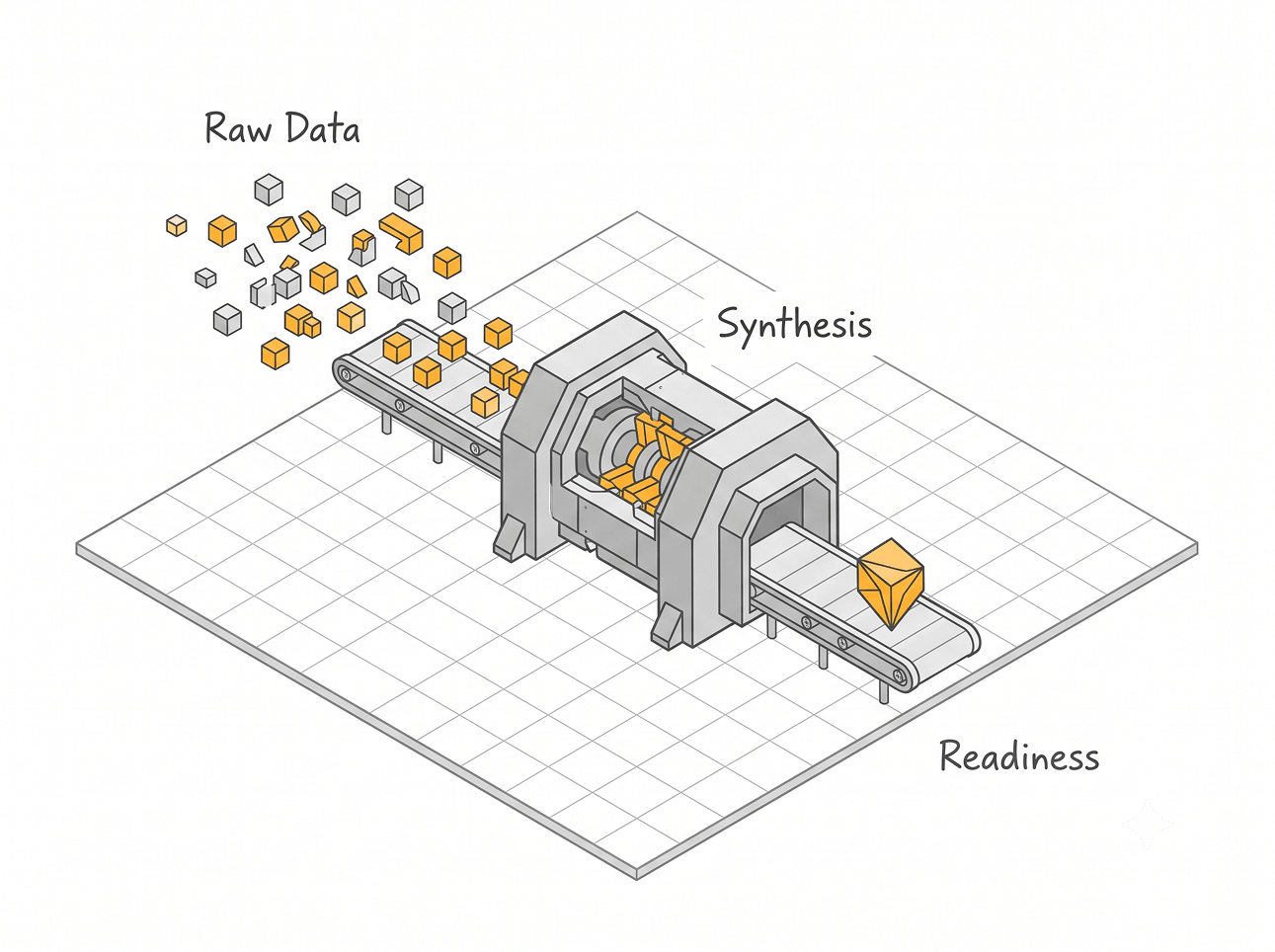
Pre-call intelligence is what prevents that: the synthesis of what a seller needs to know about an account, its people, and its technology environment into a point of view they can carry into the room.
That meeting wasn't lost on lead quality. It was qualified, in profile, with the right person and a real project. It was lost on readiness — and readiness is the one variable in that sequence that wasn't measured.
This piece is aimed at the person who owns the number rather than the person who takes the meeting, because preparation turns out not to be a time problem. It's a standards problem, and standards are set above the seller.
What is pre-call intelligence?
Pre-call intelligence is the intelligence a seller gathers and synthesizes before a buyer conversation in order to understand that buyer's situation, and to decide what is worth asking.
Pre-call planning is the act. It is the routine a seller follows before a meeting — setting an objective, drafting an agenda, deciding what to ask for at the end.
Pre-call intelligence is the input. It is what the seller knows going in: the account's situation, the people in the room, the technology they run, the pressures they are under.
Readiness is the outcome. It is the only one of the three that the buyer ever experiences.
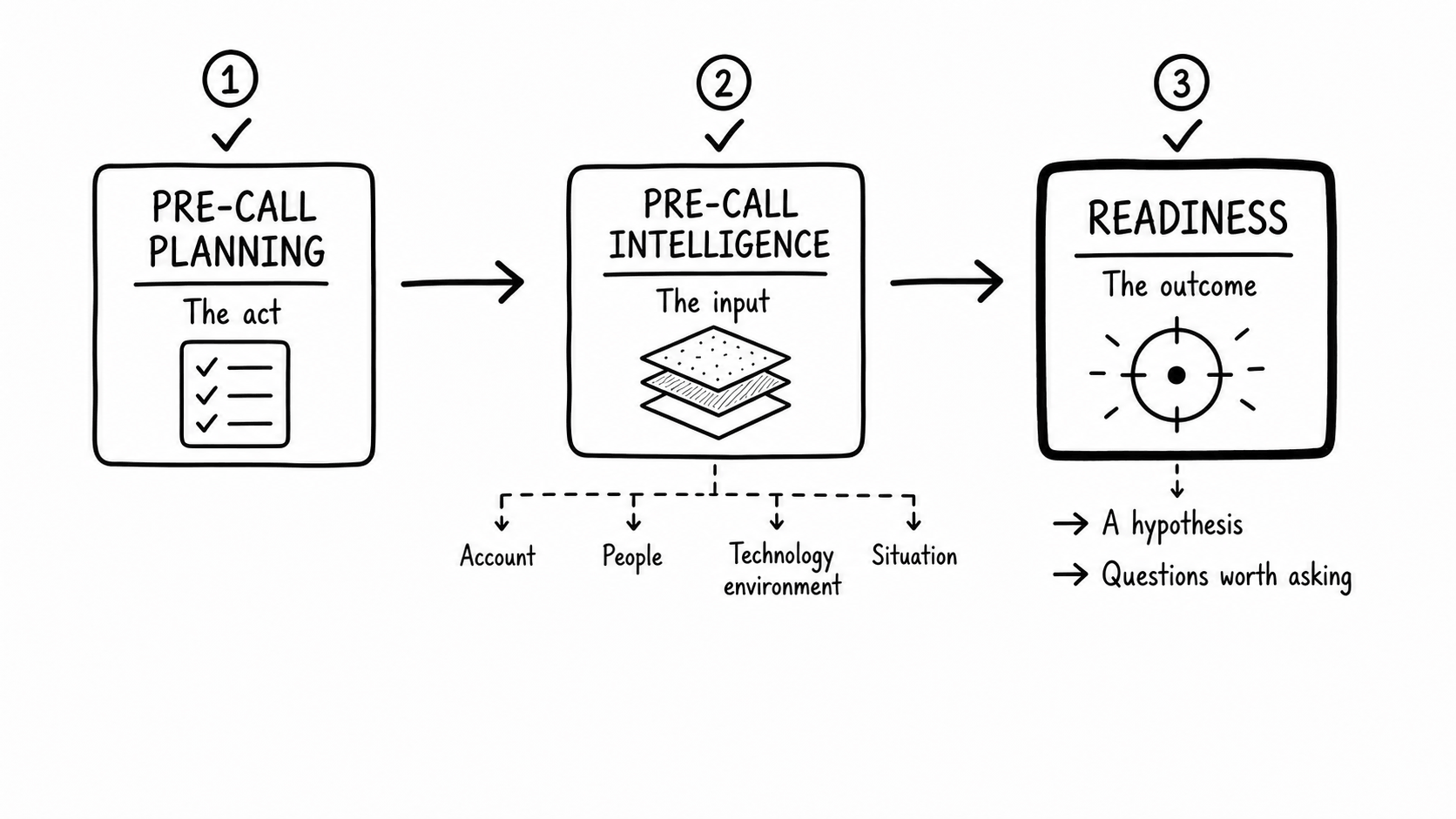
A seller can plan diligently and gather intelligence thoroughly and still walk in without readiness, because readiness requires deciding what all of it means. Intelligence that arrives as a summary is a faster version of not being ready. Intelligence that arrives as a point of view is something else entirely.
Put plainly: information is not readiness. A seller who has read fourteen facts about an account and a seller who believes something specific about that account's situation are not in the same position, even though they did the same amount of work.
It is also worth being precise about where pre-call intelligence sits relative to the tools most revenue teams already own, because the categories overlap in name and barely overlap in function.
These are complementary, not competing. But notice the pattern: three of the four look at what already happened, or at raw material that has not yet been turned into anything.
Only one is aimed at the forty-five minutes that decide whether the meeting converts — and it is the one most revenue teams have never explicitly bought, staffed, or measured.
The arithmetic: what a wasted meeting actually costs
An enterprise first meeting is something you paid for, and by the time a buyer sits down with a seller, real money has already been spent to make that specific forty-five minutes happen.
Every organization I work with can tell me their cost per meeting. Almost none can tell me what happens to that asset after it is delivered.
That gap exists because the spend is visible and the conversation is not. Marketing can produce the invoice. Sales can produce the outcome. But that part in the middle, where the seller comes unprepared, remains unaddressed.
So when meetings don't convert, the diagnosis lands on the part of the system that leaves a trail, which is almost always the lead source.
What we can see that most vendors can't
For six and a half years, TechnologyMatch has generated qualified appointments between technology buyers and technology vendors, hosted those first conversations ourselves, and handed them off.
That is roughly 5,000 to 6,000 conversations a year, and with the consent of both parties on the call, we record them. Approximately 35,000 recordings to date, across more than 1,200 IT vendors.
A conversation intelligence platform sees one vendor's calls deeply, and can compare a seller to other sellers in the same company. It cannot say what good looks like across the category, because it has no basis for comparison outside the account.
Two findings from that corpus are worth putting in front of anyone who owns first-meeting conversion.
Discovery questions: roughly four, against a benchmark of eleven to fourteen. Scored conversations in our corpus show sellers asking around four questions in a first meeting. The conversations that went on to become revenue cluster in the eleven-to-fourteen range. That gap is not a curiosity. It is the difference between a conversation that surfaces a buyer's actual situation and one that doesn't.
Seller talk time: approximately 70%, against a benchmark below 50%. In a meeting arranged specifically so a buyer could describe their problem, the seller does roughly seventy percent of the talking.
Those two numbers describe the same failure from two angles, and it is worth being precise about the mechanism, because the obvious reading is the wrong one.
A seller who talks for seventy percent of a meeting is not being self-indulgent. They are filling a vacuum. A seller who hasn't formed a view of the account has nothing specific to ask about — so they present, because presenting is the thing you can always do. Four questions isn't a discipline failure either. It's what's left when you don't know enough to ask a fifth.
Most sellers can't prepare to the depth this requires. Not won't — can't. Or maybe won't. With five meetings tomorrow and a forecast call today, the hours simply are not there. The behavior in the data is what happens when preparation is left to individuals and the calendar wins.
And the loss is quiet. The buyer doesn't argue. They answer politely, disengage, and run out the clock. The meeting still shows as held and attended. It shows as no next step, and three weeks later someone asks marketing about lead quality.
The thing to hold onto: that conversion loss is a sales pipeline generation problem created after the pipeline generation work finished. The meeting was generated. The pipeline was not. And the step in between is the only one nobody instrumented.
If you would rather not use the tool above, the arithmetic is simple enough to do on paper. Multiply your first meetings per quarter by your cost per meeting — that is committed spend. Multiply meetings by your first-meeting-to-opportunity conversion rate — that is what you get for it.
Then add ten points to the conversion rate and run it again, holding spend fixed. The difference is the number of additional qualified opportunities available inside a budget you have already spent. For most organizations it is larger than they expect, and it costs nothing in media to go and get.
How we arrived at these numbers
You should be able to interrogate a statistic before you act on it, so here is where ours come from and where they stop.
Source. First-party. The conversations were generated, hosted, and recorded by TechnologyMatch in the ordinary course of running a demand generation business, not assembled for research and not drawn from customer data.
Consent. Every recording was made with the consent of both parties on the call.
Scale. Approximately 35,000 conversations across 1,200+ IT vendors, accumulated over six and a half years at 5,000 to 6,000 per year, and still growing by roughly fifteen percent annually.
Scoring. The conversations were reviewed and scored as part of running the business, by operators accountable for whether the pipeline converted — not labelled retrospectively by researchers working to a hypothesis.
Limitations, and they matter. This corpus is qualified first conversations — introductions, discovery, and early qualification. It is strongest at the front of the deal and thinnest at the back of it.
We have comparatively little to say about competitive displacement, negotiation, or re-engaging a stalled buying committee, and you should discount any claim we make about those. The benchmarks are also drawn from enterprise technology sales specifically. I would not assume they transfer cleanly to other categories.
Why sales call planning fails as an individual habit
Every seller knows they should prepare. Nearly every sales organization has told them so. The advice is not in short supply, and it hasn't worked, so it is worth asking why rather than repeating it louder.
Preparation is a habit competing against a calendar, and the calendar wins. This is the arithmetic behind the seventy percent talk time. When we treat preparation as something individuals should simply do more of, we have designed a system that fails predictably under load and then blames the person standing in it. The gap between what buyers now expect and what a seller can produce between meetings is not a character flaw. It is a capacity problem that no amount of encouragement closes.
The published frameworks assume history that first meetings don't have. Look closely at any well-regarded pre-call planning framework and you will find it leaning on CRM records, notes from prior conversations, and product usage signals. Those are excellent inputs — for the second meeting. For a first meeting sourced by marketing, an event, a partner, or a demand generation program, that section of the framework is empty. The seller has a name, a company, and a calendar invite. The frameworks have very little to say about that situation, which happens to be the most expensive situation in enterprise technology sales.
And it is invisible to the people who could fix it. A sales leader can see lead source. They can see outcome. They cannot see readiness. There is no field for it, no report on it, and no moment in the week where anyone looks at it. That invisibility is what turns a fixable execution problem into a recurring argument between sales and marketing — a dynamic I've written about at more length in You answer for the meeting you weren't in.
Individual habits don't survive that. Standards do. Which is the whole reason this article is about implementation rather than encouragement.
How to prepare for a sales call: the standard
Below is what I think "prepared" should mean for an enterprise technology first meeting. I've written it so a seller can run it manually tonight, with no tooling at all, for tomorrow's meetings. That is deliberate. If a standard only works when you buy something, it isn't a standard.
Part one: what "prepared" means
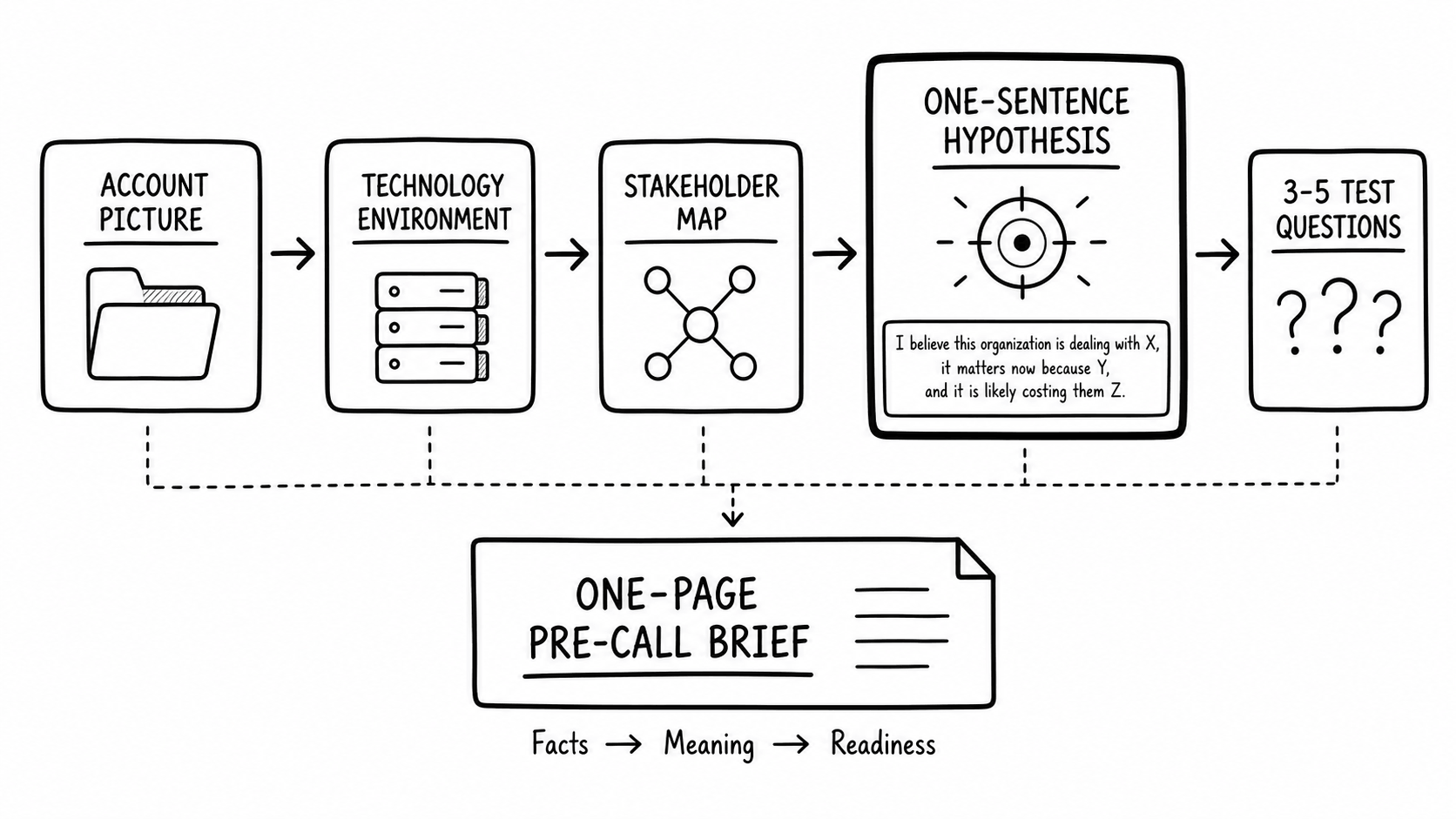
The pre-call brief. Compress it onto one page: the outcome you're asking for, two sentences on their situation, the technology environment and what it implies, who's in the room and who isn't, your hypothesis, the questions that test it, the two objections you expect, and the proof you'd offer if asked. If it runs longer than a page, you have gathered rather than decided.
Part two: making it organizational
The five steps above are what an individual seller does. The next three turn it from something good sellers happen to do into something the organization can rely on.
Where we fit, and what we sell
I should be straightforward about my position, because it is a conflicted one and you should weigh what I've written accordingly.
TechnologyMatch is a demand generation company. We sell enterprise technology meetings, and we have for close to thirty years. We are now also building software that helps sellers prepare for them — Evolve Edge, which turns account, stakeholder, and technology environment intelligence into a brief before each conversation, with every claim in it cited to its source.
So an argument that meeting conversion depends heavily on preparation is commercially useful to me twice over. It makes our meetings look better and it makes our software look necessary. That is worth saying out loud rather than leaving for you to notice.
I'd also note the obvious about the numbers above: they come from our own corpus. They are first-party, consented, and scored by people who were accountable for the outcome, and I have stated their limits — but they are ours, and you are entitled to weigh them accordingly.
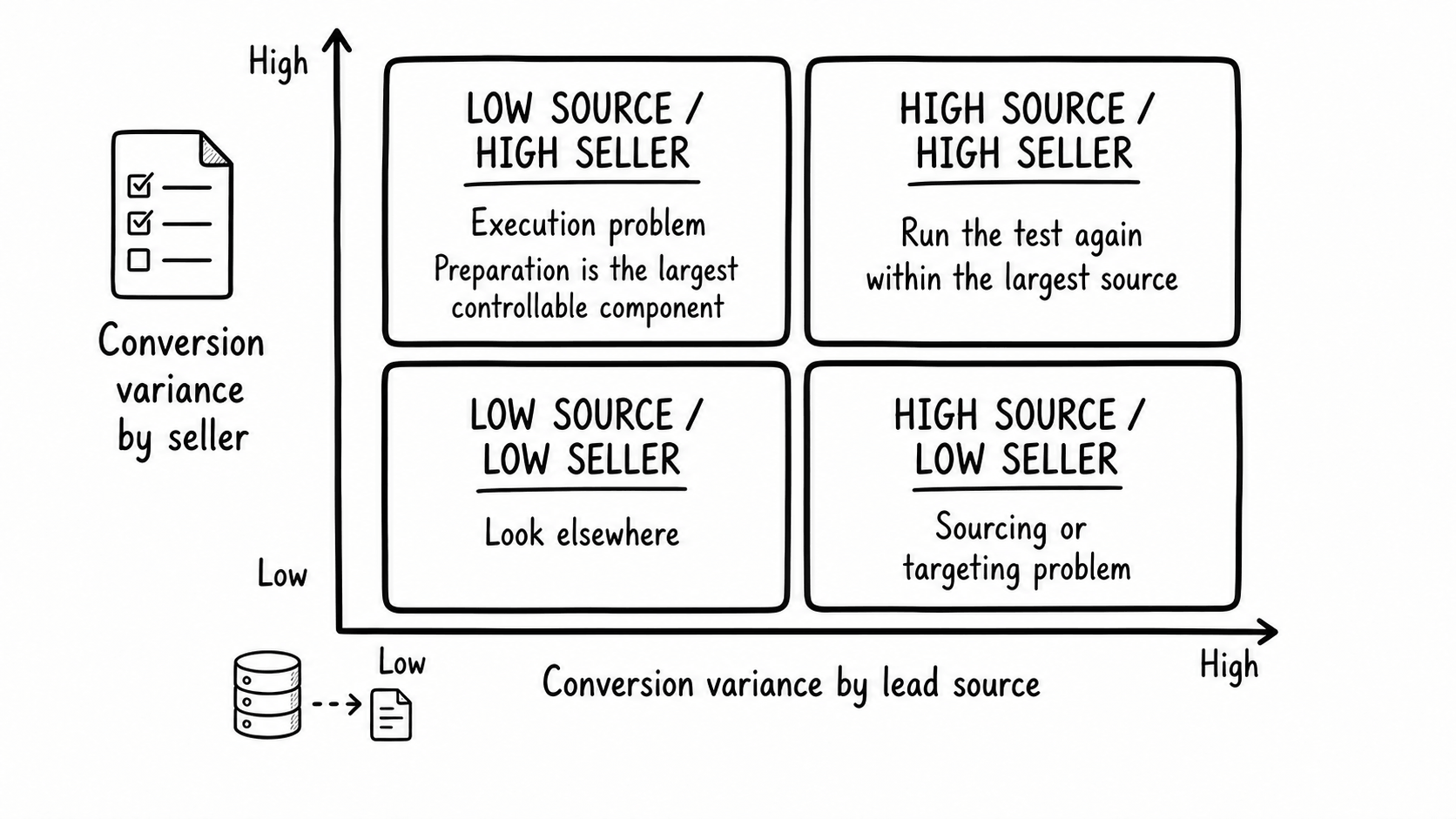
What I'd ask is that you test the claim rather than take it. The diagnostic in step seven doesn't require our product, our meetings, or our involvement. If it shows your variance sits with your lead sources, then preparation isn't your constraint and you should go work on the thing that is.
The chain we believe in is a specific one, and I want to state it link by link rather than compress it: a better brief produces better preparation; better preparation produces a more relevant conversation; a more relevant conversation converts to a qualified opportunity more often. Each link is testable, and none of them is a promise about pipeline.
Our conviction comes from watching the second link fail for a very long time — sitting on the qualification side, knowing what the buyer had told us, and then listening to the meeting begin as though nobody had asked.
If you agree with what I said, we are opening early access.
Evolve Edge handles the pre-call intelligence described above — it automatically researches every prospect and delivers a Game Day Brief before every sales call so your sellers come prepared, not just informed.
FAQ
How do you prepare for a sales call?
Decide what commitment you're asking for, build a picture of the account starting with its technology environment, map who's in the room and who else has to agree, write a one-sentence hypothesis about their situation, and prepare three to five questions that would confirm or break it. Compress it onto one page. Never ask something you could have known.
What is pre-call planning?
Pre-call planning is the routine a seller follows before a buyer conversation: setting an objective, structuring an agenda, anticipating objections, and deciding what to ask for at the end. It's the process. Pre-call intelligence is the material that process works on.
What is pre-call intelligence?
Pre-call intelligence is the intelligence a seller gathers and synthesizes before a conversation — the account's situation, the people involved, the technology environment, the pressures in play — in order to form a hypothesis about that buyer and decide what is worth asking.
What's the difference between pre-call planning and pre-call intelligence?
Planning is the act, intelligence is the input, and readiness is the outcome. A seller with good planning habits and poor intelligence walks in organized but guessing. A seller with strong intelligence and no planning has done work that never reaches the conversation. Both are needed, and neither guarantees the third.
What should a pre-call brief include?
The outcome you're asking for, two sentences on the account's current situation, the technology environment and what it implies, the people in the room and the people who aren't, a testable hypothesis, three to five questions that test it, the two objections you expect, and the proof points you'd use. One page.
How long should pre-call preparation take?
Long enough to form a view, which for a first enterprise meeting is realistically 30 to 45 minutes done manually. That's the honest answer, and it's also why preparation collapses under a full calendar — the time required and the time available don't reconcile. The organizational answer is to reduce the cost of preparation rather than ask sellers to find hours they don't have.
How do you prepare for a meeting you didn't book?
Start with whatever the buyer said during qualification, which is usually the most valuable intelligence available and the most commonly discarded. Then build the technology environment picture, because it's available from public sources and it's where enterprise pressure usually originates. Prior deal history won't exist, so the hypothesis has to be built from environment and context rather than relationship.
How do I know whether meetings are failing on lead quality or preparation?
Cut first-meeting-to-opportunity conversion by lead source, then by individual seller with the source held constant. Variance clustering by source points to sourcing. Variance clustering by seller against the same source points to execution, and preparation is the largest controllable part of that.
What's the difference between pre-call intelligence and call intelligence software?
Timing, and what each produces. Call intelligence software analyzes the conversation while or after it happens, producing transcripts, summaries, and scores. Pre-call intelligence works before the conversation and produces a point of view. One improves the next conversation. The other improves this one.
Does a sales intelligence platform handle pre-call preparation?
Partly. Sales intelligence platforms supply the raw material — companies, contacts, firmographics, sometimes technology signals — which is a genuine input. What they generally don't do is turn it into a position on a specific buyer's situation. Availability of intelligence and readiness for a conversation are different things, and the gap between them is where most preparation fails.