Why Your Sales Team Struggles to Convert Qualified B2B Appointments
Your qualified prospects don't respond after the first call because B2B tech buying changed. Adapt your sales follow-up to these seven new buyer behaviors to win.

You invested in BANT-qualified appointments, your team had solid first conversations, and then the prospect went dark. They didn’t return your call and so you never got a second meeting.
From the conversations we’ve had with Sales Leaders in the recent past, this is what frustrates you the most. And we take this feedback very seriously.
What you experience is not a lead quality problem but a market-wide change in how technology is bought, sold, and evaluated. The B2B technology buying environment shifted completely since 2020, and the expectations, benchmarks, and conversion rates that defined success five years ago simply no longer apply.
This report or article outlines the seven primary factors driving this change, each supported by third-party research from Forrester, Gartner, 6Sense, and other leading analysts.
My goal is to provide your team with a clear, data-backed understanding of why follow-up engagement is harder across the entire industry, and what we can do to maximize the return on every qualified appointment we deliver.
Generating the same pipeline and sales results as pre-2020 now takes approximately double the number of qualified leads. This happens because the buying environment is exponentially more complex, competitive, and cautious, not because leads are weaker.
1. The Shift in Technology Buyers

Impact Level: Critical. This is the single most transformative change in B2B buying behavior. Millennials or Gen Z now account for 71% of B2B buyers.
The demographics of technology purchasing decision-makers shifted dramatically. According to Forrester's annual Buyers' Journey Survey, Millennials and Gen Z represent 71% of all B2B buyers, up from 64% just two years prior. In the technology sector specifically, Millennials alone account for 59% of buyers.
These buyers behave differently than their predecessors. They are digital natives who research extensively before ever engaging a sales rep. According to 6Sense's 2024 Buyer Experience Report, buyers are approximately 70% through their purchasing journey before first contact with a seller, and 85% have already established their purchase requirements.

They demand multiple bids. Previous generations often went with the first strong proposal, but today's buyers consult at least 3 or more vendors and evaluate multiple RFPs before making a decision. Younger buyers consult 10 or more information sources before deciding. They frequently turn to peer networks and communities like the subreddit r/ITmanagers to validate claims before ever speaking to a vendor.
They reject high-pressure selling. Gartner reports that 75% of B2B buyers now prefer a rep-free sales experience. A full 61% actively avoid suppliers that send irrelevant or pushy outreach. These buyers are highly sensitive to tone, approach, and whether they feel the sales rep genuinely tries to solve their problem or just tries to close a deal.
They disengage quickly. Forrester found that 90% of Millennial and Gen Z buyers report dissatisfaction with at least one aspect of their vendor interactions, compared to 71% of older buyers. They will ghost a vendor that fails to meet their expectations on the first interaction.
How Should You Follow-Up?
A successful first call does not mean a buyer is committed. They likely had equally positive calls with two or three of your competitors the same week. Your sales team's ability to differentiate on value, not just features, determines whether the second meeting happens.
2. Declining Sales Rep Effectiveness and Tenure
Impact Level: High. The sellers following up on your leads may lack the equipment to close. The average sales rep tenure at their company is just 18 months.

The quality of what happens after an appointment is set is just as important as the quality of the appointment itself. The data reveals major challenges here that sit outside the control of any lead generation provider.
Shorter Tenure, Less Expertise
HubSpot and The Bridge Group show the average B2B sales rep tenure fell to just 18 to 20 months. Prior to COVID, average AE tenure was relatively stable at roughly 2.5 to 3 years or more. Xactly Insights data shows sales reps reach peak performance between years two and three in a role, meaning the majority of today's reps leave before they ever reach their potential.
Less time at the company means less product knowledge, weaker customer relationships, and a shorter window to develop the consultative selling skills needed to engage today's sophisticated buyers.
The CarMax vs Ferrari Problem
Today's technology companies carry much broader product portfolios than they did five years ago. A rep once supported a handful of solutions from a few partners, but they now manage dozens of SKUs across multiple vendor lines.
A sales person at a Ferrari dealership knows every specification and capability of that vehicle intimately. A sales person at CarMax sells scores of different brands and models and simply cannot achieve that same depth of expertise across their entire catalog. The result is a more generalist approach to selling that lacks the technical depth today's buyers demand.
Technology Match MatchIQ Data: The Discovery Gap
We analyze thousands of sales interactions annually through our proprietary MatchIQ Sales Analysis tools. Our data consistently shows the average sales rep scores approximately 40 out of 100 on our sales effectiveness index.

The primary drivers of this low score include:
- Leading with company or product pitches rather than first discovering the buyer's pain points.
- Research from Emblaze confirms problem-focused sellers are 30% more effective, yet only 13% take a problem-first approach to discovery.
- Feature dumping when the buyer seeks solution-focused conversations that address their specific business challenges.
- Dominating call time.
- Our data shows the average rep talks 60% to 70% of the call, leaving the prospect insufficient time to share their challenges.
- Research from Demodesk shows the optimal discovery talk ratio is 40% to 60% seller and 60% to 40% buyer.
- Deals with balanced talk ratios show up to 31% higher progression rates.

How Should You Follow-Up?
If a qualified buyer takes a meeting and then disengages, the root cause may not be a lack of interest. The follow-up call might have missed the buyer's expectations for a consultative, problem-first conversation. Evaluating your team's talk-to-listen ratio, discovery process, and follow-up cadence reveals major improvement opportunities.
3. The Explosion of Buying Committee Complexity
Impact Level: High. Your champion may love your solution, but they now need 6 to 13 others to agree. Enterprise B2B purchases involve 6 to 13 stakeholders.
Pre-2020, the average enterprise technology buying decision involved up to three key stakeholders, but today that number has exploded. Gartner reports complex B2B buying groups now include 6 to 10 decision-makers, with each bringing 4 to 5 pieces of independently gathered research.
Forrester's 2024 State of Business Buying report puts the average at 13 stakeholders, with 89% of buying decisions crossing multiple departments.
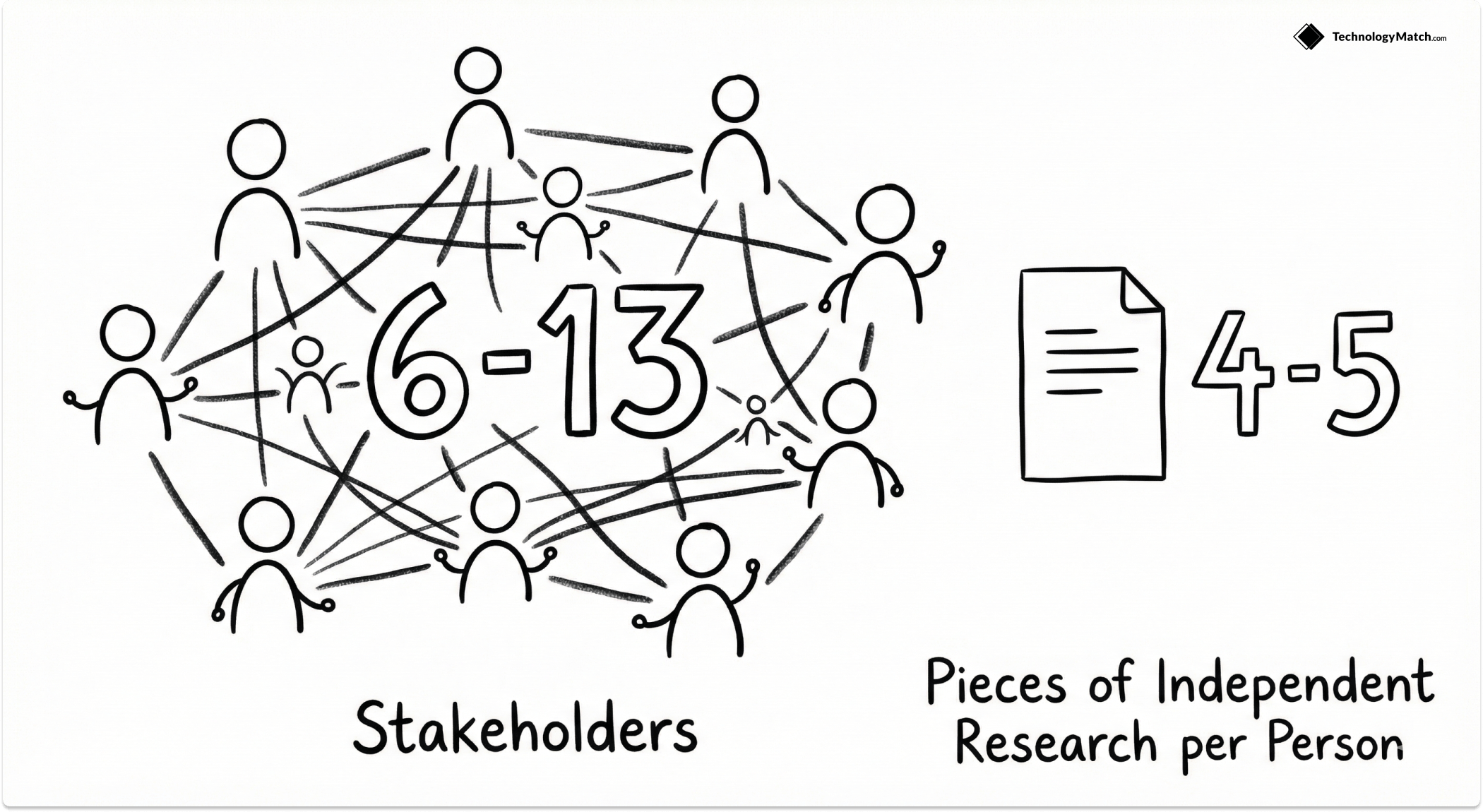
The person your team had a great first call with is likely just one voice in a committee that includes IT, finance, operations, compliance, legal, procurement, and executive leadership. Your contact must build internal consensus across all these parties before a purchase advances.
According to Gartner, this buying complexity causes a 30% reduction in customers' ability to reach purchasing decisions and a 42% decrease in the likelihood of choosing premium solutions. Advance B2B research shows more than 40% of B2B deals stall specifically because internal stakeholders fail to align. Over half of lost opportunities are no decision outcomes where committees could not move forward, rather than losses to competitors.
How Should You Follow-Up?
A contact going silent after an initial call reflects the reality that they are navigating a complex internal consensus process. They may still be interested but cannot advance until they have alignment from a much larger group of stakeholders.
4. Market Saturation and Competitive Noise
Impact Level: High. Your buyer hears from more vendors than ever before. Over 30,000 SaaS companies operate globally, up from about 8,000 in 2015.
The technology vendor market has undergone an unprecedented expansion. The number of SaaS companies grew by approximately 500% since 2015, with the U.S. now home to nearly 17,000 SaaS companies. The SaaS industry grew roughly 500% between 2013 and 2020, and AI-fueled innovation accelerated the rate of new market entrants since then.

The technology marketplace is noisier and more crowded than ever for buyers. A buyer in 2019 evaluated 3 to 5 vendors for a given solution, but today they sort through 10 to 15 or more options, many of which offer AI-powered capabilities that make them appear equally compelling on the surface.
Customer acquisition costs reflect this reality. MADX Digital research shows median Customer Acquisition Cost surged by 180% for SaaS companies, and the CAC payback period extended by 150%. Performance marketing costs continue to rise while conversions to revenue decline. These are market-wide trends, not issues specific to any one lead generation provider.

How Should You Follow-Up?
A buyer who engaged on a first call likely had equally compelling conversations with several other vendors that same week. Speed of follow-up, quality of next-step materials, and clear differentiation are more important than ever in securing second meetings.
5. The Shift from Growth-at-All-Costs to Profitability
Impact Level: High. Buyers must now prove enterprise value and cost savings before purchasing. G2 research shows 57% of B2B buyers expect ROI within 3 months of a software purchase.

Pre-2020, many technology companies operated under a purchase technology at all costs philosophy. Sales revenue was the primary metric, with relatively little scrutiny around EBITDA, payback periods, or total cost of ownership. The post-COVID environment completely reversed this dynamic.
Companies at every level laser-focus on profitability. G2's 2025 research indicates 57% of global B2B buyers expect positive ROI within three months of a software purchase, and 11% expect immediate ROI. TrustRadius reports CFO approval is required for 79% of technology purchases. Every new solution must demonstrate clear enterprise-level value and measurable cost savings.

When a buyer is genuinely interested and a first meeting goes well, advancing the deal requires building a detailed business case that survives scrutiny from finance, procurement, and executive leadership. The bar for moving from interested to approved is much higher than it was five years ago.
How Should You Follow-Up?
Buyers stall because they need to build an internal business case that demonstrates clear ROI, and that process takes time. Sales teams that proactively provide ROI calculators, business case templates, and financial justification materials will see better second-meeting conversion.
6. The Impact of Sample Size on Campaign Results
Impact Level: Moderate-High. Small pilot programs amplify statistical noise and may not reflect true market potential.
Given the market dynamics outlined above, generating the same pipeline and closed-won results achievable pre-COVID takes approximately double the number of qualified leads. This reality directly impacts how you should evaluate campaign results. A small pilot program of 10 to 20 appointments lacks a statistically meaningful sample size to draw conclusions from.
Industry benchmarks confirm this reality. The average MQL-to-SQL conversion rate across B2B is approximately 13%, and the average SQL-to-Opportunity rate ranges from 30% to 59% depending on industry. Even a well-executed campaign requires high volume to produce predictable outcomes.

Enterprise deal sales cycles lengthened by an average of 36% since 2020. A dead lead at the 30-day mark may simply be in the early stages of a 6 to 12 month buying cycle.
How Should You Follow-Up?
I recommend evaluating campaign performance over a meaningful sample size of 40 or more appointments minimum, and over a timeline that accounts for today's longer sales cycles. Judging a campaign on 10 to 15 appointments over 30 to 60 days fails to accurately reflect the program's true potential.
7. Al-Powered Buyer Research and Self-Education
Impact Level: Emerging-High. Buyers are better informed than ever, raising the bar for every sales interaction. 6Sense research shows 94% of B2B buyers use LLMs and AI tools during their buying process.
The rapid adoption of AI-powered research tools among buyers compounds all the factors mentioned. According to 6Sense's 2025 research, 94% of B2B buyers now use large language models during their purchasing process. Buyers arrive at first meetings more informed, more skeptical, and with higher expectations than ever before.

Sales reps who show up with a generic pitch or product overview start at an immediate disadvantage. The buyer already read the product specs, compared competitor features, and formed preliminary opinions. Buyers need insight, strategic guidance, and a clear connection between the solution and their specific business challenges rather than pure information delivery.
How Should You Follow-Up?
If a rep sends a generic recap email and a product datasheet as follow-up, they have likely lost the buyer. Today's follow-up must provide unique value, such as a tailored ROI analysis, a relevant case study from their industry, or specific recommendations based on what was discussed in the first call.
Recommendations: How to Maximize Results in This Environment
Understanding these market dynamics matters, but how we respond to them together dictates your success. Here are the actions we recommend to improve the conversion of qualified appointments into pipeline and revenue:
For Your Sales Team
- Lead with discovery, not demos. Ensure your reps spend the first meeting asking questions about the buyer's pain, not pitching features. Aim for a 40/60 talk-to-listen ratio on discovery calls.
- Follow up within 24 hours with personalized value. Contacting leads within 24 hours increases conversion by 5x. Send tailored follow-ups that reference the specific challenges discussed, not generic collateral.
- Multi-thread into the buying committee. Do not rely on a single contact. Ask who else is involved in the decision and work to engage multiple stakeholders early.
- Provide business-case ready materials. Arm your champion with ROI calculators, relevant case studies, and executive-ready summaries they can share with their internal committee.
- Extend your follow-up cadence. Today's enterprise sales cycles run 6 to 12 months or more. A lead that seems dead at 30 days may convert at 90 or 180 days with persistent, value-driven nurturing.
For Our Partnership
- Commit to meaningful sample sizes. We recommend a minimum of 40 appointments to generate statistically reliable performance data in today's environment.
- Leverage MatchIQ for real-time coaching. Our sales intelligence tools provide your reps with actionable feedback on talk ratios, discovery quality, and engagement patterns to improve conversion on every call.
- Evaluate results over appropriate timelines. Assess pipeline impact at 90, 180, and 360 days post-appointment rather than looking only at immediate conversion.
Closing Thoughts
I share your frustration when qualified appointments miss the conversion rate you expect. The appointments we deliver are real decision-makers, with real budgets, real authority, real need, and real timelines. We have delivered over 50% pipeline conversions and helped sales teams nurture $50K opportunities into $15 Million partnerships.
The environment in which these conversations take place has changed. The B2B technology buying environment of 2026 demands more patience, more precision, more persistence, and more volume than it did even two years ago. We can maximize every appointment and build sustainable pipeline in this new reality by adapting our collective approach.
Tech matchmaking is buyer-first because they need be in control of their decision. You can't force demand in a market where it organically exists. Our platform works on intent and so your conversations always lead somewhere.
Also read: Why your inbound funnel looks healthy but your win rate says otherwise
Looking to Connect With Active IT Buyers?
We'll get you on calls with IT buyers who are actively looking for IT solutions, each one manually verified for intent, with budget allocated for your specific solution.
FAQ
Why do prospects seem to have a great first meeting with us and then don't respond?
A successful first call no longer indicates commitment. Today's buyers consult at least three vendors and check peer networks before making decisions. If they go dark, it is often because they are overwhelmed by navigating their internal committee of 6 to 13 stakeholders. Furthermore, if your sales rep provided a generic recap instead of unique, business-case-ready value, the buyer likely moved on to a competitor who did.
Has the buyer lead quality gone bad over the years?
No. I understand the frustration, but the data proves this is a massive, market-wide transformation in buying behavior, not a lead defect. The appointments are with real decision-makers with real needs. However, the benchmarks that defined success five years ago no longer apply. The environment is more cautious and competitive, meaning it simply takes more volume and harder work to convert the same quality of lead.
Why are our sales cycles taking so much longer to close?
Enterprise sales cycles lengthened by an average of 36% since 2020. This stems directly from intense financial scrutiny. With 79% of purchases requiring CFO approval, buyers must build ironclad internal business cases before they can spend. A lead that looks dead at day 30 is often just stuck in the early stages of a 6-to-12-month internal buying cycle.
My sales team knows our product inside and out. Why aren't they closing more deals?
Deep product knowledge is no longer sufficient. Today's buyers do their own technical research using AI before you ever speak to them. They need consultative partners, not feature pitchers. Our data shows the average rep talks for 60% to 70% of a call, rather than listening. To improve effectiveness, your team must shift to a problem-first discovery approach where they listen more than they speak.
What immediate steps can we take to improve our appointment-to-opportunity conversion?
Focus on speed and financial justification. Contacting leads within 24 hours increases conversion by 5x. However, the follow-up cannot be generic. You must arm your internal champion with business-case materials—like ROI calculators and executive summaries—that they can present to their finance and buying committees to gain consensus.
How has B2B buying behavior changed with Millennials and Gen Z decision-makers?
The shift is seismic. Millennials and Gen Z now make up 71% of B2B buyers. Unlike previous generations, they are digitally native, preferring extensive anonymous research over talking to sales reps. They demand a rep-free experience, consult multiple information sources, and have a near-zero tolerance for high-pressure tactics. If they feel pushed, they ghost you. Selling to them requires a consultative, low-pressure approach focused on helping them buy, not just selling to them.
How can B2B tech companies differentiate in a saturated SaaS market?
With over 30,000 SaaS companies globally (a 500% increase since 2015) feature differentiation is almost impossible. Buyers are evaluating 10 to 15 vendors at once. In this noise, the only way to differentiate is through the sales experience itself. Speed matters: contacting leads within 24 hours increases conversion by 5x. Value matters more: your follow-up must provide unique commercial insight, business case support, and financial justification that competitors aren't providing.
What is the expected time to ROI for B2B software purchases today?
The window to prove value has shrunk dramatically. According to G2 research, 57% of B2B buyers now expect a positive ROI within just three months of purchase. Finance departments are scrutinizing every expenditure. If your sales team cannot articulate a clear path to rapid financial return, the deal will likely stall at the CFO level.
What is multi-threading in sales and why is it crucial for enterprise deals now?
Multi-threading is the process of building relationships with multiple stakeholders within a target account, rather than relying on a single point of contact. With the average enterprise buying committee now consisting of 6 to 13 people, relying on one champion is a recipe for failure. You must proactively identify and engage influencers from IT, finance, operations, and procurement to build the necessary consensus to close the deal.
What is a statistically valid sample size for a B2B lead generation pilot program?
Given that it now takes approximately double the lead volume to generate pre-2020 pipeline results, small pilots are misleading. A pilot of 10 to 20 appointments is too small to overcome statistical noise. Based on current market conversion rates, I recommend a minimum sample size of 40 qualified appointments over a sufficient timeline to accurately gauge the true potential and ROI of a lead generation program.
How is AI changing B2B buyer research and how should sales reps respond?
AI has armed buyers with unprecedented research capabilities. 94% of B2B buyers use AI tools during their process, meaning they often know more about your product specs and competitors than junior sales reps do. Showing up to a meeting with a standard "who we are and what we do" deck is an instant fail. Sales reps must assume the buyer is already informed and pivot immediately to a second-level conversation focused on strategic application and solving specific business challenges.