



Why MDF Doesn't Convert to Pipeline: How to Measure What the Funds Produced
MDF reporting proves the money was spent. It rarely proves anything was produced. How to measure MDF-to-pipeline conversion and where the chain actually breaks.
What do MDF programs actually measure?
Market development funds are money a technology vendor provides to a channel partner to fund marketing activity that generates demand for the vendor's products. Co-op funds work similarly, usually accrued as a percentage of the partner's purchases and reimbursed after the fact, while MDF is more often allocated in advance against an agreed plan.
That's the mechanism. What matters more for this article is what gets counted.
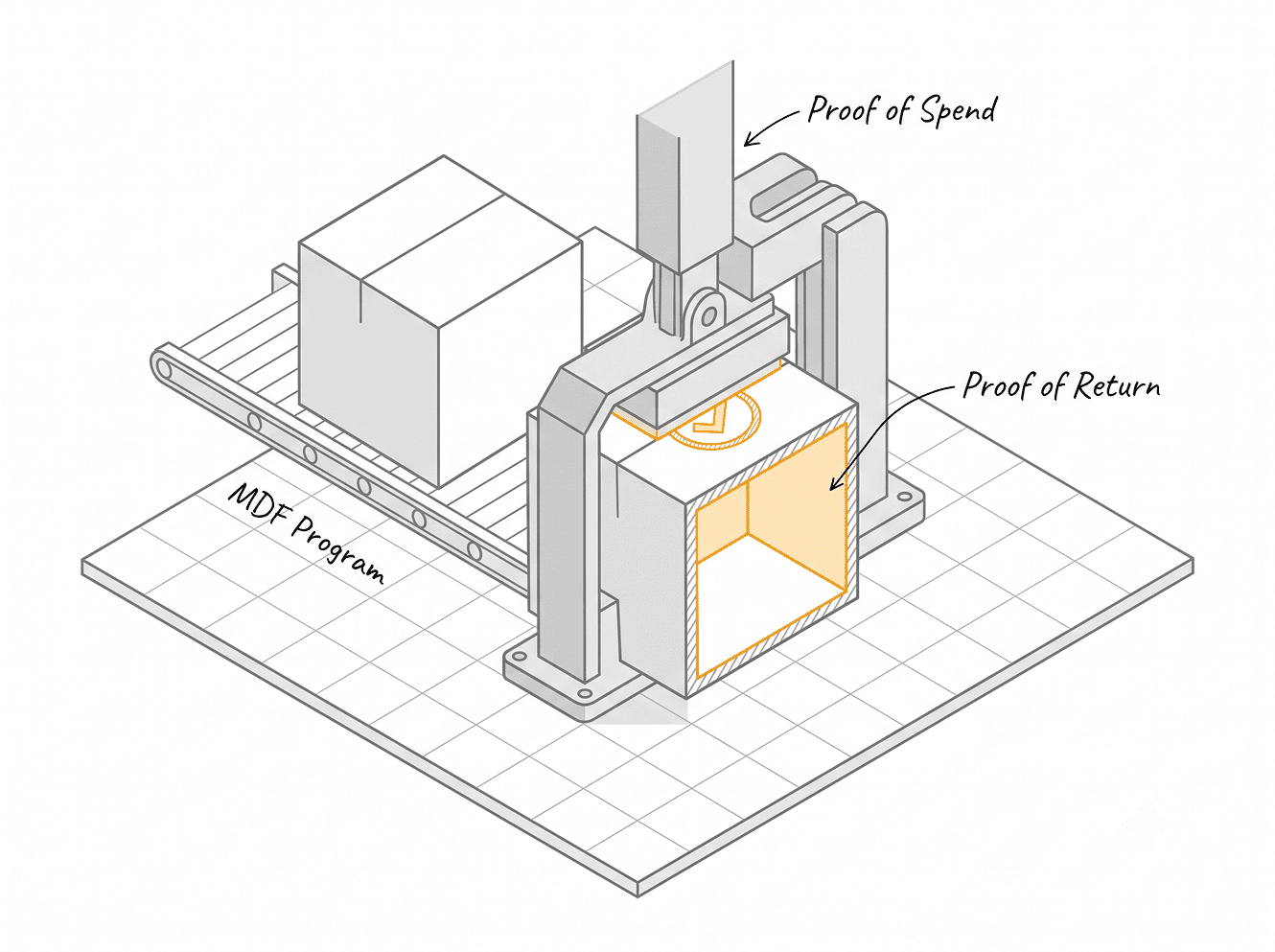
The distinction in the last row is the one that matters. Proof of performance is a compliance artifact — evidence that money was spent the way the agreement said it would be. Proof of return is a business one. Most MDF programs are rigorous about the first and close to silent on the second.
That isn't an accident of laziness. Claims processes were designed to prevent misuse of funds, and they do that job well. They were never designed to establish whether the funds produced anything, so they don't.
Why does MDF get spent without producing pipeline?
Three reasons, and only one of them is about effort.
1. The measurement genuinely can't reach that far.
The Channel Marketing Association's 2025 State of Channel Marketing Report, published in December 2025, found that nearly nine out of ten respondents say their ability to measure channel marketing effectiveness still needs improvement. Most respondents were director level or above.
That is close to unanimous, and it tells you this is structural rather than individual. A vendor allocating funds to a partner is trying to trace an outcome that happens two organizations away, inside a CRM they don't own, against an opportunity definition they didn't write. The visibility isn't there. Nobody involved is being careless.
2. The money often arrives where the capability doesn't.
This is the finding I'd put in front of any channel leader.
Forrester's Partner Ecosystem Marketing Survey, 2026 found that nearly 70% of partners operate at low to medium levels of marketing and demand maturity.
And The Channel Company's State of Partner Marketing 2025 — an in-depth survey of 151 solution providers, 44% of them MSPs and 30% VARs — found that more than half of large partners' marketing budget comes through vendor and distributor MDF programs, while smaller partners rely on part-time or shared marketing staff and fewer than a third have dedicated marketing resources.
A majority of partner marketing is vendor-funded, and most of the partners receiving it don't have mature marketing capability or, in many cases, a full-time marketer. Funding a campaign and enabling a campaign are different things, and MDF programs are built to do the first.
The same study found that 71% of partners consider marketing critical to their future while around 60% say their marketing's strategic impact is only somewhat or not effective. Partners are not hiding this. They're reporting it.
3. The reporting relationship rewards proof of spend.
Follow the incentives. A partner submits a claim to be reimbursed. The vendor approves it if the evidence shows the activity happened as agreed. Both parties have done what the process asked. Neither has any obligation, or often any means, to establish what came of it.
So the reported result of an MDF program is a set of activities, and the activities are real. They just aren't an outcome.
One thing I want to be unambiguous about. None of this is an argument that MDF is the wrong investment or that channel marketing spend should come down.
Canalys put partner-delivered IT technologies and services above $3.4 trillion, accounting for more than 70% of the total addressable IT market. The channel is where the market is, and funding partner demand generation is the correct thing to be doing.
The argument here is narrower and more fixable: the spend is under-converted, and the reason is that measurement stops before the point where conversion is decided.
How much MDF actually goes unused?
You will find one number everywhere: 60% of MDF goes unused every quarter. It appears in vendor blogs, agency posts, statistics roundups, and increasingly in AI-generated answers, sometimes described as recent research.
I went looking for the source. It traces back to a single vendor blog post, roughly a decade old, attributed to an unnamed "worldwide channel survey" with no sample size, no methodology, and no date — published by a company that sells software to fix the problem the figure describes. Everything since has cited that post, or cited something that cited it.
There's a second figure worth flagging. You'll also see claims that $14 billion to $35 billion in funds go unclaimed each year. That research is about local retail co-op advertising in the United States — surveys of local advertisers — not B2B technology MDF. The two get conflated routinely, including by sources that cite both figures in the same paragraph.
I'm not saying unused funds aren't a real phenomenon. Industry sources commonly put utilization somewhere in the 40% to 60% range, and that range is probably directionally right. What I'd resist is treating any of those numbers as established.
But here's the more useful point, and it's the reason this section exists.
Utilization is the wrong metric anyway.
A program running at 100% utilisation and converting nothing has a worse problem than a program at 60% utilisation that converts well. Chasing utilisation optimizes for money leaving the account.
It tells you the funds were spent. It tells you nothing about whether anything was produced, and it can make the underlying problem worse — because the fastest way to raise utilization is to approve activity that's easy to execute and easy to evidence, which is not the same as activity that converts.
If you only fix one metric this year, fix this one.
Where does MDF spend stop producing pipeline?
Here is the chain, and where the measurement sits along it.
The gap is at stage four, and it is not a small one. It's the stage where the outcome is actually determined.
A funded campaign delivers a meeting. The meeting goes to a seller — a partner's seller, or the vendor's, depending on the motion. That seller may have no history with the account, and frequently has not seen what the buyer said during qualification, because the qualification information arrived in a routing field or an attachment rather than in the record they actually open.
So the conversation starts from nothing. The buyer explains their situation for the second time. The meeting becomes an introduction.
It converts nothing. The claim is still approved. The activity is still reported. And the one event that decided the outcome leaves no trace in the MDF program at all.
This is why I don't think MDF conversion is a channel marketing problem in the usual sense. The campaign worked — it produced the meeting it was funded to produce.
What failed is downstream of the campaign and upstream of the opportunity, in a conversation nobody in the funding chain has visibility into. I've written about that specific failure at more length in the most expensive ten minutes in enterprise technology sales, and about how to tell whether it's your problem in do you have a lead problem or a sales system problem.
How to measure MDF ROI
Five steps, cheapest first. The first three cost conversations rather than budget.
On benchmarks. You'll find claims that MDF should return five to ten times its cost. I couldn't trace any of them to a study, and I'd treat them as vendor rules of thumb rather than benchmarks.
There is no credible published MDF-to-pipeline conversion benchmark that I've been able to verify. Measure against your own previous quarters and your own activity types. That comparison is available to you, it's honest, and it's more useful than a number someone asserted.
How to hold MDF-funded suppliers accountable
Two questions. Ask them of every supplier paid from these funds.
What proportion of what you delivered last quarter became a qualified opportunity?
What do your qualification criteria screen for?
If a supplier can't answer the first, they have no visibility into whether their work converts, which means they can't improve it. If they can't answer the second clearly, you don't know what you're buying.
Now the part I'd rather say than have you notice. We are one of those suppliers. TechnologyMatch is paid from MDF regularly. Ask us both questions, and hold the answers to the same standard you'd hold anyone else's.
Evolve Signal is the intelligence capability of the Evolve platform — it identifies and prioritizes the accounts worth a team's time.
Evolve Edge, which is live, is the preparation capability: it turns an account into a brief before the conversation, including what the buyer already told us.
Evolve Coach is the development capability — it shows what happened in the conversation afterwards.
The chain, stated link by link: better preparation produces a more relevant conversation; a more relevant conversation converts to a qualified opportunity more often; more opportunities from the same funded activity is a higher return on the same MDF. Each link is testable, and none of them is a promise about pipeline.
None of it replaces the five steps above. Steps one, two, three, and five are decisions about your own program, and no software makes them for you.
Decide where the funds go before they move
Signal is the intelligence capability of the Evolve platform: which accounts are worth pursuing, what they run today, and where the opportunity actually sits. Edge then turns any one of them into a preparation brief in a single action. Signup today for early access.
FAQ
What are market development funds?
Market development funds are money a technology vendor provides to a channel partner to fund marketing activity that generates demand for the vendor's products. Funds are typically allocated in advance against an agreed plan and released on evidence that the activity was carried out as described.
What's a good MDF-to-pipeline ratio?
There is no credible published benchmark. Figures like five-to-one or ten-to-one circulate widely without any traceable study behind them. The useful comparison is internal: your own conversion rate this quarter against previous quarters, broken out by funded activity type.
How do you measure MDF ROI?
Agree one definition of a qualified opportunity with your partner before funds move, require conversion reporting alongside proof of performance, measure by activity type rather than in aggregate, check whether qualification information reaches the seller taking the meeting, and report the conversion data back to partners so they can act on it.
Why don't partners use their MDF?
The commonly cited reasons are process friction, unclear eligibility, and reimbursement delay, and those are real. The larger factor is capability: Forrester's 2026 partner ecosystem marketing research found nearly 70% of partners operating at low to medium marketing and demand maturity, and The Channel Company's 2025 research found fewer than a third of smaller partners have dedicated marketing resources. Funds are easier to provide than the capability to deploy them.
What's the difference between MDF and co-op funds?
Co-op funds are usually accrued as a percentage of a partner's purchases and reimbursed after the activity, which makes them broadly proportional to sales volume. MDF is more often discretionary, allocated in advance against a specific plan, and directed at strategic priorities rather than earned on volume.
How do I report MDF results back to a vendor?
Report the outcome, not only the activity. Alongside proof of performance, give the number of qualified opportunities created and the conversion rate from delivered activity, with the definition you used stated explicitly. Vendors who receive conversion data from a partner tend to fund that partner again, because it's the one thing they can take upstairs.
What should an MDF program require as proof of return?
A conversion figure by cohort — what share of the activity this program funded became a qualified opportunity — against a definition both parties agreed before the funds moved. Proof of performance establishes the money was spent correctly. Proof of return establishes it produced something.


