What is CrowdStrike, How it Works, and What it Does for IT Leaders
CrowdStrike Falcon explained for IT leaders: how its single-agent EDR/XDR architecture and Threat Graph work, what the modules cost in 2026, and how to evaluate it.

Summary:
CrowdStrike is a cloud-native cybersecurity company; its product, the Falcon platform, protects endpoints, identities, and cloud workloads through a single lightweight agent that streams activity to a centralized cloud analytics engine.
Falcon detects threats primarily through behavior-based indicators of attack rather than static malware signatures, and its capabilities are licensed as separate modules — from antivirus to fully managed detection and response — added on top of the same agent. Published pricing starts at $7.99 per device per month for small-business bundles and scales to enterprise and fully managed tiers priced on request.
What Is CrowdStrike?
CrowdStrike is a cloud-native security company, and its product is the Falcon platform. When people say "CrowdStrike" in a buying conversation, they almost always mean Falcon. I'll use the two interchangeably here, the way the market does.
Falcon started in endpoint protection and grew into a broader platform covering endpoints, identity, cloud workloads, and security operations. It sits in the endpoint protection and endpoint detection and response (EDR) category, where CrowdStrike has been named a Leader in Gartner's Magic Quadrant for Endpoint Protection Platforms.
The architecture is the thing to understand first. One lightweight agent runs on each device and does fast local prevention. It streams activity to CrowdStrike's cloud, where the heavy correlation happens against data from every other customer. Everything else in this guide follows from that split.
In practice, CrowdStrike:
It's used by large enterprises, and increasingly by smaller teams through a scaled-down bundle. Most of its capability is modular, which matters a great deal once you get to pricing.
How Does CrowdStrike Work?
Falcon replaces the old model of a heavy scanner on every machine with a light agent talking to a cloud brain. The sensor handles on-box prevention and collects telemetry. The cloud does the deep, cross-customer analysis. Here is the flow, step by step.
1. The single Falcon sensor
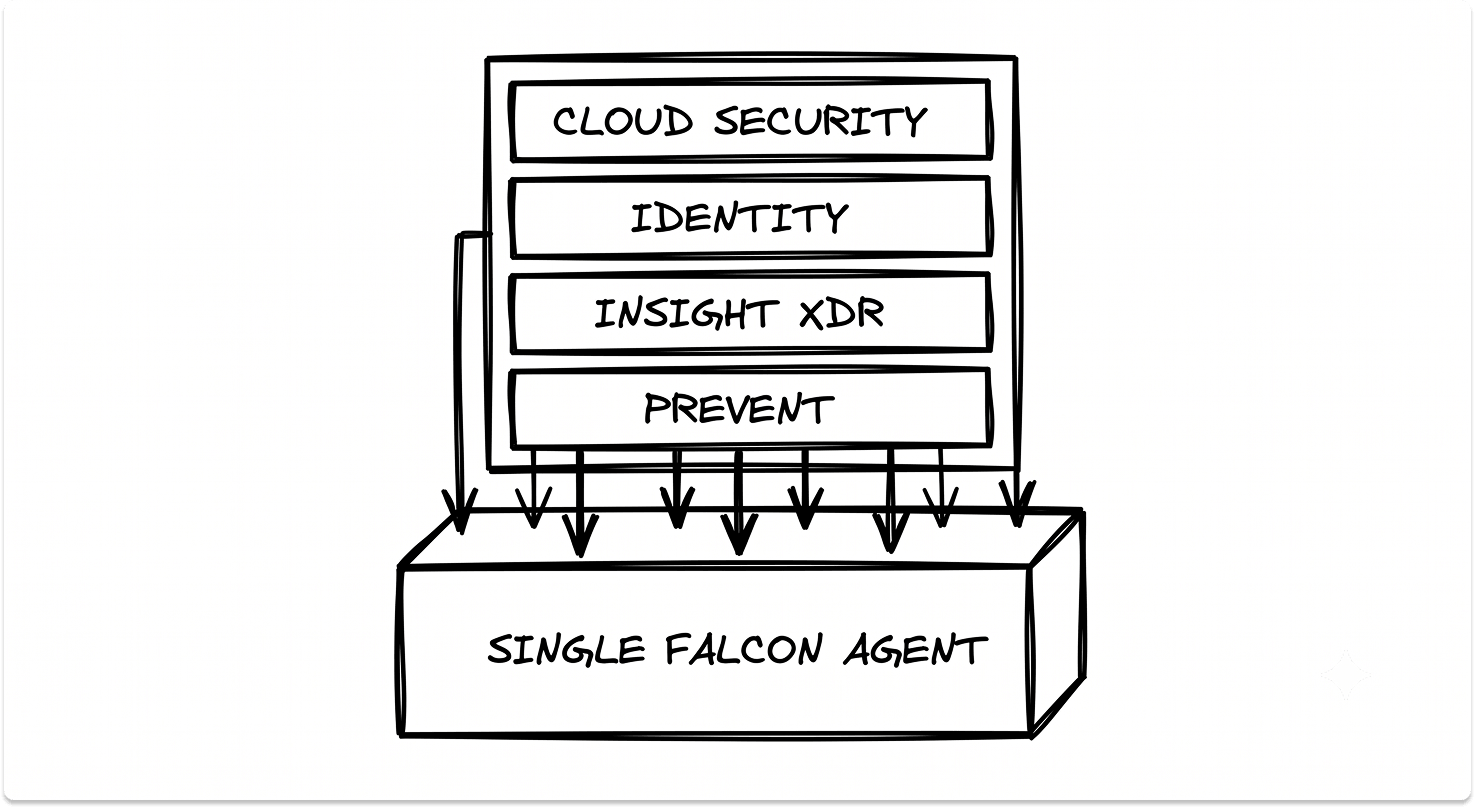
One agent runs per endpoint. On Windows it uses a kernel-mode driver plus a user-mode service. On Linux it runs in user mode using eBPF, so it needs no kernel module, and an unsupported kernel drops it into a safe Reduced Functionality Mode rather than destabilizing the host.
The sensor is light on resources and installs in minutes with no reboot. That single install is what unlocks every module. Adding EDR, identity, or cloud coverage later is a licensing change, not a new agent.
If your current setup leaves parts of the estate uncovered, Linux servers are a common blind spot, this one-agent model is the direct answer to that gap.
2. Telemetry and the Security Cloud
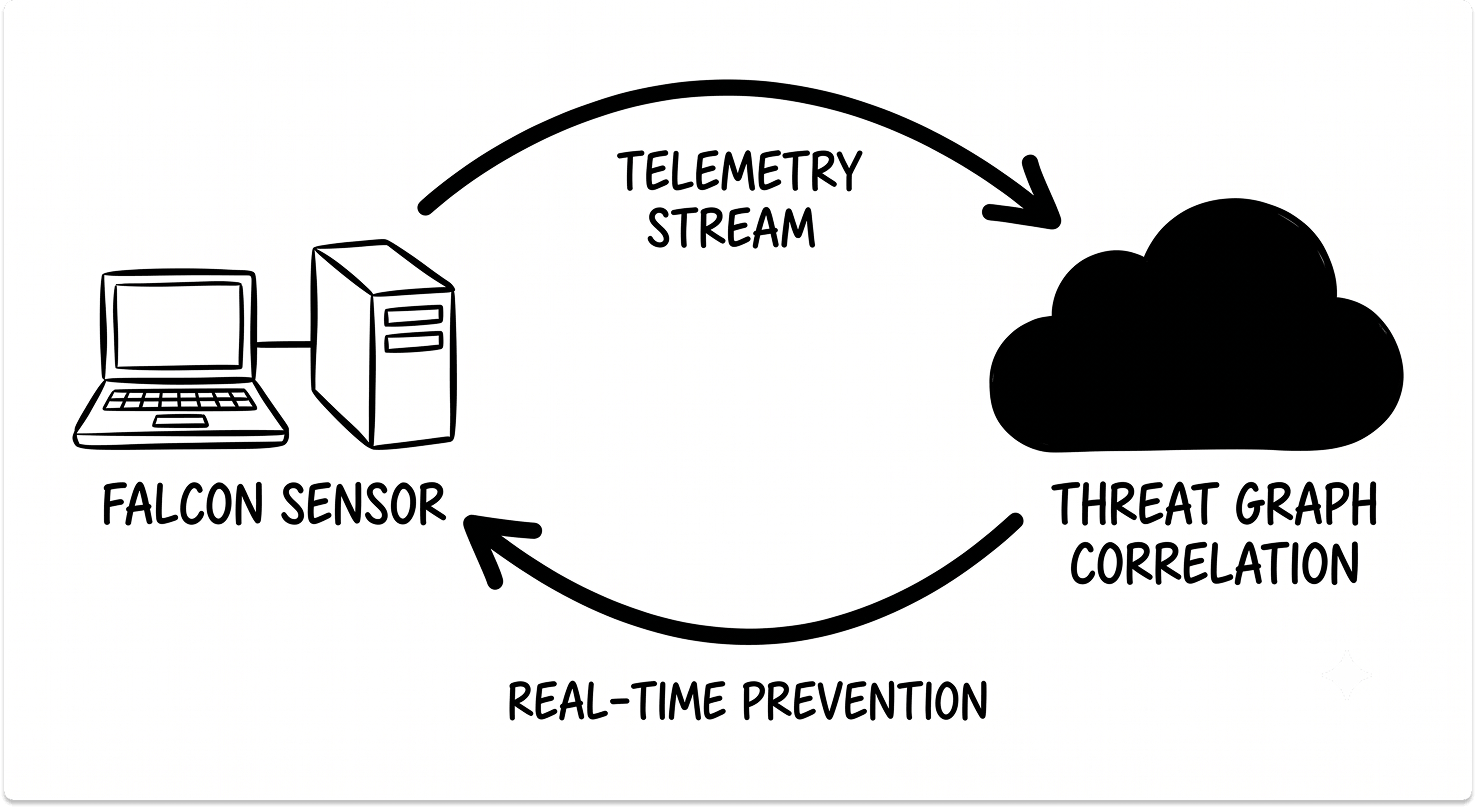
The sensor does more than scan files. It records behavioral events and streams them, filtered for relevance, to CrowdStrike's cloud. There is no on-premises management server to run or patch.
The cloud ingests trillions of events and stores the telemetry that powers detection, search, and investigation. This is where the analytics live, and why the endpoint stays light.
3. Threat Graph correlation
Threat Graph is a purpose-built graph database that models events as connected nodes and relationships, then correlates them across all customers. It looks at how events connect, not just what a single file is.
The practical effect is a network defense benefit. An attack pattern seen at one organization can inform protection for the rest. CrowdStrike is now extending this into a wider data layer that unifies its various graphs, but the core idea, correlation at scale, has been there from the start.
4. Detection through indicators of attack, not just indicators of compromise
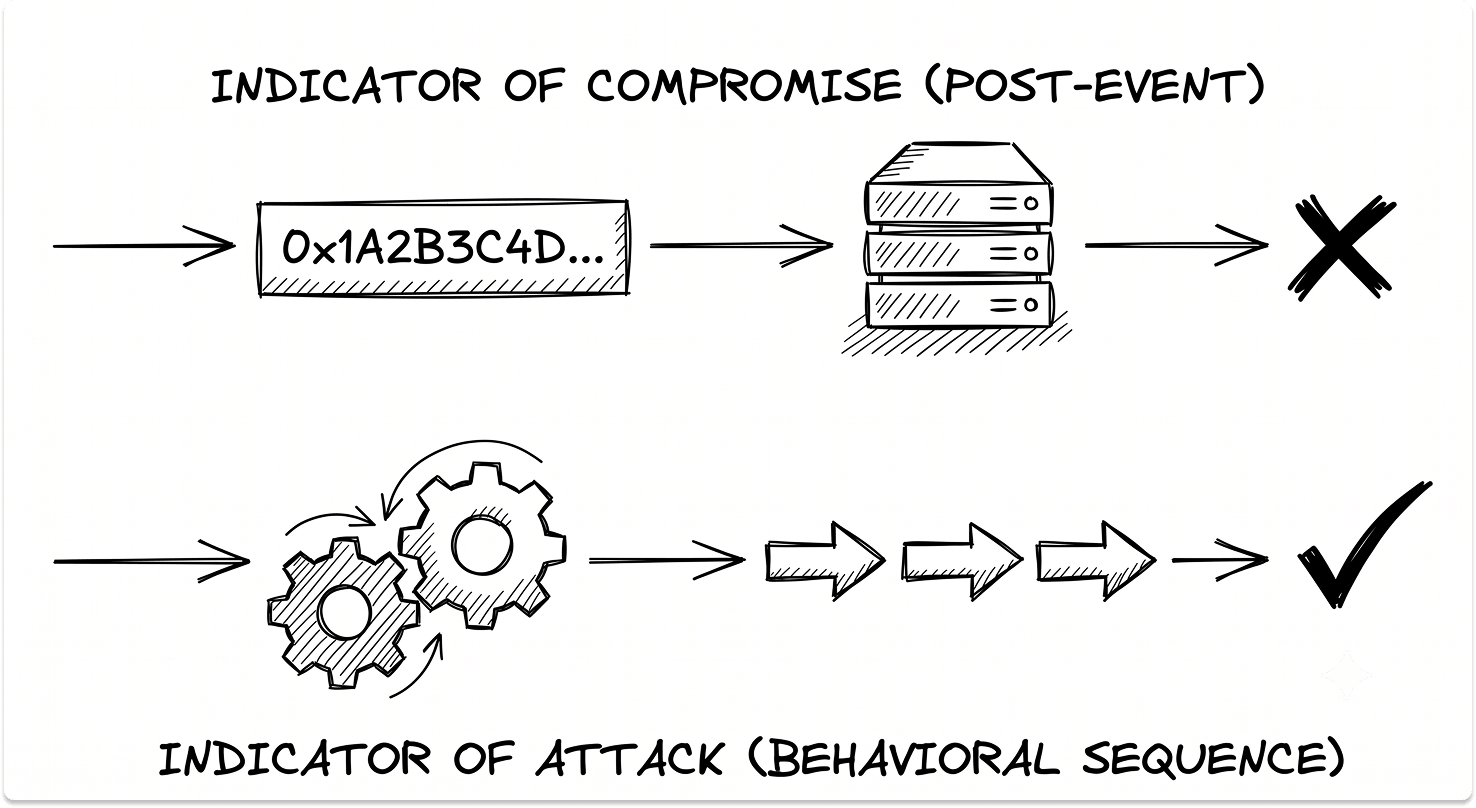
This is CrowdStrike's central detection idea, and one it pioneered. An indicator of compromise (IOC) is a static artifact left behind after a breach, a file hash, a malicious IP, a registry key. Useful, but by the time you find one, you have probably already been breached.
An indicator of attack (IOA) is a sequence of behaviors that shows an attack in progress, such as code execution, persistence, privilege escalation, and lateral movement. IOAs focus on what the attacker is trying to do, regardless of the specific tool or malware used.
This matters because attackers increasingly use no malware at all, relying on stolen credentials and built-in system tools that leave no signature to match. Signature-based tools struggle with that class of attack. Behavior-based detection is built for it.
Falcon uses both. IOAs drive prevention and early detection; IOCs still help with investigation and remediation.
5. Prevention, response, and offline behavior
Because prevention runs on the endpoint, a detection can block in real time. Response actions include isolating a host from the network, killing processes, and remote remediation through a shell-level tool.
When a device is offline, the sensor keeps its local prevention and syncs telemetry once it reconnects. This is worth stating plainly: since deep correlation happens in the cloud, an endpoint that stays disconnected for long periods gets less benefit than a connected one. That trade-off matters for air-gapped or intermittently connected environments, and it's a fair question to raise in any evaluation.
CrowdStrike Falcon Module Architecture
CrowdStrike is not a single product. It is a platform of modules, each licensed separately, all running through the same sensor. Buying conversations often collapse them into one word, so here is what each piece actually does.
Falcon Prevent (next-generation antivirus)
What it does: Blocks known and unknown malware, ransomware, and fileless attacks using machine learning and behavioral analysis instead of signature files alone.
Problems it replaces: Legacy signature antivirus that misses new threats and needs constant updates.
When you need it: When your current antivirus leaves gaps, especially on Linux servers, or when a tool caused an outage of its own and exposed how fragile the setup was.
Key capabilities: On-sensor machine learning, behavioral prevention, device control for USB media, and host firewall management in higher tiers.
Falcon Insight XDR (EDR and XDR)
What it does: Records endpoint activity continuously and correlates it with identity, cloud, and other telemetry. It gives you full process-tree visibility and maps activity to the MITRE ATT&CK framework.
Problems it replaces: Blind endpoints and siloed detection tools that each see one slice of an attack.
When you need it: When a product you run hits the news for an actively exploited flaw and you need to know fast whether it touched you, or when you simply cannot reconstruct what happened after an incident.
Key capabilities: Continuous recording, cross-domain correlation, threat detection tied to ATT&CK, and response actions from the console. If you are weighing this category broadly, our guide to MDR and XDR providers covers the field.
Falcon Identity Protection
What it does: Detects credential abuse, lateral movement, and privilege escalation across Active Directory and Entra ID.
Problems it replaces: Identity blind spots where a stolen password moves through the network unnoticed.
When you need it: When an insurer or auditor requires multi-factor authentication and tighter control of admin accounts as a condition, or after a login-based incident.
Key capabilities: Identity threat detection and response, risk scoring for accounts, and enforcement that works alongside your identity provider. For the broader access-control picture, see our identity and access management vendor guide.
Falcon Cloud Security
What it does: Protects cloud workloads and containers at runtime and flags misconfigurations across AWS, Azure, and Google Cloud.
Problems it replaces: Inconsistent security across clouds that no one governs the same way, often the result of growth through acquisition.
When you need it: When workloads spread across several clouds with no single oversight, or when a project pushes container adoption faster than your controls.
Key capabilities: Cloud workload protection, container runtime security, and posture management. This overlaps with the CNAPP category, which we cover in our guide to cloud-native application protection.
Falcon Next-Gen SIEM
What it does: Aggregates logs, runs cross-domain detections, and automates response through a built-in workflow engine. It extends CrowdStrike's detection to third-party data sources.
Problems it replaces: Rising log-collection costs and alert volumes that outpace the team.
When you need it: When your logging bill crosses a line that finance notices, or when analysts spend hours closing noise while a real threat waits in the pile.
Key capabilities: Log ingestion, automated triage, and prebuilt detections. Insight XDR customers get 10GB per day of third-party ingestion included, though most enterprises pushing network and cloud logs pass that quickly and need a paid subscription. If you are rethinking your logging stack, our piece on problems that surface after you replace an on-prem SIEM is worth a read.
Falcon Adversary OverWatch and Falcon Complete (threat hunting and managed response)
These are services layered on the platform. OverWatch provides continuous human-led threat hunting. Falcon Complete is fully managed detection and response, where CrowdStrike's team runs detection, investigation, and remediation for you, and carries a breach prevention warranty.
When you need it: When one person runs security and is overloaded, when the person who understood a key system has left, or when a hiring freeze means you cannot add the analysts you need. Our guide to managed IT services and MSPs helps frame the build-versus-buy question.
Charlotte AI and Falcon AIDR
Charlotte AI is the assistant built into the console. It triages alerts and answers questions in plain language to cut the time analysts spend on routine work. Falcon AIDR, which reached general availability in December 2025, secures the AI interaction layer, giving visibility into staff pasting company data into tools like ChatGPT and Copilot. That problem, shadow AI, is one we cover in depth in why shadow AI will outpace shadow IT.
The following table maps common situations to the module that addresses them.
Pricing is modular. The core bundles below are published list prices from CrowdStrike's pricing page, current as of July 2026. Identity, cloud, and Next-Gen SIEM are add-ons priced on top, and prices change, so confirm before you budget.
What CrowdStrike Offers to IT Leaders
Falcon is broad, so it helps to look at it through four lenses:
Breach Prevention and Threat Detection
1. Behavioral prevention that catches what signatures miss
Because Falcon leads with indicators of attack, it can stop fileless and zero-day activity that leaves no signature. That covers the class of intrusion that has grown fastest.
2. Crowdsourced intelligence at scale
Threat Graph correlates activity across every customer, so an attack seen once can harden defenses everywhere. For a single organization, that reach is hard to replicate internally.
3. Independent validation, read honestly
CrowdStrike points to strong results in MITRE ATT&CK evaluations, including full detection coverage. It's worth reading those results with care. MITRE evaluations reward configuration and tuning alongside raw capability, so they work best as a floor check, did the vendor show up and catch most techniques, rather than a strict ranking. Every serious vendor in this space performs well in these tests, which is a reason to run your own proof of concept.
Detection, Investigation, and Managed Response
1. Full process-tree visibility
Insight XDR records what ran, what spawned it, and what it touched. When you need to reconstruct an incident, that timeline turns guesswork into a clear sequence.
2. Human-led threat hunting
OverWatch adds analysts who hunt for the faint signs of a hands-on intruder, the kind of activity that blends in with normal behavior and slips past automation.
3. Managed detection and response
Falcon Complete puts CrowdStrike's team in the driver's seat for detection and remediation. The vendor publishes ROI and analyst-capacity figures for it, and those studies are vendor-commissioned, so weigh them as directional rather than independent. If your team is stretched, the value is straightforward: coverage you would otherwise have to hire for.
Cross-Domain Visibility and Consolidation

1. One agent instead of a rack of tools
The same sensor delivers antivirus, EDR, identity, and cloud signals. Consolidating point tools reduces agent sprawl and the overhead of managing several dashboards.
2. One investigation across domains
An endpoint alert, an identity alert, and an AI-traffic flag can point at the same incident and line up as one story in the console. For a small team with no time to stitch tools together by hand, that is the practical payoff.
3. Operational efficiency
CrowdStrike cites Forrester figures showing large reductions in management labor and strong ROI over three years. These are commissioned studies, so read them as claims to verify, not settled facts. The underlying point, that a cloud-native single agent cuts operational burden compared with on-prem tools, holds up in most environments.
Resilience and Operational Control
Your job includes fearing downtime, and CrowdStrike is tied to the largest software-caused outage in recent memory. Skipping that would not serve you.
1. What the July 2024 outage was
2. What CrowdStrike changed
The company added runtime bounds checks and input validation within days, and committed to staged rollouts for content updates, customer controls to pause or delay them, and independent third-party reviews of its code. Retention held afterward, with reported gross retention above 97%, which tells you customers largely stayed while asking harder questions.
3. The controls you own
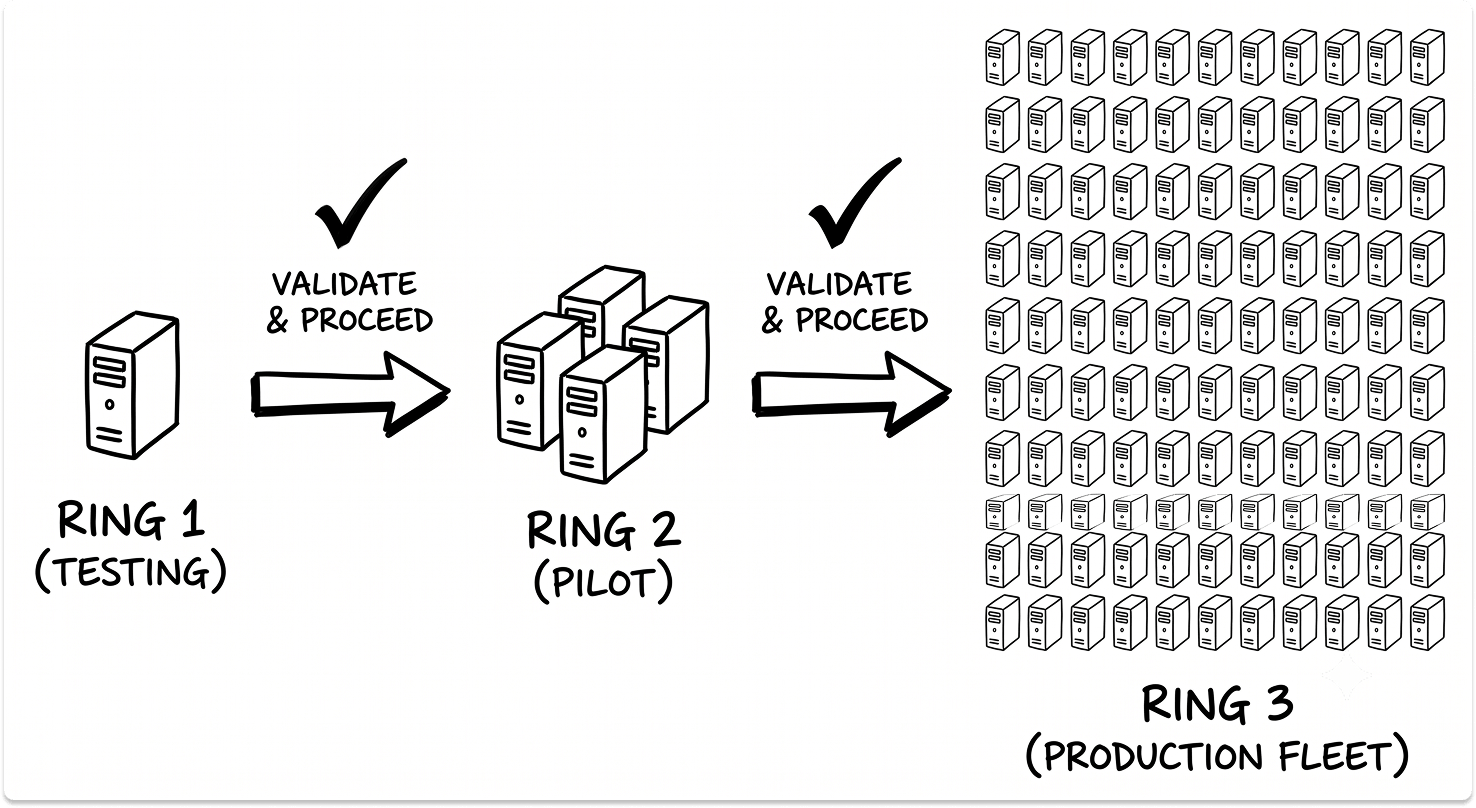
You can set sensor update policies to Auto-Latest, N-1, or N-2, test new versions on a pilot ring before production, and use long-term support sensors where stability matters most. The lesson is simple: do not push updates to your whole fleet at once. Ring your deployments.
See Which CrowdStrike Modules Best Suit Your Needs
Answer a few questions about your environment, your operating systems, your cloud footprint, whether you run a 24/7 SOC, and what triggered this search, and we will point you to the modules that fit and the alternatives worth a look.
Is CrowdStrike Right for Your Environment?
Falcon fits organizations that have accepted that endpoints, identities, and cloud workloads are all part of the attack surface, and that want strong detection with the option to consolidate tools. It fits best where you can run disciplined change control.
It is a weaker fit in a few cases. Full coverage means stacking modules, and the platform sits at the premium end on price. Its cloud-dependent analytics are a poor match for air-gapped or frequently disconnected environments. Advanced hunting has a learning curve, and alerts need tuning, especially for newer teams.
The alternatives are real and worth comparing on fit, not reputation. Microsoft Defender suits organizations already deep in Microsoft 365. SentinelOne is often shortlisted where offline autonomy matters.
Palo Alto Cortex XDR makes most sense inside an existing Palo Alto stack. We compare the managed-service angle directly in CrowdStrike vs SentinelOne vs Arctic Wolf, and cover what a switch actually involves in migrating between Microsoft Defender and CrowdStrike.
What you need to think about is whether a cloud-native, single-agent, kernel-level platform fits your environment and your tolerance for change-control risk better than the alternatives, and whether you make that call on your own timeline rather than under the pressure of a renewal, an audit, or an incident. And always run a proof of concept on a realistic slice of your estate before you commit.
Evaluating CrowdStrike against alternatives?
If you are weighing CrowdStrike against Defender, SentinelOne, Cortex XDR, or others, our platform can help. Filter vendors that fit your requirements and start conversations on your terms.
FAQ
What does CrowdStrike do?
CrowdStrike's Falcon platform prevents, detects, and responds to security threats across endpoints, identity, and cloud. A single agent on each device collects activity and streams it to CrowdStrike's cloud, where it is analyzed against threat data from across the customer base. It can block attacks locally and isolate a compromised host from one console.
Is CrowdStrike an antivirus?
It includes next-generation antivirus through Falcon Prevent, but it works by analyzing behavior rather than matching signatures alone. The platform goes well beyond antivirus into EDR, XDR, identity protection, cloud security, and managed response.
What is the Falcon sensor?
The Falcon sensor is the single lightweight agent installed on each device. On Windows it uses a kernel-mode driver and a user-mode service; on Linux it runs in user mode with eBPF. The same sensor feeds every module, so adding coverage does not mean installing another agent.
What caused the 2024 CrowdStrike outage, and can it happen again?
A faulty content update, Channel File 291, caused a memory error that crashed millions of Windows machines in July 2024. CrowdStrike has since added validation and bounds checks, moved to staged rollouts, and given customers controls to delay content updates. You can further reduce risk by ringing your sensor updates and testing new versions on a pilot group first.
How does CrowdStrike integrate with existing tools?
CrowdStrike integrates with identity providers, SIEM and SOAR platforms, and other security tools through prebuilt connectors and APIs. It is also a common source of device-posture signals for access tools, including Zscaler.