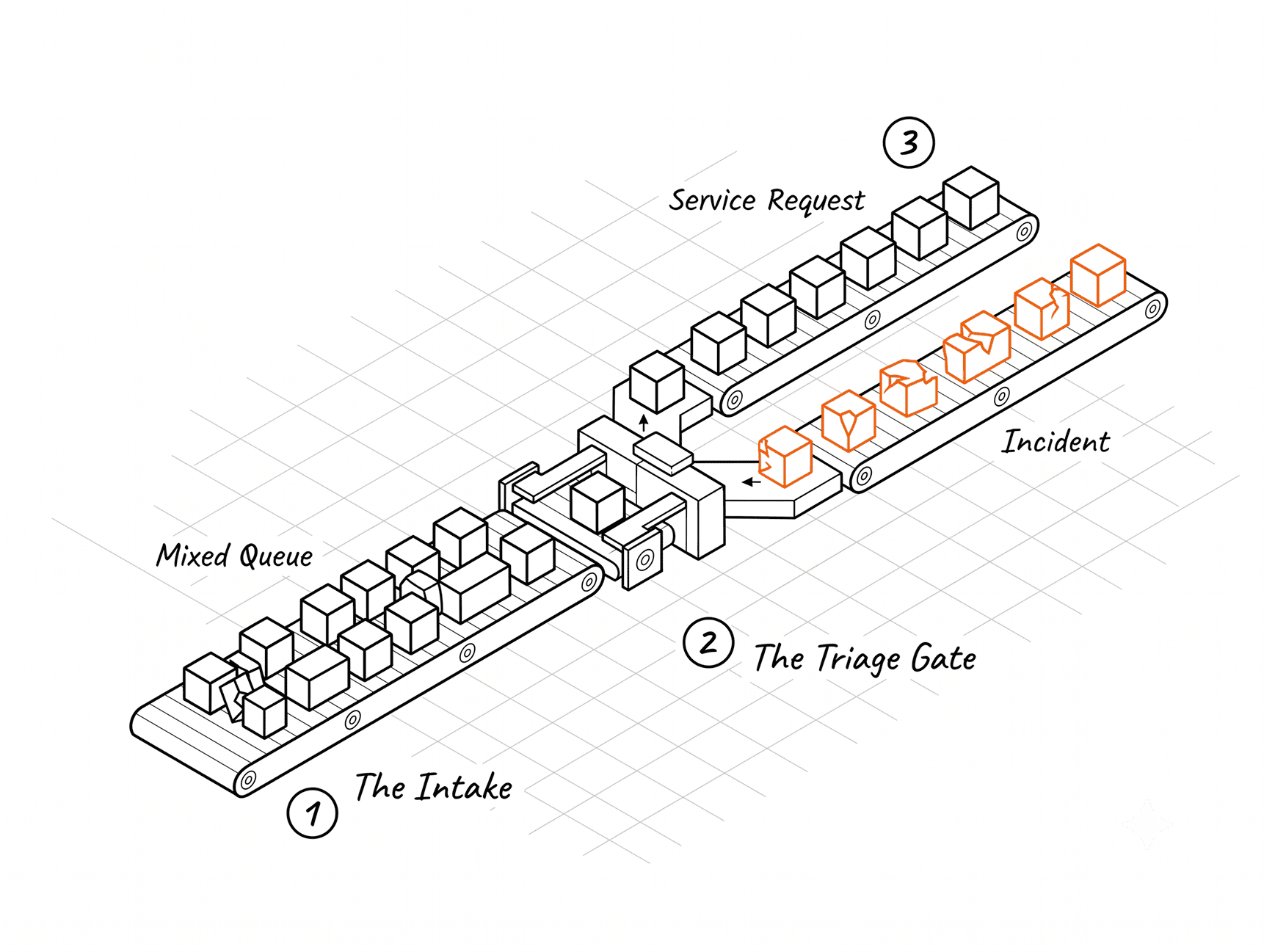
CoreWeave vs Lambda vs Nebius: renting US GPU capacity for enterprise AI
A vendor-neutral comparison of how CoreWeave, Lambda and Nebius sell reserved GPU capacity in the US, which GPUs run in which states, what federal and regulated buyers can use today, and when AWS, Azure or Google Cloud fits better.

Price per GPU-hour leads almost every comparison of CoreWeave, Lambda and Nebius. It also tells you the least, because a rate on a pricing page says nothing about whether the GPUs you need will exist when your project starts.
What decides an enterprise rental is how each provider sells capacity, the smallest unit you can rent, which GPUs run where, and the terms behind all three. I compare those four things for US buyers, using each provider's own documentation and SEC filings, and I leave list prices out on purpose: they changed during my research, and none of them says whether capacity exists.
The US is where most of this capacity sits. CoreWeave lists 49 of its 59 availability zones in the US, Lambda runs nine of its 14 regions here, and Nebius has announced new US sites in New Jersey, Missouri, Alabama and Pennsylvania.
CoreWeave, Lambda and Nebius are GPU clouds, often called neoclouds: providers built around dedicated GPU capacity, with a narrower set of services than AWS, Azure or Google Cloud. This guide covers renting that capacity for training, fine-tuning and inference.
CoreWeave and Nebius also sell hosted model APIs, which sit outside this comparison. If you meant calling a hosted model, start with our AWS Bedrock vs Azure OpenAI vs Google Vertex AI comparison.
IT Leaders Report 2026
What are your IT peers investing in 2026?
We spoke to about 1,300 IT leaders from various organisations to understand what they're evaluating. Most of it is the kind of thing you'd only hear from a peer you know well enough to ask, so we've put it in one place.
Read the report
On-demand access is not a capacity guarantee
On-demand GPU access is a place in a queue, and none of the three providers promises more than that. CoreWeave opens its General Access zones to every customer, subject to capacity, and keeps Dedicated Access zones for select customers.
Lambda describes its on-demand instances as self-serve, first-come access. Nebius applies default regional quotas to GPU virtual machines and InfiniBand use, and sends large cluster requests to its sales team.
The rest of the market says the same in writing. Microsoft's capacity reservation documentation states that quota and capacity are separate checks, and Crusoe's support documentation says quota approval does not guarantee capacity.
In the US right now, that queue is long. On CoreWeave's Q1 2026 earnings call, its CFO said the company is largely sold out of 2026 capacity and has started allocating 2027.
Nebius reported selling out of available capacity in its Q3 2025 shareholder letter, and again in each of the next two quarters. On its Q1 2026 call, management said four or more customers typically compete for every GPU it brings online.
The largest buyers lock in capacity first. Lambda signed a multi-year agreement with Microsoft to run tens of thousands of NVIDIA GPUs, including GB300 NVL72 systems, in its US data centers.
Enterprise workloads end up on reservations for a plain reason. A training run that needs 128 GPUs for four months needs every one of them in the same region, on the same cluster network, for the whole term, and a first-come queue cannot promise that.
The first test I run with any GPU provider is one request: a written capacity commitment for our GPU type, GPU count, US region and start date. The answer, and how long it takes to arrive, tells me more than any pricing page. For the facility side of the same problem, see our guide to winning the power and capacity race.
Several claims repeated across current comparison pages fail a check against provider documentation.
How CoreWeave, Lambda and Nebius are built
All three now run GPU clusters with managed Kubernetes and Slurm, and all three sell managed AI services on top. The differences that change a buying decision sit lower down: what you can rent, how you buy it and where in the US it runs.
CoreWeave runs bare-metal GPU servers through its own Kubernetes service and SUNK, its Slurm-on-Kubernetes product. Its H100, H200, B200 and B300 instances come as whole 8-GPU servers, and its rack-scale GB200 and GB300 NVL72 systems rent as 4-GPU instances. CoreWeave Forge adds managed inference, fine-tuning and Weights & Biases tooling, and CoreWeave trades on Nasdaq.
Lambda sells self-serve virtual machines with one, two, four or eight H100 or B200 GPUs, plus 1-Click Clusters of 16 to more than 2,000 GPUs. Superclusters and private cloud go through sales. Lambda offers managed Kubernetes and Slurm, has no spot tier, and is privately held.
Nebius rents virtual machines with one or eight GPUs on dedicated hosts, with managed Kubernetes and Soperator, its managed Slurm service. It adds managed PostgreSQL, managed MLflow and Token Factory for hosted inference. Nebius is headquartered in Amsterdam, trades on Nasdaq, and runs two of its nine public regions in the US.
The rentable unit matters more than it looks. A job that needs four GPUs in one machine gets a 4-GPU instance on Lambda and a full 8-GPU server on CoreWeave or Nebius.
If your team is still weighing Kubernetes against Slurm for these clusters, our EKS vs AKS vs GKE guide covers the managed Kubernetes trade-offs. Our WEKA vs VAST Data vs DDN vs Pure Storage comparison covers the storage that feeds a training run.
How each provider sells reserved capacity
Lambda is the only one of the three that publishes its reservation terms. Its 1-Click Clusters run from 16 to more than 2,000 B200 or H100 GPUs on terms of two weeks to one year, and longer terms go to its sales team.
Even that published path has a human checkpoint. Lambda's billing documentation invoices a reservation once Lambda approves it, and on October 6, 2026, every cluster row on its pricing page routed to a sales conversation.
CoreWeave documents four capacity plans: Reservations, Flex Reservations, On-Demand and Spot. Its Form 10-K for 2025 says customers generally buy a specified amount of capacity on multi-year, take-or-pay contracts, which averaged about five years at the end of 2025.
Flex Reservations, in preview since March 10, 2026, guarantee capacity up to a ceiling you choose without committing you to run at that ceiling around the clock.
Nebius sells on-demand and preemptible capacity and multi-month cluster reservations, and its largest contracts are five-year dedicated agreements. Its Form 424B5 describes two dedicated GPU clusters for Meta over five years, alongside the Microsoft agreement below.
The clearest picture of a large reservation comes from a US securities filing. Nebius's Form 6-K on its Microsoft agreement describes dedicated GPU capacity delivered in tranches from Vineland, New Jersey over five years, with service level commitments and liquidated damages for late delivery.
If Nebius misses a delivery date after a grace period and cannot provide alternative capacity, Microsoft can terminate that tranche. That is a capacity commitment, a remedy and a substitution clause in one paragraph, which makes it a useful template for your own order form.
Where the GPUs sit in the US
Where a GPU runs decides latency to your data, which zones you can reach without a sales call, and how close your team is to the hardware it depends on. The three providers spread across the US very differently.
CoreWeave lists 49 US availability zones across 20 states. Eighteen zones in ten states are General Access, open to every customer, and the other 31 are Dedicated Access zones that CoreWeave describes as single-tenant, with no other customer sharing the zone or its network fabric.
Lambda runs nine US regions: Virginia, Washington DC, Illinois, three in Texas, California, Arizona and Utah. Lambda notes that instance types vary by region, so confirm the GPU and the region together.
Nebius runs two public US regions. Kansas City, Missouri carries B200 and H200 plus every managed service Nebius sells, while Woodbury, Minnesota carries B300 with a narrower set that leaves out managed Slurm, PostgreSQL and MLflow.
GPU type narrows the map further. CoreWeave's availability matrix puts H100 in ten open-access US zones, while its newest rack-scale systems sit in fewer places: GB300 NVL72 in three zones and Vera Rubin NVL72 in one, in Texas.
Both GPU clouds are adding US capacity fast. Nebius is building a 300 MW data center in Vineland, New Jersey and has announced sites in Independence, Missouri and Birmingham, Alabama, plus a 1.2 GW campus in Pennsylvania. Lambda operates from 15 US data centers and is set to open a facility in Kansas City.
For US-only data, Lambda's cloud terms matter more than its region list.
CoreWeave groups all of its US locations in a single US Geo and says it places regions to help meet data residency requirements. Nebius's data processing agreement commits to processing personal data in the region the customer chooses.
Federal and regulated US workloads
Federal agencies and contractors handling controlled unclassified information need FedRAMP-authorized capacity, and today that runs through the hyperscalers. AWS brought Capacity Blocks for ML to GovCloud on June 12, 2026, with B200 in GovCloud (US-West) and B200 and B300 in GovCloud (US-East).
Microsoft added H200 GPUs to its Azure Secret and Top Secret clouds in December 2025. Both options run inside government-authorized boundaries.
CoreWeave is building the GPU-cloud path. It launched CoreWeave Federal on October 28, 2025 to pursue FedRAMP and other authorizations, and on July 30, 2026 it partnered with Leidos to deliver AI cloud services inside classified facilities.
Lambda's government page describes work with agencies through Cooperative Research and Development Agreements, backed by a US-based support team.
Regulated commercial data splits the field differently. Nebius offers a HIPAA business associate agreement on request and requires it before protected health information is uploaded, while Lambda's platform guidelines bar personal health information unless an order permits it.
For California consumer data, Lambda's trust page lists CCPA compliance, and Nebius's data processing agreement casts Nebius as a CCPA service provider.
Enterprise readiness: SLAs, compliance and counterparty risk
An SLA tells you what a provider owes you when something breaks, and the three publish very different answers. CoreWeave's terms of service set a service level objective of 99.9% monthly uptime for instances in multiple regions, with service credits as the remedy.
Nebius publishes a 99.5% compute SLA for a single VM and makes compensation the sole remedy. Lambda's cloud terms provide the service as-is, with no uptime commitment.
An objective is a target. Read CoreWeave's credit terms before treating it as a commitment, and ask Lambda for an SLA in the order form.
All three hold SOC 2 Type II reports and ISO 27001 certification, shared through their trust portals (CoreWeave, Lambda, Nebius).
Counterparty risk comes down to what you can see and what the contract says. CoreWeave and Nebius file periodic reports with the SEC, which is why their contract structures appear in this guide. Lambda is private, and SEC EDGAR shows only exempt-offering notices for it, with no registration statement, as of October 6, 2026.
Lambda's terms also let it delete your data after termination without obligation and assign the contract in a merger without your consent. Whichever provider you choose, ask for data return windows, transition assistance and change-of-control rights in the order form.
Why GPU capacity plans fail
GPU projects rarely stall on the GPU itself. They stall on assumptions made before anyone signs.
- Planning on on-demand. First-come capacity is the first to disappear when providers report selling out, as CoreWeave and Nebius both did in 2026.
- Choosing the provider before the GPU and the state. Nebius has no US H100, and CoreWeave's GB300 NVL72 runs in three US zones.
- Signing the default terms. Default data-location and data-type clauses apply until your order form replaces them.
- Renting a whole server for half a need. A four-GPU job on an 8-GPU unit leaves half the server idle.
- Leaving hardware failure out of the contract. Large clusters lose nodes regularly, and the contract should say what happens next.
That last point deserves numbers. In The Llama 3 Herd of Models, Meta reported 419 unexpected interruptions during a 54-day pre-training snapshot on 16,384 H100 GPUs, and traced 58.7% of them to GPU issues.
Meta still kept more than 90% effective training time, with heavy automation behind it. Ask each provider how it detects and replaces a failed node, how quickly, and whether replacement time counts against the SLA.
For the budget side of the same planning, see why AI/ML workloads break cloud budgets.
CoreWeave vs Lambda
CoreWeave and Lambda both sell InfiniBand clusters with managed Kubernetes and Slurm across many US locations, so the split comes down to how you buy and what you can see. Lambda publishes its cluster terms and rents H100 and B200 from a single GPU up.
CoreWeave sells whole servers on multi-year committed contracts and adds Spot and Flex Reservations for uneven demand. Its US map is wider and documented GPU by GPU, with 18 open zones in ten states, while Lambda's nine US regions cover six states and DC.
CoreWeave vs Nebius
CoreWeave and Nebius are both public and both quote large reservations through sales, but their US footprints are far apart: 49 CoreWeave zones against two Nebius regions. Nebius's Kansas City region pairs B200 and H200 with managed PostgreSQL, MLflow and Slurm, and Woodbury adds B300.
Nebius rents single GPUs, publishes a compute SLA and offers a HIPAA business associate agreement. CoreWeave sells whole servers, runs H100 in ten open US zones and is building a federal path through CoreWeave Federal.
Lambda vs Nebius
Lambda covers more of the US, with nine regions against Nebius's two, while Nebius documents exactly which GPU runs in each region. Lambda publishes reservation terms from two weeks and rents H100; Nebius quotes reservations, sells preemptible capacity and publishes a compute SLA.
On regulated data they part ways. Nebius signs a BAA on request, while Lambda's default terms bar health data and let it move data between regions.
When AWS, Azure or Google Cloud is the better choice
A GPU cloud adds a second vendor, a second network boundary and a second set of terms. For some workloads, that overhead outweighs everything above.
A hyperscaler usually wins in five cases: work that needs FedRAMP today; inference next to data already in AWS, Azure or Google Cloud; committed spend you already need to draw down; procurement rules that require an existing vendor; and workloads that lean on many adjacent managed services. Retrieval-heavy assistants are the common example, and our vector database comparison covers that architecture.
Hyperscaler reservations are shorter and self-serve. AWS Capacity Blocks for ML reserve GPU instances up to eight weeks ahead for up to six months, in blocks of 1 to 64 instances that can be shared across accounts. Google Cloud's calendar-mode reservations hold GPU VMs for up to 90 days once Google approves the request.
Azure needs a closer read. Its capacity reservations guarantee capacity but don't cover the ND-series or NCads H100 v5 VMs that carry its AI GPUs, and Azure Reserved Instances carry no capacity guarantee.
GPU clouds still win where the documents show it: multi-year capacity on contract, published cluster terms from two weeks on Lambda, a 49-zone US footprint on CoreWeave, and managed Slurm on all three. If your data already lives in a hyperscaler, ask any GPU cloud about private connectivity before you compare anything else.
Why Crusoe, RunPod and Together AI are out of scope
Three providers appear in most current coverage of this market and sit outside this comparison. Crusoe sells its high-density GPUs, including H100 SXM, B200 and GB200, only through reserved instance agreements, which makes it a cluster-first peer of CoreWeave and a candidate for a follow-on comparison.
RunPod is developer-first, with self-serve Instant Clusters of 16 to 64 GPUs and larger clusters through sales. Together AI leads with hosted inference, and its GPU clusters take reservations of 1 to 90 days.
Which GPU cloud fits your workload?
Answer six questions about your workload. The tool marks each provider as a fit, ruled out, or dependent on terms you'll need in writing, using the US availability and terms above, and flags when a hyperscaler deserves a look first.
Choosing on technical fit
For US buyers, the decision comes down to four facts: the GPU you need, the state it must run in, how long you need it, and what your data is allowed to do.
- Choose CoreWeave when you need H100 across many US states, rack-scale GB200 or GB300, a multi-year contracted cluster, or a federal roadmap through CoreWeave Federal.
- Choose Lambda when you want published cluster terms from two weeks, one to eight H100 or B200 GPUs on demand, and your data excludes health records.
- Choose Nebius when you need B200 or H200 in Kansas City with managed data services, B300 in Minnesota, a HIPAA business associate agreement, or preemptible capacity.
- Choose AWS, Azure or Google Cloud when the work needs FedRAMP today, or inference sits next to data you already hold there.
- Pin the hosting region in your order form on Lambda for any US-only data requirement.
Before you sign with any of the three, get these terms in writing.
If a provider won't put these three things in writing, you have your answer.
Shortlisting GPU cloud capacity?
Which provider fits depends on your GPU type, your US region and the terms you can get in writing. Shortlist pre-vetted AI infrastructure vendors on TechnologyMatch, matched to all three. You stay anonymous until you choose to talk, you pick who to talk to, and it's free for buyers.
FAQ
What is a neocloud?
A neocloud is a cloud provider built around dedicated GPU capacity for AI training and inference, with a narrower set of services than AWS, Azure or Google Cloud. CoreWeave, Lambda and Nebius are all neoclouds.
Can you rent a single GPU on CoreWeave?
Only the GH200, which CoreWeave runs in Virginia and Nevada. Its H100, H200, B200 and B300 instances rent as whole 8-GPU servers. Lambda rents H100 and B200 in 1, 2, 4 or 8 GPUs, and Nebius rents single-GPU VMs.
Where are CoreWeave's US data centers?
CoreWeave lists 49 US availability zones across 20 states. Its 18 General Access zones, open to all customers, are in Texas, Illinois, New York, New Jersey, Virginia, Ohio, Michigan, Nevada, Arizona and Washington. The other 31 are Dedicated Access zones reserved for select customers, in states including Georgia, Pennsylvania, Oregon and North Dakota.
Does Nebius have data centers in the US?
Yes. Nebius runs public regions in Kansas City, Missouri, with B200 and H200, and Woodbury, Minnesota, with B300. It is also building a 300 MW data center in Vineland, New Jersey, and has announced sites in Missouri, Alabama and Pennsylvania. Its H100 capacity runs in Finland.
Is Lambda suitable for enterprise workloads?
Lambda holds SOC 2 Type II and ISO 27001, runs nine US regions and publishes cluster terms from two weeks to one year. Its default terms offer no uptime commitment, bar health data and let it move data between regions, so set the SLA, data location and allowed data types in your order form.
Are CoreWeave, Lambda or Nebius FedRAMP authorized?
None of the three lists a FedRAMP authorization as of October 6, 2026. CoreWeave launched CoreWeave Federal in October 2025 to pursue FedRAMP and other authorizations, and Lambda works with agencies through Cooperative Research and Development Agreements. For FedRAMP High work today, AWS GovCloud reserves B200 and B300 through Capacity Blocks for ML.
How do reserved GPU contracts work?
A reservation holds specific hardware for you for a fixed term. CoreWeave's customers generally sign multi-year, take-or-pay contracts averaging about five years, and Lambda publishes cluster terms from two weeks to one year. Nebius's Microsoft agreement shows the larger shape: delivery dates per tranche, a grace period, and liquidated damages for late delivery.
Can you run HIPAA workloads on CoreWeave, Lambda or Nebius?
Nebius offers a HIPAA business associate agreement on request and requires it before protected health information is uploaded. Lambda's default terms bar personal health information unless an order permits it, and CoreWeave's Trust Center lists no HIPAA attestation, so ask its account team directly.