


What Happens When You Migrate Off Splunk: Sentinel, Google SecOps and a Pipeline in Front
Leaving Splunk? Compare four paths: a pipeline in front, Microsoft Sentinel, Google SecOps or MDR, plus what breaks in a SIEM migration and what it costs.

The renewal quote lands, and it is bigger than last year's. Your SOC already ignores a share of what Splunk flags, ingest keeps climbing, and someone in the budget meeting asks why you don't just switch.
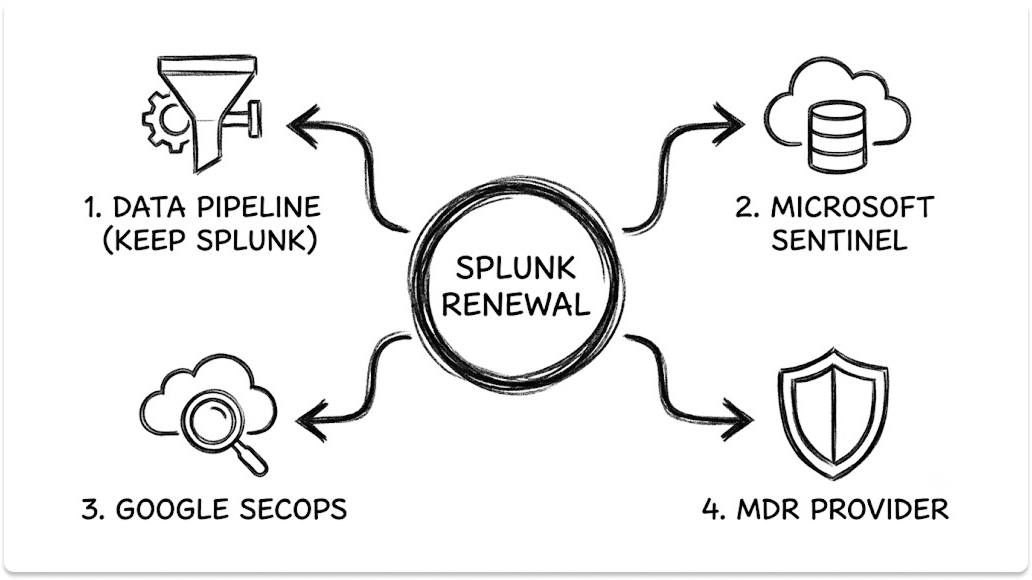
A Splunk migration has four realistic paths: keep Splunk and put a data pipeline in front, move to Microsoft Sentinel, move to Google SecOps, or hand monitoring to an MDR provider. The right one depends on where your data lives, how many detections you've built, and who runs the SOC while you move.
I treat leaving Splunk as three decisions: where your data goes, where your detections go, and who watches alerts during the move. If you need a refresher on what Splunk does today, start there. Splunk remains a valid platform, so the real question is what your renewal money buys.
IT Leaders Report 2026
What are your IT peers investing in 2026?
We spoke to about 1,300 IT leaders from various organisations to understand what they're evaluating. Most of it is the kind of thing you'd only hear from a peer you know well enough to ask, so we've put it in one place.
Read the report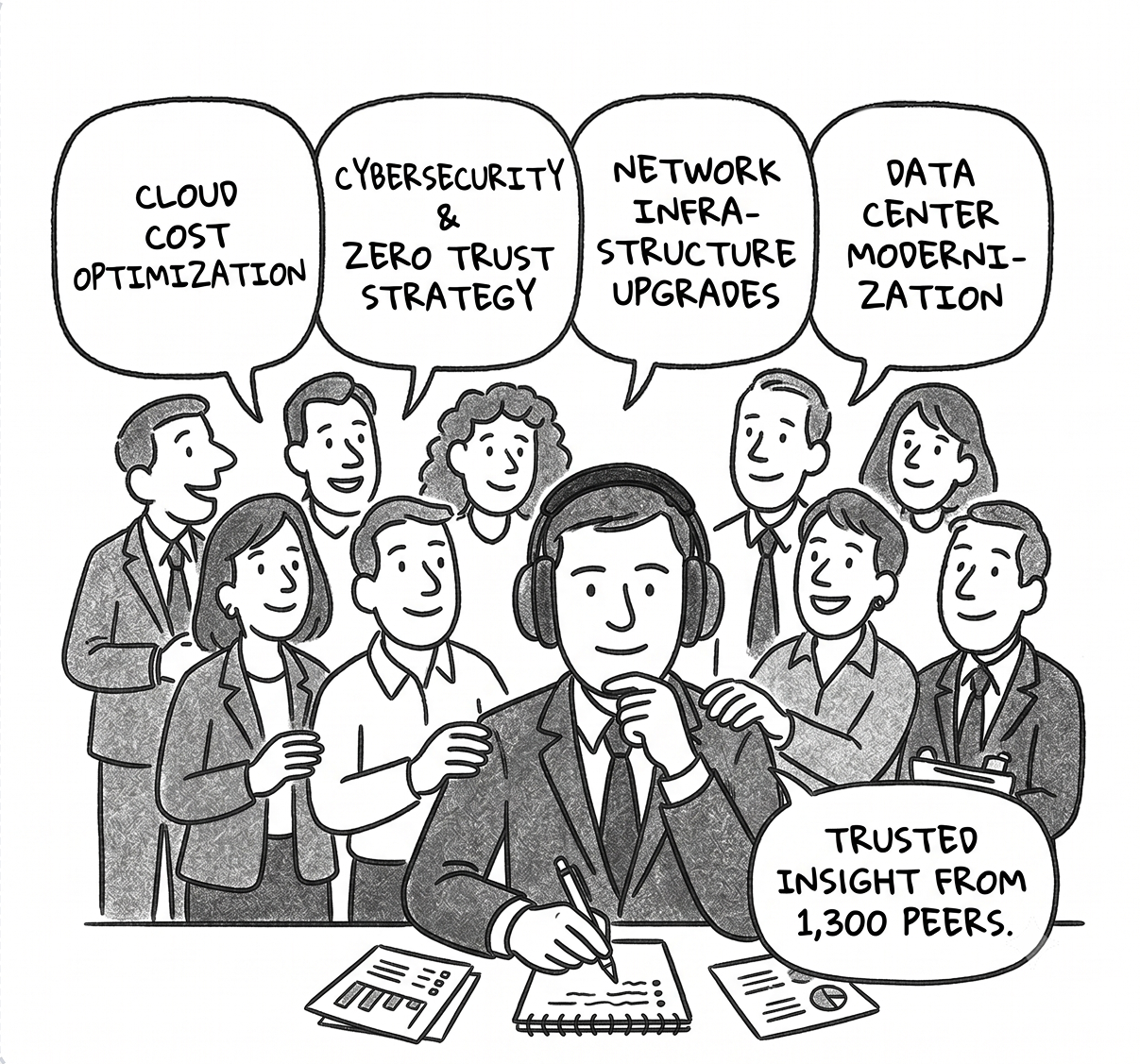
Splunk Alternatives at a Glance: The Four Paths Off a Splunk Renewal
Four paths sit in front of a Splunk renewal. A pipeline cuts indexed volume and keeps your detections. Sentinel and Google SecOps replace the SIEM and require rebuilt content, while MDR hands triage to an outside team on top of a SIEM. Pick by data location, detection count and SOC capacity, then price the move.
Path 1, pipeline in front. A pipeline filters, trims and routes logs before Splunk indexes them. It fits teams with years of SPL content and a cost problem. The effort is pipeline engineering, with zero detection rework.
Path 2, Microsoft Sentinel. Sentinel fits estates that run on Microsoft 365, Defender and Azure. You rebuild detections in KQL and onboard data through Microsoft connectors, which makes it a full SIEM migration.
Path 3, Google SecOps. Google SecOps fits Google Cloud shops, high volumes and long retention needs. You parse data into Google's Unified Data Model and rewrite detections in YARA-L, an effort on the same scale as a Sentinel move.
Path 4, MDR. An MDR provider runs detection and triage for you, usually on its own platform or on top of yours. It fits small teams drowning in alerts, and the effort is onboarding and contract scoping.
This guide skips a SIEM ranking. For that, use our full SIEM shortlist.
Which Path Fits Your SOC? Take the 5-Question Splunk Exit Check
Five answers point to a starting path: your renewal driver, where your log volume comes from, how much custom content you own, your SOC headcount and your retention need. The check recommends a path and names no product. Use the result to decide which option to model first.
Path 1: Keep Splunk and Put a Pipeline in Front
A pipeline filters, trims and routes data before Splunk indexes it, so you pay to index less without migrating detections. Your SPL content, dashboards and analyst habits stay where they are. The work moves to pipeline engineering, plus a decision about where the routed data lives and how you search it.
Cribl vs Splunk: What a Pipeline in Front Does
The two products do different jobs. Cribl Stream is a telemetry pipeline that sits between your sources and Splunk. Cribl states it can filter duplicate and low-value events, route cold data to object storage or Cribl Lake, and convert high-volume logs into metrics. Its Replay feature sends archived data back into Splunk when an investigation needs it.
Licensing is consumption-based. Cribl's documentation states that every Cribl Stream download includes a Free license for up to 1 TB per day, which requires sending anonymized telemetry to Cribl. Paid tiers carry a defined daily ingestion quota, and Cribl.Cloud bills in credits.
Splunk offers its own pipeline tools. Splunk documents Edge Processor and Ingest Processor, which use SPL2 pipelines to filter, mask, transform and route data, including to Amazon S3. Federated Search for Amazon S3 then searches those buckets from Splunk Cloud Platform without indexing them. Splunk licenses it separately through Data Scan Units and optimizes it for up to 10 TB scanned per search.
What a Pipeline Can Cut and What It Can't
A pipeline can cut:
- Noisy fields and duplicate events inside verbose sources
- Volume from chatty sources, through sampling or log-to-metric rollups
- Indexed volume, by routing cold or compliance-only data to object storage
A pipeline leaves these as they are:
- Your Splunk contract model and renewal terms
- Alert quality, since a bad correlation search stays bad
- Analyst headcount and on-call load
Other pipeline options include Bindplane, Edge Delta, Observo AI (acquired by SentinelOne in September 2025) and CrowdStrike Falcon Onum.
Path 2: Migrate From Splunk to Microsoft Sentinel
Sentinel fits organizations whose security signal already comes from Microsoft 365, Defender and Azure. Data sources move to Microsoft connectors, detections move from SPL to KQL analytics rules, dashboards move to workbooks, and Splunk SOAR playbooks move to Logic Apps. Plan the day-to-day work in the Defender portal from the start.
Splunk vs Sentinel: How Pricing and Ingestion Differ
Splunk sells by quote. Splunk's pricing page lists activity-based, ingest, workload and entity pricing, with Splunk Cloud Platform offered on activity-based, ingest or workload terms. Splunk also states that eligible Cisco telemetry comes in at a 0.5x weighted ingest rate.
Microsoft publishes Sentinel's structure. Microsoft Learn describes an analytics tier sold pay-as-you-go or on commitment tiers starting at 100 GB per day, with tier reductions allowed every 31 days. Microsoft includes 90 days of retention at no charge and bills retention beyond that, while the data lake tier bills separately for ingestion, processing, storage, query and advanced data insights.
Microsoft lists free data sources, including Azure Activity logs, Office 365 audit logs and security alerts from Defender products. Microsoft also states that the raw logs for several Defender, Entra ID and Information Protection data types are paid.
The Sentinel Data Lake and the Defender Portal
The Sentinel data lake is Microsoft's low-cost tier for high-volume, lower-value logs. You can switch secondary tables to the lake tier and query them with KQL or KQL jobs. Storage bills on a 6:1 compression ratio, so 600 GB of raw data bills as 100 GB.
Microsoft states that after March 31, 2027, Sentinel will run only in the Defender portal. That date replaces an earlier July 2026 deadline. Microsoft also states that Sentinel works in the Defender portal without Defender XDR or an E5 license.
Microsoft's SIEM Migration Experience
You upload a JSON export of your Splunk detections, which requires a Splunk admin role. Microsoft documents that the SIEM migration experience maps rules to built-in analytics, translates SPL to KQL, maps Splunk data sources to Sentinel tables, and maps lookups to watchlists. It produces a report listing the rules it couldn't match.
It stops there. Microsoft states the tool doesn't install connectors or enable detection rules. Microsoft also advises against migrating every Splunk detection blindly and suggests reviewing rules that haven't alerted in 6 to 12 months.
SPL to KQL: What Translates and What Doesn't
Common commands map cleanly. Microsoft's mapping table pairs stats with summarize, eval with extend, lookup with externaldata or lookup, and transaction with a join or row_window_session.
The hard cases depend on Splunk-specific context: correlation searches built on CIM data models, nested macros, lookups maintained by apps, and Enterprise Security risk-based alerting. In September 2024, Microsoft added schema mapping and translation support for Splunk macros and lookups, and Microsoft Learn states that Splunk CIM schemas and data models map to ASIM schemas when applicable. Every translated rule still needs testing.
The detections are the easy part to count and the hard part to move. Before you rebuild everything, check whether XDR replaces SIEM for some of your use cases.
Path 3: Migrate From Splunk to Google SecOps
Google SecOps fits organizations running on Google Cloud, organizations with high log volumes, and those that need a year or more of searchable data. Data moves through Google's parsers into UDM, detections move from SPL to YARA-L, and response playbooks move into Google SecOps SOAR.
Google SecOps vs Splunk: Pricing and Retention
Google sells SecOps in three packages: Standard, Enterprise and Enterprise Plus. Google states that pricing is based on ingestion and includes one year of security telemetry retention at no additional cost. Google publishes no list prices, so every package needs a quote.
Google documents that you can extend retention up to five years through your purchase order. The packages differ in detection capacity: Enterprise supports up to 2,000 single-event and 125 multi-event rules, and Enterprise Plus supports up to 3,500 and 200. Enterprise Plus also includes free BigQuery storage for UDM exports up to your retention period.
SPL to YARA-L and UDM Parsing
YARA-L 2.0 uses sections such as events, match, outcome and condition, which differ from SPL's piped commands. Google publishes a Transition from SPL to YARA-L 2.0 guide, and its SPL Rule Translator in SecOps Labs performs what Google calls a best-effort translation.
Parsing carries more risk than translation. Every rule depends on fields that exist in UDM, so a source without a parser breaks every rule that reads it. Google states the Standard package includes full access to more than 700 parsers and 300 SOAR integrations, and you still need to confirm coverage for each source, especially custom application logs.
Migration Tooling and Partners
Google includes Bindplane (Google Edition) at no extra charge for Google SecOps customers. Google's SecOps pricing page states that the Enterprise Plus package includes 12 months of routing to another destination for SIEM migrations, which lets you feed Splunk and SecOps at the same time. Netenrich, Google Cloud's 2026 Security MSSP Partner of the Year for North America, offers Splunk-to-SecOps migration packages.
Path 4: Hand Monitoring to an MDR Provider
When alert noise is the problem, a new SIEM moves it to a new console. An MDR provider takes over triage and investigation, and your team keeps the decisions. The ISC2 2025 Cybersecurity Workforce Study, which surveyed 16,029 cybersecurity professionals, found that 33% of respondents said their organizations lack the resources to staff their teams adequately.
MDR providers differ in where they work. CrowdStrike states that Falcon Complete Next-Gen MDR can analyze third-party logs ingested into Falcon Next-Gen SIEM. Arctic Wolf documents ingesting logs into its own platform. Red Canary states it can pivot into a customer's Sentinel environment, and Netenrich states its MDR works alongside an existing SIEM.
Ask each provider which SIEM it operates in, who owns the data, and what happens to retention if you leave. Our MDR providers compared guide covers three of the most common shortlist names.
What Breaks During a Splunk Migration: SIEM Migration Impact by Path
In a SIEM migration, data onboarding is the visible work. Cost hides in detections, dashboards, Splunk apps, CIM-dependent searches, SOAR playbooks and months of running two SIEMs. A pipeline leaves almost all of that unchanged, while Sentinel and Google SecOps both require rework or rebuilds across most rows.
Read the table down the Sentinel and Google columns and the pattern is clear. Detections get tooling help, while dashboards, apps and playbooks get rebuilt by hand. For the issues that show up later, see the problems that surface after the switch.
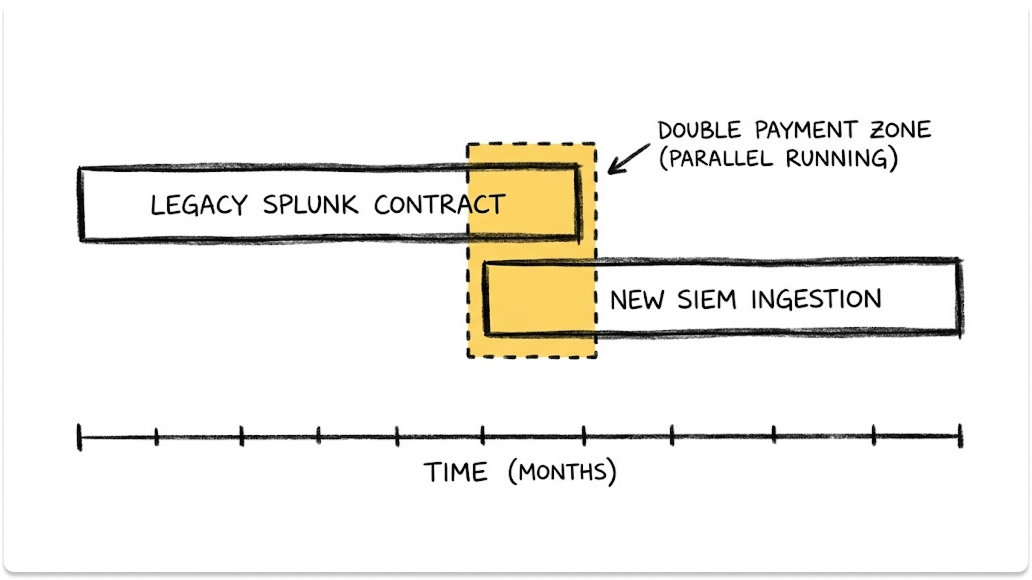
How Long Should You Run Splunk and the New SIEM in Parallel?
Neither Microsoft nor Google publishes a standard parallel-running length, so set it by exit criteria. Microsoft's recommended side-by-side method forwards alerts from the legacy SIEM into Sentinel while you move sources at your own pace. The overlap lasts as long as these factors keep it open:
- How many custom detections need validation
- How long your Splunk contract runs past the target cutover
- Whether compliance requires a continuous record in one system
- How fast new connectors and parsers reach production
I'd price parallel running before I priced the new SIEM. It is the line item renewal quotes never show.
What Happens to Your Historical Splunk Data?
You have three options: keep Splunk read-only for the retention window, export and re-ingest, or archive. Microsoft documents exporting Splunk data and ingesting it into the Sentinel data lake, which it calls the recommended platform for long-term retention. Splunk Cloud offers Dynamic Data Active Archive, which restores slices into Splunk, and Dynamic Data Self-Storage, which moves aged data to your own storage.
Self-storage has a catch. Splunk documents that restoring Dynamic Data Self-Storage data requires a separate Splunk instance, and Federated Search for Amazon S3 does not read that format.
How to Compare Splunk, Sentinel and Google SecOps Pricing Before Renewal
Compare total cost before you compare license cost. Total cost covers ingestion, retention, search or query compute, pipeline tooling, migration labor and parallel running. Each vendor meters these differently, so put your own quotes and volumes into one worksheet before you compare a renewal against a migration bid.
Two lines decide most comparisons. The first is the free or granted data row, where Microsoft-heavy estates gain the most. The second is parallel running, where every migration path pays and the pipeline path pays nothing.
Questions to Ask Before You Sign a SIEM Migration
Ask vendors and migration partners to answer these in writing before you sign. The answers expose who carries detection risk, how long you pay for two platforms, and what happens to your data if the project slips. Vague answers on detections or parallel running are the warning sign.
Closing Thoughts
Leaving Splunk comes down to three calls: where your data goes, where your detections go, and who runs the SOC while you move. Make the cheapest call first. Get a pipeline-reduced Splunk quote, then compare it against Sentinel and Google SecOps bids in the same worksheet.
If the real problem is that nobody has time to read alerts, price MDR before any of them. After cutover, keep a list of what to watch after cutover.
Planning Your Splunk Exit?
Explore SIEM, pipeline and MDR providers that fit your stack, your data and your SOC. Filter by requirements, architecture and budget, and talk to vendors only when you want to. It is private and free.
FAQ
Is Microsoft Sentinel cheaper than Splunk?
It depends on your data mix, and only a side-by-side model answers it. Microsoft publishes Sentinel's per-GB analytics rates, commitment tiers from 100 GB per day, and a low-cost data lake tier, plus free Microsoft data sources. Splunk sells by quote on activity-based, ingest or workload pricing. Price both against your own daily volume, retention and migration labor, including the months you run Splunk and Sentinel in parallel.
How long does a Splunk to Sentinel migration take?
Neither Microsoft nor Splunk publishes a standard duration, and I would distrust any quote made before a detection inventory. The timeline depends on how many custom detections you run, how many data sources need new connectors or parsers, how much SOAR automation you rebuild, and how long you validate in parallel. Microsoft's SIEM migration experience speeds up analysis, but you still install connectors and enable rules yourself.
Can you convert Splunk SPL detections to KQL or YARA-L?
Partly. Microsoft's SIEM migration experience translates SPL to KQL, maps rules to built-in Sentinel analytics, and maps lookups to watchlists, then reports which rules it could not match. Google offers an SPL to YARA-L translator in SecOps Labs that it describes as best-effort, plus a written SPL to YARA-L transition guide. Plan for engineers to review, test and rewrite anything that depends on macros, CIM data models or multi-step correlation.
Do you have to leave Splunk to cut Splunk costs?
No. A security data pipeline such as Cribl Stream, or Splunk's own Edge Processor and Ingest Processor, can filter, trim and route data before Splunk indexes it. Splunk also offers archive tiers and Federated Search for Amazon S3 for data you keep outside the index. These moves reduce what you pay to index without touching detections, though your contract model and alert quality stay as they are.
What is Cribl and how does it reduce Splunk costs?
Cribl Stream is a telemetry pipeline that sits between your log sources and Splunk. Cribl states it can filter duplicate and low-value events, convert high-volume logs into metrics and route cold data to low-cost object storage or Cribl Lake. Splunk then indexes less data, and Cribl's Replay feature sends archived data back into Splunk when an investigation needs it. Every Cribl Stream download includes a free license for up to 1 TB per day.
Should we run Splunk and the new SIEM in parallel?
Yes, for a bounded validation window. Microsoft documents a side-by-side approach and recommends sending alerts from the legacy SIEM into Sentinel while you move data sources at your own pace. Google's pricing page states its Enterprise Plus package includes 12 months of routing to another destination for SIEM migrations. Set exit criteria per use case before you start, because every month of overlap means paying for two platforms.
What happens to historical Splunk data after a migration?
You choose between keeping it in Splunk, exporting it, or archiving it. Microsoft documents exporting Splunk data and ingesting it into the Sentinel data lake, which it recommends for long-term retention. Splunk Cloud offers Dynamic Data Active Archive, which restores slices back into Splunk, and Dynamic Data Self-Storage, which moves aged data into your own storage. Map compliance retention requirements before you choose.


