Is a Gartner Subscription Worth It, and What IT Leaders Use Instead
Is a Gartner subscription worth it? Prices, the three conditions where it pays off, and the free and paid sources IT leaders use for vendor research.
There's nothing stopping from you from going to Google and typing "<vendors name> reddit review".
In fact, this is what a lot of buyers do.
Or you don't even need to go that far. Most buyers (perhaps even you) probably only rely on peer recommendations. References go further than any vendor discovery or review platform ever will.
In fact, even individual vendors hand out full Gartner reports for the price of a form fill, and Gartner Peer Insights is free to read. That covers who exists and what the product is like to run.
So, why even bother with a subscription that tells you what can be found for free? You would think.
Whether the price in front of you is fair, and whether leadership will back your pick. Those two questions are where Gartner earns its fee or wastes it.
On Gartner's federal price schedule, a single Gartner for IT Leaders advisor seat lists at $49,576 a year, paid in full at the start of the term. At that price, the subscription pays off only when you use the parts that exist nowhere else: price benchmarks drawn from Gartner's client contracts, analyst time on a live decision, and a name your executives already trust.
IT Leaders Report 2026
What are your IT peers investing in 2026?
We spoke to about 1,300 IT leaders from various organisations to understand what they're evaluating. Most of it is the kind of thing you'd only hear from a peer you know well enough to ask, so we've put it in one place.
Read the report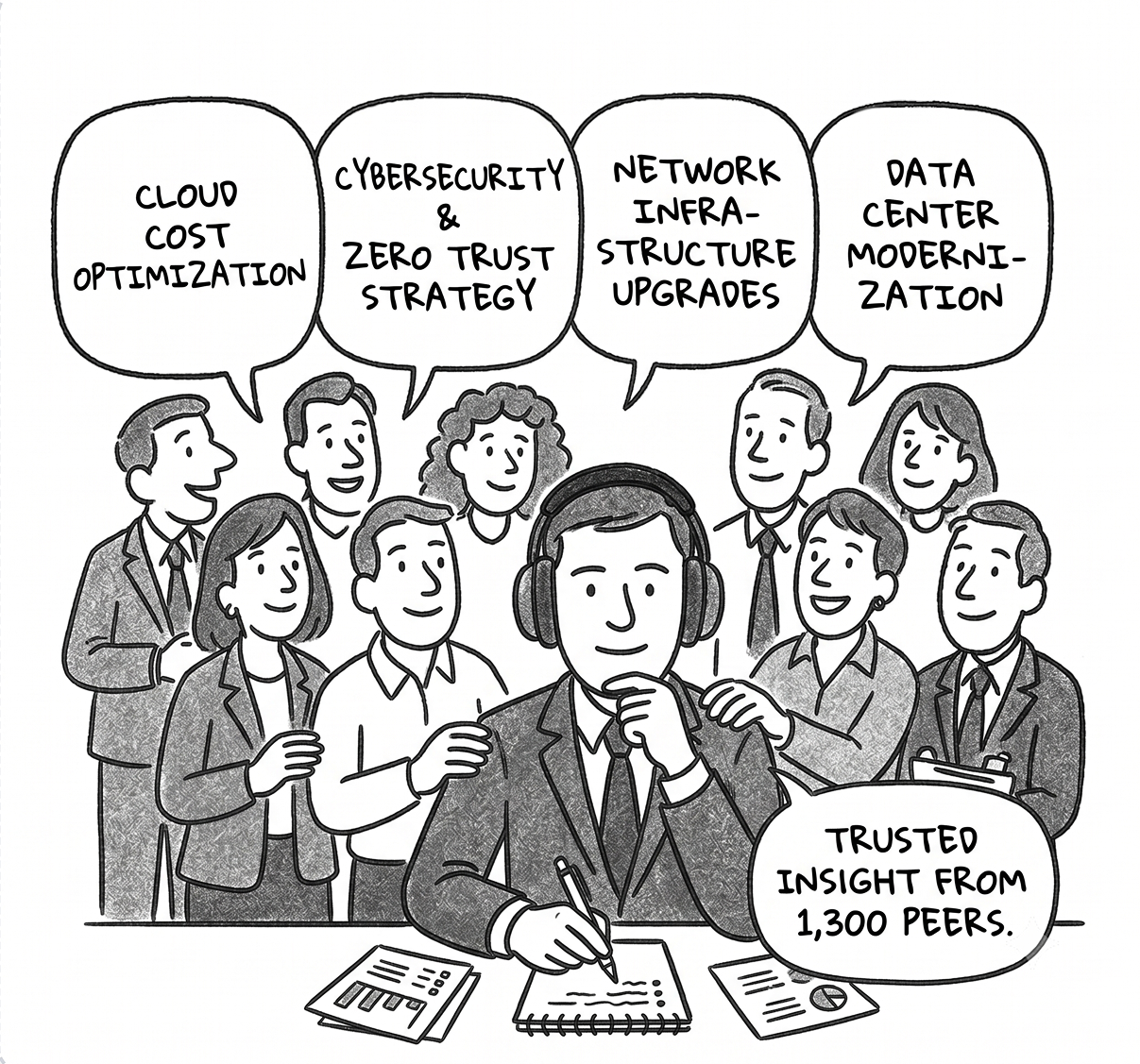
What a Gartner subscription includes beyond the Magic Quadrant
The Magic Quadrant is the part of a Gartner subscription you need least, because vendors already hand it out. What you pay for is everything around it, and the seat you buy decides how much of that you get.
A Gartner seat can include:
Gartner sells these in role-based tiers. Reference seats center on the research library, Advisor seats add analyst access, and Executive Programs add the executive partner.
The cheapest seats on the list, Essentials and Role, are team add-ons. Gartner sells team licenses only as part of a team configuration, with three team members required for each leader.
GTP deserves a look if your buyers are engineers. A GTP team with one leader and up to four members lists at $69,424, and each additional member costs $13,310. For an infrastructure team, that research often matches daily work more closely than a CIO seat does.
What a Gartner subscription costs, and what is negotiable
Gartner keeps its commercial price list private. The closest public benchmark is its GSA schedule for US federal buyers, a contract that runs through March 15, 2028, with prices current through a modification effective January 30, 2026.
Treat these figures as documented list prices for one buyer segment. Your commercial quote may differ.
Annual price for a single license on the GSA schedule:
Four contract terms shape what you actually commit to:
That 5% is the documented starting point. The levers worth pushing are seat mix (Reference seats for readers and one Advisor seat for whoever runs inquiry), the price escalator in later years, and whether bundled conference passes earn their cost.
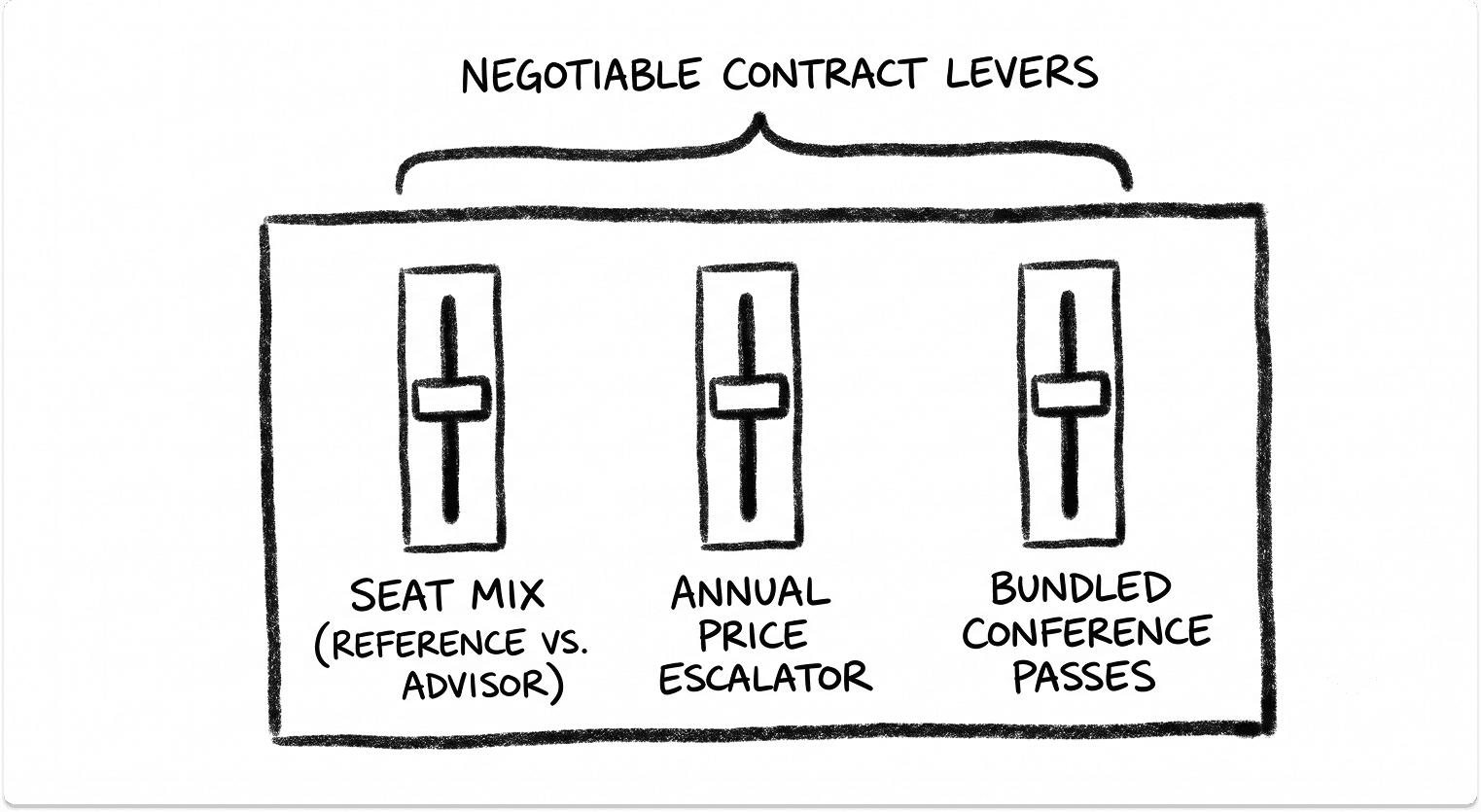
Gartner's investor materials describe annual price increases roughly in line with wage inflation, so get the escalator in writing. Treat the Gartner contract like any other stage of your IT vendor relationship lifecycle, and review it 90 days before the term ends.
When a Gartner subscription pays for itself: three conditions
Buyers are already testing the worth-it question with their budgets. In Gartner's FY2025 10-K, its Global Technology Sales segment kept 85% of its clients, while wallet retention fell from 102% to 96%. Most clients renewed, and many renewed smaller.
A seat earns its cost under three conditions. If none of them apply to your next 12 months, the money buys more elsewhere.
Condition 1: You use price benchmarking in live renewals
Price benchmarking is the highest-return entitlement and the one subscribers use least. Gartner's own terms state that client benchmarking data becomes part of its proprietary database, coded for anonymity and used in future engagements.
That view of what a company your size pays for the same platform is something you might not be able to find on forum threads.
In a 2023 r/sysadmin discussion, one subscriber credited Gartner's quote comparison with saving enough on a 2020 refresh to cover three years of fees. An IT director in the same thread drew the line at a multi-million-dollar IT budget and called it hard to justify below about $3 million, including staff. Both are single accounts, so run the math on your own renewals.
At an assumed 5% to 10% negotiated reduction, a $49,576 advisor seat breaks even at roughly $500,000 to $990,000 of negotiated vendor spend a year.
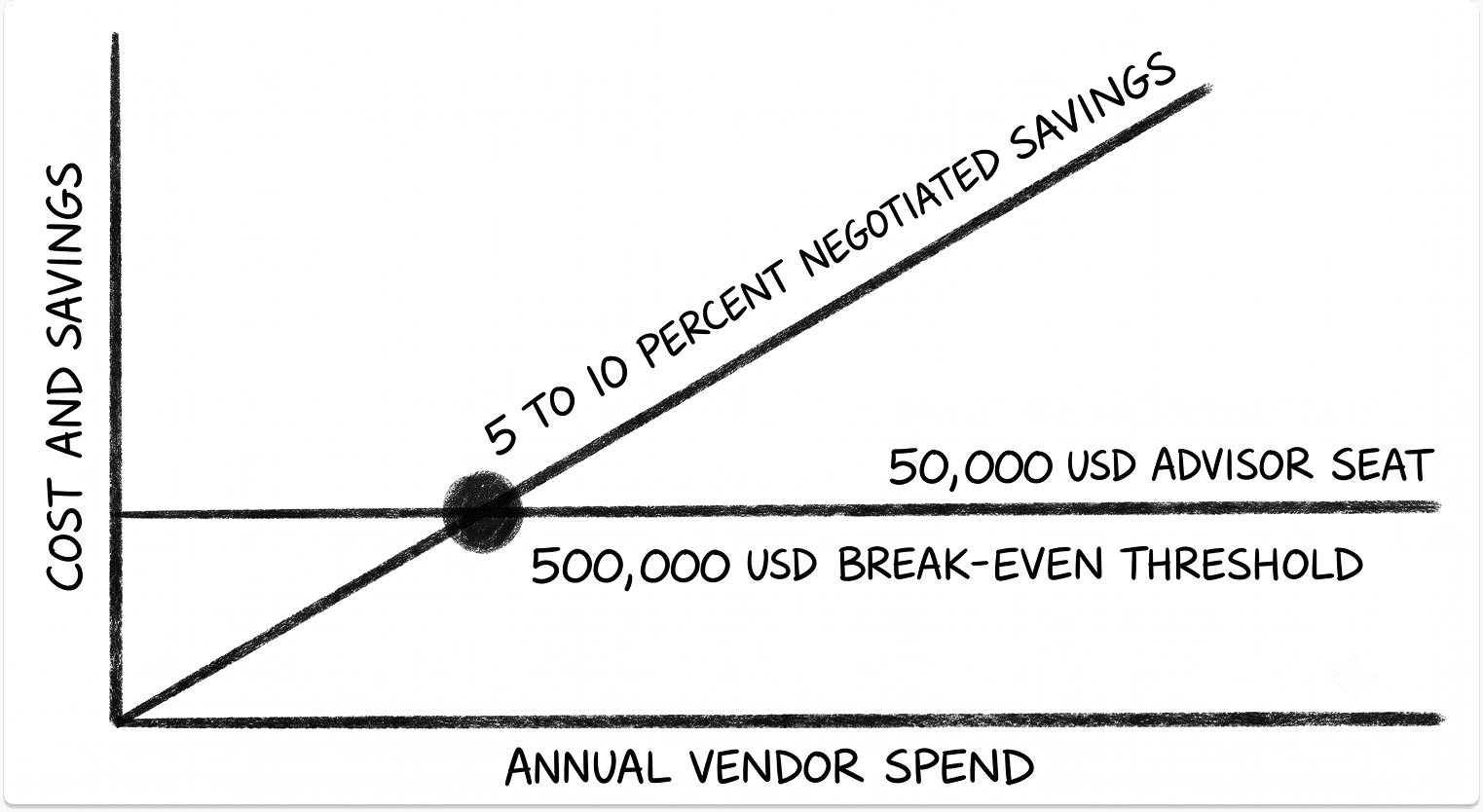
At the multi-license price of $37,730, break-even drops to about $380,000 to $755,000. Benchmarks give you leverage, and the tactics in negotiating for value in vendor selection decide how much of it you keep.
Condition 2: You bring analyst inquiry to a specific decision
Inquiry pays when you arrive with a shortlist, a draft contract or a design question. Analysts talk to buyers and vendors in their market all year, and one call can surface a roadmap risk or a pricing pattern you would spend weeks reconstructing.
General reading rarely justifies an Advisor seat.
Condition 3: Your executives need outside validation
Executive cover is a real organizational need. When a seven-figure platform choice goes to the board, a named analyst's view gives leadership an external reference point and protects the team that did the work.
Use it with care. Gartner's standard disclaimer states that it does not endorse vendors and does not advise technology users to pick only the highest-rated ones. A Leader placement works best as supporting evidence for a decision your own evaluation already reached.
Plug your own numbers into the calculator below. It uses GSA list prices and treats a year with no renewals as a hard stop.
What analyst research cannot tell you about running the product
Analyst research covers markets, roadmaps, vendor viability and pricing. Analysts see products through vendor briefings, reference customers and client inquiries. That vantage point is structural, and it leaves one area uncovered: your environment.
An analyst can tell you an endpoint agent ranks well on detection. The engineer who rolled it out can tell you how it behaved on your OS build, how long support took to answer, and what broke after the third update. The first is market knowledge. The second is operating knowledge, and it lives with practitioners and peers.
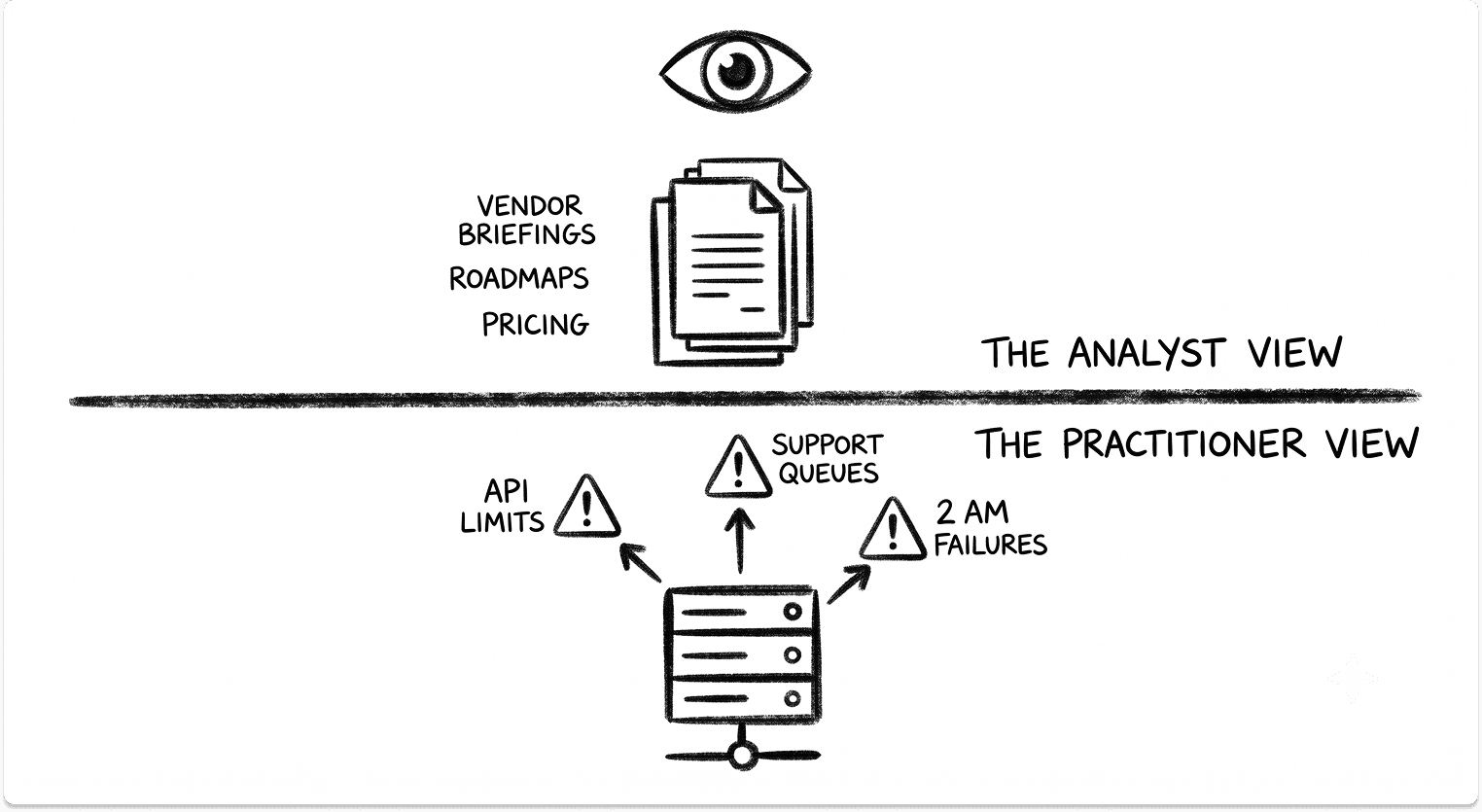
Both kinds matter for viability too. A vendor with a strong analyst rating and a support queue in freefall is a risk you only see by combining them, which is why IT vendor due diligence needs both views.
The five questions in a vendor decision, and which source answers each
Engineers and executives look at Gartner and reach opposite verdicts because they are asking different questions. The engineer wants to know what the product does at 2 a.m. The CIO wants to know whether the vendor will exist in three years and whether the price will survive scrutiny. Both are right about their own question.
Every purchase cycle contains five questions:
Each source answers one or two of these well and stays blind on the rest.
Analyst research rates Partial on question one because Magic Quadrant inclusion criteria screen out smaller vendors, while review platforms list almost everyone. Integrator labs rate Strong on question three for the scenarios they configure, and Partial on question five because the integrator is also a candidate implementer.
Read down any column and the pattern holds: question three depends on practitioners, peers and hands-on testing, and question four depends on analysts or peers with recent contracts. A complete research stack needs coverage in every column.
Paid alternatives to Gartner: Info-Tech, Forrester, IDC, GigaOm and Omdia
Info-Tech Research Group
Info-Tech is the switch IT leaders weigh most often, and its packaging explains why. According to its pricing page, every core membership of 2 to 10 seats includes unlimited IT vendor price benchmarking and vendor negotiation assistance engagements equal to the seat count.
Advisory memberships add unlimited analyst calls, and Counselor memberships add a designated executive counselor and an unlimited contract review service.
That puts price benchmarking, the entitlement behind Condition 1, in the entry tier. Info-Tech publishes its structure and keeps the price behind a quote form, so a real comparison requires quotes from both firms. Info-Tech states it has more than 30,000 members.
Forrester, IDC, GigaOm and Omdia
Peer review platforms: G2, Capterra, TrustRadius, PeerSpot and Gartner Peer Insights
Review platforms list vendors far beyond any Magic Quadrant, which makes them the strongest free source for question one. On question three they help with sentiment and thin out on operational detail.
The main trust problem is selection bias. Every major platform lets vendors invite reviews, and most allow disclosed incentives:
Regulation now reinforces those policies. The FTC's rule on fake reviews, in force since October 21, 2024, bans buying fake reviews and bans incentives tied to positive or negative sentiment.
Two developments change how you should read these sites:
For a closer look at how the review sites compare, see our G2 vs Capterra vs Trustpilot breakdown.
My rule for review sites: read the three-star reviews first, filter by company size, and check each review's date against the product's release history.
Practitioner communities: how IT leaders use Reddit, user groups and Slack channels
Practitioner communities are the only broad source for question three. Discipline subreddits such as r/sysadmin, r/networking, r/cybersecurity and r/msp hold the same asset as vendor user groups, professional Slack and Discord servers, Spiceworks and Server Fault: people who run the product, describing what happened.
The search itself is simple. Start with the product name plus the community, then pair the product name with the word you fear most: outage, renewal, support or migration.
Reading the results well takes discipline:
AI assistants now sit in front of this workflow, and they speed up the first pass. They also invent. In the same r/sysadmin thread, a chatbot asked about Gartner's competitors returned precise market-share percentages for IDC, Forrester and G2 with no source behind them.
Ask for links to the underlying threads and read them yourself. Our guide to building an IT vendor shortlist with ChatGPT, Perplexity, Gemini and Claude covers prompts that force citations.
Peer networks and CIO groups: the research source with no invoice
Peer networks answer questions three, four and five better than any paid service, within one limit: the size of your contact list. A peer who signed the same contract last quarter knows the discount, the implementation partner and the failure you should test for.
The formats vary: CIO and CISO peer groups, local user groups for major platforms, ISACA and ISSA chapters, industry associations and alumni networks from past employers.
Sector networks can replace a subscription outright. Arizona State University ended its Gartner contract on March 31, 2026 and pointed staff to EDUCAUSE, the higher education technology association. The cost is membership fees and time, and the return grows with how much you contribute.
Vendor discovery platforms: what they answer and what they do not
Vendor discovery and matchmaking platforms answer questions one and five: who exists for a specific requirement, and which providers can deliver it. TechnologyMatch, which publishes this blog, works in this category by matching IT buyers with vendors based on a described need.
We as TechnologyMatch, help connect IT buyers such as yourself to vendors who fit.
TechnologyMatch was started on the idea that modern buyers are inundated with cold outreach. They don't want to be sold to. So, we made a platform where buyer can anonymously browse pre-vetted vendors and choose to start the conversation on their terms.
You can also tell our team about what you're looking for and we'll get back to you with a shortlist of vendors who fit. If you want to move forward, we'll prep the vendors before your conversation with their team so it starts with context.
Building a vendor research stack on your budget
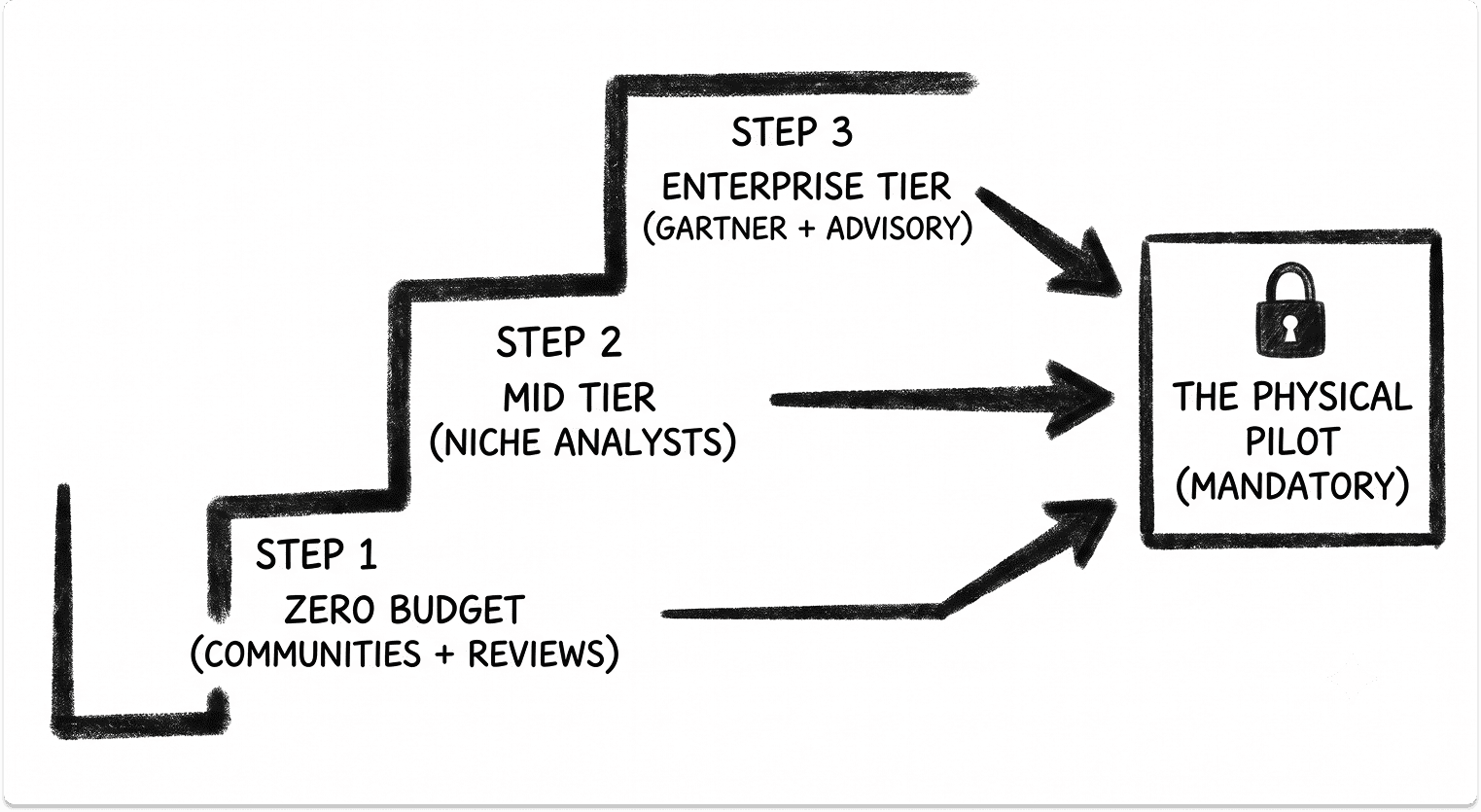
Match the band to your renewal calendar, then fill question three from the free row whatever you spend. How to build a technology vendor shortlist covers combining free sources into a first cut.
Every band still ends in the same place: a pilot.
What no research source replaces: the pilot
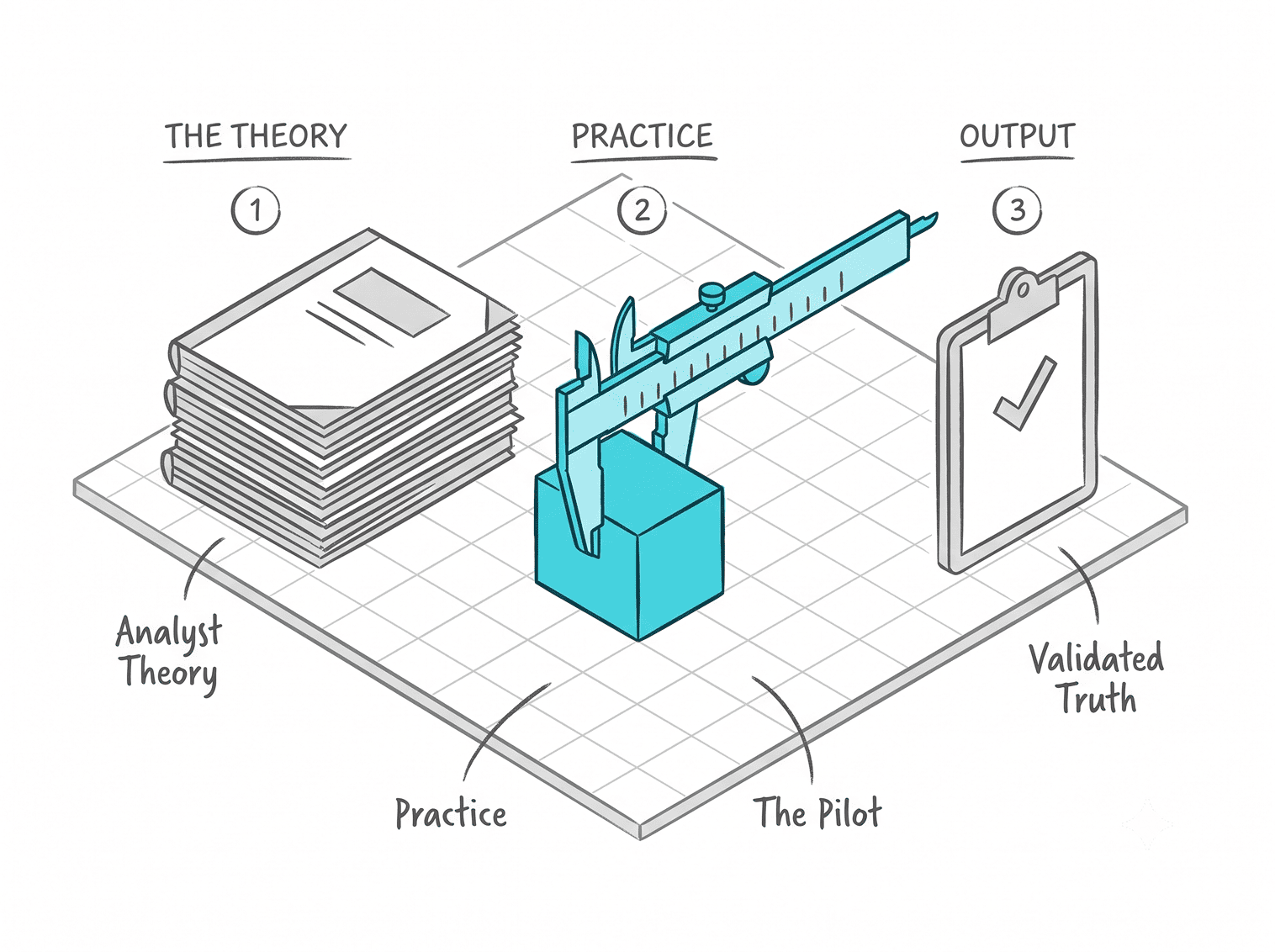
Every source above works at one remove from your environment. A pilot puts the product on your network, against your data and integrations, with your team running it. It answers question three with certainty and tests the implementation partner behind question five.
Write success criteria before the vendor touches anything. Our guide to running an IT vendor proof of concept covers criteria, timelines and exit terms.
Find the right IT vendors without a research subscription
If you came here looking for a Gartner alternative, start with the question every purchase begins with: who can actually solve your problem. You can explore and find pre-vetted vendors on TechnologyMatch based on your requirements. Your info stays anonymous until you decide to connect and it's free.
FAQ
Is Gartner worth it for a small business?
Rarely at list price. On Gartner's GSA schedule, the cheapest standalone seat is $33,346 a year, paid upfront, and most of the value depends on negotiating large renewals. A small business with few six-figure contracts gets more from practitioner communities, Peer Insights, peers and free trials. Run your renewal spend through the break-even calculator above before taking a sales call.
How much does a Gartner subscription cost?
Gartner keeps commercial pricing private. Its US federal GSA price list, current through January 2026, lists single licenses from $33,346 for Gartner for IT Leaders Reference to $240,600 for a Global CIO team leader. Subscriptions are billed in full upfront, and a two-year order earns 5% off the first year.
Is Info-Tech cheaper than Gartner?
Info-Tech publishes its membership structure and keeps prices behind a quote request, so a direct comparison requires quotes from both firms. Its core memberships include unlimited IT vendor price benchmarking, which makes the entry tier useful for renewal-heavy teams. Compare the two line by line on benchmarking, analyst access and contract review.
Are G2 reviews trustworthy?
G2 verifies reviewers through LinkedIn or a business email and labels incentivized reviews, and the FTC's 2024 rule bans incentives tied to positive or negative sentiment. The remaining risk is selection bias, since vendors invite their happiest customers. Read the mid-range reviews, filter by company size and check dates against the release history.
Can I see Magic Quadrant reports for free?
Yes. Vendors named in a Magic Quadrant license reprints and give them away, usually behind a registration form. Reprints expire, and each one reaches you through a vendor that chose to promote it, so look for the same report from a competitor as well.
What is Gartner Peer Insights?
Gartner Peer Insights is Gartner's free review platform for enterprise technology. Gartner moderates reviews before publication, caps reviewer incentives at $25, and states that reviews may inform its analyst research. It is free to read.
Is Reddit reliable for vendor research?
Reddit is the strongest free source for what a product is like to run, provided you read it critically. Check the post date, the poster's role and deployment scale, and whether the complaint concerns the product or a partner's rollout. Trust patterns that repeat across independent threads over any single viral post.
What is the cheapest way to shortlist vendors?
Combine free sources by question: review platforms and vendor reprints for who exists, practitioner communities and peers for production reality, and vendor trials for hands-on testing. Then validate the top two or three options in a scoped pilot. That stack costs time and covers every question except large-scale price benchmarking.