Clutch.co Alternatives for IT Buyers: Directories, Partner Locators and Matchmaking Compared
How Clutch.co alternatives work for IT buyers: review directories, vendor partner locators, MSP rankings, cooperative contracts and matchmaking.

Search for a managed service provider, a security services firm or a cloud partner, and Clutch.co shows up early. Its managed IT services directory listed 25,201 firms on October 8, 2026, and every published review passes an identity check first.
That makes Clutch good at one question: what have past clients said about this firm? When I shortlist an IT provider, I need three more answers before I book a call.
Is the firm certified on our stack? Can we buy from them under our procurement rules? Who can I speak to this week? Clutch.co alternatives answer those questions, and each one checks something different, orders results differently and leaves you with something different.
How Clutch.co works: listings, reviews, rankings and sponsored placement
Clutch.co is a B2B review directory. Providers build profiles and invite clients to review them, and Clutch ranks firms within each service and location using those reviews plus market signals.
How IT providers get listed on Clutch.co
A profile is free to create. Before it goes live, Clutch confirms the firm provides B2B services and runs an active website, and it can ask for a lease, utility bill or tax records to back up a claimed office (Clutch research methodology).
The profile holds what buyers filter on: service lines with a percentage split, minimum project size, hourly rate band, team size, industries and portfolio. On category pages, you can filter by service, client budget, hourly rate, industry and location.
How Clutch.co collects and verifies client reviews
Reviewers sign in and submit a structured review online. The project must be in progress or finished within the past two years, Clutch accepts one review per client company, and former employees or relatives of the provider can't review.
Clutch states it rejected 10% of submitted reviews in 2025 for signs of falsified information. It does not fact-check opinions, and a provider cannot remove a negative review, though it can post a response.
Some Clutch category pages still mention in-depth client interviews. The methodology page, which is the more detailed source, describes the sign-in and submission process above.
How Clutch Rank and the Leaders Matrix work
Clutch Rank combines two scores. Ability to Deliver runs to 40 points, built from reviews, clients and experience, and market presence. Focus measures how much of a firm's stated work sits in the service you searched for.
The Leaders Matrix plots the top 15 firms in a market on Focus and Ability to Deliver, and Clutch Rank updates in real time. Clutch notes that in crowded markets all 15 can land in its Market Leaders group, so the matrix separates firms less there.
How results are ordered on a Clutch.co category page
The default order puts paid placement first. Sponsors sit at the top across nine tiers, then Clutch Verified firms, then everyone else, with Clutch Rank deciding the order inside each group (Clutch help center).
Featured Listings add up to 15 more paid positions, shown in groups of three among the organic results. Clutch states that sponsorship does not change Leaders Matrix positions.
What Clutch.co verifies, and what it leaves to you
Clutch checks that a reviewer is a real client and that the firm is a real B2B business. Clutch Verified adds business registration data, a credit check and a minimum average rating above 3.0, but providers opt into it.
Three gaps matter when you buy IT services:
- Technical credentials. Clutch does not check vendor certifications or partner designations.
- Contract shape. Profiles describe work in project terms, such as minimum project size and hourly rate, which map loosely onto a multi-year managed services agreement.
- Review age. Old reviews stay on the card. On October 8, 2026, the top sponsored listing on the managed IT page showed review excerpts from 2021 and 2022.
Clutch's coverage of managed IT is deep, and the MSP reviews I read there describe ongoing service relationships. It answers the past-client question well. The other questions need other tools.
IT Leaders Report 2026
What are your IT peers investing in 2026?
We spoke to about 1,300 IT leaders from various organisations to understand what they're evaluating. Most of it is the kind of thing you'd only hear from a peer you know well enough to ask, so we've put it in one place.
Read the report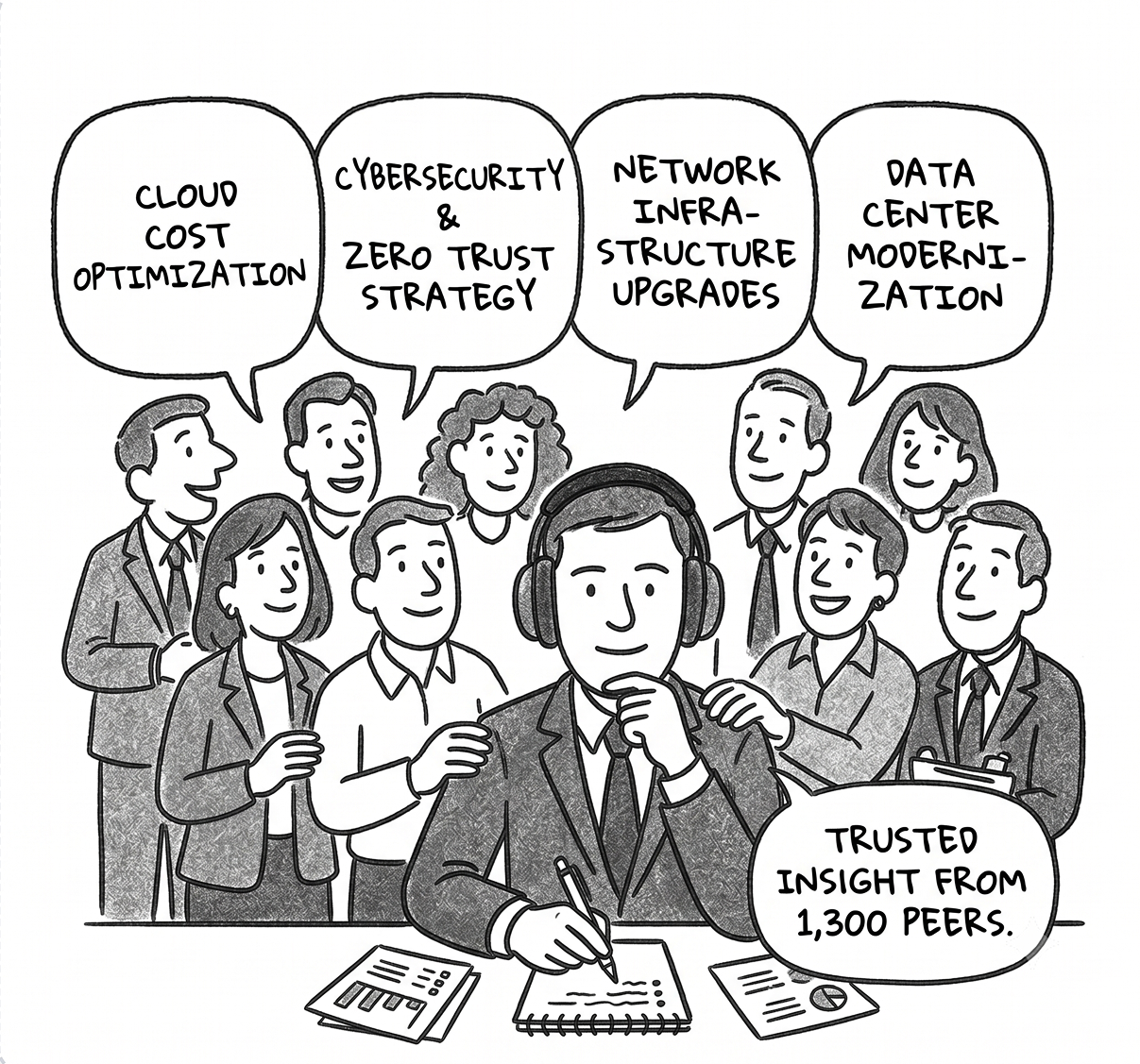
Six questions to ask of any route for finding IT service providers
Use these six questions to judge any provider-finding route, including ones not listed here. Each answer tells you what the tool did for you and what you still have to check yourself.
Question four separates the routes most. Directories verify who wrote a review, partner locators verify skills and deployments, and cooperative contracts verify that an award followed a competitive process.
Review directories similar to Clutch.co: GoodFirms, The Manifest, and Gartner Peer Insights
Review directories answer the same question Clutch does. Their differences sit in how they check reviews and order results, and those mechanics decide what you see first.
GoodFirms
GoodFirms publishes its ranking formula. Client reviews carry 50% of the weight, recent reviews count for more across an 18-month window, and a firm needs 10 or more verified reviews and a 3.5+ rating before it ranks at all (GoodFirms research methodology).
GoodFirms states that sponsorship does not affect placement. Its IT services section listed 17,351+ companies in October 2026, so it covers IT firms broadly.
The Manifest
The Manifest is Clutch's sister site. It features firms with a Clutch profile and client reviews, then ranks them on service focus and the number, quality and recency of those reviews (The Manifest FAQ).
Because the formula differs, a firm can rank higher on one site than the other. The reviews underneath are the same, so a strong showing on both counts as one data point.
Gartner Peer Insights
Gartner Peer Insights checks reviewer identity and screens for conflicts of interest (Gartner). Its categories center on software, so it helps you judge the platforms a provider runs more than the provider itself.
UpCity, DesignRush, Sortlist and TechReviewer also list IT firms. Before you rely on any of them, find its published method for checking reviews and ordering results.
Best for: breadth, and evidence from past clients.
Falls short: none of these directories checks vendor certifications. A five-star review says nothing about whether a firm holds a current Microsoft or AWS designation.
Vendor partner locators: how to confirm certified skills on your stack
Partner locators answer the question review directories skip: does this provider meet the vendor's own bar for skills and customer deployments? The vendor sets the requirements, checks partners against them and publishes the result.
I run this check before any first call. It rules out providers that claim a stack they can't back up.
Microsoft Solutions Partner designations
Microsoft scores partners from 0 to 100 in each solution area across performance, skilling and customer success. A Solutions Partner designation needs 70 points, with at least one point in each metric, and partners requalify every year (Microsoft Learn).
The old Gold and Silver competencies stopped being valid after September 30, 2022. A provider that still advertises Microsoft Gold is quoting a credential that no longer exists.
AWS Partner Solutions Finder and AWS Specializations
AWS Specializations require technical validation, including reviews of several customer success examples against published checklists (AWS Specializations). Partner Solutions Finder filters by industry, use case, partner program, AWS service and geography.
AWS states that its Service Delivery and Service Ready designations will be deprecated on June 1, 2027. AWS also cites 2023 Canalys research finding that 87% of customers rank AWS Specializations among their top three criteria for choosing a partner.
Google Cloud Partner Advantage
Google Cloud separates Expertise from Specialization. A Specialization requires certified individuals plus customer success stories, vetted by Google and a third-party assessor (Google Cloud).
The bar is specific. The Data Analytics specialization, for example, calls for four certified Professional Data Engineers.
Cisco 360 Partner Program
Cisco launched the Cisco 360 Partner Program in January 2026 and retired Gold status. Partners now earn Cisco Portfolio Partner or Cisco Preferred Partner designations, measured by a Partner Value Index across six portfolios, from networking and security to Splunk and collaboration (SDxCentral).
Fortinet Partner Locator
Fortinet's locator filters by business model, such as integrator or MSSP, and by specialization, including Secure Networking, SASE, SD-WAN, OT, Security Operations and Cloud Security (Fortinet Partner Locator). Partners in its services programs pass an evaluation against Fortinet best practices.
CrowdStrike and Palo Alto Networks
CrowdStrike's partner locator lists 1,000+ global partners (CrowdStrike). Palo Alto Networks ties its NextWave specializations to certified staff and engagement points (Palo Alto Networks).
Neither publishes buyer-facing criteria in Microsoft's or AWS's depth. Ask the provider for the exact specialization name, then confirm it in the locator.
Designation names change more often than provider websites do. Here is what has moved since 2022.
Best for: confirming technical capability on a specific stack.
Falls short: no locator measures client satisfaction, and each one shows only that vendor's partners.
Industry rankings: CRN Solution Provider 500, CRN MSP 500 and Channel Futures MSP 501
Industry rankings tell you who is large or financially established. Each is an annual snapshot built from data providers submit when they apply, so read it as a filter for scale and staying power.
I use these lists to sanity-check a provider that claims enterprise reach. They say nothing about certifications, client satisfaction or sector fit, and a provider missing from all three may simply never have applied.
Best for: checking scale and segment.
Falls short: self-reported, published once a year, and not searchable by service or stack.
Public sector routes: cooperative contracts, GSA MAS and Procurated
If you buy for a state or local agency, a school district, a university or an eligible nonprofit, a cooperative contract can replace your own solicitation. A lead agency or cooperative runs the competitive process once, and eligible buyers use the awarded contract.
Private companies can't buy through these routes. Public buyers still confirm that their own procurement rules allow each contract.
NASPO ValuePoint's IT Managed Service Providers portfolio runs from 2023 to 2029 with Connecticut as lead state (NASPO ValuePoint). Sourcewell restricts use to government, education and nonprofit entities (Sourcewell FAQ).
GSA's schedule works differently from the cooperatives. A provider can submit an offer at any time, so you compete providers when you place an order (GSA). State, local and tribal governments can use the IT professional services (54151S) and cybersecurity (54151HACS) categories through GSA Cooperative Purchasing.
Procurated
Procurated adds peer evidence for public buyers. Only public-sector employees verified through a work email can write or read reviews, reviews can be anonymous, and they stay out of Google search (Procurated FAQ).
Best for: public buyers who need a compliant contract quickly.
Falls short: an award proves a provider won a solicitation. It says little about service quality on a contract like yours, so references still matter.
Requirements-first routes: from defined needs to a shortlist
Directories and locators start with a list and leave the narrowing to you. Requirements-first routes start with what you need and work toward a few providers you can talk to.
They depend on written requirements: scope, stack, locations, service levels, compliance needs and a budget range. Without those, a directory or locator shows you more of the market.
Run your own RFP
An RFP gets you written, comparable answers to your exact requirements, at the highest effort of any route. Our guide to writing an IT vendor RFP recommends inviting five to eight providers for complex IT services.
The RFP timeline breakdown covers how long each stage takes. Smaller teams can run a lean RFP instead.
Matching tools inside directories
Clutch's directory pages now carry a Get Matched option, so the line between directory and matchmaking has started to blur. Before relying on any match, ask how it was made and whether sponsored firms get priority.
TechnologyMatch
TechnologyMatch starts from the buyer's requirements and offers two paths. You can search its dashboard yourself, staying anonymous until you accept a match, or hand your requirements to an account manager who builds a shortlist and books introductory calls. You can read how TechnologyMatch works to understand the process better.
TechnologyMatch vets all their vendors before they get listed on the platform and each vendor only keeps their place be performing. If a vendor underperforms or doesn't hold up the standards, they're removed from the platform.
Where it falls short:
- Smaller pool. TechnologyMatch has a smaller pool than Clutch.co but that's by design because they prioritize quality over quantity.
- Needs defined requirements. In early research, a directory or locator shows you more of the market. But TechnologyMatch focuses on connecting you to vendors who are worth your time, even when you're browsing, which requires getting to know you better.
If your requirements are already defined and you'd rather start with providers that fit than screen a long list, share them with TechnologyMatch and get introduced to matched providers.
Clutch.co and every alternative compared
Every route trades breadth for screening. The more checking a route does before you see a provider, the fewer providers it shows you.
Find the column that matches your question, then scan down it. The verification column usually settles which route to open first.
Which route fits where you are in the buying process
Each route earns its place at a specific stage. I start wide, validate before I talk to anyone, and only then ask for proposals or introductions.
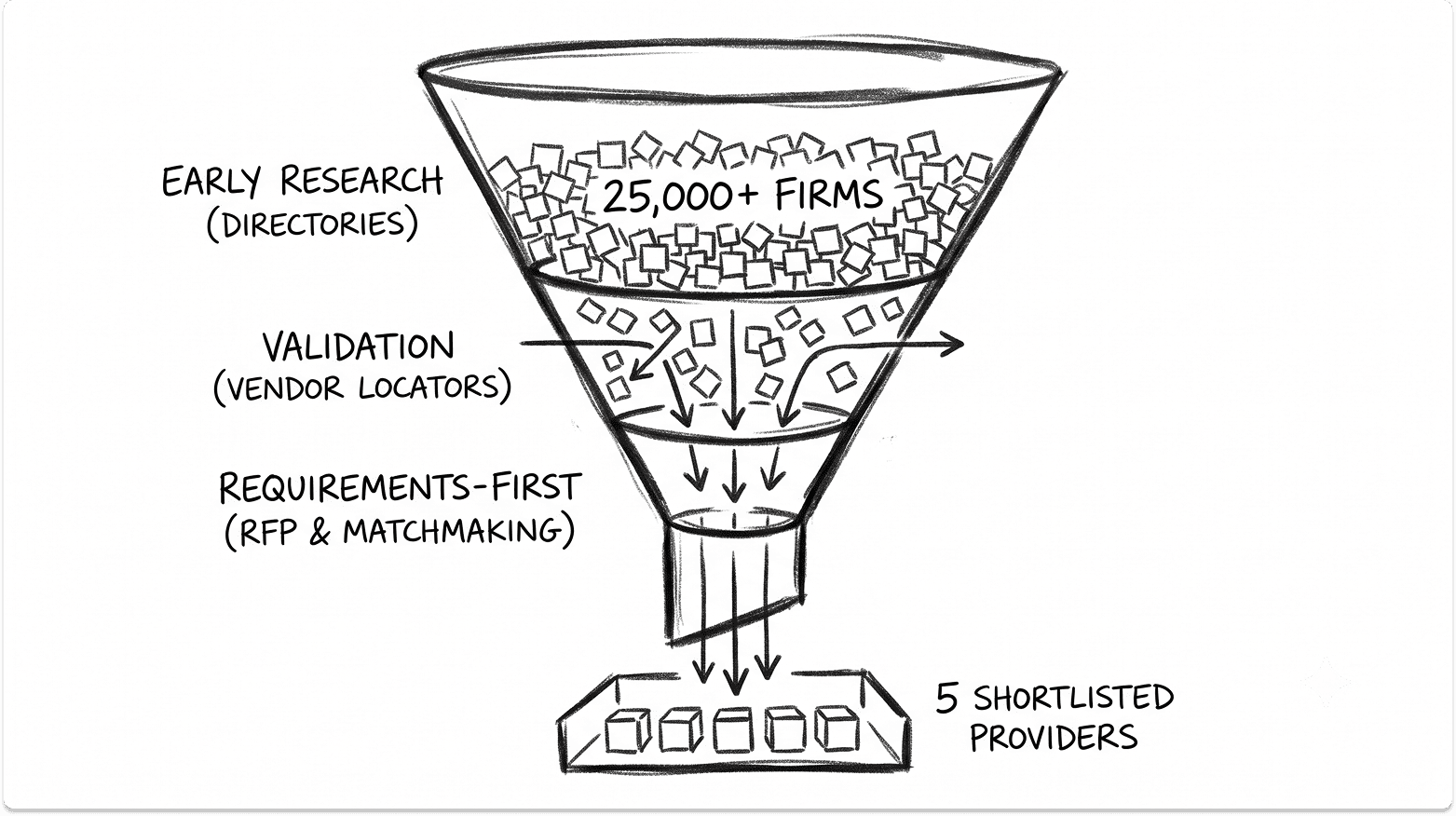
Public buyers can move from validation straight to a cooperative contract when an eligible contract covers the scope. Peer communities help at every stage, since practitioners on Reddit, in user groups and in CIO peer networks report what no directory records; our guide to what IT leaders use instead of a Gartner subscription covers them in depth.
How to cross-check an IT service provider before you shortlist it
Whichever route surfaces a provider, run the same checks before a first call. They catch stale credentials and old reviews early.
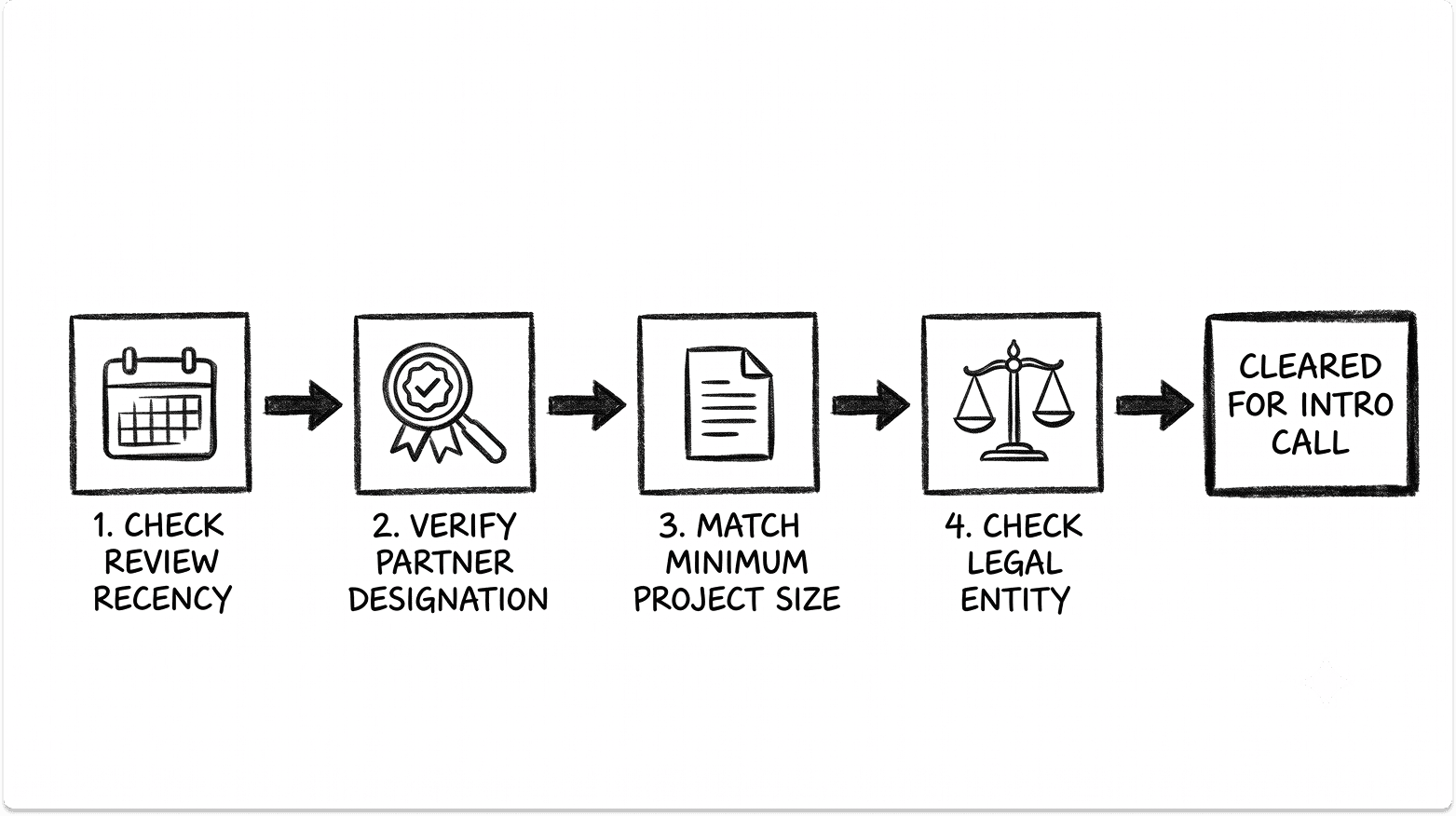
For the full evaluation, from SLAs to onboarding, see the IT buyer's guide to managed IT services and how to switch and select a new IT partner or MSP.
Find the right route for your search
Answer four questions to see which routes fit your search, in the order to use them, and what to check on each.
Requirements Defined? Meet IT Providers That Fit Them
Share your requirements with TechnologyMatch and get introduced to vetted MSPs, integrators and security providers matched to your stack, size and timeline. Talk to an expert on our team to get started.
FAQ
Is Clutch.co reliable for finding IT service providers?
Yes, for what it is built to show. Clutch checks reviewer identity and business legitimacy, accepts reviews only for projects active within two years, and listed 25,201 firms in its managed IT directory on October 8, 2026. It does not check vendor certifications, and sponsors appear first by default, so sort by Clutch Rank and confirm designations in vendor locators.
What sites are like Clutch.co?
GoodFirms and The Manifest work most like Clutch. GoodFirms uses its own review verification and a published ranking formula, while The Manifest re-ranks Clutch's review data with a different formula. Gartner Peer Insights also verifies reviewers, though its categories center on software.
Is GoodFirms better than Clutch?
They differ in mechanics, and neither suits every search. GoodFirms ranks a firm only after 10+ verified reviews and a 3.5+ rating, and states that sponsorship does not affect placement. Clutch puts sponsors first by default and scores firms on a 40-point Ability to Deliver scale plus Focus.
What is The Manifest?
The Manifest is Clutch's sister site. It lists firms that have Clutch profiles and reviews, then ranks them on service focus and the number, quality and recency of those reviews, so the same firm can rank differently on each site.
How do I find a certified Microsoft or AWS partner?
Use each vendor's own locator. Microsoft Solutions Partner designations require a capability score of at least 70 out of 100 across performance, skilling and customer success, renewed every year. AWS Partner Solutions Finder shows Specializations earned through technical validation and customer success reviews, filterable by industry, use case, service and geography.
How do I find a vetted MSP?
Decide first which kind of vetting you need. Directories vet who wrote the reviews, vendor locators vet skills and deployments, and cooperative contracts vet the award process for public buyers. Requirements-first routes vet fit against your written requirements before an introduction.