Best CI/CD Pipeline and DevOps Tools for IT Leaders in 2026
A comprehensive buyer's guide comparing 5 CI/CD and DevOps vendors for IT leaders, with vendor profiles, comparison table, and decision framework.
You're here because you need to make a decision. Your team needs better CI/CD pipelines, your DevOps processes are bottlenecking releases, or leadership is pushing for faster delivery without compromising security. You don't have time for vendor fluff or 20-page whitepapers.
This article cuts through the noise. We've evaluated five vendors that specialize in CI/CD pipeline implementation and DevOps transformation. Each has different strengths, different ideal customers, and different approaches to solving your problems.
By the end of this article, you'll know which vendor aligns with your organization's size, industry, technical maturity, and strategic priorities. Let's get to it.
Quick Decision Framework
Before diving into detailed vendor profiles, use this framework to quickly identify your best match:
If you need enterprise-scale digital transformation with government-grade compliance → Consider Nortal
If you want fully managed DevOps services with integrated cybersecurity → Consider Z7 Solutions
If security must be embedded in every stage of your CI/CD pipeline → Consider Pentamix Security
If you're deploying AI/ML models and need MLOps capabilities → Consider Data Products
If you're heavily invested in AWS and need cloud-native DevOps → Consider Tribloom
Still not sure? Keep reading. The vendor profiles below will help you make the right call.
Nortal
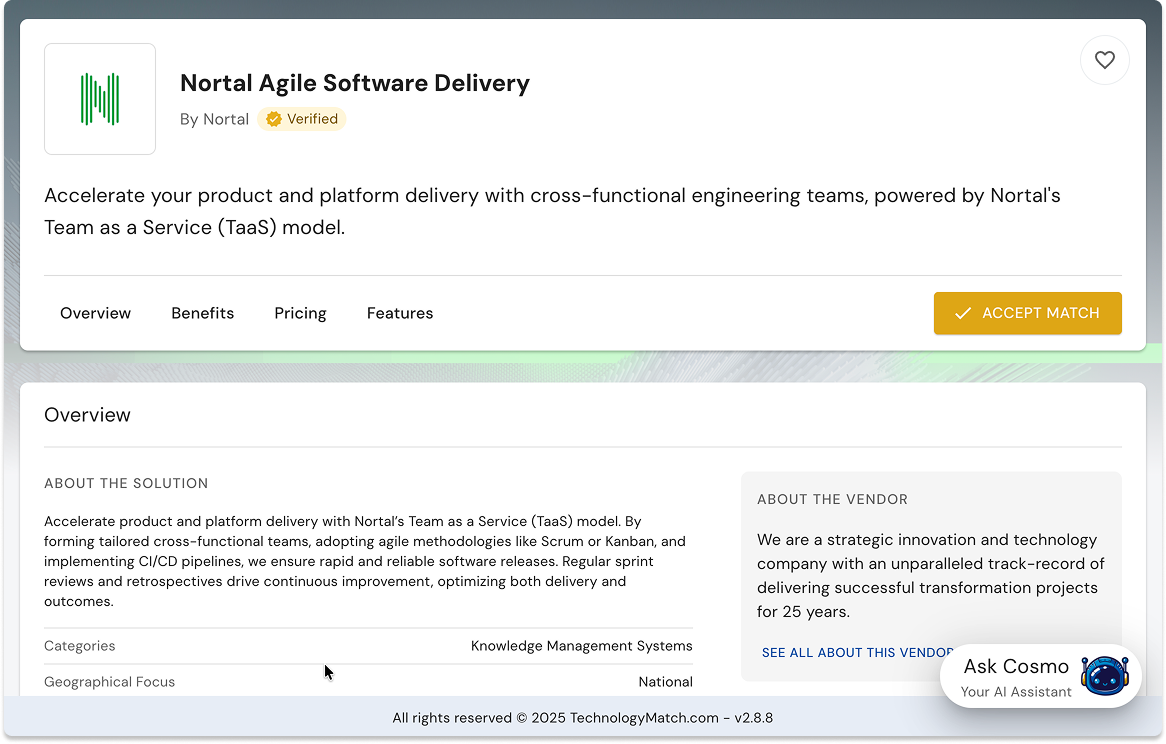
What they do best: Transform legacy systems into cloud-native architectures with enterprise-grade CI/CD pipelines.
Core CI/CD and DevOps Capabilities
- Cloud-native infrastructure modernization across AWS, Azure, and Google Cloud
- Microservices architecture design and implementation
- Automated deployment pipelines with built-in compliance controls
- Event-driven architecture for scalable applications
- Comprehensive telemetry and observability frameworks
- Developer experience platforms that accelerate feature delivery
- Multi-cloud and hybrid cloud deployment strategies
Best Fit For
Company size: Mid-market to enterprise (500+ employees)
Industries: Government, healthcare, defense, financial services, telecommunications
DevOps maturity: Organizations moving from monolithic applications to cloud-native architectures
Technical profile: Teams dealing with regulatory compliance, legacy system modernization, or complex multi-cloud environments
Key Differentiator
Nortal has delivered 40% of Estonia's digital government transformation. This isn't marketing speak. It means they've built CI/CD pipelines that handle citizen data, meet strict compliance requirements, and scale to national levels.
Their internal frameworks are battle-tested across government and enterprise deployments. They understand how to build pipelines that satisfy auditors, security teams, and developers simultaneously.
Not Ideal If
You're a startup or small business looking for quick wins. Nortal's approach is comprehensive and structured. If you need a lightweight DevOps setup or have fewer than 100 employees, their enterprise focus may be overkill.
You're looking for the cheapest option. Quality and compliance come at a price.
Getting Started
Nortal typically begins with an assessment phase. They evaluate your current architecture, identify bottlenecks, and create a transformation roadmap. Engagements are project-based or retainer-based depending on scope.
Expect a consultative process. They'll want to understand your business goals, not just implement tools.
Z7 Solutions

What they do best: Take DevOps operations off your plate while keeping security front and center.
Core CI/CD and DevOps Capabilities
- Fully managed CI/CD pipeline construction and maintenance
- Infrastructure automation using Ansible and AWS CloudFormation
- Automated testing strategies integrated into deployment workflows
- Multi-cloud deployment and operations (AWS, Azure, Google Cloud)
- Continuous monitoring and performance optimization
- DevSecOps integration with real-time threat detection
- Identity and access management across development environments
- Remote deployment and operations support
Best Fit For
Company size: Small to mid-market businesses (10-500 employees)
Industries: Manufacturing, financial services, commercial enterprises, startups
DevOps maturity: Organizations without dedicated DevOps teams or those looking to augment existing staff
Technical profile: Teams that need operational support, not just consulting advice
Key Differentiator
Z7 Solutions operates as an extension of your team. They don't just build your pipelines and walk away. They manage, monitor, and continuously improve them.
Their managed services model means you get ongoing support. When a pipeline breaks at 2 AM, it's their problem, not yours. This is valuable for IT leaders who are stretched thin or managing multiple priorities.
The cybersecurity integration is another standout. Many DevOps providers treat security as an afterthought. Z7 Solutions builds it into every layer of your deployment workflow.
Not Ideal If
You want complete control over every aspect of your DevOps infrastructure. Managed services require trust and delegation.
You're a large enterprise with complex governance requirements. Z7 Solutions focuses on small to mid-market clients. Enterprises may need more customization than their managed model provides.
Getting Started
Z7 Solutions offers assessments to understand your current infrastructure and pain points. From there, they propose a managed services package tailored to your needs.
Pricing is typically subscription-based with different tiers depending on the level of support and infrastructure complexity.
We recently did a podcast with Z7 Solutions and also worked on an MSP evaluation scorecard together.
Pentamix Security
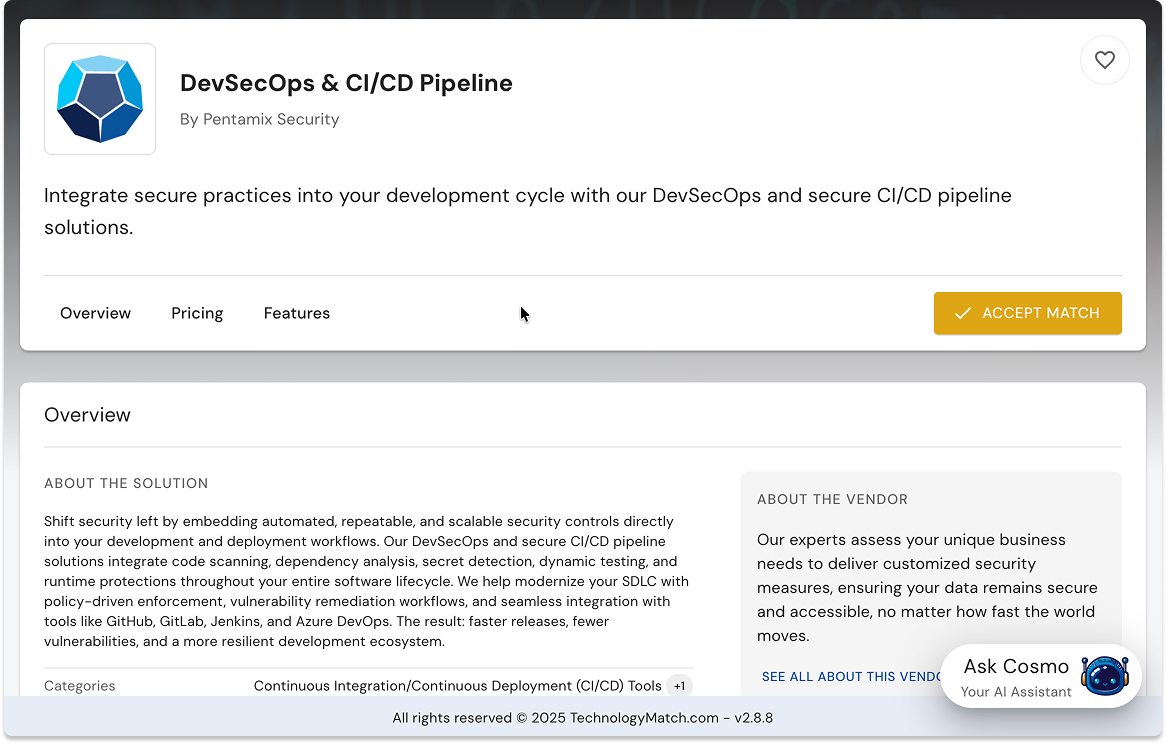
What they do best: Embed security into every stage of your CI/CD pipeline without slowing down releases.
Core CI/CD and DevOps Capabilities
- DevSecOps integration with automated security scanning
- Secure CI/CD pipeline design with compliance controls
- Static code analysis and dependency scanning
- Container image scanning and vulnerability management
- Infrastructure validation and configuration security
- Identity and access management for development workflows
- AWS and container security in DevOps contexts
- Real-time threat detection and response automation
- Compliance and audit automation for regulated industries
Best Fit For
Company size: Mid-market to enterprise (200+ employees)
Industries: Financial services, healthcare, government, any regulated industry
DevOps maturity: Organizations with existing CI/CD pipelines that need security hardening
Technical profile: Teams facing compliance audits, security incidents, or regulatory pressure
Key Differentiator
Pentamix Security doesn't just add security tools to your pipeline. They redesign your entire CI/CD workflow around security principles.
Their approach catches vulnerabilities early when they're cheap to fix. Finding a security flaw in development costs a fraction of what it costs in production. Pentamix ensures your pipelines catch issues before they become incidents.
If you're in a regulated industry or have experienced security breaches, Pentamix understands the stakes. They work with vendors like Palo Alto Networks, CrowdStrike, and Zscaler to build defense-in-depth strategies.
Not Ideal If
Security isn't a primary concern. If you're building internal tools with minimal risk exposure, Pentamix's security-first approach may be more than you need.
You're looking for general DevOps consulting. Pentamix specializes in security. If your main challenge is pipeline speed or developer experience, other vendors may be better fits.
Getting Started
Pentamix typically starts with a security assessment of your current CI/CD pipeline. They identify vulnerabilities, compliance gaps, and areas where security slows down development.
From there, they propose a remediation plan that balances security with velocity. Engagements can be project-based or ongoing depending on your needs.
Data Products

What they do best: Extend CI/CD principles to machine learning and AI model deployment.
Core CI/CD and DevOps Capabilities
- MLOps pipelines for model training, testing, and deployment
- Data pipeline automation and orchestration
- CI/CD for data science and analytics projects
- Cloud data platform deployment (AWS, Azure, Google Cloud)
- DataOps and data engineering automation
- Model versioning and deployment strategies
- Integration with data governance tools
- Reproducible ML workflows with metadata tracking
- AI and data literacy training programs
Best Fit For
Company size: Mid-market to enterprise (200+ employees)
Industries: Any organization deploying AI/ML models, data-driven enterprises, research institutions
DevOps maturity: Organizations with data science teams struggling to productionize models
Technical profile: Teams with ML models stuck in notebooks or facing deployment bottlenecks
Key Differentiator
Most DevOps vendors understand application deployment. Few understand machine learning operations.
Data Products bridges the gap between data science and production. They build pipelines that handle model training, validation, deployment, and monitoring. This is critical if you're trying to move from proof-of-concept AI projects to production systems.
Their MLOps approach ensures models are versioned, reproducible, and governed. This matters when models impact business decisions or customer experiences.
Not Ideal If
You're not deploying AI or machine learning models. Data Products specializes in MLOps. If your DevOps needs are purely application-focused, other vendors offer more relevant expertise.
You don't have a data science team. MLOps assumes you have models to deploy. If you're still building data infrastructure, you may need foundational work before MLOps makes sense.
Getting Started
Data Products typically begins with a data and AI strategy assessment. They evaluate your data maturity, existing models, and deployment challenges.
They then build a roadmap for implementing MLOps practices. This includes pipeline design, tool selection, and training for your team.
Tribloom
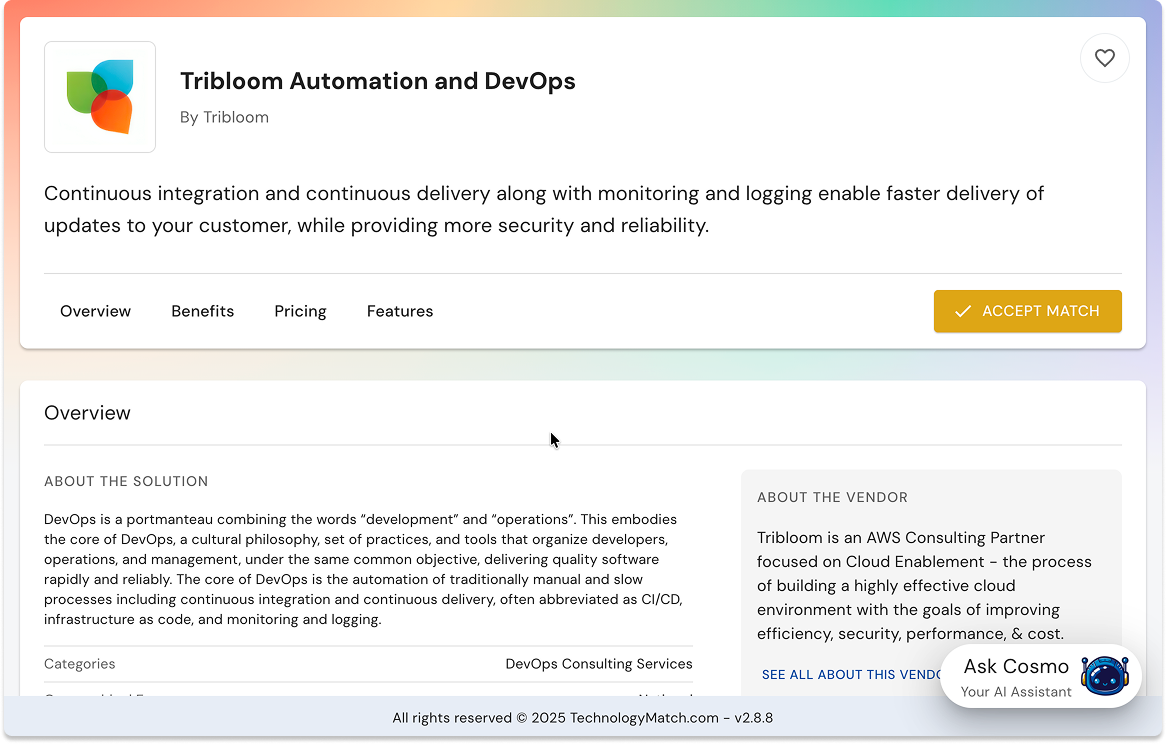
What they do best: Build and optimize CI/CD pipelines specifically for AWS environments.
Core CI/CD and DevOps Capabilities
- AWS-native CI/CD using CodePipeline, CodeBuild, and CodeDeploy
- Infrastructure as Code with Terraform and AWS CloudFormation
- Container orchestration using ECS and EKS
- DevOps culture transformation and best practices
- Automated testing and quality assurance
- Cloud migration and modernization strategies
- Monitoring and observability with AWS native tools
- Secure infrastructure design following AWS Well-Architected Framework
Best Fit For
Company size: Small to mid-market businesses (50-500 employees)
Industries: Technology, education, commercial enterprises
DevOps maturity: Organizations committed to AWS or migrating to AWS
Technical profile: Teams that want to maximize AWS capabilities without multi-cloud complexity
Key Differentiator
Tribloom is an AWS Consulting Partner and Authorized Channel Reseller. They've been doing AWS consulting since 2011.
Their deep AWS expertise means they know the platform inside and out. They understand which AWS services to use, how to optimize costs, and how to build resilient architectures using AWS best practices.
If you're all-in on AWS, Tribloom can help you leverage AWS-native tools instead of third-party alternatives. This reduces complexity and often lowers costs.
Not Ideal If
You're running multi-cloud or hybrid cloud environments. Tribloom specializes in AWS. If you need expertise across Azure, Google Cloud, or on-premises infrastructure, other vendors offer broader coverage.
You're a large enterprise with complex requirements. Tribloom focuses on small to mid-market clients. Large enterprises may need more extensive resources.
Getting Started
Tribloom offers cloud enablement assessments. They evaluate your current AWS setup (or migration readiness) and create a roadmap.
Engagements are flexible. They can work in an advisory capacity or handle full implementation. Pricing varies based on project scope.
Comparative Analysis for All CI/CD Tools
Making Your Decision
Before you reach out to vendors, ask yourself these three questions:
1. What's your primary constraint?
If it's security or compliance: Pentamix Security or Nortal
If it's resources or expertise: Z7 Solutions
If it's AWS optimization: Tribloom
If it's AI/ML deployment: Data Products
2. What's your DevOps maturity level?
Just starting: Z7 Solutions or Tribloom offer more hands-on support
Mid-level: Any vendor can help depending on your specific needs
Advanced: Nortal, Pentamix, or Data Products for specialized challenges
3. What's your budget reality?
Be honest about what you can spend. Premium vendors like Nortal and Pentamix deliver enterprise-grade solutions but come at enterprise prices. Mid-range options like Z7 Solutions and Tribloom offer excellent value for small to mid-market budgets.
Next Steps
Once you've identified your top two choices:
- Schedule discovery calls with both vendors
- Prepare your current state documentation (architecture diagrams, pain points, goals)
- Ask about case studies in your industry or similar technical environments
- Request proof of concept proposals if you're uncertain about fit
- Check references from clients with similar challenges
What to Prepare Before Your First Call
- Current CI/CD tools and processes
- Team size and structure
- Cloud platforms you're using or planning to use
- Compliance requirements (if any)
- Budget range (even a rough estimate helps vendors propose appropriate solutions)
- Timeline expectations
Need Help Finding the Right Match?
Choosing between vendors can be overwhelming, especially when each has legitimate strengths. If you want expert guidance without the sales pressure, we can help.
TechnologyMatch is a platform that connects IT leaders with pre-vetted technology vendors based on your specific requirements. Instead of spending weeks researching and scheduling calls, you submit your needs once and get matched with vendors that fit your criteria.
Here's how it works:
- Tell us what you need: Share your CI/CD and DevOps requirements, company size, industry, and constraints
- Get matched: We connect you with vendors from our network that align with your needs
- Schedule calls: Talk to vendors that are actually relevant to your situation
- Make your decision: Compare proposals and choose the best fit
No vendor spam. No wasted discovery calls with companies that aren't a fit. Just relevant matches that save you time.
Closing Thoughts
The wrong CI/CD and DevOps vendor will cost you more than money. You'll lose time, team morale, and possibly your competitive edge. The right vendor becomes a strategic partner that accelerates your delivery, reduces risk, and makes your job easier.
You now have the information you need to make an informed decision. Don't let analysis paralysis set in. Pick your top two vendors and start conversations this week. Or let TechnologyMatch do the matching for you.
The cost of delay is higher than the cost of choosing imperfectly. You can always adjust course. You can't get back lost time.
Also read: Jenkins vs. GitLab CI vs. CircleCI vs. Github Actions: The CI/CD Decision Guide in 2026
Looking for IT partners?
Find your next IT partner on a curated marketplace of vetted vendors and save weeks of research. Your info stays anonymous until you choose to talk to them so you can avoid cold outreach. Always free to you.
FAQ
1. What is the best CI/CD tool for enterprise organizations in 2026?
The best CI/CD tool depends on your specific needs. For enterprise digital transformation with compliance requirements, Nortal offers cloud-native CI/CD pipelines across AWS, Azure, and Google Cloud. For security-first enterprises, Pentamix Security provides DevSecOps integration with automated scanning and compliance controls.
2. How much does DevOps implementation cost for mid-sized companies?
DevOps implementation costs vary by vendor and scope. Mid-range providers like Z7 Solutions and Tribloom offer subscription-based pricing starting at manageable monthly rates for companies with 50-500 employees. Premium vendors like Nortal and Pentamix Security charge higher rates but deliver enterprise-grade solutions with compliance and security features.
3. What is the difference between DevOps and DevSecOps?
DevOps focuses on automating software development and deployment workflows. DevSecOps integrates security practices throughout the entire CI/CD pipeline, including automated security scanning, vulnerability management, and compliance controls. Pentamix Security specializes in DevSecOps for regulated industries that require security-first approaches.
4. Can small businesses benefit from CI/CD pipeline automation?
Yes. Small businesses benefit significantly from CI/CD automation through faster deployments, fewer errors, and reduced manual work. Z7 Solutions and Tribloom offer managed DevOps services designed for small to mid-market companies (10-500 employees) without dedicated DevOps teams.
5. What is MLOps and do I need it for AI deployment?
MLOps applies DevOps principles to machine learning workflows, automating model training, testing, deployment, and monitoring. You need MLOps if you're deploying AI or machine learning models to production. Data Products specializes in MLOps pipelines that help data science teams productionize models faster and more reliably.