Best Certified ITAD and Data Destruction Services: A Technical Guide for IT Leaders
Certified ITAD and data destruction services explained: NIST 800-88 Rev. 2, HDD vs SSD methods, NAID AAA vs R2v3, and how to pick a provider.

Summary:
Certified IT asset disposition (ITAD) hinges on matching the sanitization method to the media type and proving it with a device-level chain of custody.
NIST SP 800-88 Revision 2, published in September 2025, sets three sanitization levels — Clear, Purge, Destroy — while IEEE 2883-2022 supplies the exact technique for each media type; magnetic overwrite methods like DoD 5220.22-M no longer qualify for flash storage.
What IT Asset Disposition Covers
IT asset disposition (ITAD) is the managed process of retiring hardware at end of life. Done properly, it runs the full lifecycle: collection and logistics, chain of custody, data sanitization or physical destruction, verification, resale or value recovery, and environmentally sound recycling.
Two failure modes sit on your desk when this goes wrong. The first is a data-exposure incident traced back to a drive you thought was gone. The second is a fine for improper e-waste handling. Both are avoidable, and both come from treating disposal as a logistics problem rather than a data-security one.
The UN's Global E-waste Monitor 2024 recorded 62 million tonnes of e-waste generated in 2022, with only 22.3% documented as formally collected and recycled. The rest is largely undocumented, and undocumented disposal is where both data leaks and regulatory penalties originate.
The Standard That Changed in September 2025: NIST SP 800-88 Rev. 2
For a decade, the reference for media sanitization was NIST Special Publication 800-88 Revision 1, published in 2014. In September 2025, NIST published Revision 2, and it changes how the standard works.
The three-tier model survives. Every sanitization action still falls into one of three categories, defined by the level of effort required to recover the data afterward.
Here is what each level means:

Three changes in Revision 2 matter for how you write policy and contracts.
First, NIST removed the technique-level instructions. Apart from cryptographic erase, the guidance now points to IEEE 2883-2022 for how to Clear or Purge each media type. IEEE 2883 defines the exact interface commands, including the NVMe Sanitize command that did not exist when Revision 1 was written. NIST sets the policy; IEEE supplies the engineering.
Second, Revision 2 separates verification from validation. Verification confirms the sanitization technique ran to completion. Validation confirms the target data is actually gone and produces an approve-or-reject decision. These are distinct assurance steps, and a defensible program does both.
Third, the document reframes sanitization as a governance program with defined roles rather than a set of hands-on instructions. It assigns responsibility across the CIO, system owners, information owners, and property managers.
Why DoD 5220.22-M and DBAN No Longer Qualify
The three-pass overwrite from DoD 5220.22-M is obsolete for modern drives. A single overwrite pass satisfies a magnetic Clear, and no number of overwrite passes reliably sanitizes flash storage. Any vendor or internal document still citing a "DoD wipe" as best practice is working from a standard that time has passed by.
DBAN (Darik's Boot and Nuke) sits in the same category. Its current owner, Blancco, states directly that DBAN cannot detect or erase SSDs, produces no certificate for auditing, and receives no updates or support. It is unsuitable for any business that needs to prove what it did.
Matching the Method to the Media
The correct sanitization method depends entirely on how the media stores data. Applying a magnetic-era technique to a solid-state drive is the most common technical error in this field, and it leaves data behind.
Magnetic Drives (HDD)
Hard disk drives store data as magnetic domains on spinning platters. One overwrite pass achieves Clear. For Purge, you can use an enhanced overwrite, the drive's built-in ATA Secure Erase, or degaussing.
Degaussing applies a magnetic field strong enough to erase the domains. The field has to exceed the drive's coercivity, which for modern perpendicular-recording drives sits around 5,000 oersteds, so practitioners choose degaussers rated well above that. Degaussing also erases the servo tracks and firmware, so the drive is permanently inoperable afterward. It cannot be reused or resold.
Degaussing does nothing to a solid-state drive. Flash stores charge, not magnetism, so a magnetic field leaves it untouched.
Flash Media (SSD and NVMe)
Solid-state drives break the assumptions that overwriting relies on. Wear leveling spreads writes across cells unpredictably, so an overwrite command aimed at a logical block may never touch the physical cells holding the old data. Over-provisioning hides spare capacity from the operating system entirely; a drive sold as 400 GB may carry 512 GB of physical NAND, and the difference is invisible to any host-level tool.
The answer is firmware-level commands built into the drive:
One caution applies to all of these. Built-in erase commands work when implemented correctly, but manufacturers sometimes implement them incorrectly, and single-file overwrite attempts left between 4% and 75% of file contents intact on the SSDs tested. Firmware commands cannot be trusted blindly. This is exactly why post-command verification is not optional.
Self-Encrypting Drives and Cryptographic Erase
A self-encrypting drive (SED) encrypts everything at rest with a media encryption key held in the controller. Cryptographic erase destroys or replaces that key, leaving the ciphertext unreadable. It completes in seconds regardless of drive size, which is why it scales well.
NIST accepts cryptographic erase as a valid Purge method, but only under conditions. Encryption must have been active since the drive was provisioned, so no plaintext was ever written.
Keys must come from an approved random number generator, use at least 128-bit strength, and, for federal use, sit inside a FIPS 140-validated cryptographic module. Independent research has found SED firmware that failed to encrypt all data or fully purge keys, so for the most sensitive data, pair cryptographic erase with physical destruction.
Physical Destruction Specifications
When destruction is the right call, particle size is the variable that matters. Shredding a drive into large chunks can leave intact flash packages that a determined lab can read.
The NSA/CSS media destruction requirements set the high-security bar in the US. For solid-state media, disintegration to a nominal 2 mm edge size is required; the older 5 mm specification has been retired. For hard drives, the platters must be degaussed and then physically deformed. Destruction is witnessed and documented.
The NSA/CSS Evaluated Products List (EPL) names the specific degaussers, shredders, and disintegrators that meet these requirements. Inclusion is a performance benchmark, not a government endorsement, and it is the reference point for any organization handling classified or high-assurance data. If you operate in that environment, EPL-listed equipment is the floor, not the ceiling.
Certifications That Verify Something Real
Certifications in this space are not interchangeable. Each governs a different part of the lifecycle, and the strongest providers hold several. Treat a single logo as a starting point for questions, not an answer.
NAID AAA (i-SIGMA) is the data-destruction certification. Its defining feature is that audits are both scheduled and unannounced, carried out by independent security professionals across employee screening, access controls, GPS-tracked vehicles, and particle-size verification. It carries separate endorsements for hard drives, solid-state drives, and overwriting, so you can confirm the specific service you need is covered.
R2v3 (SERI) is the most widely adopted electronics-recycling standard and governs both environmental handling and downstream due diligence. Its data-sanitization requirements sit in Appendix B, which mandates serialized per-drive records, software that fails any media it cannot fully sanitize, and routine verification of at least 5% of logically sanitized media. Each facility is certified independently, so a certificate for one site does not cover another.
e-Stewards (BAN) takes a stricter environmental and export position, prohibiting the export of hazardous e-waste to developing countries and requiring ISO 14001 alongside NAID AAA for data destruction. Where downstream export exposure is a governance concern, e-Stewards addresses it more tightly than R2. Where operational flexibility and global reach matter more, R2 has broader adoption.
ADISA is UK-based and approved under UK GDPR, and its research center runs forensic product-claims testing that actually attempts to recover data from sanitized media against NIST 800-88 and IEEE 2883. The UK's National Cyber Security Centre recommends using an ADISA-certified provider. It is worth knowing about even for US-weighted programs because the testing is genuinely adversarial.
ISO frameworks round out the picture: ISO 27001 for information security management, ISO 14001 for environmental management, and SOC 2 Type II for audited operational controls.
The practical takeaway: the strongest ITAD partners stack NAID AAA for data destruction, R2v3 or e-Stewards for recycling, and ISO 27001 for security management. This mirrors the vendor evaluation discipline compliance-heavy industries already apply to any partner touching regulated data.
Data Sanitization Software Compared
The software that performs logical wiping is where verification and reporting live. The axes that matter are the standards supported, whether the tool handles SSD and NVMe firmware commands rather than plain overwrites, whether it generates tamper-proof certificates, and whether it fails any media it cannot fully sanitize.
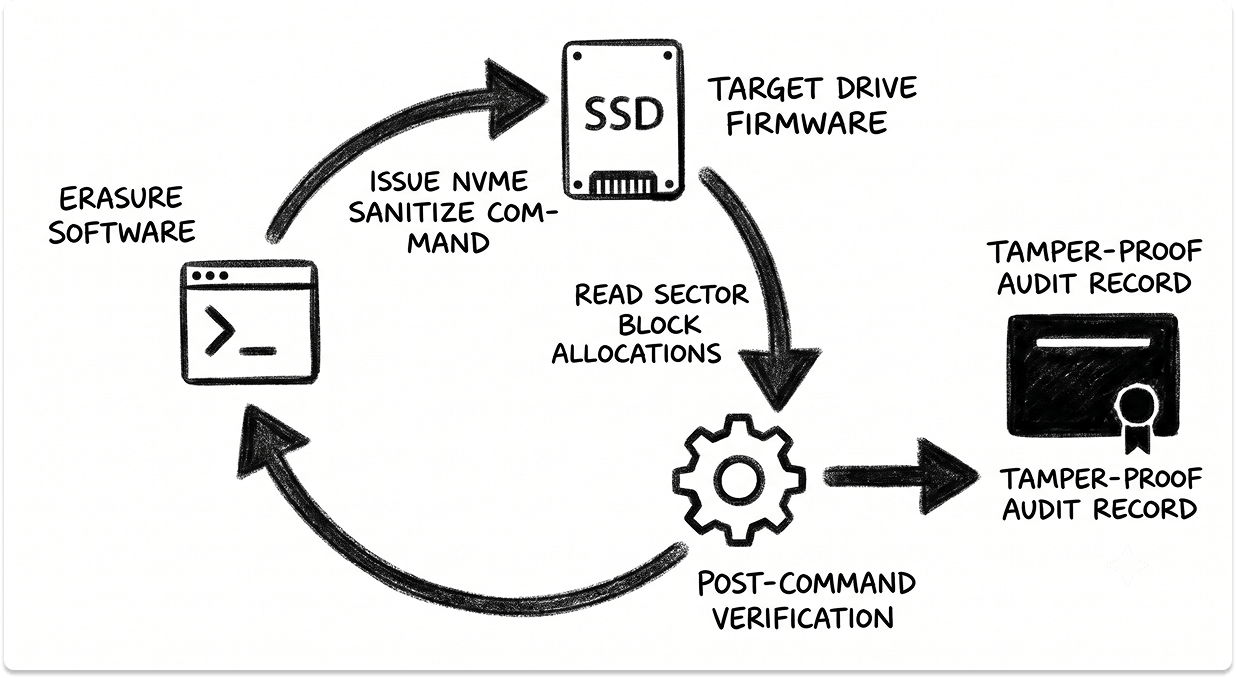
- Blancco Drive Eraser is the enterprise reference. It erases hard drives and complex SSDs, supports more than 20 standards including NIST 800-88 and IEEE 2883, dismantles RAID and UEFI configurations, and produces digitally signed, tamper-proof certificates. It holds multiple third-party certifications, including Common Criteria.
- BitRaser covers HDDs, SSDs, SEDs, Macs, and servers, supports NIST 800-88 and IEEE 2883:2022, and generates tamper-proof certificates with cloud reporting and API integration.
- WipeDrive and KillDisk both produce signed certificates and support modern standards; KillDisk also offers hardware appliances for higher-volume operations.
- DBAN is the cautionary case covered earlier. No SSD support, no certificate, no verification, and no updates.
ITAD Service Providers and Their Technical Capabilities
Providers differ on capability, not just price. The axes that decide a defensible program are the certifications held per facility, whether recycling happens in-house or through brokers, whether on-site destruction is available, the chain-of-custody technology, and the reporting they issue.
- ERI operates eight US facilities, all certified to R2, e-Stewards, NAID AAA, and ISO, and was the first company to hold NAID AAA, R2, and e-Stewards together. Its tracking software creates a serialized digital chain of custody from the point of pickup, and it offers both on-site and off-site destruction.
- Iron Mountain runs secure ITAD in more than 30 countries and holds NAID AAA, R2v3, ISO 27001, and SOC 2. It uses GPS-tracked transport and serialized asset tracking, with an online portal issuing settlement, audit, and destruction reports. Independent analysts note it relies substantially on partner relationships for the actual recycling step, which is worth confirming for downstream control.
- Sims Lifecycle Services operates globally, certifies most sites to ISO 27001, and integrates Blancco erasure into its portal. All data destruction is certified to NIST 800-88 with certificates of data destruction. Its history is weighted toward large-volume recycling for hyperscalers and OEMs.
- Dell Asset Recovery Services runs a reuse-first model through its TechDirect portal, accepts multiple brands, and offers both on-site sanitization and on-site drive shredding. It is a strong fit for Dell-centric fleets and value recovery, though its sanitization detail is less publicly specified than the pure-play providers.
Verify every claim against the i-SIGMA, SERI, and e-Stewards directories directly. Certifications lapse, and they are facility-specific. The same due-diligence rigor you would apply to any critical vendor applies here, with the added step of checking downstream partners.
Chain of Custody, On-Site Versus Off-Site, and Certificates
The mechanics between the loading dock and final disposition are what make a program defensible. A broken chain of custody is where data leaks and audit failures start.
What an Unbroken Chain of Custody Looks Like
A defensible chain starts the moment an asset goes offline. It includes serialized scanning at pickup, tamper-evident seals, GPS-tracked transport, access logs, handoff signatures, and, for high-sensitivity data, witnessed or video-recorded destruction. Broker handoffs and batch-level tracking are the weak points, because they break the link between a specific device and a specific event.
On-Site Versus Off-Site Destruction
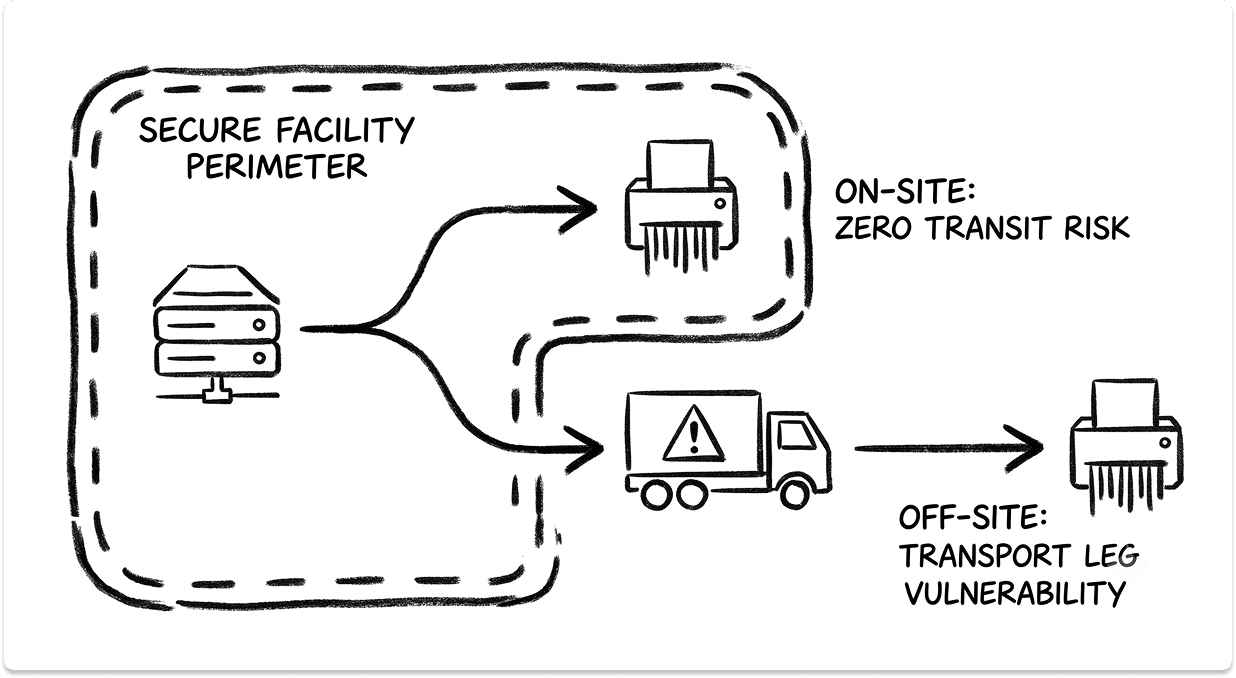
On-site destruction, using mobile shredding units or on-premises wiping, eliminates transit risk by destroying media before it leaves your control. Off-site destruction lowers cost for high volumes but extends the chain of custody across a transport leg. When the data is sensitive enough, on-site or witnessed destruction is the safer architecture.
What a Defensible Certificate of Destruction Must Contain
A certificate has to be device-level, not batch-level. A line that reads "Lot 17 destroyed" cannot tie a specific drive to a specific event, and it fails HIPAA and SOC 2 review for that reason.
An audit-grade certificate includes:
Retain these records per your regulatory obligations, which for HIPAA runs about six years and for SOX about seven.

How Disposal Maps to Your Compliance Obligations
Several US regimes turn disposal into a documented obligation. The regulatory texts are technology-neutral, so the link to NIST comes through agency guidance rather than the statutes themselves.
Under the HIPAA Security Rule, covered entities must have policies for the final disposition of electronic protected health information, and HHS guidance directs entities to NIST SP 800-88 for how to do it.
The FACTA Disposal Rule at 16 CFR Part 682 requires reasonable measures to protect against unauthorized access when disposing of consumer report information.
The GLBA Safeguards Rule requires secure disposal of customer information. GDPR's Article 17 covers erasure for organizations handling EU data, and state breach-notification laws set the clock running once exposed data surfaces.
SOX works in the opposite direction. Its records-retention provisions mean sanitization has to be reconciled against legal holds before anything is destroyed.
The discipline here overlaps with the vendor evaluation practices HIPAA and SOC 2 environments already run, and increasingly it shows up on the same cyber-insurance renewal questionnaires that now shape security roadmaps.
Use the Questionnaire Below to See Which ITAD Suits You
A Decision Framework: Sanitize and Reuse, or Destroy
The choice between recovering value and destroying media follows the data and the drive.
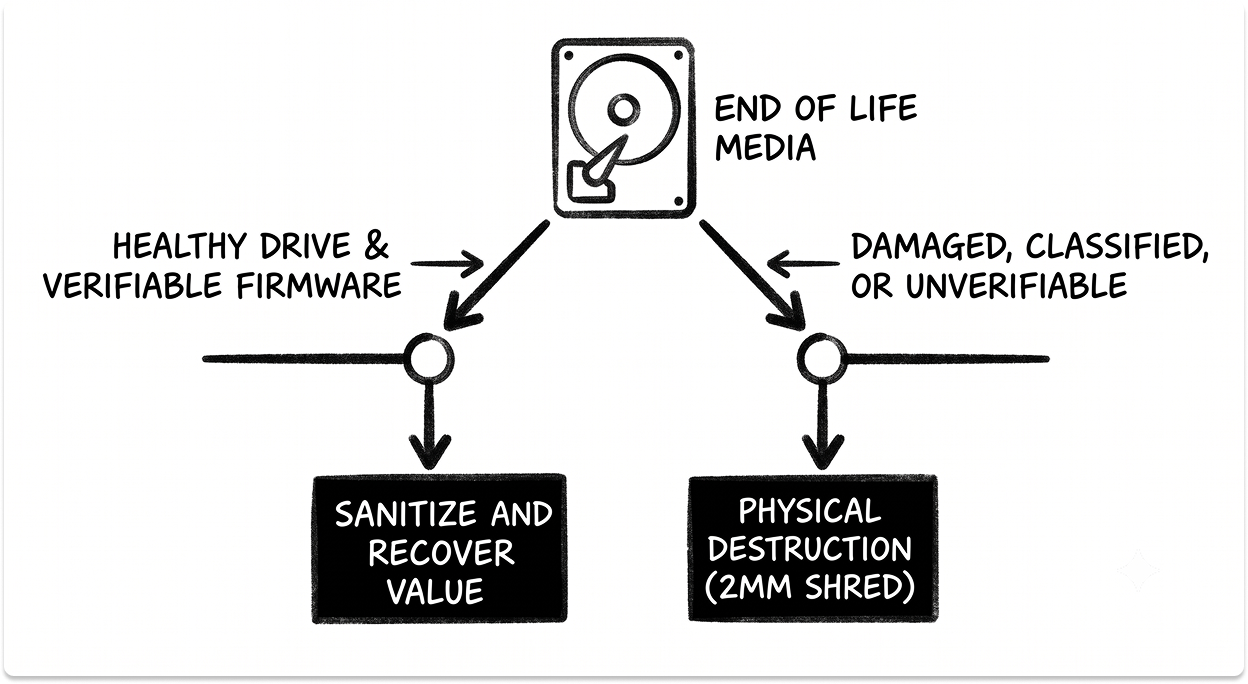
Sanitize and reuse when the drive is healthy, its firmware sanitize commands are supported and verifiable, and the data sensitivity permits a Purge. This recovers value and keeps working hardware out of the waste stream.
Destroy when the media is damaged or non-functional and sanitize commands cannot be confirmed, when the data is classified or highest-sensitivity, when the drive firmware cannot be trusted, or when policy or contract requires it. For an SSD whose sanitize command cannot be verified, physical destruction to specification is the only defensible option.
Two thresholds override everything else. If a drive fails sanitize-command verification, escalate to physical destruction. If the data is classified, the NSA EPL path applies regardless of cost.
Choosing a Certified ITAD Partner With Confidence
The drives waiting in that storeroom hold everything the business trusted them with. The question is not whether they will be picked up. It is whether, a year from now, you can produce a record showing exactly what happened to each one.
That record is the whole point of a certified ITAD service. It is the difference between a routine hardware refresh and a data-exposure incident traced back to a device you signed off on.
Ask for per-facility certifications, insist on device-level certificates tied to an unbroken chain of custody, require verification evidence, and confirm the method matches the media. A provider that can supply all four gives you something worth more than the recovered value of the hardware: proof.
If you are weighing certified ITAD providers against your own requirements, the same principles that guide any IT asset lifecycle decision apply. Define what you need, verify the certifications yourself, and choose the partner who can prove their work.
Find a certified ITAD partner matched to your requirements
Retiring hardware after a refresh or site closure means proving where every drive went. And this requires help. Find vetted ITAD vendors based on your compliance scope, media types, and chain-of-custody needs. Match with vendors who fit and start conversations when you're ready.
FAQ
What is the current standard for data sanitization?
NIST SP 800-88 Revision 2, published in September 2025, is the US reference. It defines three levels (Clear, Purge, Destroy) and delegates the technique-level detail to IEEE 2883-2022. The older DoD 5220.22-M three-pass overwrite is obsolete for modern drives.
Can you wipe an SSD the same way as a hard drive?
No. Overwriting is unreliable on SSDs because wear leveling and over-provisioning hide data from host-level commands. SSDs require firmware commands such as ATA Secure Erase or NVMe Sanitize, and degaussing has no effect on them at all.
Does degaussing work on solid-state drives?
No. Degaussing erases magnetic media by applying a strong magnetic field. Flash storage holds data as electrical charge, not magnetism, so a degausser leaves an SSD untouched. It also permanently destroys a hard drive, so degaussed media cannot be reused.
Which certifications should a certified ITAD provider hold?
For a full-lifecycle program, look for NAID AAA for data destruction, R2v3 or e-Stewards for recycling and downstream due diligence, and ISO 27001 for information security management. Verify each certification per facility in the i-SIGMA, SERI, and e-Stewards directories, because certifications are site-specific and can lapse.
What makes a certificate of destruction audit-ready?
It must be device-level rather than batch-level, listing the serial number, sanitization method, standard met, date, operator, and verification outcome for each device. Batch certificates that group many drives under one line fail HIPAA and SOC 2 review because they cannot tie a specific device to a specific event.
Is on-site or off-site destruction more secure?
On-site destruction removes transit risk by destroying media before it leaves your control, which suits the most sensitive data. Off-site destruction lowers cost for high volumes but extends the chain of custody across a transport leg, which is where handoff failures occur.