NetSuite vs SAP S/4HANA vs Dynamics 365: ERP Guide for IT Leaders
How do NetSuite, SAP S/4HANA, and Dynamics 365 differ technically? Compare architecture, extensibility, APIs, and upgrades for mid-market ERP selection.

Core Architectural differences
The core design of each platform sets the rules for everything you do afterward. Read this section as the foundation for the rest.
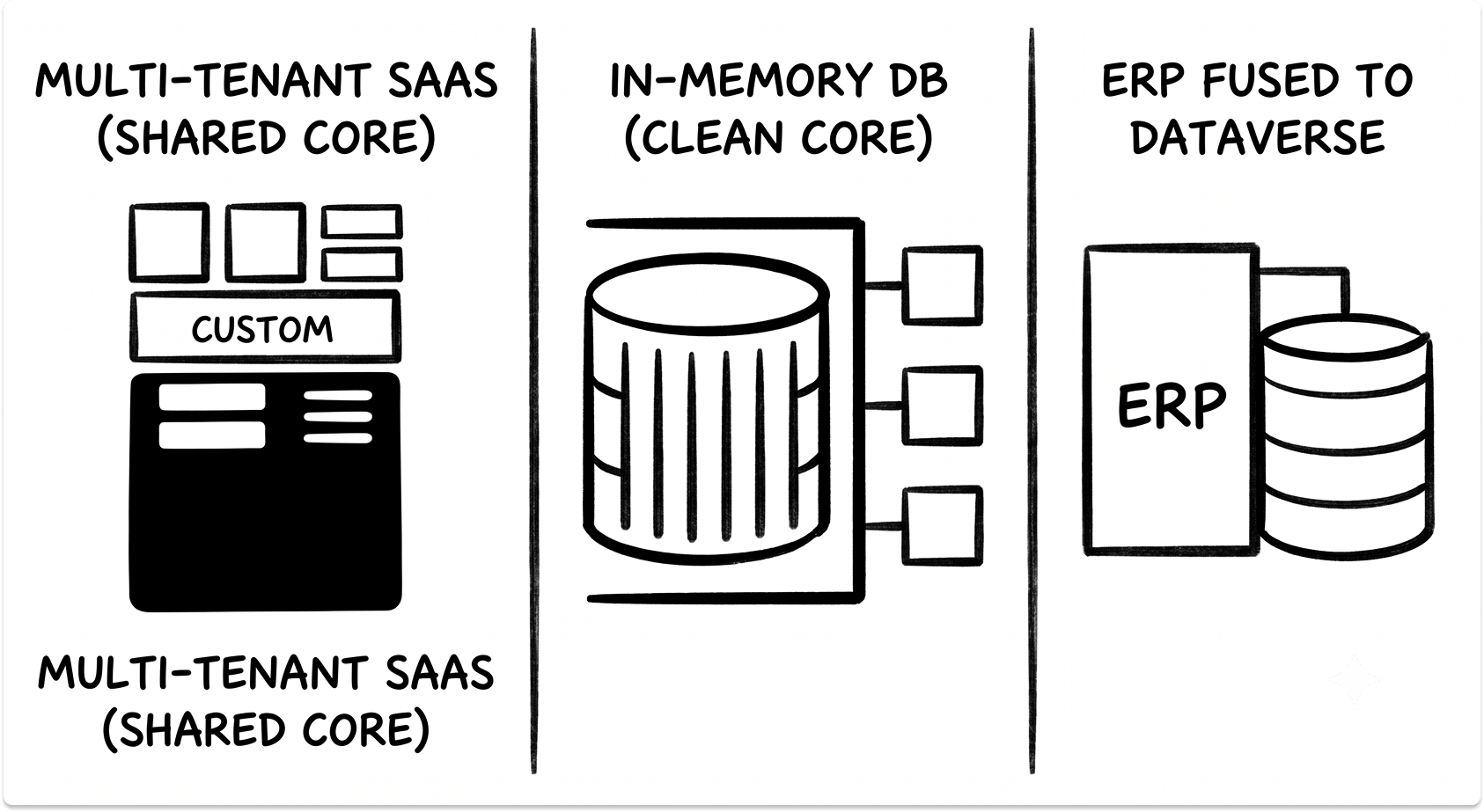
NetSuite is a single, multi-tenant SaaS instance you never control directly. Every customer runs the same application code on a shared database, hosted on Oracle Cloud Infrastructure. Oracle's own definition of multi-tenancy describes this as one instance of the software serving many customers at once. Your customizations sit in a layer on top of that shared core. The payoff, per NetSuite's SuiteCloud platform documentation, is that any customization you make migrates automatically with every upgrade. The trade is that you do not choose when upgrades happen. Oracle upgrades all tenants on its own schedule.
SAP S/4HANA is an in-memory data platform built around a clean core. It runs on the SAP HANA columnar in-memory database. Its guiding rule, stated plainly in SAP's own extensibility documentation, is that extensions should not break an upgrade and upgrades should not break an extension. To hold that line, SAP pushes most customization off the core. It comes in three deployment shapes: multi-tenant Public Cloud, single-tenant Private Cloud, and on-premise.
Dynamics 365 Finance and Operations is an ERP fused to a low-code platform. It sits on a shared data layer connected to Microsoft Dataverse. As of May 1, 2025, Microsoft requires Power Platform integration on every Finance and Operations environment. The ERP and the Power Platform are no longer separate choices. They are one system.
Here is the summary before we go deeper.
How each ERP handles customization, and who can actually do it
This is the axis that decides your staffing plan. The question is not whether a platform can be customized. All three can. The question is who on your team can do it, and where the work runs.
NetSuite: SuiteCloud, layered on a locked instance
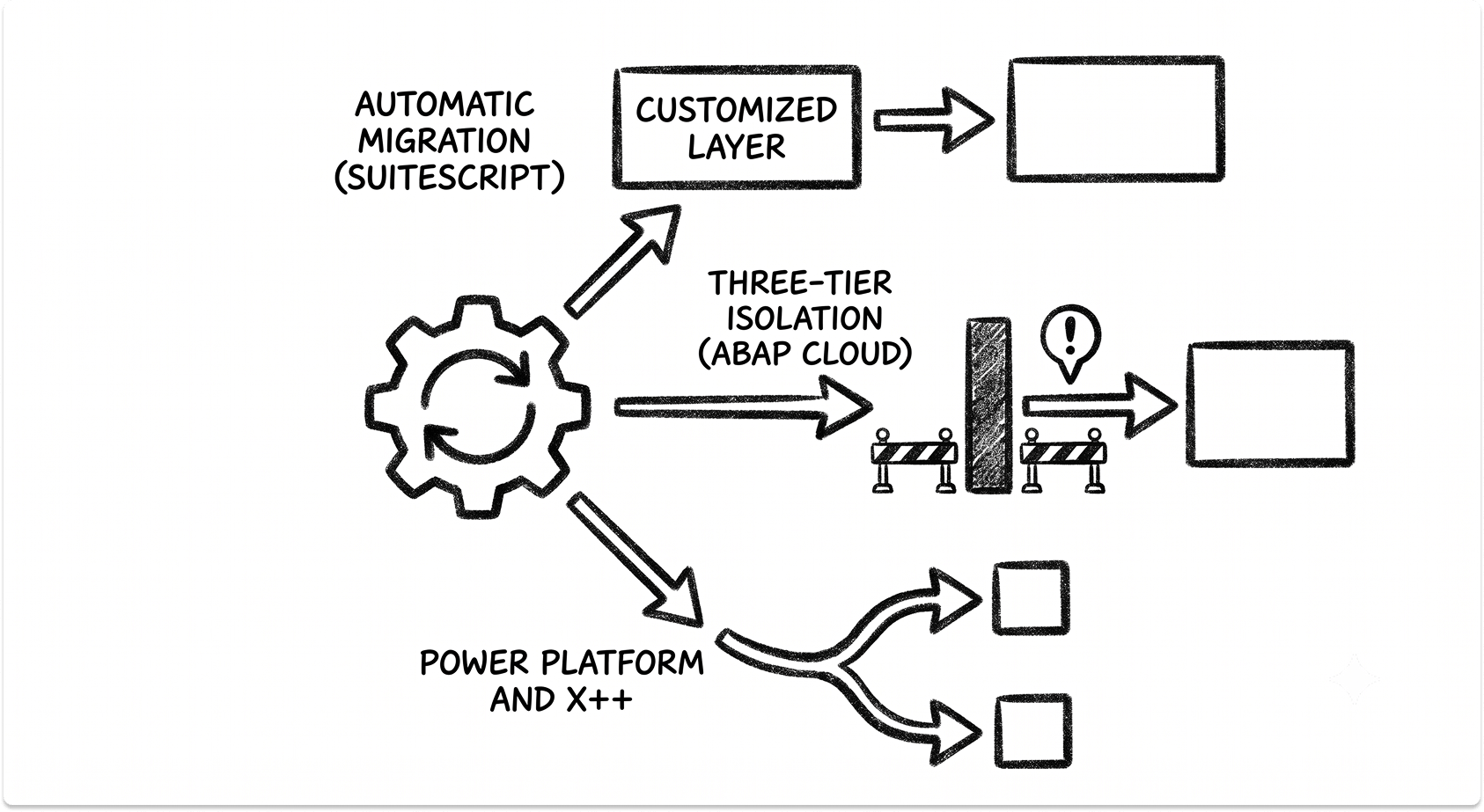
NetSuite's customization tools sit together under the SuiteCloud platform. There are three levels of effort.
The important technical point is the skill base. SuiteScript is JavaScript, which most teams already have in-house. That lowers the barrier to writing real logic inside the ERP.
The limit to plan for comes from the multi-tenant design. Because you share infrastructure with other customers, NetSuite enforces governance limits on scripts and API calls. These include caps on records per request, query row limits, and concurrency limits. For everyday customization this is invisible. At high transaction volumes or heavy integration loads, it becomes the ceiling you design around.
SAP S/4HANA: three tiers, kept off the core
SAP splits customization into three defined tiers so the core stays clean and upgradable.
The deployment edition changes what is allowed. Public Cloud does not permit classic modification of the core at all. Private Cloud and on-premise allow all tiers, including the older classic approach, though SAP steers customers away from it.
The skill reality: the deepest customization runs on ABAP Cloud, a specialized language. Teams without SAP experience will hire or train for it. The upside is a strict, upgrade-safe model that protects you from the modifications that make old systems slow and fragile to change.
Dynamics 365: Dataverse, dual-write, and the Power Platform
Dynamics extends through its connection to Dataverse and the Power Platform. Microsoft documents four building blocks that make up the shared data layer.
Much of the customization here is low-code through Power Apps and Power Automate, which widens who can build. Deeper work uses X++. The trade to weigh is coupling. Since Power Platform integration is now mandatory, your ERP customization strategy and your Microsoft platform strategy are the same strategy.
The skill-barrier reality
If your priority is customizing inside the ERP with people you already have, NetSuite's JavaScript base is the shortest path. If you want the widest low-code reach and you already run Microsoft, Dynamics fits your existing skills. SAP's ABAP Cloud asks the most of a new team, and gives back the strictest guarantee that your changes survive upgrades.
For a structured way to score these differences against your own priorities, see the essential IT vendor selection criteria and checklist.
Integration and APIs, where rollouts actually break
Most stalled implementations do not fail on the ERP itself. They fail at the seams, where the ERP has to talk to everything else you run. This is the area that gets the least attention in typical comparisons, so it deserves the most here.
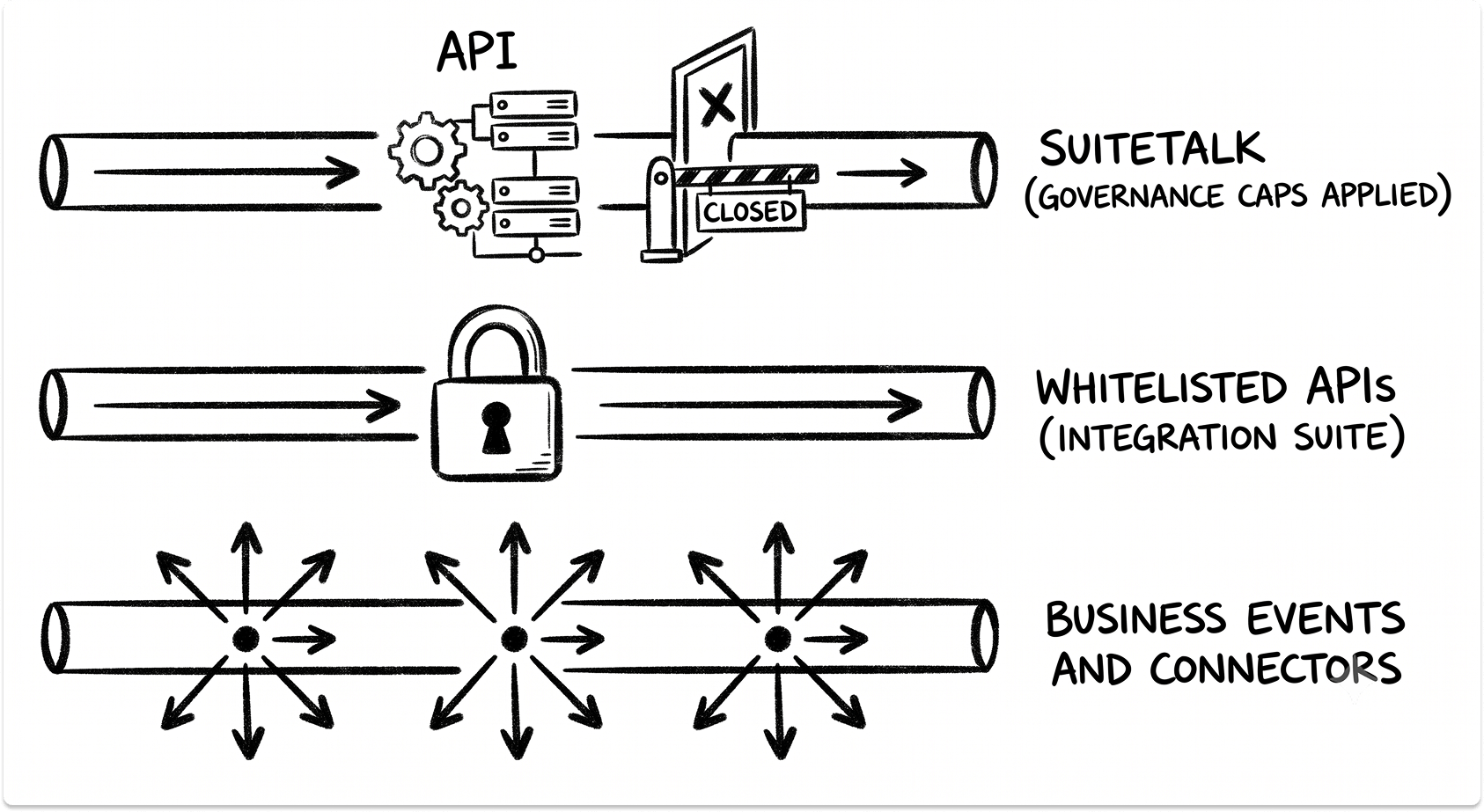
NetSuite exposes SuiteTalk web services in both REST and SOAP, plus SuiteQL for querying data. It supports integrations built in Java, .NET, and other stacks. The constraint is the same multi-tenant governance mentioned earlier. Your integration architecture has to respect rate and concurrency limits, so high-volume data movement needs to be designed for those caps rather than assumed away.
SAP integrates through OData services and custom CDS views, with SAP Integration Suite and Event Mesh as the middleware backbone. Under clean core, you connect only through whitelisted, released APIs published in the SAP API Hub. This is more disciplined and adds an integration platform to own, but it keeps the connections stable across upgrades.
Dynamics 365 leans on its event model and connectors. Business events and data events push changes outward, and the Power Platform connector library plus Dataverse give you a large set of prebuilt links to other systems, especially Microsoft ones.
If your systems already run on Salesforce, QuickBooks, and other tools, and pulling numbers together today means someone copying data into spreadsheets by hand, the integration model is the part of this decision that will affect your daily reporting the most. Test it early.
Upgrades and control, what you keep and what you give up
The upgrade model is a genuine trade, not a feature to rank.
NetSuite upgrades every customer on a fixed schedule, and your customizations come along automatically. You give up timing control in exchange for never running an out-of-date system.
SAP Private Cloud and on-premise hand you control over when upgrades happen, which matters if you run heavy on-core logic and need to test carefully before each change. Dynamics runs Microsoft-managed continuous updates, so you stay current without large upgrade projects, as long as your extensions follow the supported model.
None of these is better in the abstract. The right answer depends on how much you value control versus how much you want to avoid running upgrade projects yourself.
Deployment models compared
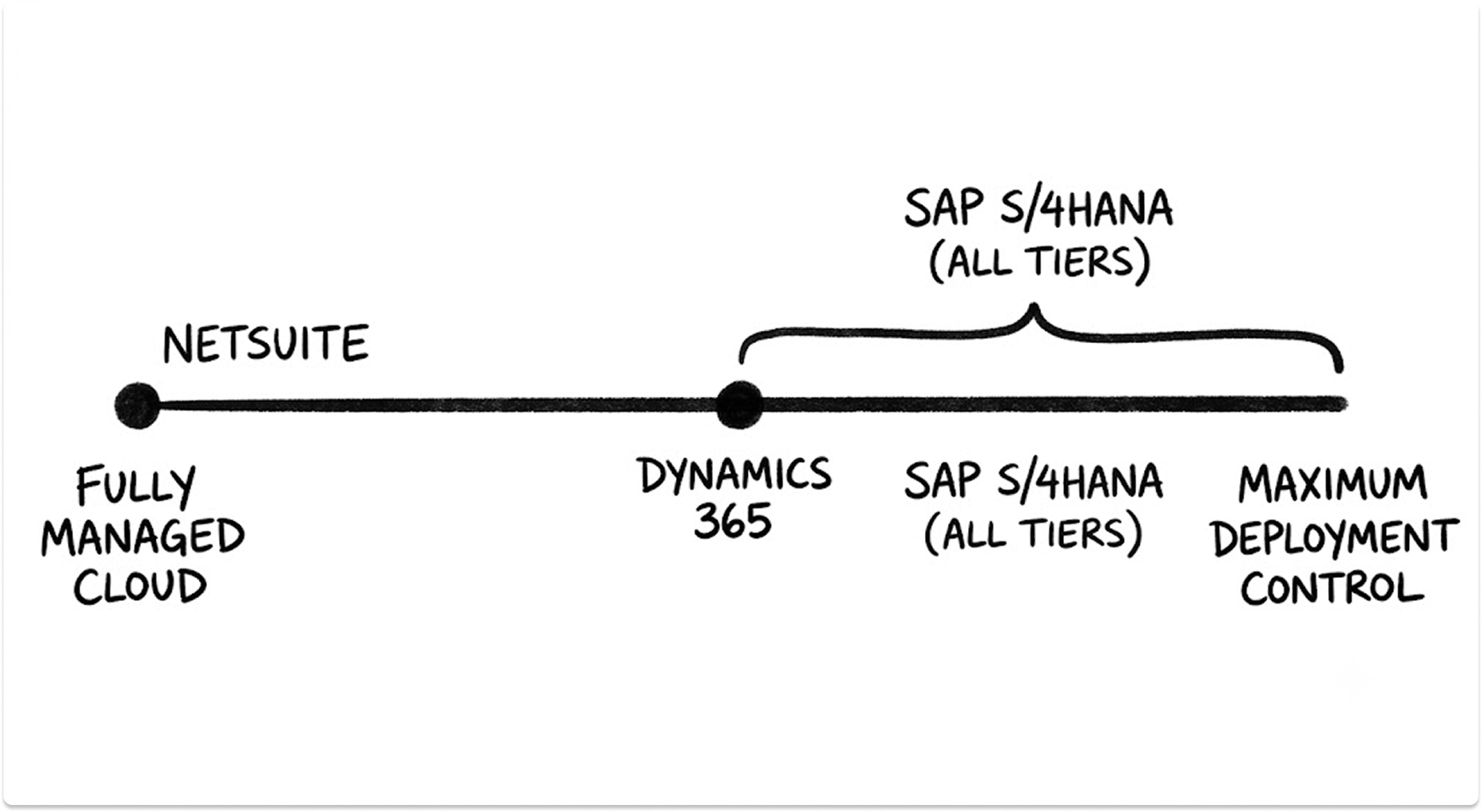
SAP is the only one of the three that offers the full range from shared cloud to on-premise. If a data residency rule or a control requirement forces you off shared infrastructure, that narrows the field on its own.
NetSuite vs SAP S/4HANA
These two sit at opposite ends of the control spectrum. NetSuite gives you one cloud model, JavaScript customization, and automatic upgrades, with governance limits as the ceiling.
SAP gives you a choice of deployment, an in-memory database, and a strict clean core model, with ABAP Cloud as the deeper skill and an integration platform to own. Pick NetSuite when you want a managed cloud system your existing developers can extend. Pick SAP when you need deployment choice, on-core logic, or full control over upgrade timing.
NetSuite vs Dynamics 365
Both are cloud-first and approachable to customize. The split is the ecosystem. NetSuite is self-contained, so your customization and integration work stays inside SuiteCloud.
Dynamics is fused to Dataverse and the Power Platform, which is a strong fit if you already run Microsoft and want low-code reach across your stack. That same fusion is a commitment, since Power Platform integration is now required. Pick NetSuite for a contained system. Pick Dynamics when the Microsoft platform is already your center of gravity.
SAP S/4HANA vs Dynamics 365
This is a contrast between depth and breadth. SAP offers deployment range, an in-memory core, and a disciplined three-tier extension model that keeps heavy customization upgrade-safe.
Dynamics offers a low-code platform welded to the ERP and a large connector library, strongest inside Microsoft environments. Pick SAP when you need deployment flexibility and on-core depth. Pick Dynamics when low-code speed and Microsoft alignment matter more than deployment choice.
Use the Questionnaire Below to See which ERP Suits Your Needs
How to verify technical fit before you sign
The gap between a good demo and a working system is where budgets and go-live dates disappear. A signed contract with the wrong architecture is expensive to walk back, and the old system keeps limping along while the new one gets fixed. You can avoid most of that by testing the technical claims before you commit, not after.
A scenario-based evaluation like this surfaces the limits a sales cycle hides. Our guide to scenario-based vendor evaluations and proofs of concept covers how to structure one.
You do not have to run the search for candidates by hand either. TechnologyMatch connects you to pre-vetted vendors matched to your technical requirements, so you spend your time verifying fit rather than sorting through pitches. That is the difference between choosing on a claim and choosing on evidence.
Looking for ERPs?
If you're comparing ERP tools, explore options on TechnologyMatch. Filter based on architecture, priorities, and budget. Find vendors that fit on a marketplace of pre-vetted vendors. Reach out when you're ready and start conversations on your terms.
FAQ
Which ERP is easiest to customize?
NetSuite has the lowest skill barrier for in-ERP customization because SuiteScript is built on standard JavaScript, which many teams already know. Dynamics 365 offers the widest low-code reach through the Power Platform. SAP S/4HANA asks the most through ABAP Cloud, but enforces the strictest upgrade-safe model.
Which ERP gives the most control over upgrades?
SAP S/4HANA Private Cloud and on-premise let you control upgrade timing. NetSuite upgrades all customers on a fixed schedule with no opt-out. Dynamics 365 runs Microsoft-managed continuous updates.
What API options does each platform offer?
NetSuite provides SuiteTalk REST and SOAP web services plus SuiteQL. SAP S/4HANA uses OData services and CDS views with SAP Integration Suite and Event Mesh. Dynamics 365 uses business events, data events, and Dataverse and Power Platform connectors.
Is Dynamics 365 Finance and Operations tied to the Power Platform?
Yes. Since May 1, 2025, Microsoft requires Power Platform integration on every Finance and Operations environment, so the ERP and the Power Platform operate as one system.
Which ERP can run on-premise?
SAP S/4HANA offers on-premise, Private Cloud, and Public Cloud. NetSuite is cloud-only multi-tenant SaaS. Dynamics 365 is cloud-first with limited on-premise options.