ZoomInfo vs. Cognism vs. Lusha vs. TechnologyMatch: Which is Best for IT Sales in 2026?
This guide helps you compare Zoominfo vs. Cognism vs. Lusha vs. TechnologyMatch to decide on a lead gen or sales platform. Modern IT buyers don't respond well to cold calls anymore, and so modern sales leaders need more than just lead gen platforms.

IT buyers actively block cold outreach. CIOs, CISOs, and IT Directors configure strict email filters to trap automated pitches. They ignore unrecognized phone numbers and heavily restrict their LinkedIn inboxes.
Selling complex managed IT services, software, or hardware requires connecting with decision-makers who actually hold budget. You need reliable channels to reach these buyers. The market offers several platforms designed to fill your sales pipeline.
ZoomInfo, Cognism, and Lusha dominate the traditional contact data market. They scrape, verify, and package contact information to fuel outbound sales teams. TechnologyMatch operates on a completely different model. It functions as an inbound vendor matchmaking platform where buyers initiate the conversation.
If you want raw data to supply a massive business development team, you will choose one of the traditional data providers. If you want active IT buyers coming to you with defined, funded projects, you will look toward matchmaking platforms.
Understanding the Traditional B2B Data Broker Model
You need to understand the structural differences between the major data brokers before investing your budget. They all provide phone numbers and email addresses. They differ significantly in data sourcing, accuracy guarantees, and pricing models.
ZoomInfo: The Enterprise B2B Data Giant
ZoomInfo holds the largest contact database in the B2B sector. It operates as a comprehensive go-to-market platform tailored heavily toward large enterprise sales organizations.
ZoomInfo Database Size and Geographic Coverage
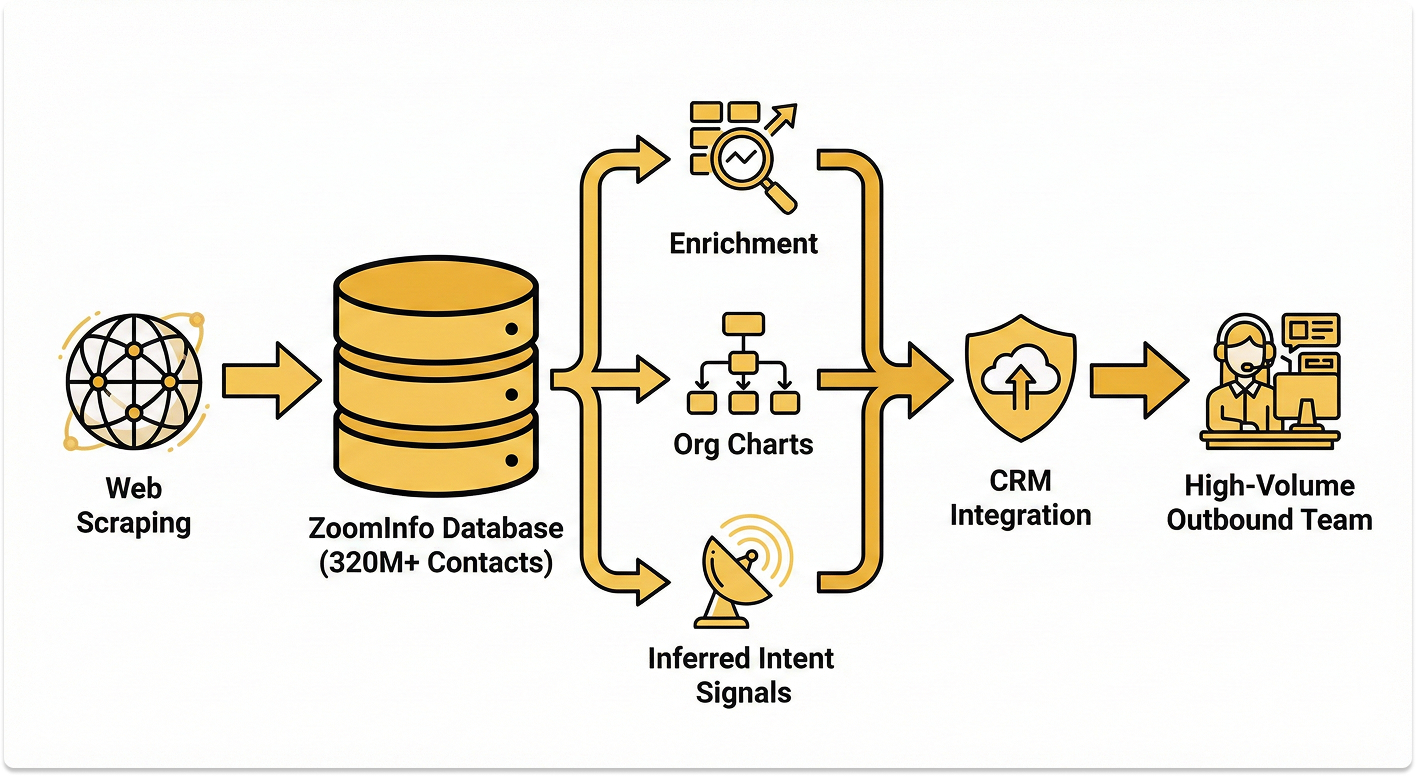
ZoomInfo dominates raw data volume. The platform boasts over 320 million professional contacts and 100 million company profiles globally. It excels specifically in the North American market.
The platform maps out complex organizational charts and tracks personnel changes across enterprise companies. You integrate ZoomInfo directly into customer relationship management platforms like Salesforce or HubSpot. Your sales team can build massive lists of target accounts based on highly specific firmographic criteria.
This volume allows large sales teams to operate without running out of leads. The platform provides direct dial numbers and verified email addresses to fuel high-volume outbound campaigns. Users frequently note that while the database is massive, a percentage of the contact data remains outdated due to the sheer scale of the web-scraping operation.
ZoomInfo Intent Data and SalesOS Features
ZoomInfo packages its data within a suite of operational tools, primarily SalesOS. This system includes automated workflows, dialers, and deep CRM enrichment features. It goes far beyond a simple contact directory.
The platform heavily promotes its proprietary intent data. ZoomInfo tracks content consumption across hundreds of thousands of publisher domains. When a company researches specific keywords related to your IT solutions, ZoomInfo flags that account as showing a buying signal.
This intent data aims to help your representatives prioritize their cold outreach. You call the companies showing spikes in research activity first. You must still execute the cold call, but you base your timing on these digital behavioral signals.
ZoomInfo Pricing Models and Contract Requirements
This massive scale and feature set come with an exceptionally high price tag. ZoomInfo does not publish transparent pricing on its website. It requires multi-year contracts and significant upfront investment.
A typical deployment for a small team frequently starts above $15,000 annually. You purchase access based on a credit system, meaning you pay for the number of data exports you execute. You also pay extra for advanced features like intent data or global market expansion.
You need dedicated sales operations personnel to manage the ZoomInfo data flow and prevent CRM data decay. The platform assumes you have a large team of outbound representatives ready to execute thousands of cold calls a week to justify the high annual contract cost.
Cognism: The Premium Mobile Data and Compliance Leader
Cognism has evolved beyond its origins as a European-centric tool to become a primary challenger in the US market. It differentiates itself through "Diamond Data"—manually verified mobile numbers—and strict adherence to global privacy regulations like CCPA and GDPR.

The "Diamond Data" Advantage: Mobile-First Accuracy
Cognism focuses heavily on mobile number accuracy. In the modern sales environment, decision-makers work remotely or in hybrid setups. Calling a corporate switchboard often leads to a dead end. You need the direct mobile number to reach an IT Director.
Cognism’s "Diamond Data" service validates mobile numbers through a human verification process. This ensures your sales team does not waste time dialing disconnected numbers or navigating gatekeepers. While ZoomInfo offers volume, Cognism competes on connection rates.
For US-based sales teams, this is a critical differentiator. If your strategy relies on connecting directly with senior leadership, the accuracy of the mobile number matters more than the sheer size of the database.
Strict Compliance as a Safety Net
Cognism positions itself as the safest choice for enterprise teams concerned with regulatory risk. It scrubs its database against global "Do Not Call" (DNC) registries, including those in the US, UK, and Europe.
This focus on compliance appeals to risk-averse organizations. As data privacy laws like CCPA in California become stricter, using a compliant data provider is essential to avoid potential lawsuits. Cognism provides transparent data provenance, allowing your legal team to verify exactly how contact information was sourced.
Unrestricted Access and Pricing Structure
Cognism typically operates on a license-based model rather than a strict credit model for viewing data. On its core plans, it often offers unrestricted views and page-level exporting.
This removes the friction found in ZoomInfo’s credit system, where sales managers must constantly ration data credits. With Cognism, your team can build lists and sync data to your CRM without hitting a monthly ceiling.
The entry price remains significant, typically targeting mid-market and enterprise teams. It is a tool built for mature sales organizations that value data quality and compliance over raw, unverified volume.
Lusha: The Agile Chrome Extension for Fast Prospecting
Lusha targets small to mid-sized businesses and independent sales representatives. It abandons the complex, enterprise-heavy features in favor of speed and simplicity.
Lusha User Experience and Chrome Extension
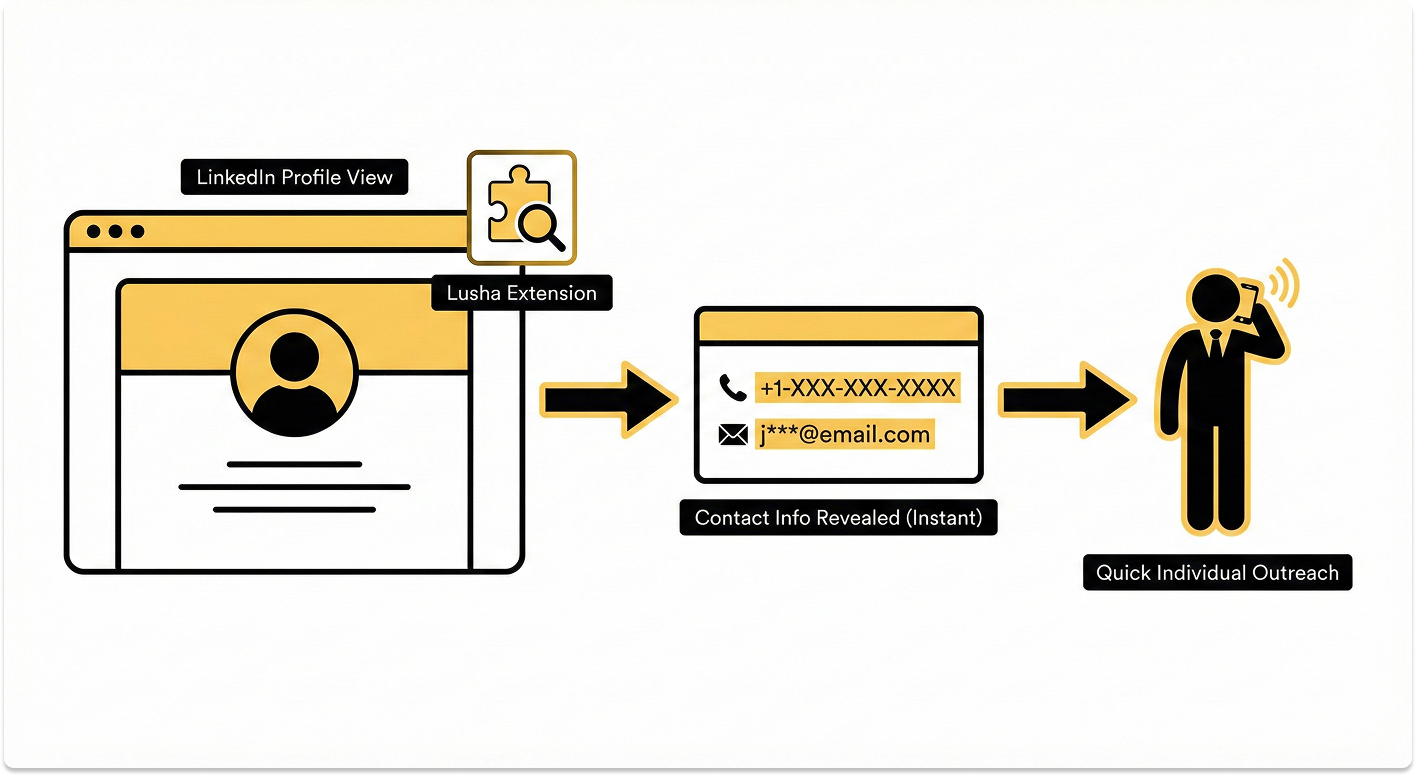
Lusha primarily operates as a web browser extension. It integrates directly into your daily workflow. Your representatives visit a LinkedIn profile or corporate website, and the extension immediately surfaces available contact details.
The platform requires almost zero training or technical setup. A new sales representative can install the extension and begin finding direct dials within five minutes. This makes it highly attractive for lean teams without dedicated sales operations managers.
Lusha also provides built-in email sequences and basic automation tools. You can find a contact, add them to a campaign, and trigger an email directly from the Lusha interface.
Lusha Contact Accuracy and SMB Focus
Lusha maintains a smaller database than ZoomInfo, hovering around 100 million contacts. It relies heavily on a crowdsourced validation approach and proprietary algorithms to verify its data.
The platform performs best when searching for contacts in the North American market, specifically within small to mid-sized businesses. It struggles to map complex, multinational enterprise organizational charts.
If your ideal customer profile includes local IT service providers or regional businesses, Lusha provides highly accurate direct dials. If you need to map out the entire IT procurement committee of a Fortune 500 company, Lusha will lack the necessary depth.
Lusha Transparent Pricing and Credit System
Lusha wins significantly on pricing transparency and accessibility. The platform offers a completely free tier with a limited number of monthly credits.
Paid plans operate on a clear, self-serve model starting around $30 to $50 per user per month. You can purchase monthly subscriptions and cancel at any time. You are not locked into auto-renewing annual contracts.
Lusha strictly enforces a credit-based system. Every time you reveal a phone number or email, you consume a credit. This model works perfectly for targeted, low-volume prospecting, but becomes prohibitively expensive if you attempt to export massive lists of thousands of contacts.
The Inherent Flaw of Traditional B2B Data Brokers
ZoomInfo, Cognism, and Lusha all share one fundamental characteristic. You pay them for the privilege of interrupting people. You buy contact information to execute cold calls and cold emails.
IT leaders actively resist this sales motion. Consider the reality of a modern IT Director:
- They manage complex, high-stakes infrastructure environments.
- They face constant cybersecurity threats.
- They operate under strict budget constraints.
- They receive dozens of automated vendor pitches every single day.
A cold call from an MSP or software vendor breaks their concentration and provides zero immediate value. Even with the most accurate mobile phone number in the world, you still face a prospect who does not want to speak with you. Buying better data does not change the fact that the prospect is fundamentally uninterested in an unsolicited pitch.
The Illusion of Intent Data in Complex IT Sales
Data providers attempt to solve the cold outreach problem by selling intent data. They claim their platforms can identify companies actively looking to purchase your specific IT solutions. You need to understand how this data actually works to see its limitations.
How Inferred Intent Fails IT Vendors
Most platforms source intent data through content consumption networks. They track IP addresses across thousands of B2B websites. If an IP address registered to a specific company reads three articles about cloud migration, the platform flags that company as showing intent for cloud services.
This tracking model relies entirely on inferred intent. The platform guesses that a company wants to buy something based on anonymous browsing behavior. It cannot differentiate between a CTO planning a massive infrastructure overhaul and a junior analyst researching a blog post.
Your sales team receives this inferred intent data and begins calling the target account. They quickly discover that no actual project exists. The buyer was simply doing high-level research. Your team wastes expensive sales hours chasing false signals, burning out your representatives and annoying potential future clients.
Why Intent is Important in B2B Tech Sales
Declared intent works entirely differently. A buyer explicitly states they have a problem, a budget, and a timeline. They actively request conversations with vendors who can solve their specific technical challenge.
Data brokers cannot provide declared intent. They only observe external behavior. To capture declared intent, you must participate in environments where buyers actively submit their project requirements.
When you act on declared intent, you do not need to guess if the timing is right. You know the prospect holds the budget and the authority to make a purchasing decision. This dramatically increases your win rate and reduces your customer acquisition cost.
TechnologyMatch: The Paradigm Shift for IT Vendors
TechnologyMatch abandons the data scraping model entirely. It operates as a closed marketplace specifically built for the IT sector. The platform aligns the buying process with how modern IT leaders actually prefer to evaluate vendors.

100 Percent Real Intent from Verified IT Buyers
You do not buy lists of raw contact data on TechnologyMatch. You review actual, funded projects submitted by verified IT buyers. This is the definition of declared intent.
IT leaders use the platform to research solutions anonymously. They outline their technical requirements, infrastructure constraints, and project timelines. The platform matches these active projects with the specific capabilities of registered IT vendors.
The buyer defines the scope of work. They indicate when they intend to make a purchasing decision. You only engage with prospects who have explicitly stated they are ready to evaluate solutions. This eliminates the guesswork inherent in traditional intent data models.
Eliminating the Need for Outbound Cold Calling
Your sales representatives never make a cold call on this platform. The buyer reviews vendor profiles and actively chooses which companies they want to speak with and match with them.
The buyer clicks a button to accept the match and initiate contact. This completely reverses the traditional power dynamic of B2B sales. You are no longer an annoyance interrupting their day.
You are an invited expert brought in to consult on a specific, defined problem. Your team spends their time selling rather than prospecting. This heavily reduces sales representative turnover and burnout, as they no longer face daily rejection from angry prospects.
Driving Context-Rich Initial Sales Conversations
Traditional cold calls start with an awkward pitch attempting to uncover a problem. A conversation initiated through TechnologyMatch starts with deep technical context.
You already know the buyer's infrastructure, their current challenges, and their desired outcomes before you even say hello. Your first meeting transitions immediately into a high-level consultation. You discuss specific implementation strategies and technical architecture.
This dramatically shortens the overall sales cycle. It immediately establishes your team as trusted advisors rather than aggressive salespeople. You build trust from the very first interaction because you focus entirely on solving their explicitly stated problem.
ZoomInfo vs. Cognism vs. Lusha vs. TechnologyMatch
Choosing Your IT Sales Platform
You must align your platform choice with your overall go-to-market strategy. No single tool fits every IT sales organization. Review your budget, team size, and ideal customer profile before making a decision.
- Choose ZoomInfo if: You manage a massive outbound business development team. Your primary target market is Enterprise companies in North America. You possess a large budget and can commit to multi-year contracts. You need deep organizational charts to map complex buying committees and have dedicated revenue operations personnel to manage the data.
- Choose Cognism if: You require the highest possible connection rates on mobile phones. You prioritize strict data compliance (CCPA/GDPR) to mitigate legal risk. You want unrestricted data views without worrying about monthly credit limits throttling your sales campaigns. It is ideal for teams that need accurate direct dials over sheer database volume.
- Choose Lusha if: You operate an independent consulting firm or a small MSP. You need a flexible, self-serve system without long-term commitments. Your representatives source their own leads manually through LinkedIn. You simply need a reliable, affordable Chrome extension to find direct contact information quickly for highly targeted outreach.
- Choose TechnologyMatch if: You sell complex managed IT services, cybersecurity solutions, or enterprise software. You want to completely eliminate cold calling from your sales motion. You require high-quality conversations driven by declared, actionable intent. You prefer to engage with IT leaders who have actively requested vendor evaluations and provided deep technical context upfront. You want higher pipeline-to-conversions with high-intent leads.
Closing Thoughts
The market has shifted firmly toward a buyer-led motion. Forcing demand through aggressive outbound tactics yields diminishing returns every single quarter. IT buyers possess all the tools necessary to research solutions independently and block unwanted solicitations.
Continuing to invest heavily in raw data lists ensures your team will spend the majority of their time facing rejection. You cannot build a sustainable, scalable IT consultancy or managed service provider by annoying your target market.
Stop buying lists and start getting matched with active projects. You need to position your company where buyers are actively looking for solutions. Focus your sales talent on closing deals rather than dialing cold numbers.
Looking for active tech buyers?
Buyers are searching for potential partners on TechnologyMatch right now. Create your profile to see high-intent buyers who are looking for a partner like you.
FAQ
How does intent data from ZoomInfo differ from TechnologyMatch?
ZoomInfo uses inferred intent, tracking web searches and content consumption to guess if a company might be buying. TechnologyMatch uses declared intent, where verified IT buyers actively list their specific technical projects and request vendor introductions.
Is Lusha a viable alternative to ZoomInfo for a small MSP?
Lusha provides an affordable, credit-based alternative for finding basic contact information. It works well for small MSPs executing highly targeted outreach, but it lacks the enterprise-level organizational mapping and complex CRM integrations that ZoomInfo offers.
Is Cognism only for European markets?
No. While Cognism built its reputation on European compliance, it is a strong competitor in the US market due to its "Diamond Data" verification. It is often preferred by US teams that value mobile number accuracy and strict CCPA compliance over raw database size.
Why are cold call connection rates dropping in the IT sector?
IT decision-makers configure strict call screening and email filtering protocols. They operate in high-stress environments and refuse to engage with unsolicited interruptions from vendors they have not actively researched.
How does a vendor matchmaking platform reduce the IT sales cycle?
Matchmaking platforms provide vendors with deep technical context before the first meeting. Sales teams skip the basic discovery phase and immediately begin consulting on the buyer's explicitly defined infrastructure challenges and timelines.