



Best Vendor Performance Management Tools for IT Leaders in 2026
7 best vendor performance management tools for IT leaders in 2026. Venminder, Gatekeeper, Prevalent, Panorays, Kodiak Hub, Graphite Connect, and Zapro, with real user feedback, pricing data, and a decision framework by use case, vendor count, and regulatory context.

Summary:
Vendor performance management (VPM) tools measure, score, and enforce vendor accountability after contracts are signed, replacing complaint-driven tracking with structured scorecards, SLA monitoring, compliance alerts, and risk scoring.
The category splits into operational performance tracking and risk-and-compliance tracking. This guide compares seven tools, Venminder, Kodiak Hub, Gatekeeper, Prevalent, Panorays, Graphite Connect, and Zapro, by use case and regulatory context.
Vendor performance management software helps IT leaders measure whether technology vendors meet the commitments they made after contract signing.
The right platform brings together SLA attainment, incident performance, vendor scorecards, corrective actions, contract obligations, renewal dates, and stakeholder feedback. It gives IT, procurement, security, and finance a shared record of whether a vendor delivers the value, service quality, and risk controls the organization expects.
This category overlaps with vendor risk management and supplier management software, but the functions are not identical. Vendor performance management software focuses on delivery after contracting.
Vendor risk management software assesses security, compliance, financial, and operational exposure. Supplier management software centralizes supplier data, onboarding, and documentation.
This guide covers seven vendor performance management tools IT leaders are using to measure, score, and enforce vendor accountability after contracts are signed. Each profile includes what users consistently praise, what they consistently complain about, and where the tool fits versus where it does not.
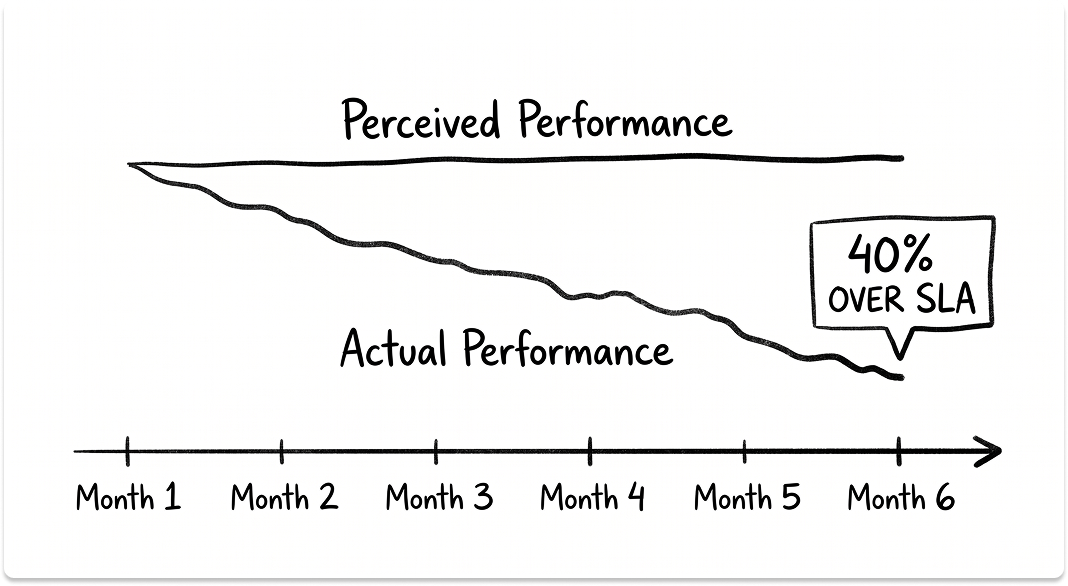
One scope note: This article covers the post-contract performance layer specifically, including SLA tracking, compliance monitoring, security posture scoring, and vendor scorecarding. If you need full vendor lifecycle management covering intake, onboarding, SaaS discovery, and spend management, see our guide to best vendor management software for IT leaders.
What Vendor Performance Management Software Actually Does
Without a structured system, performance issues surface at renewal, not at the point where they are still fixable.
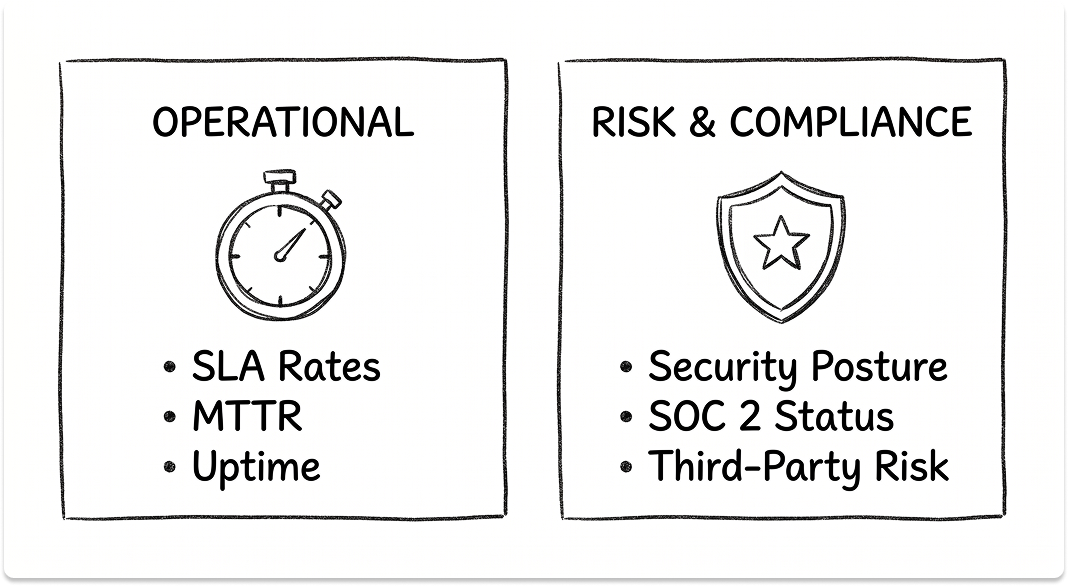
Vendor performance management software automates the measurement problem. It replaces manual tracking with structured scorecards, automated compliance alerts, and real-time risk scoring. It creates a record of vendor performance over time that your team can act on, audit against, and use in renewal negotiations.
The tools in this category split into two distinct use cases:
- Operational performance tracking: SLA compliance rates, ticket response and resolution times, uptime and availability, delivery accuracy, and contractual obligation fulfilment.
- Risk and compliance performance tracking: Security posture decay, compliance certification status, audit findings, third-party risk scores, and regulatory framework adherence.
Some tools do both well. Knowing which problem you are primarily solving determines which vendor performance management tool is worth evaluating.
7 Vendor Performance Management Tools at a Glance
Venminder: Best Vendor Performance Management Tool for Regulated IT Environments
Venminder is a stronger fit for organizations where vendor performance must be reviewed alongside regulatory evidence, due diligence, and ongoing third-party monitoring.
It works best for compliance-led vendor governance in financial services, healthcare, insurance, and other regulated environments. Teams can centralize vendor records, collect assessment evidence, monitor changing risk signals, and maintain a documented review trail.
Venminder is not the best fit if your primary need is a procurement-led supplier scorecard with extensive quality, delivery, cost, and corrective-action workflows. It is strongest when performance management needs to sit within a broader third-party risk management program.
What it does well:
- Centralised vendor repository that eliminates compliance documents scattered across email and shared drives
- Continuous monitoring via Venmonitor, which tracks vendor risk scores on an ongoing basis rather than point-in-time assessment
- Venminder Exchange: a library of pre-completed vendor assessments you can purchase, cutting assessment time when your vendor base is large
- Pre-built questionnaire templates aligned to NIST, ISO 27001, SOC 2, FFIEC, and GLBA
- Full vendor lifecycle coverage from onboarding through offboarding
What users consistently report as friction:
- Custom reporting is limited. Standard reports cover the majority of use cases, but anything non-standard requires workarounds.
- Built specifically for regulated financial services. Workflows, audit trails, and questionnaire libraries are optimised for banking and credit union regulatory requirements. General IT teams without a compliance driver find the platform over-engineered for their actual needs.
- The learning curve is real, particularly for teams without a dedicated vendor risk analyst. The depth that makes it valuable for compliance teams creates onboarding friction for smaller IT functions.
The honest assessment: If your IT environment operates under FFIEC, GLBA, HIPAA, or similar regulatory obligations and regulators expect documented third-party oversight, Venminder is one of the most complete vendor performance management platforms in this category. Outside regulated industries, the specialisation becomes a constraint.
Pricing: Quote-based. Tiered model with a la carte assessment services. No public pricing.
Kodiak Hub: Best Vendor Scorecard Software for Mid-Market IT Teams
Kodiak Hub is one of the stronger options in this comparison for teams that need supplier performance management software and vendor scorecard software, rather than only a third-party risk dashboard.
Its value sits in supplier KPI tracking, scorecarding, performance reviews, and supplier-development workflows. This makes it particularly relevant when IT works closely with procurement to manage strategic hardware, services, cloud, or technology suppliers.
Use Kodiak Hub when you need to measure vendor delivery, quality, responsiveness, cost, and corrective actions over time. Confirm reporting depth, multi-entity data management, ERP integration scope, and supplier collaboration features during evaluation.
Best for: Mid-market and enterprise procurement-led IT teams that need structured supplier scorecarding and performance improvement workflows without a heavy implementation project.
What it does well:
- AI-powered supplier scoring with configurable, weighted KPI frameworks
- Supplier development workflows built directly into the platform. Performance improvement planning happens inside Kodiak Hub, not in a separate email thread.
- Fast deployment. Reviewers consistently cite weeks to initial value rather than the months typical of enterprise procurement suites.
- ERP integration with SAP, Oracle, and others
- Automated data collection from suppliers, replacing manual outreach and chasing
- Customer support and responsiveness from the Kodiak team rated highly across independent reviews
What users consistently report as friction:
- Collaboration scores below category average. G2 rates Kodiak Hub's communication features at 8.1 versus the category average of 8.7. Collaboration between your team and suppliers is less mature than the scoring and risk modules.
- Complex company structures create data management issues. Multi-entity organisations with subsidiaries report friction in how the platform handles hierarchical supplier relationships.
- Historical data storage and report exporting are recurring complaints. Printing and sharing reports outside the platform requires more effort than it should.
- Occasional system speed issues and AI data misinterpretation reported by a subset of reviewers.
The honest assessment: Kodiak Hub is procurement-first, IT risk second. If your primary need is structured supplier scorecarding and performance improvement tracking, it delivers well at mid-market scale. If your performance management requirement is driven by security risk or compliance monitoring, it is the wrong tool.
Pricing: Quote-based. No public pricing.
Gatekeeper: Best for IT Teams That Need Contract and Performance Data on the Same Record
A performance scorecard has limited value when it sits outside the contract that defines the service level, renewal date, obligations, remedies, and escalation route.
Gatekeeper is relevant for teams that need contract performance management and vendor performance management in the same workflow. Its value comes from connecting vendor records to contracts, obligations, scorecards, renewal workflows, risk signals, and corrective actions.
Gatekeeper promotes contract-linked scorecards, RAG alerts, continuous risk monitoring, and renewal management. Validate which capabilities are included in the plan you evaluate, how data enters the scorecard, and whether the platform integrates with your ITSM, procurement, finance, and identity systems.
Best for: Mid-market IT and procurement teams running NetSuite or Microsoft 365 who need SLA tracking and vendor performance monitoring tied directly to the contract record.
What it does well:
- Contract lifecycle management with vendor performance monitoring integrated on the same record. SLA breaches and contract terms live together, so performance issues can trigger contract actions without manual cross-referencing.
- Approval workflows rated above category average on TrustRadius
- Native NetSuite SuiteApp integration. Community threads confirm this works well in practice for NetSuite-heavy procurement environments.
- Microsoft 365 integration
- Customer support is a genuine standout. Multiple reviewers across TrustRadius and Capterra explicitly note that the Gatekeeper team stays engaged post-implementation, a common frustration point with enterprise software vendors.
- Audit trails and e-signature built in
What users consistently report as friction:
- Milestone reminders and alerting rated below category average. This is the feature most directly relevant to proactive SLA enforcement, and it is where Gatekeeper lags. If automated breach alerts before they become contract violations is your primary requirement, test this feature specifically during evaluation.
- Custom reporting is a recurring friction point. Standard reports handle most scenarios, but non-standard reporting requires workarounds.
- Multi-contract vendor navigation requires excessive back-clicking. Minor UX issue, but flagged consistently enough to mention.
The honest assessment: Gatekeeper is the strongest option when you need performance and contract data on the same record and you are running NetSuite. The milestone alerting gap is worth probing in any demo. For teams whose primary requirement is security risk scoring or compliance monitoring, it is not the right fit.
Pricing: Gatekeeper publishes starting pricing, but plan limits, included workflows, implementation scope, and vendor or contract allowances can change. Confirm the current commercial model directly with Gatekeeper before using it in a buying decision.
Prevalent: Best Vendor Risk Management Platform for Enterprise Compliance Obligations
Prevalent is an enterprise third-party risk management platform for organizations that need vendor performance to sit inside a wider program for risk, compliance, assessments, and ongoing monitoring.
Its lifecycle coverage includes sourcing and selection, intake and onboarding, inherent risk scoring, third-party assessments, SLA and performance management, and ongoing risk monitoring. That makes it suitable for organizations managing large vendor portfolios, regulated services, or material fourth-party dependencies.
Use Prevalent when the primary requirement is enterprise TPRM with performance workflows. It may be more platform than a lean IT team needs if the only goal is simple vendor scorecards and quarterly reviews.
Best for: Large enterprises with 300+ vendor relationships operating under DORA, FFIEC, GLBA, or similar regulatory frameworks that require documented fourth-party risk visibility.
What it does well:
- Nth-party (fourth-party) risk documentation is the most explicit of any platform reviewed. Prevalent maps your vendors' vendors, a regulatory requirement under DORA and increasingly expected under FFIEC guidance for systemically important financial institutions.
- Vendor intelligence database drawing on 550,000+ external sources for continuous monitoring
- Pre-built regulatory framework coverage: FFIEC, GLBA, DORA Articles 28-30, SOC 2
- G2 support score of 9.7/10, the highest of any tool on this list
- Optional managed services available as a separate product line, useful for teams that need assessment capacity without hiring
What users consistently report as friction:
- Low review volume (21 G2 reviews) compared to Venminder (150+) or Gatekeeper (90+). Independent peer validation is harder to find, which makes your own reference checks more important.
- No public pricing. Contract values observed as high as $159,090.
The honest assessment: Prevalent is built for enterprise compliance teams with a dedicated risk function and a regulatory mandate. Below 300 vendors or without a dedicated risk analyst, the cost and complexity are difficult to justify. Budget additional time for implementation and user training relative to more modern-UI alternatives.
Pricing: Quote-based. Average contract approximately $25,873. Enterprise TCO can exceed $100K.
Panorays: Best Vendor Performance Management Tool for Continuous Security Monitoring
Panorays is a continuous third-party security monitoring platform. Known customers include Payoneer, ClearBank, WalkMe, and Gett, indicating a fintech and mid-market SaaS profile. Unlike broader vendor performance management tools, it focuses exclusively on the security posture layer.
Panorays helps security-led teams monitor vendor cyber posture and changing external-risk signals. It is useful when your vendor-performance process needs early warning of security deterioration, exposure, or breach-related risk.
It should complement, not replace, operational vendor performance management. A vendor can have a strong cyber-risk score while still missing service levels, delivery milestones, support commitments, adoption targets, or corrective-action deadlines.
Use Panorays when the central problem is continuous vendor security monitoring. Pair it with a scorecard or contract-management process if you also need operational performance reporting.
Best for: IT security and CISO-led teams that need ongoing external monitoring of vendor cybersecurity posture across a large vendor portfolio.
What it does well:
- External-facing assessment with no vendor installation required. Panorays evaluates vendor security posture from the outside, removing the dependency on vendor cooperation during the initial assessment phase. This is a practical advantage when vendors are slow to respond.
- "Risk DNA" dynamic scoring updates vendor risk scores in real-time as security posture changes, rather than reflecting a point-in-time snapshot from the last questionnaire cycle.
- 24/7 monitoring with automated breach and vulnerability alerts
- Pre-built compliance templates: GDPR, ISO 27001, CCPA
- Questionnaire components with automated evidence collection for when vendor participation is available
What users consistently report as friction:
- No deep penetration testing. The assessment is external-facing only. It evaluates what is visible from outside the vendor's perimeter, not internal controls. For vendors where internal control validation is required, supplementary assessment is needed.
- Focused exclusively on cyber risk. Panorays does not track operational performance, SLA compliance, or procurement KPIs.
- Vendor questionnaire components still require vendor participation, which creates delays when vendors are unresponsive.
An honest note on review data: Independent community reviews for Panorays are sparse across G2, TrustRadius, Capterra, and practitioner forums at the time of writing. Product claims are supported by documentation and known customer references, but have not been validated by the same volume of independent IT practitioner reviews as Venminder or Gatekeeper. Weight that in your evaluation accordingly.
The honest assessment: Panorays is purpose-built for one problem: continuously monitoring the external security posture of a large vendor portfolio. If security monitoring is the primary use case, it deserves evaluation. If you need operational KPI tracking alongside security monitoring, you will need a second tool.
Pricing: Custom pricing only.
Graphite Connect: Best Vendor Performance Tool for Salesforce-Native Enterprise Teams
Graphite Connect is best positioned as a supplier-management platform for teams that need validated supplier data, onboarding workflows, compliance checks, and a shared supplier record.
It belongs in this comparison because reliable supplier data is a prerequisite for credible vendor performance management. Teams cannot run useful reviews when the contract owner, compliance evidence, supplier contacts, banking details, and vendor profile live in disconnected systems.
Treat Graphite Connect as supplier-management and onboarding software with performance-monitoring support. Buyers that need mature post-contract SLA scorecards, QBR workflows, and corrective-action management should validate those capabilities directly before selecting it.
Best for: Enterprise procurement teams already running Salesforce that need supplier onboarding accuracy, OFAC and TIN validation, and audit trail completeness within their existing ecosystem.
What it does well:
- Banking detail verification and OFAC/TIN validation automated on supplier onboarding. Supplier bank account fraud is a growing problem in enterprise AP. Graphite's automated verification reduces exposure at the point of onboarding.
- Single point-of-entry intake for all procurement requests, reducing shadow procurement and ensuring every supplier relationship starts with a documented process
- Audit trails are strong. Procurement teams with compliance requirements cite this as the primary reason for choosing Graphite over alternatives.
- Customer support and implementation speed rated positively across G2 reviews
- ERP integration with SAP and Oracle
What users consistently report as friction:
- Onboarding difficulties. The platform that automates your supplier onboarding has its own onboarding friction. Multiple reviewers report a steeper-than-expected ramp.
- Navigation can be difficult. Some workflows described as inefficient, particularly for users new to the platform.
- Scorecarding and post-contract performance tracking are less developed than Kodiak Hub or Gatekeeper. Graphite is stronger on onboarding accuracy than ongoing performance management.
The honest assessment: Graphite Connect fits a specific scenario: large enterprise, Salesforce procurement environment, where supplier fraud prevention and audit trail completeness are the primary drivers. Outside that scenario, the Salesforce dependency limits applicability and the post-contract performance features do not differentiate it.
Pricing: Quote-based. No public pricing.
Zapro: Best for Mid-Market IT Teams Starting a Vendor Performance Programme
Best for: Mid-market IT and procurement teams that need a single platform combining procurement workflows and vendor performance management, without the cost or complexity of enterprise suites.
Zapro may suit mid-market procurement teams that want to connect purchase workflows, vendor records, approvals, and reporting in one operating model.
It can serve as a foundation for vendor operations, particularly where procurement processes and spend visibility remain fragmented. However, buyers should validate its depth in vendor scorecards, SLA tracking, risk integrations, corrective-action workflows, and executive reporting before selecting it specifically for vendor performance management.
Avoid presenting Zapro as a category leader in performance management until stronger independent evidence supports that position.
What it claims to do:
- AI-driven insights and predictive risk scoring
- Single platform combining purchase order management and vendor performance tracking
- Automated performance reporting
- Fast onboarding relative to enterprise alternatives
An honest note on review data: Zapro has limited independent review volume on G2, Capterra, TrustRadius, and IT practitioner forums at the time of writing. Most available content is vendor-controlled or from affiliate review sites. The independently verified user experiences from IT practitioners that exist for Venminder, Gatekeeper, or Prevalent do not exist in comparable volume for Zapro.
Newer AI-native platforms accumulate independent review volume more slowly than established ones, and the AI accuracy and predictive analytics claims have not yet been stress-tested by a broad independent community of IT practitioners.
The honest assessment: Include Zapro in your evaluation if you are a mid-market team looking for a combined procurement and performance platform at lower cost than enterprise alternatives. Run a structured proof of concept before committing. Given the thin community review base, your own POC carries more weight here than it does with tools like Venminder or Gatekeeper.
Pricing: Quote-based. No public pricing.
Vendor Performance Management Software Features to Require
A vendor performance platform should reduce manual reporting and give every stakeholder the same view of vendor health.
Prioritize these capabilities:
- KPI and SLA scorecards with configurable weighting
- Contract-linked obligations, notice periods, and renewal dates
- Integration with ITSM, procurement, finance, IAM, CMDB, and security tools
- Automated review reminders and corrective-action tracking
- Evidence repository for audit, compliance, and assurance documentation
- Risk and performance data on the same vendor record
- Role-based dashboards for IT, procurement, security, finance, and executives
- Vendor tiering and review cadence controls
- Data-export capability and audit trails
- Supplier or vendor collaboration workflows where external input is required
Ask every vendor to demonstrate how performance data enters the platform. A dashboard only helps when it uses current SLA, incident, spend, adoption, or quality data rather than manual status updates.
How to Choose the Right Vendor Performance Management Tool for Your IT Environment
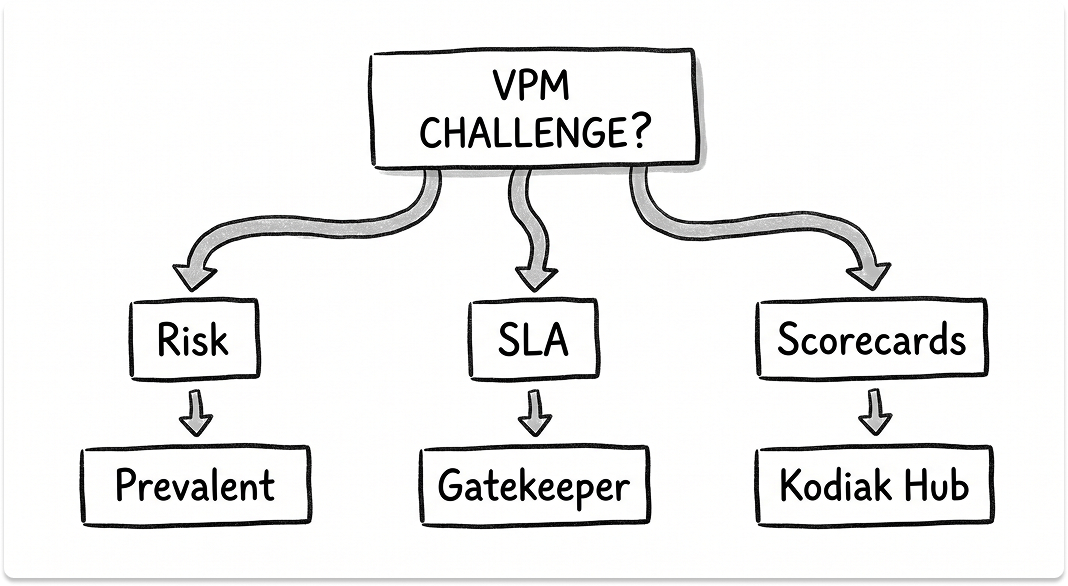
Filter 1: What is the primary performance problem you are solving?
- Security posture decay across a large vendor portfolio → Panorays, Prevalent
- SLA compliance and contract-linked accountability → Gatekeeper
- Compliance documentation for regulators and auditors → Venminder, Prevalent
- Operational KPI scorecarding across strategic suppliers → Kodiak Hub
- Combined procurement and performance on one platform → Graphite Connect (Salesforce environments), Zapro (mid-market)
Filter 2: What is your vendor count and internal capacity?
- Under 50 vendors, small team → Gatekeeper, Zapro
- 50 to 200 vendors, procurement-led team → Kodiak Hub, Gatekeeper
- 200+ vendors, dedicated risk analyst → Venminder, Prevalent, Panorays
Filter 3: What is your regulatory context?
- Financial services or healthcare, audit-driven compliance → Venminder, Prevalent
- General IT environment, no specific mandate → Gatekeeper, Kodiak Hub
- EU operations or DORA obligations → Prevalent (explicit DORA Articles 28-30 mapping)
- Active CISO-led security programme → Panorays
What Vendor Performance Management Tools Do Not Replace
None of these platforms replace a vendor governance process. They enforce and automate one.
If you have not defined what good performance looks like per vendor tier before selecting a vendor performance management tool, the software will measure the wrong things precisely. A scorecard built on vague criteria produces defensible-looking data and meaningless decisions.
Before evaluating any platform, document your vendor KPI framework by tier. Critical vendors need different performance metrics than tactical ones. Define what triggers an escalation, a performance improvement plan, and an exit conversation.
For working frameworks, see The IT Vendor Scorecard and Template and the Vendor Management KPIs Framework.
These tools are most valuable when enforcing a process you have already designed, not replacing the design work.
Looking for Vendor Performance solutions?
Browse pre-vetted vendors on a curated marketplace specially built for how IT leaders buy. Match with vendors who fit and start conversations on your terms. It's free and private.
FAQ
What is vendor performance management software?
Vendor performance management software tracks, scores, and reports on how well your vendors are meeting their contractual and operational obligations after contracts are signed. It replaces manual tracking with automated scorecards, SLA monitoring, compliance alerts, and risk scoring. The category overlaps with TPRM at the security and compliance end, and with supplier relationship management (SRM) at the procurement KPI end.
How is vendor performance management different from vendor risk management?
Vendor risk management assesses whether a vendor poses acceptable risk before and during a relationship, covering security posture, compliance certifications, financial stability, and operational resilience. Vendor performance management tracks whether a vendor is delivering on their commitments after contract execution: SLA compliance rates, uptime, response times, and delivery accuracy. Most enterprise platforms cover both, but depth in each area varies significantly by product.
What KPIs should IT leaders track in a vendor performance management tool?
For critical vendors, track SLA compliance rate (target 98%+), mean time to resolve (MTTR) against contracted SLAs, uptime and availability, security certification currency (SOC 2, ISO 27001 expiry dates), and audit finding resolution time. For strategic vendors, add innovation delivery against roadmap commitments and executive relationship health scores. For tactical vendors, track on-time delivery and invoice accuracy. Define escalation thresholds before you build scorecards.
How much do vendor performance management tools cost?
Gatekeeper is the only platform in this review with publicly published pricing, starting at $1,125/month. Prevalent averages approximately $25,873 per contract with enterprise TCO observed above $100,000. Mid-market platforms like Kodiak Hub and Graphite Connect are generally in the $30,000 to $80,000 annual range based on available market data, though confirmed pricing requires direct engagement. Factor implementation and configuration costs into any TCO calculation.
Which vendor performance management tool is best for small IT teams?
For small IT teams with under 50 vendors and limited dedicated risk resource, Gatekeeper offers the best combination of transparent pricing, strong customer support, and manageable implementation scope. The published $1,125/month starting price allows for budget planning without a full sales cycle. Zapro is worth evaluating for teams that want combined procurement and performance on one platform, with the caveat that independent review validation is thinner than Gatekeeper.
What is the difference between a vendor scorecard and a vendor risk score?
A vendor scorecard is an operational measurement tool. It tracks performance against defined KPIs over time: SLA compliance, delivery accuracy, responsiveness, and relationship quality. It is built from data your team collects and defines. A vendor risk score is typically generated by a platform or risk framework, aggregating security posture data, compliance certification status, financial health indicators, and threat intelligence feeds into a composite score. Scorecards measure delivery. Risk scores measure exposure. Both are necessary.


