What are your IT peers investing in?

We spoke to about 1,300 IT leaders from various organizations to understand what they're evaluating.

The data presented is consensual and comes directly from our conversations.

Most of it is the kind of thing you'd only hear from a peer you know well enough to ask, so we've put it in one place.
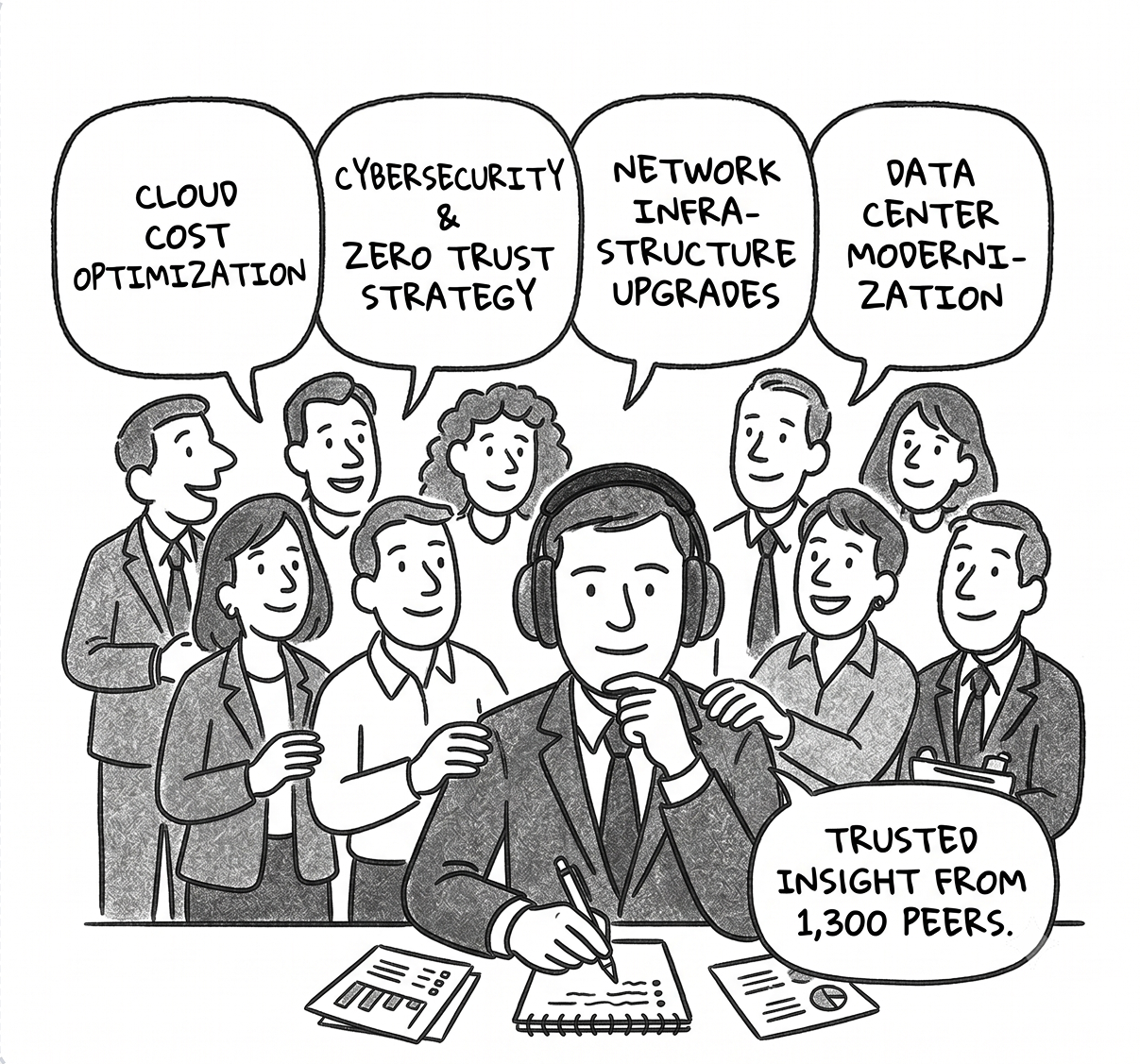
IT leaders talking about what they're evaluating
Free access

Get the full benchmark

Enter your details and we'll email you the full report.

We use your details to send you the report and to follow up about your requirements. Nothing else.

4,388
vendor evaluations
1,296
organizations covered
872
IT buyer conversations, across two waves
1,468
needs heard on the latest 450 calls
Inside the report

What the full benchmark covers

PRIORITIES
The ten categories peers are evaluating, and the ten things they bring up on calls
WHAT'S SHIFTING
Where AI and security evaluations are moving
THE PRICE SHOCK
What VMware renewals and hardware quotes are doing to projects
BUYING TRIGGERS
The twelve things actually creating urgency
RUN FOR THEM
Where peers are buying a service instead of a tool
PACE AND SPEND
How quickly peers are moving and what they're budgeting
WHAT THIS MEANS
8 gaps already showing up across peer environments
THE FULL DATA SET
Ten charts drawn from 872 buyer conversations
Sign up to read the report
The numbers

What your peers are prioritizing

Top ten categories, by number of organizations evaluating each one:

Vendor evaluations, Q1 2025 to Q1 2026.

AI / machine learning
265
Zero Trust security
214
AI-enabled automation
168
Storage
148
Network security
136
Backup and recovery
124
Cloud security
114
Laptop and endpoint refresh
110
Networking
103
AI infrastructure
82
AI and security Infrastructure and refresh

A couple of things worth pulling out:

  • AI and security categories together make up a little over half of all the evaluations in the data.
  • Storage, backup, endpoints and networking add up to around 485 evaluations between them, which is a fair chunk of the list.
  • That's the quiet half of the list that a lot of IT leaders haven't been able to pay much attention to, and going by these numbers, a good number of their peers have been getting on with it anyway.

What came up on the latest 450 calls

Top ten areas by number of calls where at least one need came up, March to November 2026. A call usually carries three or four.

Security operations
206
AI adoption and governance
148
Cloud and data centre
107
Network and connectivity
97
Laptops, desktops and devices
96
Storage and data
90
Business applications and data
86
Backup, DR and resilience
85
Virtualization and compute
82
Identity, email and access
78
AI and security Infrastructure and refresh Applications

Reading the two charts together:

  • Security is still the biggest topic by some distance, and AI has moved from one category among many to the second most discussed area on a call.
  • The quiet half hasn't gone quiet. Cloud, network, devices, storage, backup and virtualization together account for 557 call-mentions, more than security and AI combined.
  • Business applications (ERP, BI, CRM) make the top ten by calls even though they never show up in the evaluation list, which says a lot about what ends up on an IT leader's desk regardless of plan.
The shifts

What your peers are moving towards

We compared the first half of the evaluation period with the second, and two shifts came through fairly clearly. The 450 later calls tell us where each one went next.

AI evaluations got more specific

Number of evaluations, first half of the period against the second.

First half
Second half
General AI/ML 215
AI agents for procurement 10
AI agents for IT help desk 9
Conversational and agentic AI 7
AI agents for HR self-service 5
AI security 1
69 AI agents for IT help desk
49 Conversational and agentic AI
30 AI agents for HR self-service
22 AI agents for procurement
19 AI security
0 General AI/ML
  • General AI/ML: 215 evaluations in the first half, and none in the second. Those evaluations went into named use cases instead, which is why the general category empties out.
  • AI agents for IT help desk: 9 to 69. The biggest of the named use cases.
  • Conversational and agentic AI: 7 to 49.
  • AI agents for HR self-service: 5 to 30.
  • AI agents for procurement: 10 to 22.
  • AI security as its own line: 1 to 19.

Where it went next, on the 450 later calls:

  • Governance comes first. Policy and data leakage led the AI conversations (53 calls), ahead of building agents (49), Copilot rollout (30) and AI security as its own line (19). The first question is what staff are pasting into public AI and what Copilot can see.
  • It's arriving from the top. 73 calls mention a boss, board or CEO pushing AI, usually before there's a plan or an owner. The peers who got funded had a defined task; several said they'd been burnt trying to build their own tools first.
  • Licence sprawl has started. 17 calls raised AI subscriptions nobody owns, in one case about $4–5K a month across three tools for 120-odd users each, many unused. AI infrastructure carried a median budget of $200K in the evaluation data, but on the later calls most peers are still asking what to buy.

Security evaluations moved down a layer

Change in evaluations between the two windows. Grew to the right, shrank to the left.

Zero Trust
145 → 44
Network security
93 → 32
Cloud security
73 → 29
Data protection
51 → 11
Identity and access management
19 → 50
SIEM
10 → 20
Managed detection and response
1 → 21
Shrank
Grew

Where it went next, on the 450 later calls:

  • The move from choosing an architecture to operating it has carried on. Buying or replacing MDR, a SOC or an MSSP came up in 87 calls, and an EDR or XDR switch in 84. Most of the demand is for someone else to watch and respond, not for another tool.
  • Identity is now a topic in its own right, in 78 calls. A fair share of it is moving between Okta and Entra, or dropping a duplicate Microsoft service (25), with stale accounts and joiner-mover-leaver automation close behind.
  • SIEM is about cost and noise rather than acquisition: 38 calls, mostly log bills climbing and real alerts being missed.
  • Compliance still drives security spend, but less than it did: it's the stated reason in 39 calls, mostly CMMC, HIPAA, PCI and SOC 2. Renewals, visibility gaps and a leader's mandate do more of the work now.

One caveat on the comparison: the second window covers nine months and the first covers six, so the direction of each move is more reliable than the size of it. Both charts cover the evaluation period only; the later calls are summarised in prose here and in the sections that follow.

The price shock

Price is the new end-of-life

An end-of-support date used to be the thing that started a project. On the later calls, a renewal quote or a hardware quote does the same job, and sometimes the opposite one: it stops a project that was already approved.

75
calls where VMware or Broadcom came up
2x to 8x
the licence rise peers reported at renewal; 2x in most cases, roughly $6K to $51K a year in one
60%+
higher hardware quotes; one server at $130K, about 4 to 5 times its 2024 price

What the price shock did to projects:

Number of calls, March to November 2026.

Virtualization needs tied to the VMware exit or price rise
53
Shortage, lead-time or RAM-price language
49
Server refresh stalled or re-scoped on price
23
Moving to Hyper-V as the landing platform
15
Moving to Nutanix, HCI or VxRail
12
Laptop orders that couldn't be filled or priced
10
Storage refresh deferred for price or budget
8
Peers who moved Peers who froze

What we'd take from that:

  • Peers split two ways. Some leave VMware, usually for Hyper-V first and then a look at HCI. Others freeze the refresh and run hosts past warranty, which turns the next failure into an emergency purchase at the worst price.
  • Quotes don't hold. Several peers had a hardware quote expire and come back higher, in one case about $100K higher on the RAM alone, and a CFO who said to wait it out.
  • The first ask is a comparison across a few partners, then a bridge: a support extension, refurbished kit, a lease or an as-a-service option. The months that spiked were March, May to June and November.
  • End-of-life dates haven't gone away, they've just stopped being the only clock. Storage, network and devices still account for most of the 79 calls where one was the trigger.
See what reaches end of life in 2027
Buying triggers

What's creating urgency

Most purchases start with a person or a price, and only then a deadline.

The twelve things IT leaders named most, across 450 recorded conversations, March to November 2026:

An AI initiative
A boss, board or CEO wants AI, or a pilot is already underway
151
No visibility into the environment
Heaviest in security and the network
86
End-of-life or end-of-support
Storage, network gear and devices first
79
An application or platform migration
Cloud moves, M365, Entra or Okta, ERP
78
Contract or subscription renewal
Security services, phones, backup and Microsoft licensing
64
Performance or capacity pain
Storage filling up, starved hosts, slow networks
57
Cutting cost
Cloud bills most of all
57
A vendor price increase
35 of the 56 are VMware or Broadcom
56
Growth or a new site
New plants, warehouses, clinics and hotels
51
Too many tools
Security, backup or ITSM sprawl, often after an acquisition
45
The budget cycle
Money just approved, or held until the next fiscal year
41
A compliance requirement
Mostly CMMC, HIPAA, PCI and SOC 2. First place in the earlier wave
39

The quieter triggers: staff loss or cuts (34), hardware price or supply (27), a merger or acquisition (20, though 106 calls mention one in some form), an audit finding (18), an incident of your own (16), a customer or bid requirement (15), a peer's incident (11) and cyber insurance (4). Ransomware came up in 67 calls, but was the thing that started the look in only 16.

Worth saying about these numbers: 62% of peers named at least one hard outside trigger, and 41% also had something they were only exploring. The earlier wave counted a trigger only when somebody raised it unprompted; this wave tagged every need, so the counts are higher for that reason and the ranking is the part to compare.

Run for them

Your peers want it run for them

The managed or as-a-service version came up far more often than the product itself. The reason given most was the same every time: too few people, and capex that's hard to get approved.

Managed or as-a-service asks, by number of calls:

March to November 2026.

MDR, a SOC or an MSSP (buy, replace, or a vCISO)
87
Cloud backup or backup as a service
17
Weighing up an MSP (response time or cost)
17
VDI or DaaS so cheaper laptops can be bought
12
Storage as a service or Evergreen-style buying
12
Staff augmentation or fractional help
9
A 24x7 or tier-1 help desk
8
Network as a service
7
Security Everything else

What we'd take from that:

  • Detection and response is being bought, not staffed. A fair few of the 87 were replacing a provider that wasn't delivering, or going to bid on a three-year contract worth $250K or more.
  • The maths peers are doing is annual against five-yearly. One network lead put it as about $75K a year against roughly $500K every five years, and preferred the first.
  • It cuts both ways. 17 peers were weighing up their MSP, and a few were pulling tools back in-house after budget cuts, so the question is less "managed or not" than "which parts".
  • Most of these are replacements, not first purchases: an EDR switch (84 calls), a phone system (54), a backup renewal (36), an ITSM swap (26), Okta to Entra or back (25). A renewal date is the usual start line.
75
calls where a VMware or Broadcom renewal came up
87
calls asking for MDR, a SOC or an MSSP rather than another tool
73
calls where a boss, board or CEO was the one pushing AI

How quickly peers are moving

Share of evaluations by purchase window, Q1 2025 to Q1 2026.

15%
0–3 mo
19%
0–6 mo
27%
3–6 months
40%
6–12 months
  • 15% are working to a 0–3 month window.
  • 19% are inside six months.
  • 27% are in a 3–6 month window.
  • 40% are looking at 6–12 months, which tends to line up with planning for the next fiscal year.
  • The later calls say the same thing in dates: 71 cite year-end or Q4, 58 cite 2027, 33 cite January or Q1 2027, and 37 cite the fiscal cycle. Contract end dates and the new budget year are the deadlines peers actually name.
  • Detection and response, identity, and help desk agents all sit towards the faster end, and all three are fairly operational, so that fits.

What peers are spending

Share of evaluations by budget band, Q1 2025 to Q1 2026.

7%
7%
27%
34%
11%
14%
Under $25K
$25–50K
$50–100K
$100–250K
$250–500K
$500K+
  • The most common band is $100K–$250K, which covers just over a third of all evaluations.
  • About a quarter are budgeting above $250K, and 14% are above $500K.
  • On the later calls, the bands peers put on things themselves: $3–10K for an RMM or a signature tool; $40–50K for patching or MFA; $50–100K for cloud cost, monitoring or ZTNA; $100–250K for storage, backup, DaaS or MDR; $250K to $1M+ for an ERP migration, an MSSP, a contact centre or AI agents.
  • It's a reasonable sanity check on scope. Integration and implementation work tend to move the number around more than the category does, and one-off and annual figures often get mixed in the same conversation.
The gap checklist

What this means for you

Have a read down this list. If one of them sounds like your situation, it's something a fair number of your peers have already started on.

01

Zero Trust on the roadmap and nothing lined up on identity.

Identity came up in 78 of the later calls, and 12 of those were accounts still active for people who'd left.

02

Prevention tools in place with no round-the-clock detection.

MDR, a SOC or an MSSP came up in 87 calls, the single most common ask in the data, and most of it is managed.

03

Logs being collected without much correlating them.

SIEM came up in 38 calls, mostly about log bills climbing and real alerts going unseen.

04

AI on the roadmap without a policy or a specific job attached.

73 peers had a boss pushing for it. The ones that got funded had a defined task, and most sorted out what staff could paste where before they built anything.

05

A VMware renewal coming up with no exit plan on paper.

53 peers were working through it, with licence rises of 2x to 8x. Hyper-V was the usual first stop, then a look at HCI.

06

Refresh work sitting still because the quote came back higher.

23 server refreshes, 8 storage refreshes and 10 laptop orders stalled on price. The peers who moved asked for a comparison first and a bridge second.

07

AI subscriptions on the card that nobody owns.

17 peers raised it: pay-as-you-go seats across two or three tools, a few thousand a month, many of them unused, and an owner who won't fund it without results.

08

Visibility gaps you know about and haven't funded.

86 IT leaders raised this, which makes it the second most common reason to start looking, after an AI push from above.

In most of these, the thing that's missing is the next layer down from something that's already been bought, so it's usually less about rethinking the strategy and more about finishing it. The rest start with a renewal date, which is the one deadline nobody gets to move.

If one of them landed, you've probably got a rough idea of the category already. The harder part tends to be working out who's actually in it, and most IT leaders we speak to are at exactly that stage when they call us.

We connect you to vendors that fit your requirements and your budget

We've worked with thousands of IT leaders, and a fair few of them have ended up talking to companies they'd never have come across on their own.

If you're just looking to explore options, book a call with our team and we'll come back with a shortlist. And if you decide to take one of them forward, we'll brief the vendor on your requirements beforehand, so the first conversation picks up where you left off with us.

Based on 4,388 technology evaluations across 1,296 organizations (Q1 2025 – Q1 2026) and 872 recorded conversations with IT leaders in two waves (422 in Q1 2025 – Q1 2026; 450 from March to November 2026). Call counts are the number of conversations where a topic came up, so read them as rankings rather than market sizes. Published September 2026, updated November 2026.

TechnologyMatch